Ladakh’s dying glaciers leave villages without electricity
 Kargil district, Ladakh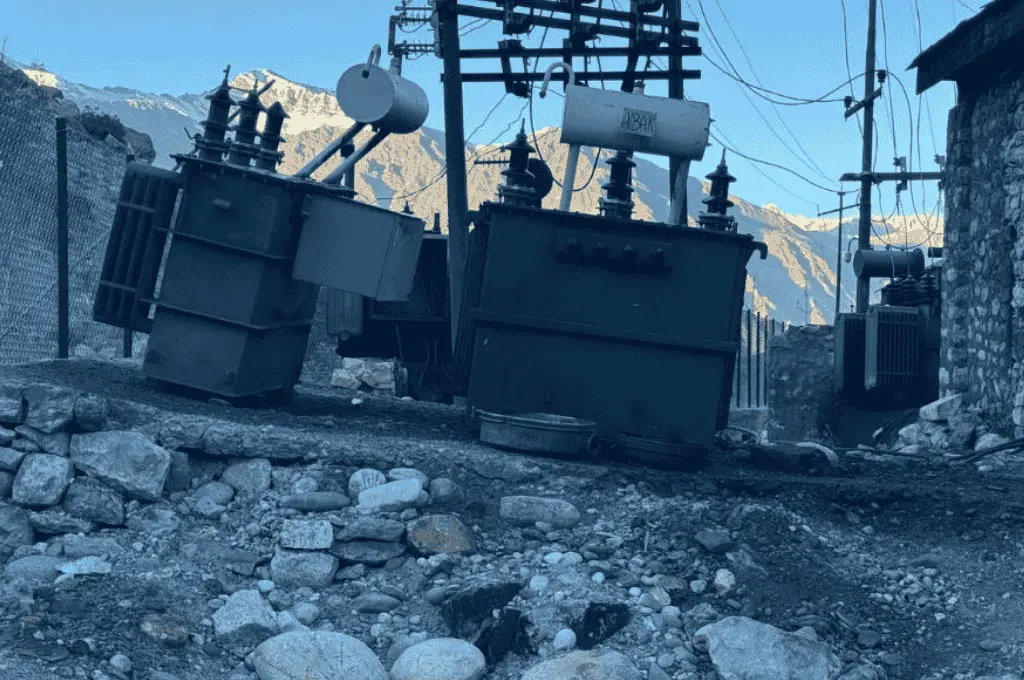
On the slope towards upper Kumik, the oldest village in Ladakh’s Zanskar Valley, approximately 250 km from Kargil, a low stone wall runs along the path for nearly 3 km. Legend has it that, centuries ago, it was built overnight by a protective bear spirit who guarded homes and fields.
“Elders say that we had plenty of water and food, until the bear spirit turned against us,” shares Kharfa Largyal, a man in his twenties from Kumik.
Residents now use the story to make sense of the changes around them—a glacier slowly pulling back and a stream that no longer reaches their homes.
The meltwater from the Sheila Kumik glacier, once the village’s lifeline, has shifted to the other side of the ridge. As the flow dries up, many families have moved downhill towards water that is more reliable. But this inconsistent flow has impacted their day-to-day lives, including their access to electricity.
Hydropower is an important source of electricity in Zanskar, with two micro-hydel projects, Haftal Sani and Raru, playing a significant role. Haftal Sani has been under repairs since 2022 following mudslides and leakages in its canal, leaving the region almost entirely dependent on Raru. Small hydropower projects rely heavily on consistent run-off, and even slight changes in river flow can significantly affect electricity generation.
Most people still depend on the micro-hydel plant, and when streams freeze in winter’s minus 30°C temperatures, they turn to diesel and firewood for heat.
“We’re not planning more micro-hydro projects because climate change has reduced the water flow to canals,” says Sajad Kacho, assistant executive engineer at the Power Development Corporation in Kargil. “Flash floods have damaged several micro-hydro structures. The focus is shifting to larger hydro plants on the Suru and Indus rivers.”
To fill the growing energy gap, the Kargil Renewable Energy Development Agency has been pushing small-scale solar solutions. In the village of Rangdum, Shafee, a 26-year-old tea-stall owner, says, “Our village gets electricity from a community off-grid solar plant.”
But, in Kumik, a 57 KW off-grid plant lies defunct after snowfall damaged its panels. “It worked only for two years, before being damaged in April 2025,” says Tresing Motup, a lineman.
Rooftop solar systems face similar challenges. Although subsidies under the PM Surya Muft Bijli Yojna and Ladakh’s own scheme encourage adoption, heavy snowfall harms poles, wires, and connections.
These winter shortages affect not just households but also local businesses.
“It is difficult to have a long tourist season,” says Abdul Aziz, who runs a guesthouse. “Winter starts in September. Tourists want warm water and heaters, but we don’t have enough voltage from diesel or hydro. Electricity means lighting a single bulb.”
This is an edited version of an article originally published on 101 Reporters.
Safeena Wani is an independent journalist from Kashmir and a member of 101reporters.com.
—
Know more: Read about the increasing human–wildlife conflict in Ladakh.
 Gaurela-Pendra-Marwahi district, Chhattisgarh