On a rainy October morning in 2025, a team from Indus Action visited one of New Delhi’s labour chowks—an informal gathering point where workers seek daily wage employment. At the chowk, the team noticed black streaks running down a worker’s beard. When asked about it, he explained that he dyes his beard with ink because contractors prefer younger-looking men. Workers with white hair often get passed over or receive lower wages. This quiet act of masking one’s age just to secure a day’s work reveals how factors such as appearance, age, and perceived strength determine who earns and who goes home empty-handed at Delhi’s labour chowks.
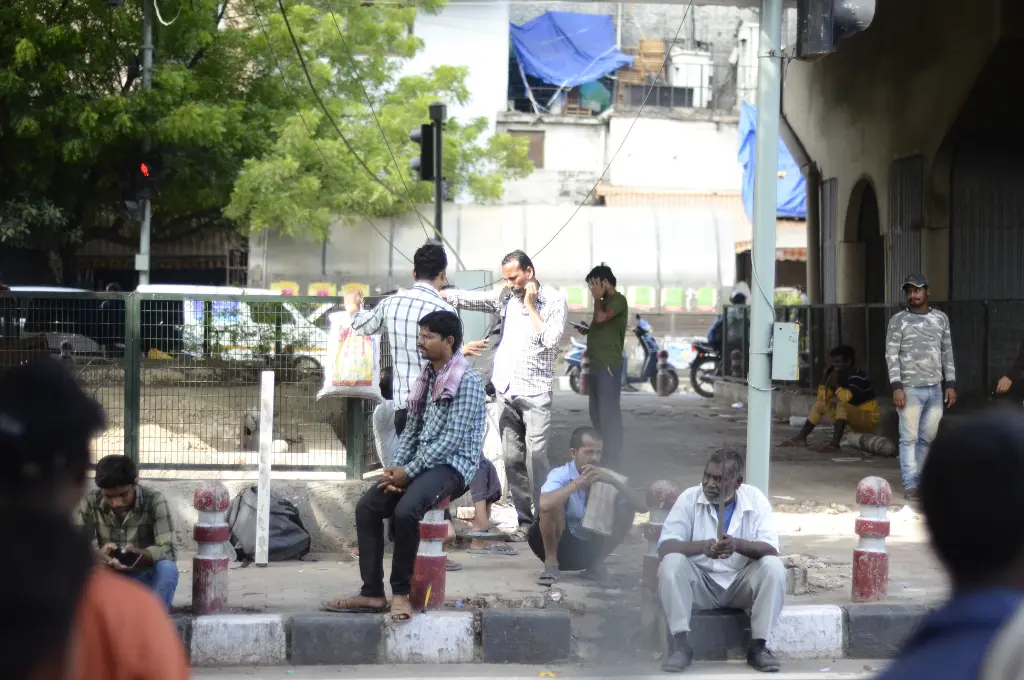
The team visited three labour chowks that month: Maharani Bagh, where 40–50 workers gather daily; Wazir Nagar, one of the largest chowks with 90–110 workers; and Shadipur, a smaller site with 15–20 workers. These informal gathering points operate for four to five hours each day, usually from 7 am until noon. Workers stand with their tools, waiting for small subcontractors, or chhota thekedars, to choose them for a day’s work. Women are almost entirely absent from these spaces, which reflects a daily-wage market stripped of dignity, security, and welfare.
No shelter, no water, no respite
The labour chowks offer almost no facilities. By mid-morning, workers stand exposed to heat, dust, or rain with nowhere to rest. In some locations, a lone tree provides sparse shade. Drinking water is scarce, toilets don’t exist, and neither do benches or waiting spaces.

Workers reported to us that heavy rains during the monsoon reduced their productivity and increased illnesses. The absence of shaded areas, insufficient rest cycles, inadequate protective equipment, and poor water supply prevent workers from shielding themselves from extreme heat, leading many to experience health issues during recent heatwaves as well.
In India’s hot and humid conditions, productivity decreases by 2 percent for every 1°C rise in temperature. This reduced productivity promotes exploitative practices, forcing workers to work longer hours and increasing their exposure to heat stress and other related disorders.
Workers are not a monolithic class
Public discourse often frames ‘daily wagers’ as a single class. Labour chowks reveal a different reality. A variety of actors constitute this workforce: migrant and non-migrant, skilled and unskilled, younger and older.
These distinctions fundamentally organise how labour chowks function. Younger migrant men from Bihar, eastern Uttar Pradesh, or Jharkhand often arrive earlier. They carry heavier tools and accept physically demanding or uncertain work more readily. During one visit to Wazir Nagar, a mason in his late fifties told us he arrives by 6.30 am each day but rarely gets picked unless younger workers have already been hired. “They say the work is too heavy for me,” he said, pointing to his tools, even though he has done the same work for decades. When he does get selected, he usually gets offered lighter tasks or shorter hours.
Older local workers have lived in the city for decades. They rely on familiarity with contractors but find themselves increasingly edged out as preferences shift toward younger workers.

The chowk is not a neutral market. It’s a socially stratified arena where vulnerability gets unevenly distributed.
Migration status, skill level, age, and physical appearance determine who waits longest, who gets hired first, and who returns home empty-handed. Several migrant workers we spoke to described accepting lower wages on days when work was scarce to avoid returning to their shared rooms without income. One young worker from eastern Uttar Pradesh explained that earning INR 400 for the day was “better than nothing.” It covered food and rent, even if it meant postponing savings or remittances.
The chowk is not a neutral market. It’s a socially stratified arena where vulnerability gets unevenly distributed. Desperation becomes a weapon used against the very people these spaces were designed to protect.
Women are almost entirely absent from labour chowks. This absence reflects the gendered patterns in how construction work gets distributed. Women typically work at sites for longer durations, often alongside family members, rather than seeking the short-term jobs available at chowks. When women do find construction work, they earn 30–40 percent less than men for similar tasks.
Any attempt to formalise or reform labour chowks must recognise this diversity. A single policy response cannot address such a heterogeneous workforce.
Selection, survival, and social hierarchies
Delhi has 300–400 labour chowks, where workers contend with chronically low wages. The morning labour market operates as a ‘buyer’s market.’ Employers know a glut of desperate men seek work, and they use this knowledge to push rates down.
The Delhi Government’s April 2025 advisory revised minimum wages for unskilled labour to INR 710. However, this starkly contrasts the reality of what’s offered. Even when the going rate reaches INR 500 for a day’s work, workers undercut each other to secure employment. Some agree to INR 400 or less. Skilled tradesmen, including carpenters and painters, reported daily wages of INR 450–650. Masons typically received INR 350–500.
Workers rarely secure the full financial worth of their labour. Subcontractors often charge clients INR 700–900 for a day of work, but hand over barely half to the worker. They pocket margins of 60–100 percent. For most families, monthly earnings rarely exceed INR 13,000, even when two members work. This falls far short of Delhi’s estimated basic living wage of INR 22,696. Many workers reported to us that they can no longer afford basic necessities.
Funds static while workers wait in the sun
These chowks also reveal the gap between the law and lived realities. The Building and Other Construction Workers (BOCW) Act requires construction workers to register with welfare boards. Registration entitles them to pensions, health support, and scholarships for their children. Most workers at these chowks remain excluded from these benefits.
Many lack labour cards or face difficulties renewing them, cutting them off from crucial entitlements. Even those who apply often complain of delays or denials. As of February 2026, fewer than 3 lakh construction workers in Delhi have an active labour card, excluding the other workers from welfare schemes. Meanwhile, the funds set aside for them remain unused. States have collected tens of thousands of crores from the construction industry as welfare cess over the years. Close to INR 70,000 crore in government coffers are static nationwide. Delhi had INR 4,271 crores of unspent cess as of July 2024. States across India face this challenge, with some now experimenting various solutions to address it.
A recent CAG report shows Delhi spent only INR 605 crore between 2019 and 2023 while collecting INR 1,174 crore during the same period. Of the amount spent, INR 527 crore (87 per cent) was allocated to COVID-19 ex gratia payments. This depicts a lack of focus on the 17 comprehensive schemes offered to workers in Delhi under the BOCW Act. Around half of India’s states utilise under 50 percent of the cess collected under the act.
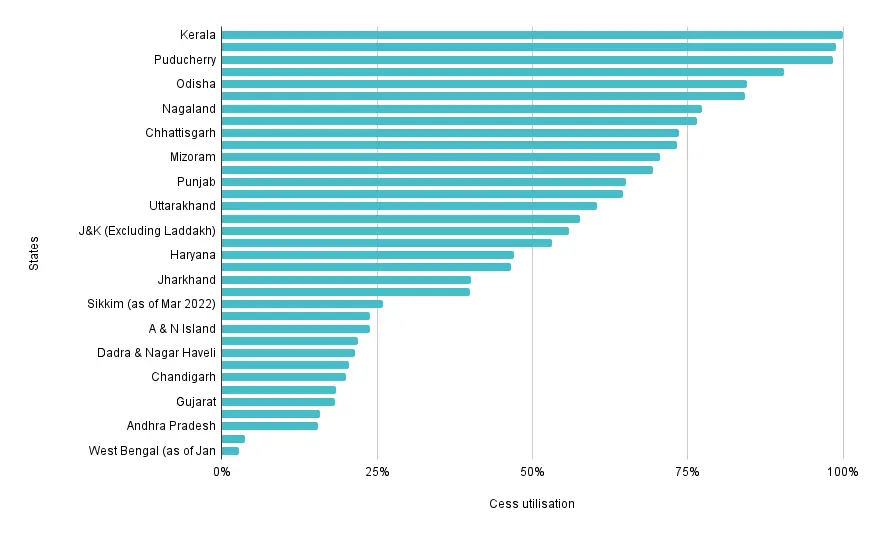
Analysing the state-wise utilisation of cess funds shows West Bengal to have the lowest utilisation rate despite being highly unionised. This raises concerns, as solving this problem would need triangulated efforts from all stakeholders in the labour ecosystem.
The persistence of idle funds points to deeper structural issues within the BOCW ecosystem. Registration and renewal processes remain document-heavy and fragmented across states. This makes portability nearly impossible for migrant workers who move frequently. Welfare boards prioritise scheme announcements over last-mile delivery. Employer compliance and cess utilisation receive limited scrutiny. As a result, labour chowks, the very sites where workers assemble daily, remain untouched by welfare planning.
Recent positive steps and best-practice solutions
Experts have long called for targeted interventions to bridge this gap. The 2018 Model Welfare Schemes under the BoCW Act specifically recommended transit accommodations, labour sheds, mobile toilets, and crèches at major worker gathering points. A few of these have materialised in Delhi and other urban centres.
The recent implementation of the new labour codes, particularly the Code on Social Security 2020, makes the need to improve labour chowks more urgent. These reforms aim to expand the definition of who counts as a worker and to ensure the portability of benefits for migrant and informal workers. Yet at the chowk level, this shift remains largely invisible. Workers continue to navigate employment through informal negotiations with limited awareness of how new frameworks might translate into tangible protections.
Efforts to formalise labour chowks sit alongside the reality that most construction work continues to be short-term, informal, and mediated through small contractors.
The Ministry of Labour and Employment (MoLE) has begun piloting Worker Facilitation Centres and digital interventions aimed at informal labour markets. Initiatives such as the e-Shram portal and experiments around ‘digital labour chowks’ aim to create a basic employment and work-history record, facilitate scheme discovery, and enable grievance redressal. In theory, these efforts could transform chowks from informal hiring points into gateways for social security.
At the same time, efforts to formalise labour chowks sit alongside the reality that most construction work continues to be short-term, informal, and mediated through small contractors. Workers themselves articulated this tension clearly. While they value access to identity-linked benefits such as health support, pensions, and education assistance, they remain cautious of formalisation that does not account for the episodic nature of their work.
Existing laws under the BOCW framework already recognise many of these entitlements. Yet workers frequently cite documentation hurdles, portability constraints, and limited on-the-ground facilitation as barriers to actual access. In this context, the promise of the new labour codes lies not in replacing existing protections, but in addressing long-standing implementation gaps. The codes can enable portability, simplify registration, and create interoperable systems that better reflect how informal labour markets actually function. This would come in as a respite and legal backing supported by an administrative framework for construction workers.
A dignified way forward
Some state-level efforts show what’s possible. In Bhubaneswar, Odisha, the state government piloted Labour Waiting Centres at Dumduma and Kalpana Square. These centres provide shaded seating, drinking water, and toilets, giving workers a dignified space to wait for employment. Such initiatives prove that well-designed interventions are both feasible and impactful. Improving labour chowks requires a sequenced approach, combining immediate dignity, medium-term welfare delivery, and long-term structural reform while staying anchored in what workers themselves say they need most.
Immediate: Dignity, safety, and predictability at the chowk
Workers consistently emphasised shade, drinking water, toilets, and a place to sit as their most urgent needs, basic protections that determine whether waiting for work is bearable or physically draining. To offer workers much-needed respite, the state construction boards, Ministry of Housing and Urban Affairs (MoHUA), urban shelter boards, and other state departments can therefore:
- Shelters and amenities: Offer covered waiting spaces with seating, drinking water, and toilets at every major chowk. The labour canteens operating in Chhattisgarh, which offer food at a significantly subsidised rate, serve as an example of what’s possible.
- Formal waiting centres: Convert larger chowks into organised hubs under flyovers, near metro stations, or bus depots as per the worker facilitation centre reforms of the MoLE.
- Heat and rain protection: Erect temporary structures during extreme weather, including heatwaves and monsoons
- Implementation of Digital Labour Chowk: Deploy the Digital Labour Chowk app launched by the MoLE on the ground and continue testing and improving it over time based on worker feedback.
Medium term: Taking welfare to where workers are
Most workers were not aware of labour cards and schemes. Moreover, many who were aware viewed registration as costly, uncertain, and time-consuming, especially for migrants who move frequently. In light of these concerns, the state BoCW Boards and trade unions can:
- On-site outreach: Provide labour card registration and renewal, health check-ups,grievance redressal, and e-Shram enrolment at chowks. For example, Gujarat mobile medical vans offer one model for delivering health services directly to workers.
- Targeted fund use: Channel a portion of unutilised BOCW cess towards regular facilitation camps and mobile welfare units as suggested by the MoLE.
- Assisted processes: Help with documentation, bank linkage, and Aadhaar seeding to reduce exclusion.
Workers often describe formalisation not as a legal status but as “whether benefits actually reach us,” making last-mile delivery more critical than expanding the rules.
Long term: Formalisation as access, not compliance
Many workers expressed ambivalence towards formalisation. While they welcomed access to health care, pensions, and education support for their children, they also feared that formal records could reduce flexibility or invite surveillance without guarantees. Their fears could be assuaged if the central and state governments do the following:
- Chowks as governance nodes: Recognise labour chowks in urban planning and labour welfare frameworks.
- Facilitation-led formalisation: Expand Worker Facilitation Centres and digital systems with strong on-site support.
- Interoperable systems: Enable portability across states and employers without tying benefits to a single contractor.
For workers, meaningful formalisation is not about contracts or enforcement, but about portability, trust, and continuity of support, even when work is irregular.
Effective implementation will require coordination between the MoLE, the MoHUA, the Delhi Urban Shelter Improvement Board, and construction welfare boards. Civil society organisations and trade unions must play a central role in design, facilitation, and accountability, ensuring reforms reflect the workers’ lived realities.
The hardships experienced at Delhi’s labour chowks are not inevitable; they are the outcome of policy neglect. With funds already collected and guidelines already in place, improving conditions for workers at these sites is a matter of political will. The Odisha model shows what is possible when governments act decisively.
Delhi, and indeed all Indian cities, must treat labour chowks as critical nodes of the urban economy. Governments can transform chowks into spaces of safety and opportunity by equipping them with amenities such as shade, water, and toilets, thereby offering dignity to the workers they attract.
—
Know more
- Learn more about how Mumbai’s hamal workers are collectivising to demand their rights.
- Read what data reveals about the state of gig workers in India.