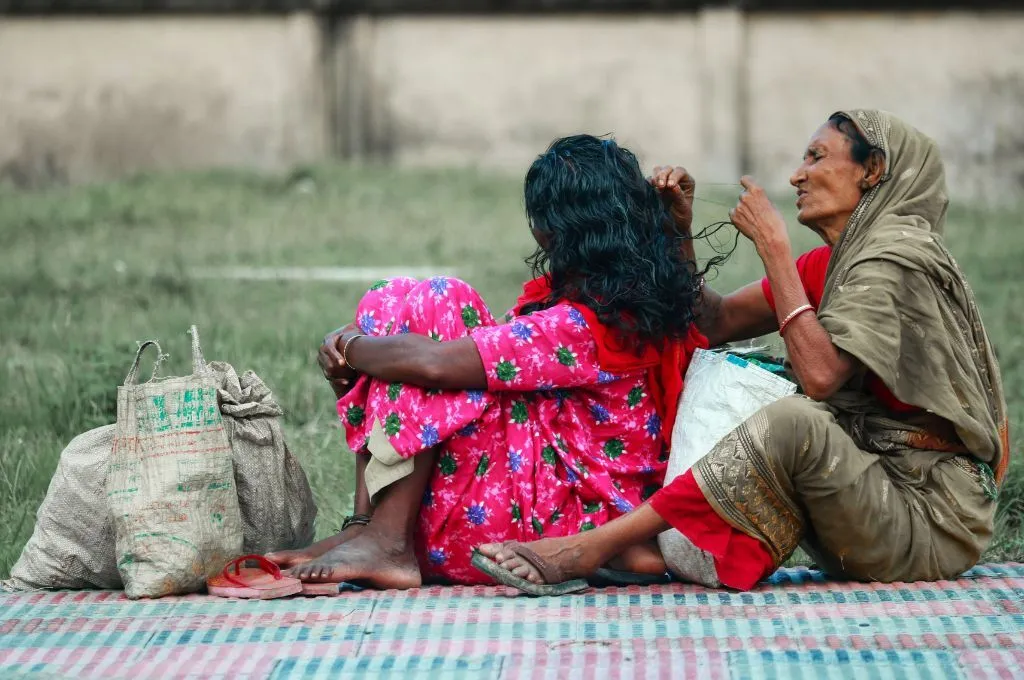
Sixty-year-old Sakina*, lives in an urban informal settlement of the Mumbai Metropolitan Region (MMR). During COVID-19, she was diagnosed with hypertension and diabetes. She consulted several doctors for her treatment and started medication, but after a few months, financial constraints at home led her to stop taking allopathic medicines. When her symptoms like dizziness and chest pain worsened, she resorted to over-the-counter pain killers and sedatives for relief. She was also unable to adhere to any specific diets to manage her disease, which she felt was not possible in her joint family setting. Poor access to sanitation in her neighbourhood further exacerbated the challenges that she faced. Frequent urination, a symptom of her condition, became difficult to manage, leading her to rely instead on an ayurvedic syrup.
Many like Sakina suffer in silence, facing the travails of living in vulnerable urban informal settlements (often referred to as slums) while managing their chronic ailments. In recent years, urban informal settlements across low- and middle-income countries have noted an increase in the burden of non-communicable diseases (NCDs). Residents of such settlements are at a higher risk for chronic diseases due to a range of factors, including congested housing, unfavourable working conditions, poor diets, stress, and environmental pollution. Access to quality healthcare is frequently lacking in such areas. The adverse influence of financial insecurity and social marginalisation further compromises health outcomes in this population group.
The many challenges of managing NCDs in urban informal settlements
Recognising the rise of NCDs in urban informal settlements, the Society for Nutrition, Education and Health Action (SNEHA)—a nonprofit that has been working on improving health in these settlements in the MMR—conducted a qualitative study in one Tier-II municipality in 2022-23 to explore care-seeking patterns among residents in urban informal settlements living with hypertension and diabetes.

The municipality studied has almost half of its 7 lakh population living in urban informal settlements. Health infrastructure there included one public secondary-level hospital, 15 public primary-level facilities and several private practitioners. Drawing on in-depth interviews with hypertension and diabetes patients, public and private health practitioners operating in the vicinity, and discussions with community residents, the study highlights several patterns and challenges related to NCD care in urban informal settlements. It points to gaps in how preventive care is understood, how patients get diagnosed, and how patients manage their disease and adhere to medical advice—insights that are valuable in shaping policy action for improved healthcare services.
Here are some key highlights:
Preventive care is not seen as necessary
Residents in urban informal settlements in our study did not perceive that diseases such as hypertension and diabetes could be prevented. Consequently, preventive lifestyle changes for these diseases were neither recognised nor followed. As one resident stated, “We are poor, we don’t have money to just go to do such (screening) tests without cause. Now we don’t have anything (symptoms) then why would we go for testing?”
The concept of screening for a disease when one had no symptoms was perceived as illogical. Moreover, screening involved precious costs in terms of time and money. Community-based screening was rare. Though screening at the public hospital was free, it involved travelling and long waiting times. At local clinics or pathology labs, screening involved significant costs ranging from INR 200–2000. Taking out the time for screening was also seen as a loss of daily wages, and therefore less practiced.
Diagnosis comes late, often after multiple consultations
Due to a lack of preventive measures and screening, most people ignored early symptoms, leading to delayed diagnosis. Many patients also reported engaging in multiple consultations across different providers before accepting their diagnosis. A patient diagnosed with diabetes said, “I had a cut that did not heal and became painful. I went to a private skin doctor who diagnosed me with diabetes. But my family was worried and asked me to confirm. I went to another doctor to confirm, and there also it showed up. I went to five doctors in total. When they all told me I have sugar (diabetes), that is when I believed it.”
The lived realities of most patients, many of whom were daily wage workers or engaged in household work, led them to focus on symptomatic relief. They preferred quick-fix pain-relieving medicines for which they accessed local healthcare providers who had their clinics in and around the settlements. These providers mostly had degrees or diplomas in Unani and homeopathy medicine (commonly referred to as AYUSH (Ayurveda, Yoga and Naturopathy, Unani, Siddha and Homeopathy) practitioners).
As one practitioner explained, patients were often reluctant to pursue further testing or follow-up care, instead prioritising immediate relief, saying, “They’ll say just give something for today, we’ll see about everything else later.”
While such practitioners try to provide NCD care through preliminary diagnosis, counselling, referral, symptomatic treatment, and guidance for treatment adherence, many avoid engaging deeply with NCDs due to the diseases’ reliance on allopathic medication, limited training, fear of reputational damage, and patients’ reluctance to pursue formal diagnosis. Their ties with the local public hospital were weak or non-existent, and their capacity to manage chronic conditions without training and support from the public health system remained constrained.
Nevertheless, they were the first contact point for patients, and it was only when symptoms became severe or unmanageable, in some cases leading to emergencies, that patients went to allopathic private doctors or hospitals, where most received a confirmed diagnosis.
Managing chronic illness is fragmented and costly
Once diagnosed, patients adopted multiple ways in which they attempted to adhere to medical advice to manage their disease. Patients weighed the financial cost of treatment against symptom severity.
They oscillated between private providers depending on affordability or accessibility. Most residents in urban informal settlements did not trust the only public hospital nearby for their treatment. Primary-level health posts provided limited NCD services which most people were unaware of. Poor quality of services, distance, lack of care-giving support and unavailability of medicines were key reasons why patients did not access public healthcare in the municipality. For those who could not afford private healthcare, this meant travelling long distances in the metropolitan region to access better public hospitals in other municipalities. Many patients often relied on allopathic medicines provided during their first diagnosis, which they took directly from pharmacies, never returning to doctors for follow-ups on their treatment. Unani and homeopathic providers closer to their homes who provided cheaper services than private allopathic providers were approached for providing symptomatic treatment, and monitoring their blood pressure and blood sugar.
Consequently, for their medical treatment, patients either oscillated between allopathic and alternate medicines, took breaks in their medication regimes, or completely stopped their medications, depending on affordability and disease severity. Medication adherence was thus characterised by sporadic treatment and hopping between several private providers for medicines that were both affordable and effective.
A person diagnosed with hypertension shared, “I had a heart attack when I was at work. There is a public hospital here, but they don’t give good treatment. So I went to a private hospital and then to a public hospital in another municipality, where I was diagnosed with hypertension. I was taking the medicines prescribed from there and visiting local doctors here to check my blood pressure. When I went outstation for four months, I stopped the medicine thinking I’m all right and I had another attack.”
Most patients also did not regularly follow lifestyle changes such as better diet and exercise to alleviate their disease symptoms. Few mentioned that such lifestyle changes were either not possible in their context or were not a part of the medical advice received from doctors.
Thus, poor awareness, convoluted and fragmented care-seeking journeys, erratic adherence patterns, poor accessibility to public healthcare, and low affordability of treatment characterised how patients in urban informal settlements managed chronic diseases like hypertension and diabetes.
What can be done to improve NCD care in vulnerable urban settlements?
The above findings reiterate the need for improving disease management among patients and providing affordable and accessible healthcare services in urban informal settlements. This would require an integrated approach involving community-level action along with policy-level changes in public health systems.
1. Community-level initiatives
Community-level interventions are required to improve awareness regarding prevention, diagnosis, and treatment, and to enable better management of chronic diseases.
Community health workers and peer educators can play a vital role by delivering contextually relevant health messages highlighting preventive measures and the importance of timely diagnosis among residents to help reduce disease burden and increase early detection. For instance, in our context, regular exercise and following home-based diets as preventive measures was not always possible. Health messaging can therefore be accordingly tailored— such as suggesting the consumption of healthy and low-cost snacks like roasted chana and bhutta as alternatives to deep-fried ones.
For patients diagnosed with hypertension and diabetes, door-to-door visits by community health workers and community-level peer support groups need to inculcate the importance of treatment adherence, provide affordable and easily accessible options for treatment, and help patients to adopt lifestyle changes such as a healthy diet through community kitchens. Since patients attempt to adhere to medical advice in multiple ways, behavioural change interventions need to be context-specific and recognise the diverse adherence patterns to be successful.
2. Strengthening the role of local providers
Local practitioners played a significant role in healthcare delivery, highlighting the need to formalise and strengthen their role in providing community-level health services for chronic diseases. There is a need for targeted capacity building through training programmes that improve local AYUSH practitioners’ skills to act as a community contact point for patients—recognising symptoms, conducting basic screenings and monitoring, making timely referrals, stocking medicines, and following up with patients to ensure adherence to prescribed medications.
Formalising linkages between local health providers and the public health system through referral linkages and their inclusion in local health networks, etc. can enhance coordination and patient outcomes. Successful models from tuberculosis and COVID-19 programmes mentioned by practitioners demonstrate that integrating local providers for monitoring and support is both feasible and effective, and these lessons should be adapted for NCD management.
3. Improving public health facilities
Public health facilities are the backbone for affordable care in vulnerable communities. Although national programmes for the prevention and control of NCDs exist in India, there have been persistent gaps in their implementation. In the municipality studied, public health facilities were underutilised for chronic disease care, even though they offered free services. While patients accessed local private providers, strengthening public healthcare systems particularly for specialised care, medications, and emergencies related to these chronic diseases is a must.
Urban primary health centres or health posts need to be equipped with trained staff, appropriate diagnostics, availability of medicines, and standardised treatment protocols focused on chronic disease management, to move beyond infectious diseases and maternal health. Likewise, public hospitals need to be strengthened through improved staffing and infrastructure, to provide affordable out-patient care and emergency services for chronic diseases. Patient-centric and long-term NCD care mechanisms need to be better integrated into all tiers of the public health system to make NCD prevention and control programs successful.
In conclusion, a policy focus on strengthening public health services along with crucial partnerships with local providers, closest to the community, can enable a holistic health system for chronic care in vulnerable urban settlements. Community-level initiatives can strengthen patient-led action, resulting in better management of chronic diseases. Recognising the urgent need to act on better management of chronic diseases will be crucial for reducing health inequities in urban settings.
*Name changed to maintain confidentiality.
—
Know more
- Read more about what does it take prioritise prevention of NCDs.
- Learn about the implementation challenges of national NCDs programmes in India.