It started, as these things do, at midnight on LinkedIn—the app that has quietly replaced Instagram as your doomscroll of choice. This is a well-documented condition among the unemployed and the underemployed: an obsessive, Pavlovian attraction to anything resembling a job, especially a good one. The moment you see the words ‘research associate’ or ‘MEL’ or ‘project management’, your thumb stops scrolling on its own before the rest of you has caught up.
Then you begin to read it—the post that caught your attention. Tone warm enough that you almost believe a human wrote it, the mission statement using the word ‘impact’ without irony. Before you know it, you are adding this listing to an Excel sheet you maintain specifically for this reason.
And let’s take a minute to applaud the Excel sheet, complete with a drop-down: Sector, Role type, Status, and a column, optimistically titled ‘Response’, which is mostly empty. It requires the dedication of a committed relationship to work, and you make sure it gets it.
Sometimes you go one step further than the sheet, finding someone two connections away who works there and rewriting the same LinkedIn message four times until it sounds like a request for advice rather than the referral it very obviously is.
And before you know it, the situationship is underway.
Stage 1: The voice note
This is the part where they ask you to send a voice note, except it’s a video: 60 to 90 seconds, with a clear ask—“Tell us why you want to join us.”
Eleven takes for 90 seconds of footage. When the talking is fine, the expressions are wrong; you look like someone reading their own hostage note. When the expressions are right, your flatmate starts laughing loudly in the next room, immortalised now in take seven.
Stage 2: They say they’re not seeing anyone else
The assignment lands with a two-day deadline and a note about how impressed they are with your profile so far. You build a whole logframe for a programme that does not exist, complete with a baseline you invented at midnight and a theory of change diagram you are fairly confident nobody will actually go through. By the end of it, you have accidentally written the first draft of what suspiciously looks like an actual proposal, unpaid, for an organisation that has not yet agreed to pay you for anything. You are, at this point, more invested than most people are on a second date, and nobody has called this a relationship yet.
Stage 3: Meeting the parents, or: They ask you for a guesstimate
You walk in ready for a family dinner, having memorised your own life story and rehearsed the anecdote about the project that ‘really shaped your understanding of the sector’. This is the round where they’re supposed to ask if you have serious intentions.
Instead, a stranger at the head of the table says, “Let’s say we are rolling out a youth training programme across a state you have never worked in. Walk me through how many young people you’d train, in what time, with what budget, and how you’d know it worked.”
You open with a confident ‘so, let’s break this down’, the guesstimate version of “so, how did you two meet?”, a stalling question that buys five seconds and reveals nothing. You invent a number of clusters, a training-to-impact ratio you’re fairly sure exists in no framework anywhere, and a monitoring schedule that assumes you can visit 12 districts in three days without violating either geography or the laws of physics.
What follows is a hostage negotiation with your own brain. You arrive at a final number nobody believes, least of all you. You leave uncertain whether you have been welcomed into the family or gently been permanently banned.
Stage 4: Left on read, professionally
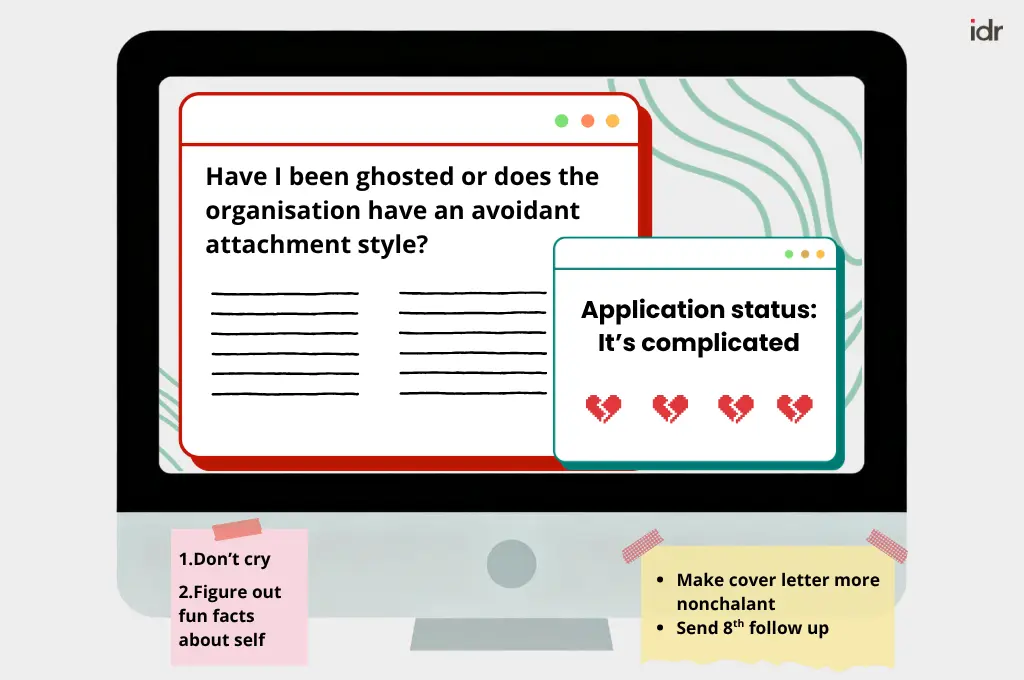
Nobody says ‘we reject you’. They say they’ll keep your profile in their talent pool. They say they’re currently restructuring the role. This is the sector’s version of ‘let’s stay friends’. Said kindly, occasionally by people who mean it, but far more often by people who will never open that file again, while you both nod like it’s news. You update the Status column anyway. You don’t have a drop-down for ‘left on read’, so you type it in manually, every time, like it’s the first time.
Stage 5: Moving on
A new posting appears. The tone is warm enough that you almost believe a human wrote it. You already know which cell this one is going in. You apply anyway.