Community-driven change can be difficult to measure. Organisations working closely with communities often work towards change and impact in areas such as agency, confidence, collective problem-solving, and social norms. These changes can take years to emerge and are not always captured by conventional monitoring and evaluation metrics.
Social Return on Investment (SROI) offers one way of making these outcomes more visible. It helps assign an economic value to social outcomes. It also enables organisations to communicate the broader value of their work to funders and other external audiences.
Mumbai-based nonprofit Apnalaya has grappled with this challenge in its own work. For nearly half a century, it has worked with communities in the densely populated Govandi area of the city. Residents of the informal settlements that make up over 70 percent of this area have faced poor living conditions for years, mainly due to their proximity to one of Mumbai’s largest landfills. They also have limited access to basic amenities, quality healthcare, and education.

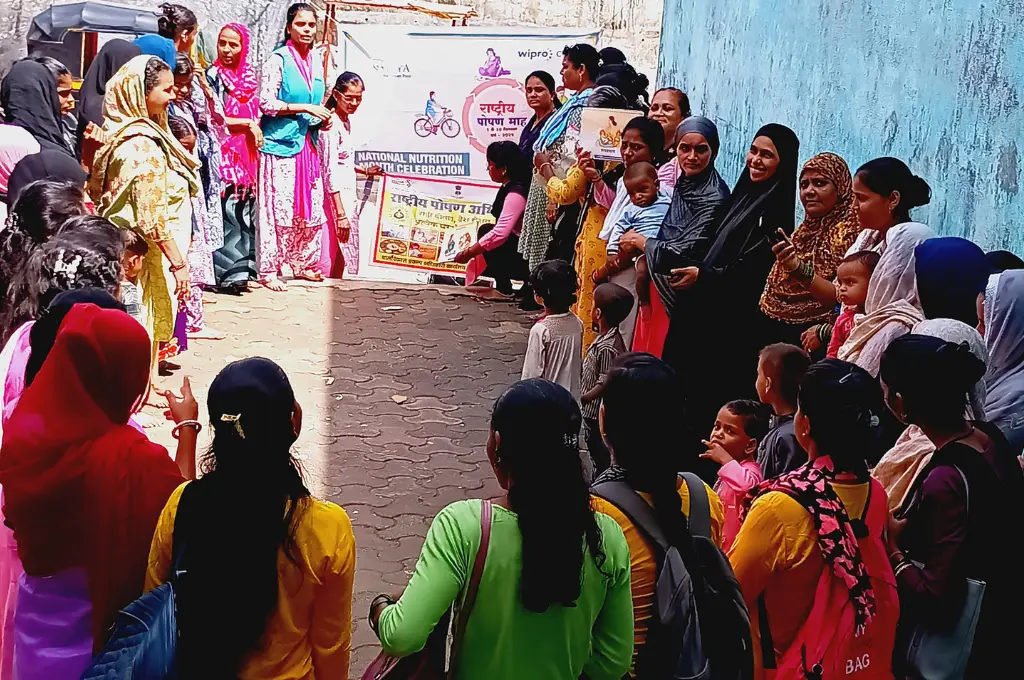
Through its ‘collectivisation’ approach, Apnalaya helps local communities take collective responsibility and action to address the socio-economic challenges they face, including those related to health, sanitation, and access to entitlements. This model is built on the principles of community-driven change (CDC), which empowers communities to act as owners of their own development goals.
The challenge of measuring CDC
Despite working with communities for nearly half a century, Apnalaya faced a persistent challenge in assessing and communicating its progress—an issue also experienced by other community-driven change organisations. Regular measurement and evaluation models captured more traditional metrics (for example, the number of volunteer groups created), but didn’t adequately measure shifts in social norms, agency, or improvement in a community’s ability to collectively solve problems. The team knew these changes were taking place through stories and field visits, but it was difficult to show outcomes such as ‘increased confidence’ to external audiences, including funding partners and the government. Since transformative change takes time, communicating this value was important to sustain long-term investment in the work.
For Apnalaya, opting for an SROI study was one way to address this gap. The purpose of the study was to help translate complex, multidimensional social change into a metric that everyone, especially funders, can understand: economic value.
What the SROI study revealed
The study reiterated what Apnalaya had already experienced in the field. The organisation found that every rupee invested in community collectivisation generated more than INR 11 in value. Overall, the INR 6 crore Apnalaya invested in community engagement over three years yielded over INR 68 crore in social returns.
The value was calculated by combining recurring monthly benefits from government schemes along with one-time benefits.
It also helped the team assign a specific economic value to complex outcomes such as ‘building a community’s agency’. For example, one of the main ways Apnalaya built agency was by supporting communities in navigating government systems independently. With this support, community collectives have helped over 1,800 households access essential government documents like Aadhaar and PAN cards. The study estimated that households saved INR 10,964 by avoiding intermediaries to obtain essential documents. It also estimated that access to government schemes generated INR 1,32,833 in social value per household over three years.

This value was calculated by combining recurring monthly benefits from government schemes such as food subsidies, pensions, and disability allowances with one-time benefits from schemes like the Pradhan Mantri Matru Vandana Yojana, Mahatma Jyotirao Phule Jan Arogya Yojana, and the Mahajyoti scholarship scheme. It reflects the financial savings reported by respondents who accessed these government services over a period of three years.
Another related goal is to support community members in advocating for their own rights. Apnalaya’s training on grievance redressal, for example, helped community members submit complaints to the Brihanmumbai Municipal Corporation about poor sanitation or the lack of streetlights in their neighbourhood. Apnalaya’s SROI study quantified the savings resulting from these infrastructure improvements at INR 28,380 per household.
How the study was conducted
- Defining the scope: Apnalaya first defined the intervention it wanted to assess, focusing on its collectivisation approach. It focused on 20 clusters in Shivaji Nagar, Mumbai, over three years—from 2020 to 2023. It also mapped stakeholders, including primary (those who benefitted directly from interventions) and secondary (frontline health workers, other nonprofits working in the area), whose experiences would inform the study. The study had a sample size of 275 volunteers and 36 external stakeholders and used a mix of qualitative interviews and surveys to collect data.
- Identifying individual- and community-level outcomes: Apnalaya then identified the key community-level outcomes it wanted to assess. These focused on outcomes such as how well communities were able to independently navigate government systems, engage with the government to advocate for better infrastructure, change behaviour around health and education, or improve financial independence. Then, for each group (women, youth, persons with disabilities, etc.) it worked with, Apnalaya created a ‘chain of change’. This mapped how activities led to individual (intermediary) outcomes that feed into key outcomes over time. For example, the increase in knowledge of health and hygiene in youth groups led to reduced alcoholism and violence, and over time, contributed to increased safety in the community. This process also helped them identify the ripple effect that CDC often creates. Responses were then collected from community members across different groups for the outcomes identified.
- Monetising outcomes: Apnalaya identified financial proxies for each of the different outcomes. For example, for an outcome around ‘cleaner environments and reduced disease outbreaks’, the financial proxy was the average savings in healthcare costs per month per individual.
- Discounting outcomes: This step involved accounting for factors such as deadweight (changes that would have happened even without the organisation’s intervention), attribution (changes caused by other factors), drop-offs (the gradual decline in benefits over time), and displacement (unintended negative consequences). For Apnalaya, discounting outcomes was essential in accurately assessing the social and financial benefits generated by their collectivisation approach while considering the complexities of evaluating community-led social interventions.
- Calculating the SROI ratio: Finally, the team arrived at the SROI ratio of 11.19:1 by comparing the total monetised value with its total investment in the programme. This means that for every rupee invested in community collectives, the community derived INR 11.19 worth of social value.
What SROI studies can and cannot do
By putting a numeric value on community-focused outcomes, an SROI study can serve a number of functions. First, it can indicate programme efficiency. For example, the SROI study helped Apnalaya understand which areas of its collectivisation approach were generating the most social value. Increased access to government schemes and improved economic independence for women emerged as the biggest drivers of value, highlighting areas for further investment.
SROI studies can be a powerful tool to help organisations communicate a more cohesive picture of community-led impact.
Second, assigning a monetary proxy value to outcomes can bolster traditional evaluation metrics (such as numeric programme outputs or qualitative case studies) and help organisations more easily compare diverse outcomes. This, in turn, can help organisations better understand which activities were creating the most ‘value for money’. In Apnalaya’s survey, the biggest drivers of value for community members were increased access to government schemes and improved economic independence for women, signalling that these two areas were ripe for further investment.
But SROI studies are not without limitations. For example, while they can assign economic value and, to an extent, indicate causality (which changes are directly attributable to the work and which would likely have happened regardless), they cannot account for contextual variables. This means that they cannot predict that the value generated in one community will necessarily translate to another.
That is why it’s important to also note that SROI calculations are not the final word when it comes to measuring progress on CDC approaches like Apnalaya’s. There are other ways in which practitioners can assess progress on CDC outcomes. But when used with existing programme evaluations, SROI studies can be a powerful tool to help organisations communicate a more cohesive picture of community-led impact.
There are other considerations when it comes to an SROI study. The process is rigorous and involves significant investments of time, budget, and human resources. It also needs high-quality outcomes data, preferably over a long period of time for accurate financial approximations. For younger organisations, or those new to third-party evaluations, starting with another form of mixed-methods outcomes study might be more viable.
What this means for other CDC organisations
For many organisations that work with locally led development approaches like CDC, SROI can help put a value on outcomes such as community agency, confidence, and problem-solving skills. This can give organisations a clearer way to communicate their impact to external audiences. Given that no-strings-attached, multi-year, trust-based funding is still not the norm, especially for locally led development approaches, these numbers help organisations communicate their impact story in a way that’s easy to understand for external audiences.
Ultimately, the aim of an SROI study is not to replace the lived experiences that are at the heart of community-driven change. Instead, it can be used to help bolster stories of change with metrics that can travel across contexts and encourage more investment in approaches that put communities at the centre of development programmes.
—
Know more
- Watch this webinar to learn how organisations are using SROI to measure social value.
- Read this guide to know how SROI works.
- Read this article to learn how SROI helped measure the impact of government entitlements for waste pickers in Bengaluru.