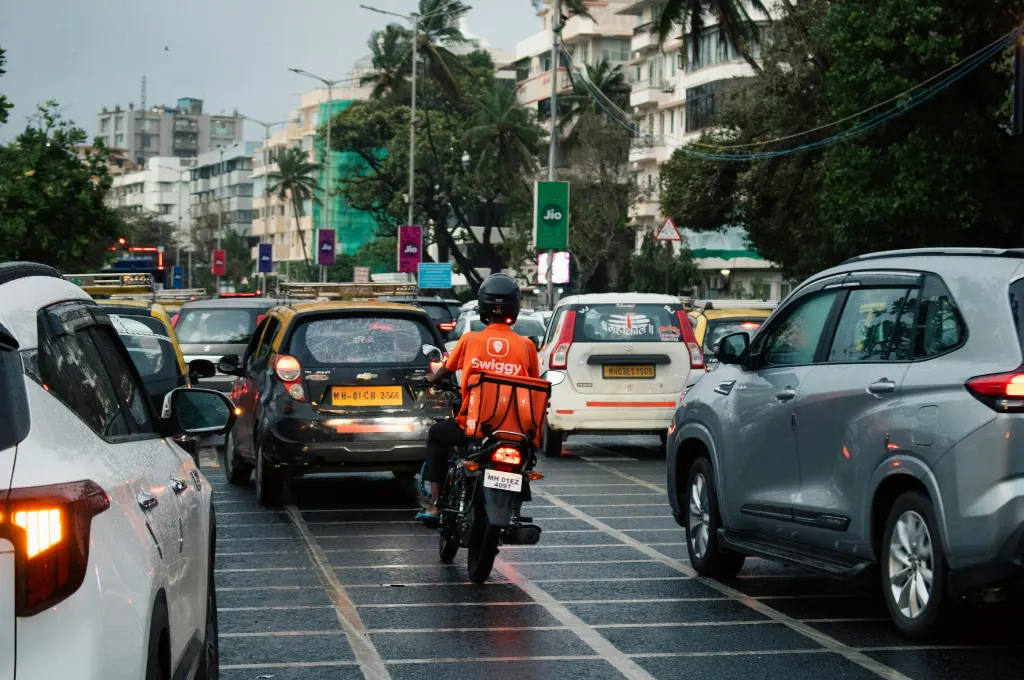
Calling for “fair pay, dignity, and safety,” more than 2,00,000 platform-based delivery workers went on strike on New Year’s Eve. The workers demanded an immediate ban on the 10-minute delivery promise made by platforms, reinforced by automated systems that penalised delivery workers and reduced their ratings when delays occurred.
Citing the gig economy as one of India’s “largest organised job creation engines,” Zomato CEO Deepinder Goyal indicated that “if the system were fundamentally unfair, it would not consistently attract and retain so many people who choose to work within it.” He also warned that banning or excessively regulating gig work could drive workers back into informal jobs with even fewer safeguards.
While workers’ accounts emphasise low and unpredictable pay, long and exhausting workdays, algorithmic surveillance, and absence of basic labour protections, platform executives highlight flexibility, rising earnings, and the freedom for workers to choose when and how much they work.

What is often missing from this debate is acknowledging that gig workers are not a homogenous group. Treating their diverse experiences as interchangeable flattens the realities of platform work and obscures the trade-offs it creates.
In 2024, IDInsight conducted a study that analysed two-wheeler delivery drivers engaged by a platform in India requiring location-based gig work. The study focused on understanding the economic realities of gig workers.
The study leveraged administrative data from the platform to draw a representative sample for a phone survey. The sample consisted of two types of workers.
- Active: Those who made at least one delivery in the three months preceding the study.
- Inactive: Those who have not been driving for the platform in the nine to 18 months preceding the study.
The dataset provided by the platform contained key variables such as age, gender, location of the driver, average number of hours per day that a worker drove for the platform, number of deliveries made, tenure on the platform, and platform rating for the driver. Based on their driving patterns, the active drivers were further classified into three categories.
- Full-time: Those who worked eight or more hours per day on average for the platform.
- Part-time flex: Part-time drivers who did deliveries at different times of the day.
- Part-time fixed: Part-time drivers who mostly carried out deliveries in the evenings.
A total of 13,914 active drivers and 1,049 inactive drivers were determined to be suitable for phone interviews, of which 2,547 active drivers and 114 inactive drivers ultimately participated in the study.

What the study reveals
1. Who gig workers are
The study finds that the gig worker population predominantly consists of young men, with the average age being 28 years. Although the study attempted to deliberately oversample women workers in order to better understand their experiences, they constituted less than 1 percent of the sample.
Just above half (51 percent) of the gig workers are migrants (24 percent intrastate and 26 percent interstate migrants), suggesting that platforms play a role in rural to urban economic transitions.
2. The hidden cost of ‘easy entry’
The ease of entry into platform work relies on access to the assets required to perform such work. According to the study, 95 percent of workers owned a smartphone prior to joining the platform. Additionally, 73 percent of respondents owned a vehicle (motorbike, cycle, or electric cycle)—a figure significantly higher than the 54 percent ownership of two-wheelers in households across India. Almost all (99 percent) of drivers had a bank account to their name prior to joining the platform.
Half of those who owned these assets prior to joining the platform had taken a loan (with or without interest) to finance the purchases. Close to a third of those who borrowed reported missing at least one repayment, indicating that for many workers, platform work begins not as a safety net but as a financially precarious wager, where future earnings are expected to service past debt.
3. Full-time vs part-time
As per the data gathered, just over three quarters of drivers operate on a less-than-full-time basis. This contradicts findings from earlier studies that generally report a higher prevalence of full-time workers in similar contexts.
Full-time drivers on average work 51 hours per week; some even logged as many as 95 hours.
The study notes significant differences in the working patterns of drivers, with full-time drivers on average working 51 hours per week; some even logged as many as 95 hours. These drivers are typically the primary breadwinners of their households. They rely heavily on the platform for their earnings, have few alternative sources of income, and tend to prefer fixed working hours and fixed payments.
On the other hand, part-time fixed drivers tend to have rigid commitments outside of platform work—often educational pursuits or other full-time work. They are least likely to be primary breadwinners and work fewer total hours than other drivers due to their fixed schedules. And they are most likely to prefer flexible working hours and fixed payments.
Part-time flex drivers’ profiles are similar to full-time drivers, as many of them are often the primary breadwinners. However, like other part-time drivers, many also hold full-time jobs. Their work schedule is the most varied among the three categories of active drivers, and administrative data indicates that they earn the highest hourly wages in comparison to other driver types, possibly because they take better advantage of surge pricing.
4. Earnings
The study estimates that drivers earn an average of INR 170 per hour, before deducting expenses. This figure, however, obscures the substantial costs workers must absorb in order to earn that income. Operating expenses, including fuel or charging costs, vehicle maintenance, and repairs, consume roughly 32 percent of gross earnings. Once these costs are accounted for, average take-home pay falls to approximately INR 115 per hour.
Even this adjusted figure, however, overstates what many workers can expect to earn on a sustained basis. The overall average includes drivers who log in selectively during surge-pricing windows, when payouts are higher. To arrive at a more realistic picture of platform work as a means of regular livelihood, the study examines a subset of ‘consistent’ drivers whose working patterns closely resemble full-time employment and who remain active across both peak and non-peak periods. These drivers experience the full volatility of platform pricing rather than its most lucrative moments.
For this group, the average net earnings drop to approximately INR 75 per hour. While these earnings remain higher than those from casual urban labour, which the study estimates at roughly INR 62.3 per hour, they are broadly comparable to wages in sectors such as sales, crafts, and service work.
5. Gendered differences
Women constitute less than 1 percent of delivery drivers on the platform, and those who do participate in platform work tend to be slightly older than their male counterparts and are more likely to have children. While access to basic assets such as smartphones and vehicles does not differ markedly by gender prior to joining platform work, women are significantly more likely to have borrowed money to finance smartphone purchases, suggesting greater economic precarity at the point of entry.
Women are less likely to work the same hours each day, and less likely to take advantage of surge pricing.
Women also work fewer hours overall, spending roughly 13 hours less per week across all earning activities compared to men. Their engagement with the platform itself is more irregular: Women are less likely to work the same hours each day, less likely to take advantage of surge pricing, and more likely to log in only when they have free time. These patterns reflect not merely preference, but also the constraints imposed by the need to balance paid labour with domestic obligations.
These constraints translate into measurable differences in earnings. Using platform administrative data, the study finds that women earn approximately 7 percent less per hour than men on average. This gap is partly explained by the timing and types of orders women are able to take, including working on less busy days or not being able to take advantage of surge pricing slots. Safety concerns potentially play a significant role here, shaping where women are willing to go and when they are willing to work.
6. What platforms count vs what workers experience
When it comes to earnings, self-reported figures from drivers closely align with platform administrative data. However, where the divergence becomes stark is in how work itself is measured. Drivers consistently reported working significantly more hours per week than what appeared in platform records. This discrepancy is not a matter of exaggeration so much as a difference in definition. Platforms count only logged-in, order-assigned time as work. Drivers, on the other hand, also account for ‘idle’ periods that are necessary to earn but remain unpaid, including time spent waiting for orders, commuting to high-demand zones, and staying available to accept jobs.
It is thus apparent that algorithmic systems define work narrowly, rewarding only moments of measurable productivity. As long as this experiential labour remains invisible in platform accounting, debates about fairness, pay, and flexibility will continue to overlook the realities of how gig work is actually lived.
How can governments and platforms address the lived reality of platform work?
The recommendations outlined in the study point less to the need for sweeping new regulations and more to the importance of closing gaps between existing systems and the realities of platform work.
1. Social protection schemes for gig workers
For governments, a first and pressing task is improving awareness of, and access to, social protection schemes that gig workers are already eligible for. The study finds that participation in pensions, insurance, and other welfare programmes remains low not because of ineligibility, but due to limited information and procedural barriers. Addressing this gap requires targeted outreach, simplified enrolment processes, and sustained engagement with a workforce that is mobile, young, and often difficult to reach through conventional channels.
2. Financial literacy
Alongside social protection, the study highlights significant gaps in financial literacy, particularly around taxation, insurance, and long-term financial planning. While platforms may deduct taxes at source or provide limited insurance coverage, many workers remain unaware of their actual tax liabilities, exemptions, or entitlements. Governments can play a role here by collaborating with platforms to provide targeted workshops on financial literacy. Workshops could cover essential topics such as savings, investment options, and taxes, thus empowering drivers to better navigate and manage their earnings.
3. Infrastructure for electric vehicles (EVs)
Public investment in supporting infrastructure, especially electric vehicle charging networks, also emerges as a meaningful intervention. The study finds that drivers using electric vehicles tend to earn 20 percent more and incur lower operating costs, suggesting that infrastructure investments could improve earnings while helping reduce pollution in metro cities.
4. Safety and support for drivers
Platforms, meanwhile, have considerable scope to improve conditions through safety-related interventions. Features such as crash detection and safer route mapping can help drivers tremendously, as 24 percent of them reported road accidents as a safety concern.
5. Better conditions for women drivers
Finally, the study calls attention to the need for targeted support for women drivers, who face distinct barriers despite the ostensibly gender-neutral design of platforms. Organising informational campaigns to destigmatise women’s participation in gig work will be highly beneficial, since nearly half of the women respondents cited lack of societal and family acceptance as a significant barrier to taking up platform work. Interventions such as mentorship programmes and female-only support groups can also foster a safe and supportive environment for women, enabling them to address their thoughts and concerns around platform work. Additionally, simple infrastructural provisions, such as rest areas with women’s restrooms and private spaces, can remove practical barriers that make platform work less viable for women drivers.
—
Know more
- Read the report that this article is based on.
- Learn more about the struggle for securing welfare for gig and platform workers.
- Learn how state-level gig work legislation could contribute to labour protection for all workers.