Despite threats of displacement, the Sahariyas defend their land
 Jhansi, Uttar Pradesh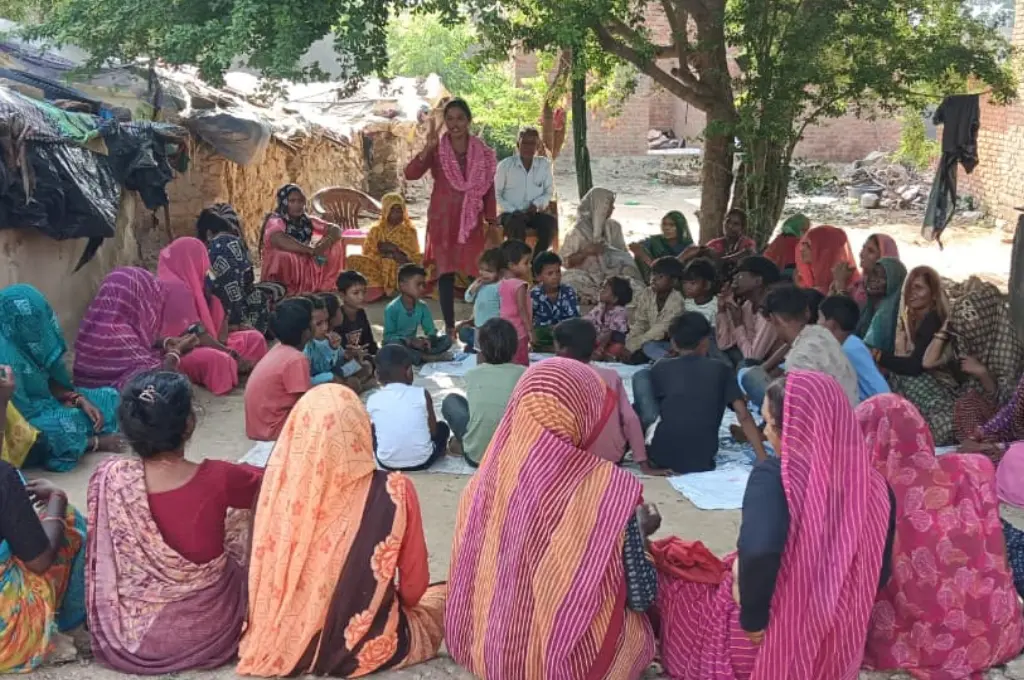
I come from a small village, Pali Deli, in Jhansi district, Uttar Pradesh. Located just 15 kilometres from the village headquarters, the area was once under the influence of landlords. And among them lived 68 families of my community, the Sahariya Adivasis, who struggled and are in some ways still struggling to assert their rights.
I have been associated with Ekta Parishad, an organisation that works on the issues of jal, jungle, zameen (water, forest, land) since 2016. My father passed away in 2014. This is when the local coordinator of the nonprofit visited my mother and recommended that I work for my community.
There are a lot of issues here such as women not being allowed in the panchayat, lack of education, children migrating for work, and lack of housing and water. As I understood all this, I learned how to raise my voice and support others in raising theirs. I work across 10 villages on women empowerment, forest issues, and education. Madhya Pradesh, our neighbouring state, has made significant progress in implementing the Forest Rights Act (FRA), but Uttar Pradesh has lagged far behind. This work was essential.
If we look back to 1999, the situation of the Sahariyas was even worse. Though we are a forest-dwelling community, many of us were forced to work as bonded labourers for landlords. Several families lived together in single-room houses. Our land was being used for illegal mining.
Troubled by the mining activities, the community identified a vacant gram sabha plot to set up a committee that would work for the welfare of the people. It was led by a senior member of our community, Keshar Bai. Together, we built huts.
In 2007, we participated in a people’s movement organised by Ekta Parishad to fight for our forest rights and access to basic services such as housing, water, and sanitation, and to be freed from bonded labour.
This wasn’t easy. We were harassed by some individuals and government officials who worked in the nearby stone quarries. Dynamite and explosives were used for blasting stones, causing severe problems for the Sahariya families.
The village committee decided to stage a protest and bring senior officials to the site. One day, when the subdivisional magistrate (SDM) arrived in the village, Keshar Bai asked him to enter a quarry pit and said, “Now see for yourself, sir, what happens here.” Just then, the loud sound of explosives was heard. The administration immediately understood how dangerous it was to live there, and the SDM promptly ordered the blasting to be stopped.
Some mining work continues in the area, and our forest rights are still not recognised. Today, Sahariya families across 30 villages who live and farm on forest land are being forcibly displaced. In our neighbouring village Jhaavar, which falls under Lalitpur district, even those with recognised individual forest rights and cultivating more than 100 acres of land had their homes burned down by the forest department. When the community protested, cases were filed against them instead.
Other villagers often do not support us, claiming that Adivasis now own land worth lakhs and earn well through farming. Even the police lack awareness of the FRA, forcing us to repeatedly explain that the land we are living on has belonged to our families for generations.
My community hasn’t always been as informed of the regulations. All we know is that the land is our right, this is where our ancestors lived, this is where our families live, and we won’t leave even if our lives are at stake. We have never fought for our rights even when we did not have access to basic facilities, but for this the community will fight. The forest department tries to scare us into thinking that a bulldozer will take away our homes; it happens every couple of months. The government is asking us to be removed in the name of tree plantation drives, but what about the farming we’ve been doing for years?
Mewa Sahariya is a member of Ekta Parishad’s International Committee.
—
Know more: Read about how Baiga Adivasis in Chhattisgarh map their food, forest, and fires.
Do more: Connect with the author at sahariyamewa@gmail.com to learn more about and support her work.