India is counted among the world’s fastest-growing economies. Recently, the country’s unemployment rates have also shown a decline. Despite this, employment remains a major concern—especially as the country’s working-age and youth populations continue to grow.
In 2026, young people aged 15–29 constitute about 26 percent of India’s total population, approximately 36.7 crore individuals. Of these, 19.2 crore are men and 17.6 crore are women. Despite their demographic weight, unemployment among this age group stood at 10.2 percent in 2023-24, the highest across age cohorts.
Meanwhile, according to the Periodic Labour Force Survey (PLFS), the unemployment rate declined from six percent in 2017–18 to 3.2 percent in 2023–24. However, under the current weekly status measure, unemployment remains higher at 4.9 percent, indicating that a large section of the population still does not have access to stable and regular work.

Employment is deeply linked to social, geographical, and gender inequalities. Against this backdrop, it becomes important to examine how the Union Budget 2026–27 responds to these layered challenges.
Employment in the 2026–27 budget
In her speech before the Parliament, the finance minister did not present employment as a standalone priority in the 2026–27 Union Budget. Instead, it was framed according to different sectoral contexts. She spoke about a Textile Expansion and Employment Scheme to ‘modernise traditional clusters’ with support for machinery and technological upgrades in the textile industry. A standing committee on ‘Education to Employment and Enterprise’ in the services sector will also be set up to better align skills with labour market needs.
The finance minister also announced plans to transform the National Council on Hotel Management into the Indian Institute of Hospitality. There will be a pilot programme, implemented by the Indian Institutes of Management, providing 12-week training to 10,000 guides in 20 major tourist destinations. Additionally, the budget has also reserved resources to promote employment and entrepreneurship in sectors such as sports and animal husbandry.
Revised budget 2025–26 shows a different picture
While the Union Budget speech and the Economic Survey claim that the economy has grown at 7.4 percent in 2025–26, fiscal realities suggest otherwise. Revenue targets fell short, as a result of which, gross revenue estimates were reduced from INR 42.70 lakh crore to INR 40.77 lakh crore in the revised estimates.
To control fiscal deficit and rising public debt, the government cut total expenditure. As a result, the overall budget for 2025–26 was reduced by nearly INR 1 lakh crore. This has directly impacted centrally sponsored schemes, where allocations fell from INR 5.41 lakh crore to INR 4.20 lakh crore. Similarly, capital expenditure was cut down from INR 15.48 lakh crore to INR 14.03 lakh crore.

These cuts have significantly affected ministries linked to education, health, drinking water, and rural and urban development—sectors that are crucial for employment generation. Notably, the Ministry of Jal Shakti saw a cut of around 58 percent and the Ministry of Housing and Urban Affairs experienced a reduction of nearly 40 percent.
Budgets for the ministries of labour and employment; micro, small, and medium enterprises (MSMEs); and skill development and entrepreneurship faced cuts ranging from 47 to 61 percent. The Ministry of Food Processing Industries recorded an 18 percent reduction.
Importantly, the 2026–27 budget does not indicate any substantial increase for these ministries. Consequently, sectors expected to generate large-scale employment continue to face resource constraints.
The question of MGNREGA and VB-G Ram G
Rural employment generation primarily falls under the Ministry of Rural Development. The Mahatma Gandhi National Rural Employment Guarantee Act (MGNREGA) has now been replaced by the Viksit Bharat – Guarantee for Employment and Livelihood Mission (Rural) (VB-G Ram G).
In the 2026–27 budget, INR 95,692 crore has been allocated to VB-G Ram G, higher than the INR 86,000 crore set aside for MGNREGA in the previous budget. Additionally, INR 30,000 crore has been separately allocated for MGNREGA this year.
While these allocations appear higher on paper as compared to last year, the key question remains: Are they sufficient to provide 125 days of guaranteed employment to all rural households? Many experts have stated that the current provisions are inadequate. States are expected to contribute more to VB-G Ram G, and its implementation will be suspended for two months during the agricultural season. Therefore, despite a rise in the budget allocation, challenges still persist in claiming employment guarantee.
Allocation vs utilisation
Image 1 shows that funds for the Pradhan Mantri Gram Sadak Yojana (PMGSY) have remained stuck at INR 19,000 crore for the past five years, and less than 60 percent were utilised in 2025–26. The numbers for the Pradhan Mantri Awas Yojana (PMAY)–Gramin and Swachh Bharat Mission (SBM)–Gramin also show major gaps between allocation and expenditure.
The state of Deendayal Antyodaya-National Rural Livelihood Mission (NRLM), which promotes self-employment of women in rural areas, is similar. Actual expenditure on the scheme has been less than the allocations in the last two years, and its budget for the year 2026–27 is almost the same as the 2025–26 financial year.
Over the past two years, budget utilisation under the Pradhan Mantri Awas Yojana (PMAY)–Urban has also been extremely low—only 19 percent in 2024–25 and 37 percent in the revised estimates for 2025–26. Meanwhile, in 2026–27, the budget for the Swachh Bharat Mission (SBM)–Urban has been reduced to nearly half of the levels seen in 2023–24 and 2024–25.
The Jal Jeevan Mission (JJM) further illustrates that the challenge facing large public schemes is not merely one of allocation, but of execution. In 2024–25, only 32 percent of the scheme’s budget was spent, and it is estimated that only 25 percent will be utilised by the end of the 2025–26 financial year. Despite this, allocations for 2026-27 remain largely unchanged. This underutilisation carries wider implications. JJM is not only connected to the fundamental right of water, but also provides employment through construction, maintenance, and other services. As such, the underutilisation of funds raises questions about its capacity to generate employment.
The state of employment-linked schemes
Budget trends across employment-related ministries present a mixed picture. The budgets of some ministries, such as the Ministry of Labour and Employment and the Ministry of Skill Development and Entrepreneurship, show a notable increase between 2023–24 and 2026–27. However, during the same period, there has been no significant rise in the allocations for the Ministry of Food Processing Industries and the Ministry of MSMEs. The budget of the Ministry of Youth Affairs and Sports has also seen only a limited increase (Table–1).
An important initiative linked to employment generation is the Prime Minister’s Viksit Bharat Rozgar Yojana, which was earlier called the Naya Rozgar Srijan Yojana (New Employment Generation Scheme). The objective of this scheme is to promote formal employment, incentivise companies to create new jobs, and strengthen social security.
In 2025–26, INR 20,000 crore was allocated for this scheme, but in the revised estimates, this amount was sharply reduced to just INR 848 crore. For 2026–27, an allocation of INR 20,082 crore has been made. It is hoped that the scheme will be fully implemented this year.
Skill development
Under the Ministry of Skill Development and Entrepreneurship, the allocation for the Pradhan Mantri Kaushal Vikas Yojana (PMKVY), which falls under the Skill India programme, was INR 2,700 crore in 2025–26. In the Revised Estimates, this was reduced to INR 2,000 crore. For 2026–27, the budget has been set at INR 2,800 crore.
However, according to a recent report by the Comptroller and Auditor General (CAG), of the 56.14 lakh candidates trained in the first three phases of the PMKVY, only 41 percent were able to secure employment. The report also highlighted several other shortcomings in the implementation of the scheme.
In addition, the Prime Minister’s Skill and Employability Transformation (PM-SETU) scheme was announced in October 2025. With an allocation of INR 6,140 crores, it will be implemented through upgraded Industrial Training Institutes (ITIs) and will replace some of the other existing schemes.
Women’s employment
In the context of women’s employment, the announcement of She-Mart, a digital marketplace aimed at supporting women entrepreneurs, may help improve market access. However, this initiative alone does not address the broader employment-related challenges faced by rural women.
Apart from She-Mart, the budget does not introduce any major new initiative for women. The Economic Survey itself has acknowledged that the burden of unpaid domestic and care work on women is a significant barrier to their participation in the workforce. Despite this, no concrete policy interventions or large-scale investments have been announced to address this challenge.
Schemes that support women’s employment, such as Anganwadi services (Saksham Anganwadi and Poshan 2.0), the Palna childcare scheme, and Working Women’s Hostels (Shakhi Niwas), which fall under the larger umbrella scheme SAMARTHYA, have either seen only marginal increases in allocation or have remained nearly stagnant. This indicates that the care economy still does not receive adequate policy priority.
Increase in women’s employment: Real or illusion?
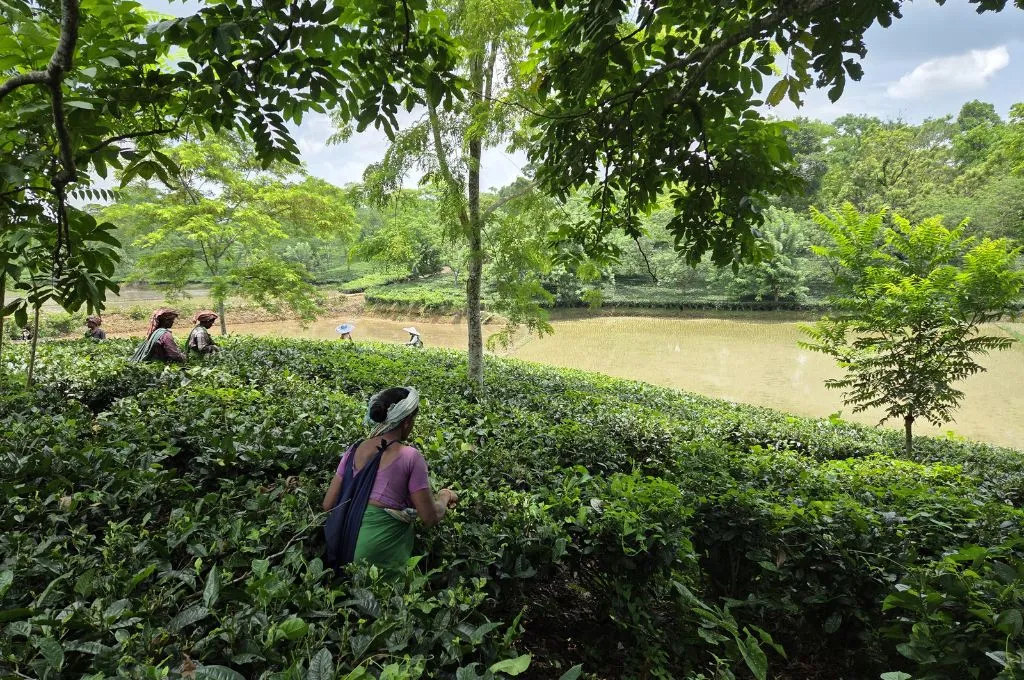
The most notable shift over the past few years has been in women’s labour force participation. In 2017–18, the female labour force participation rate stood at 23 percent. By 2023–24, it had risen to 41.7 percent. However, this increase has been uneven across regions. In urban areas, women’s work participation rose modestly from 20 percent to just 28 percent. In contrast, rural areas saw a much sharper uptick—from 25 percent to nearly 48 percent (Table–1). Despite this improvement, a significant gap persists between male and female work participation rates. Much of the recent employment growth, especially among women, has been concentrated in rural areas and largely in the form of self-employment linked to agriculture.
In 2018, around 50 percent of working women were self-employed; by 2024, this share had increased to 66 percent. In rural areas, data shows that 73 percent of women and 59 percent of men are engaged in self-employment. Most of them are small and marginal farmers involved in small-scale agricultural activities, where incomes tend to be low and unstable.
Nearly half of the women engaged in self-employment are unpaid workers in household enterprises or family farms. In other words, they provide labour, but do not receive direct income. The proportion of self-employed individuals who are employers is also extremely low. While about nine percent of self-employed men are employers, this figure is less than one percent for women (Image 3).
Based on these figures, the rise in women’s employment cannot be described as entirely positive. However, one encouraging improvement is that women engaged in unpaid family work are now being counted in official statistics. This marks an important step toward recognising labour that has long been invisibilised and unacknowledged.
More work, less pay
The state of employment in a country cannot be assessed by merely looking at how many people are working. It is equally important to examine how much they earn and whether that income provides economic security. On this count, the picture over the past few years is worrying.
Between 2017–18 and 2023–24, real monthly incomes declined for both self-employed people and those in regular salaried jobs. According to the Economic Survey 2024–25, the real monthly income of self-employed men was 9.1 percent lower in 2023–24 than in 2017–18. For women, the decline was even steeper—real incomes of self-employed women fell by nearly 32 percent during this period.
This decrease is not limited to self-employment. The real monthly income of men in regular salaried jobs also fell by 6.4 percent, while women experienced a sharper decline of 12.5 percent. In other words, even jobs typically considered more stable and secure have seen weakening income levels.
The only section of workers to witness a marginal rise in income during this period were casual labourers. However, this increase was not sufficient to offset inflation or the risks associated with insecure informal employment.
At a time when incomes are low, and in a country where agriculture- and self-employment-based work are dominant, one might have expected a stronger emphasis on increasing allocations to employment-generating ministries and ensuring effective implementation of schemes in the budget.
Instead, the announcement of a High-Powered ‘Education to Employment and Enterprise’ Standing Committee, aimed at strengthening the services sector as a key pillar of a ‘Viksit Bharat’, makes it clear that the services sector is being presented as a major pathway to fulfilling the aspirations of young India.
In addition, the budget proposes a INR 10,000 crore SME Growth Fund, tax reforms (both direct and indirect) to promote manufacturing, and rising capital expenditure on infrastructure such as roads, railways, and bridges to stimulate job creation.
However, these measures are largely long-term in nature. In the context of the current employment scenario, a gap remains between the employment claims made in the budget and the realities on the ground.
—
Know more
- Learn more about the decline in social sector spending in the 2026–27 Union Budget.
- Understand the gaps in skill training and formal employment opportunities for rural youth in India.
- Read why measuring poverty in India requires a multi-dimensional approach which accounts for access and equity.