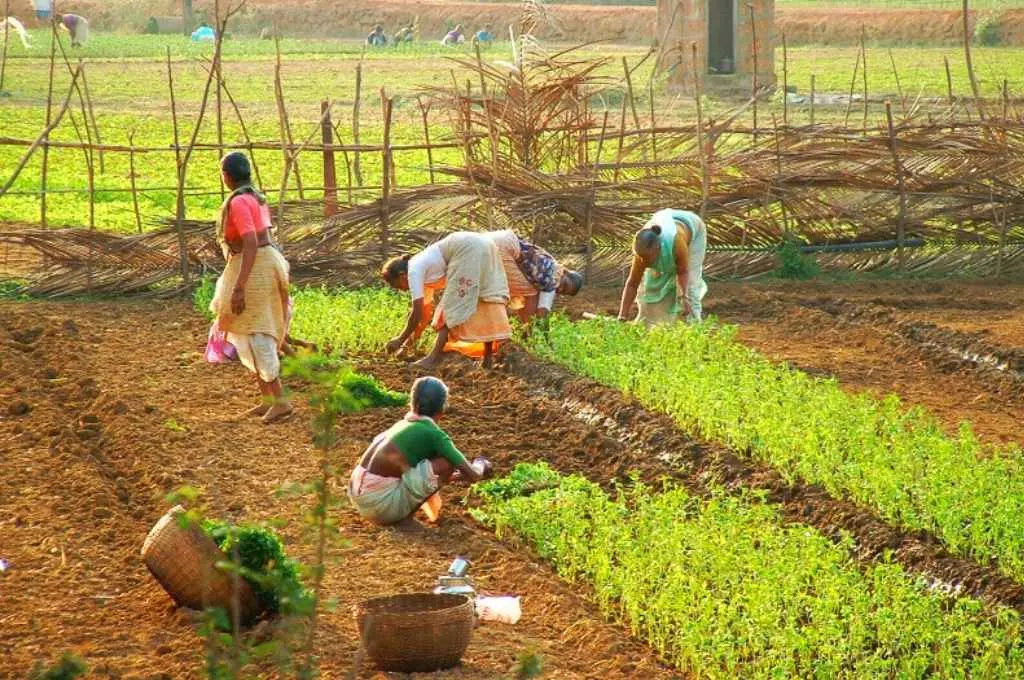
For decades, Tripura’s farmers have largely engaged in subsistence farming, with only a small fraction of them venturing into high-value native crops such as agar wood and queen pineapple.
The deterrents to transitioning to a more commercial model of farming are manifold:
- Intensive agriculture demands large water reservoirs, steady climate conditions, and rapid land restoration in order to guarantee consistent yields. However, Tripura’s farmers frequently face crop losses due to poor irrigation and unpredictable rainfall.
- Poor road connectivity and an inadequate transport system make markets inaccessible to producers, forcing them to depend on middlemen for their livelihood.
- The state’s troubled history of land ownership also exacerbates these issues. Land ownership is typically over small and medium plots, and fallow land is often leased out to marginal farmers. Additionally, due to migration and settlement patterns from the pre-Partition period to the present, land ownership remains layered, with many cases pending and demarcations unclear.
In a state that is largely dependent on agriculture, the inability to earn a secure living has limited people’s economic growth.

Over the years, the Tripura government has made several attempts to strengthen the agricultural economy, including irrigation projects and the introduction of cash crops such as rubber. However, these measures have had limited success and, in some cases, led to problems like monoculture. In such a situation, could it help farmers to collectivise and start their joint enterprises?
In many parts of India, farmer producer organisations (FPOs) have helped farmers benefit from collective action to reach larger markets, negotiate better prices, secure access to inputs, and expand businesses. They offer an organised model for small landholding farmers and help them access markets directly, bypassing middlemen and risky credit. To understand the model’s efficacy in Tripura, we spoke with FPO members and nonprofits supporting these organisations in the state. In the process, we gained perspective on what has worked so far, and the challenges that remain.
The women-led agri-entrepreneurship formula
In Fatikroy village, Unakoti district, the women-led Kumarghat FPO focuses on the local market to build a brand that generates stable sales. Before starting the FPO in 2023, Rajib Deb, a young agriculturist and entrepreneur from Tripura, studied similar structures in Jharkhand.
Small landholding farmers and landless labourers face structural difficulties of limited credit, decision paralysis, and uncertainties in farm-based livelihoods.
He says, “As a research assistant with National Smallholder Poultry Development Trust, I witnessed the remarkable progress of women-led self-help groups (SHGs) and FPOs in Jharkhand. We helped women generate lakhs in revenue through mushroom cultivation and livestock farming. After returning home, I studied the agricultural sector in the state and spent years in the fields and inside labs at ICAR, trying to figure out a solution for the marginal farmer. When I met these women who wanted to build a business but lacked access to knowledge and resources, I saw it as an opportunity to apply my learnings here.”
Rajib realised that the problems in his area mirrored those experienced by farmers in Jharkhand to a large extent. In Jharkhand’s remote villages, access to high quality agricultural inputs is determined by geography and mediated by middlemen. Small landholding farmers and landless labourers share the same structural difficulties of limited credit, decision paralysis, and uncertainties in their farm-based livelihoods. In Tripura, these issues come up in different contexts, but the essence remains the same.

With support from the administration and facilitating organisations, many of these structural issues are now being targeted. The policy support towards forming 10,000 FPOs has shown fruition and fleshing out the region-specific nuances was perhaps the most important step in ensuring the policy remains sustainable. It was also helpful that instead of the 300-farmer requirement for forming an FPO in most places in India, FPOs in Northeast and hilly areas only need a minimum of 100 farmers. This allowed Rajib to mobilise women in his immediate surroundings and start an organisation. He says, “When I pitched this idea to the women farmers, the initial apprehensions subsided after rounds of careful discussions and workshops. The organisation is now completely run by women.”
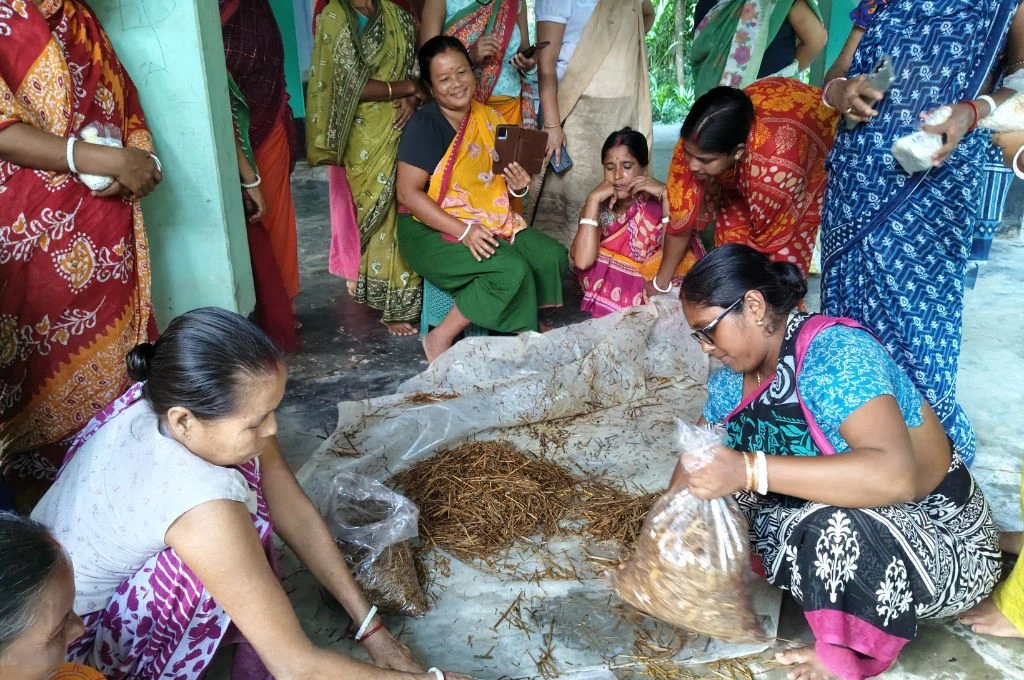
But despite Kumarghat FPO’s success in diversifying farming and encouraging women entrepreneurs, it has struggled to resolve the issues related to women’s lack of access to the market. A member of the organisation says, “When I joined in 2024, I was only growing chillies in my own backyard. Now I collaborate with other farmers and grow spices and vegetables all over the village. I have also learned about packaging and distribution. However, we quickly understood that getting our products into people’s kitchens was the hardest challenge. As women, it is very difficult to sell products door-to-door. We need to visit villages and towns where we are often ignored by male-dominated markets that judge products according to the gender of the producer and not the quality of the product. So we have had to largely rely on Rajib da and word-of-mouth to generate sales, but that is hardly enough to be profitable. We can handle cultivation and packaging, but going to the market is a challenge for us.”
Incubation, training, and market linkages
While Kumarghat FPO’s problems are gendered, Bagma Agri Producer Company Limited (BAPCL), a farmer producer company registered in 2019, battles technology gaps, lack of awareness, and monoculture in its operations across multiple districts in the state.
Sudip Majumder, BAPCL’s managing director, says, “We were a farmers group that evolved into a farmer producer company and then became a federation of FPOs to strengthen farmers’ capacities beyond our immediate organisation. When we first started, we had no clear roadmap. But we always knew one thing: we needed to secure the agronomy of this region and the state.”
BAPCL currently functions as a federation of FPOs that builds and supports other farmers’ organisations across Tripura on leadership development, technology adoption, and local market linkages.
Sudip adds, “We send the [incubated] FPO members outside Tripura for training in business management schools and banking institutes in cities like Kolkata. There, they learn modern tools and techniques, such as UPI transactions, that help them stay ahead of the curve.”
The federation spearheads various initiatives to provide direct support to marginal farmers and improve market access. From setting up integrated fisheries and straight-from-farm procurement pipelines to enabling steady credit guarantees by setting up financial literacy centres through collaboration with RBI, they have worked across the districts of Gomati, Dhalai, and several rural development blocks in West Tripura. But challenges persist.
FPOs like BAPCL have invested in establishing processing units, built local market connections, invested in branding, and created a strong presence for agricultural products. However, there have been cases that show that even these efforts aren’t enough.
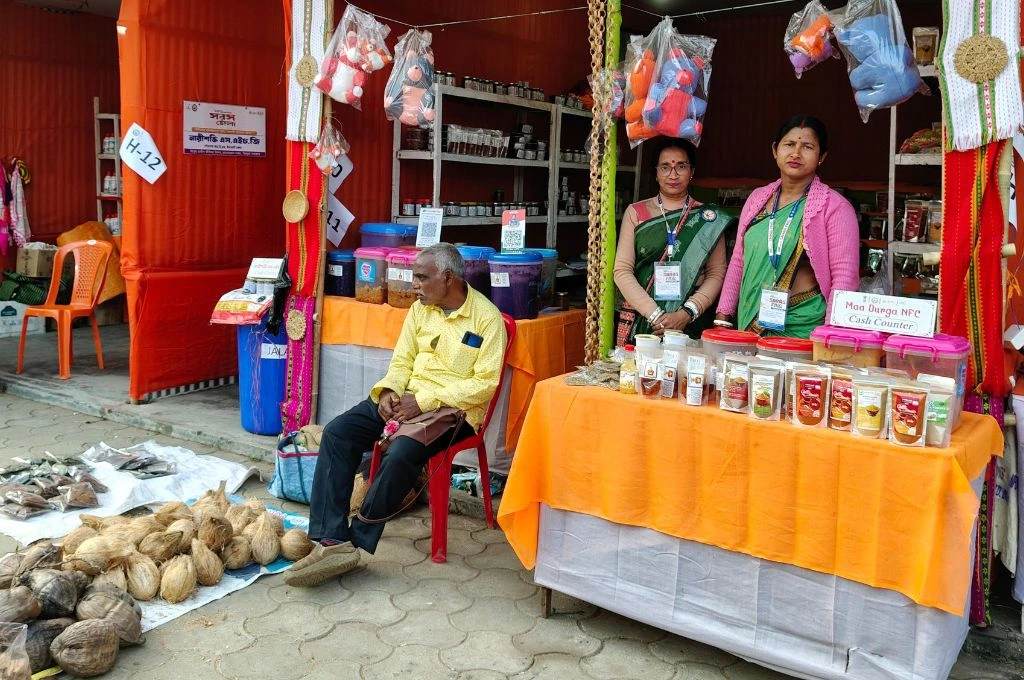
In February 2026, Gomati district’s Udaipur block saw a surge in demand for mustard oil without adequate supply. BAPCL had offered the farmers INR 70 per kilogram for mustard seeds, which is higher than the market rate. For comparison, rice has a minimum support price of INR 23 in the market. So, the federation’s move to promote mustard for crop diversification should have worked. But financial incentives alone couldn’t mobilise the farmers, revealing gaps in coordination and awareness on ground. Analysing the situation, a report in Tripuranet.com points out, “Block-level agricultural officers and extension workers have not yet established a comprehensive database of interested farmers. Furthermore, access to quality seeds, irrigation facilities, pest management solutions, and market risk protection remains uneven.”
Technology, human resource, and coordination
Of late, the Tripura government has been focusing on ensuring easy microfinance and subsidised processing equipment, and government schemes are increasingly targeting the financial and infrastructural aspects of the rural economy. For example, NABARD is actively investing in rural haats, climate-resilient farms, credit linkages, and farmer upskilling programmes. These initiatives are certainly supporting the emerging ecosystem of FPOs in the state. However, the organisations think that progress will be gradual, as technological training and adoption among farmers remains low. Modern methods like climate-smart agriculture, large-scale hydroponic farming, and innovative high-yield production systems require intensive farmer training.
Punam Bhattacharjee, founding member and secretary of Growing Seed, a nonprofit formed in 2011 that supports FPOs in North Tripura, Unakoti, and other nearby areas, shares: “We prioritise training farmers and rural workers through camps and programmes. Growth in agriculture cannot be sustained without strong training and infusion of talent. But a consistent pattern for us has been the gap between human resources and the scale our work demands.”
Growing Seed is actively investing in research and development across agriculture and allied sectors. This directly translates to enhanced on-ground support for farmers and entrepreneurs. Punam says, “From IP generation to on-field innovation, we’re focusing on the entire range of challenges where technology can provide an edge.”
Climate change has shortened the crop cycles in Tripura, leaving training organisations with very little time to demonstrate technological innovations to farmers.
Additionally, Growing Seed is leveraging technology like GIS and database management tools to strengthen monitoring and support for the FPOs and SHGs it promotes. But they have to also transfer this technical know-how to FPOs that are still at a nascent stage of development. Day-to-day operations demand diligence, procedural compliance, and clarity at every step, much of which turns into hurdles for under-equipped and under-trained organisations. There is no large-scale funding infrastructure for technical education of FPOs across the state. Nonprofits have been filling this gap, but their reach is limited to the pockets where they function. “To add to this, bureaucratic hurdles, red-tapism, and lack of awareness about FPO operations lead to severe roadblocks for nascent FPOs and their promoter organisations,” Punam adds.
Rajib notes, “The farmers know how to practise agriculture, but there need to be better training modules that integrate traditional methods with technological inputs. It is easy to convince them to adopt bio-fertilisers or cocopeat, but beyond that, farmers are scared of taking risks due to the fear of crop failures.”
He further highlights that climate change has shortened the crop cycles in Tripura, leaving training organisations with very little time to demonstrate technological innovations to farmers who are already busy with multiple agricultural responsibilities.
All the organisations agree that for the FPO ecosystem to flourish in the state, processes need to be streamlined. There must be a concerted effort towards working together rather than in silos. It is important to build stronger connections between the farmers, nonprofits, technology providers, and state and central government departments. Until that happens, efforts of individual nonprofits, while valuable, will remain isolated solutions to what is fundamentally a systemic challenge in the state’s agricultural economy.
—
Know more
- Learn how cash crops are threatening the bamboo-based livelihoods in Tripura.
- Read about the challenges faced by farmer producer organisations.