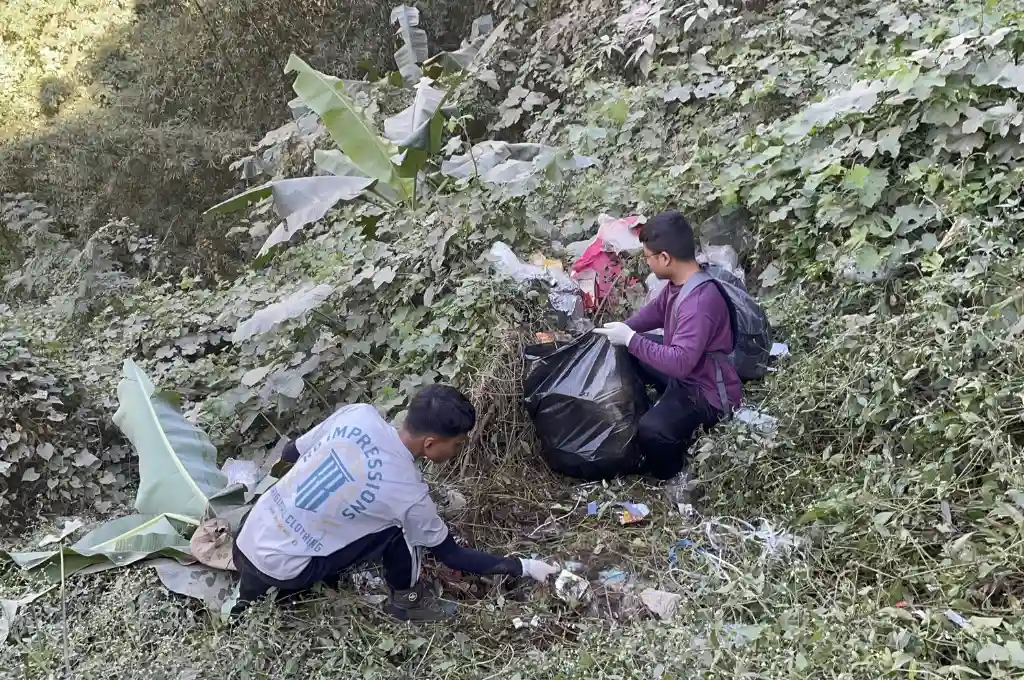
In early 2024, during one of our initial cleaning drives, we were working with young people to clean river Tlawng in Aizawl. This group included schoolgoing children. We had just finished collecting the waste and were getting into our pick-up trucks to carry it to the solid waste management facility. That’s when one of the volunteers casually took off his pair of gloves and threw it into the water. A student called him out. “We just cleaned the river. Why are you throwing the gloves back into it?”
Incidents like these reinforce our belief that Save the Riparian, our river-cleaning initiative, is a people’s movement. It is built by them, carried forward by them, and adapts and shapes itself according to the needs of the community.
When we started the initiative, it was just seven of us—researchers, environmentalists, hikers, and adventurists—who were tired of seeing trash floating in our rivers. These are, after all, the primary water sources for the people in Mizoram, especially those on the margins of society who don’t have access to piped and filtered water.

Our first cleaning drive in April 2024 was entirely paid for by us. As we cleaned the river, we kept posting photos and videos on our Instagram page. Word spread and more people joined us. I clearly remember the joy we felt when, on the 13th day, a small catering business in Aizawl reached out to fund us. With that money and small individual donations, we managed to clean up 3.4 km of the river trail in a month, which in hindsight we call the first phase of our initiative.
During that month, we saw a footfall of 500 volunteers. Not everyone turned up every day; the numbers varied across weekends and weekdays. A lot of this was driven by our Instagram page and YouTube videos. As the initiative gained popularity, local media, politicians, and civil society leaders turned up to work with us.
Lessons from that phase helped us design our strategies. Now, when the movement is almost two years old, we know what informally run community initiatives like ours need to do in order to sustain and grow their operations. And, thankfully, we are also more aware of the actions that could derail our movement.
No gatekeeping in a people’s campaign
The first lesson we learned is that there should be no memberships in a people’s campaign. We often get queries on how to become a member of Save the Riparian, and we respond by saying, “These are your rivers, so you are already a member.”
When initiatives mandate membership, people tend to feel they are on the outside and have to earn the right of entry. We instead encourage people to turn up, do the work, wear the campaign T-shirts, click photos, and share them with their friends who can also join us.


Social media is the secret sauce
In fact, social media is one of our key drivers. Very early on, we understood its power. We knew that, in Mizoram, Instagram is the most popular medium among the youth, so we used it to its potential.
We consciously decided not to have a website, and to use Instagram and YouTube for outreach—which would be in the Mizo language. This aligned with our branding as a nimble-footed, quick-acting movement that prioritises cleaning the river. It is for and by the people. That’s why, despite having a little more than 6,000 followers on Instagram, some of our videos have garnered almost 3 lakh views.
We also collaborate with influencers who are interested in environment and wildlife. We reach out to them and ask if they would be open to doing a collaborative post with us. This allows us to expand our audience.
When we run out of money, we ask for support on these channels and funds pour in. Some people give us INR 2, some INR 10, and others in thousands. All of it matters to us.
Local media, local leadership, and ease of working
We have also focused on dissemination through news media outlets. On alternate days, we prepare reports about our work and share them, along with photos and videos, with our media contacts at platforms such as Mizoram Public Service Commission, Doordarshan, and India Today NE. We encourage media organisations to cover our work on the ground.
The coverage brings more attention to our initiative, especially among government officials, civil society organisations, and political leaders. These connections have made our work much easier. For example, when the National Service Scheme (NSS) cell joined us in a cleaning drive, we managed to get more than 1,500 volunteers. Within a month, we conducted 224 pick-ups of solid waste. Similarly, we have partnered with Young Mizo Association in the past.
Usually, when we dump waste at the solid waste management facility, we have to pay 50 paisa per kg. However, because of these networks, our fee has been waived off on several instances.
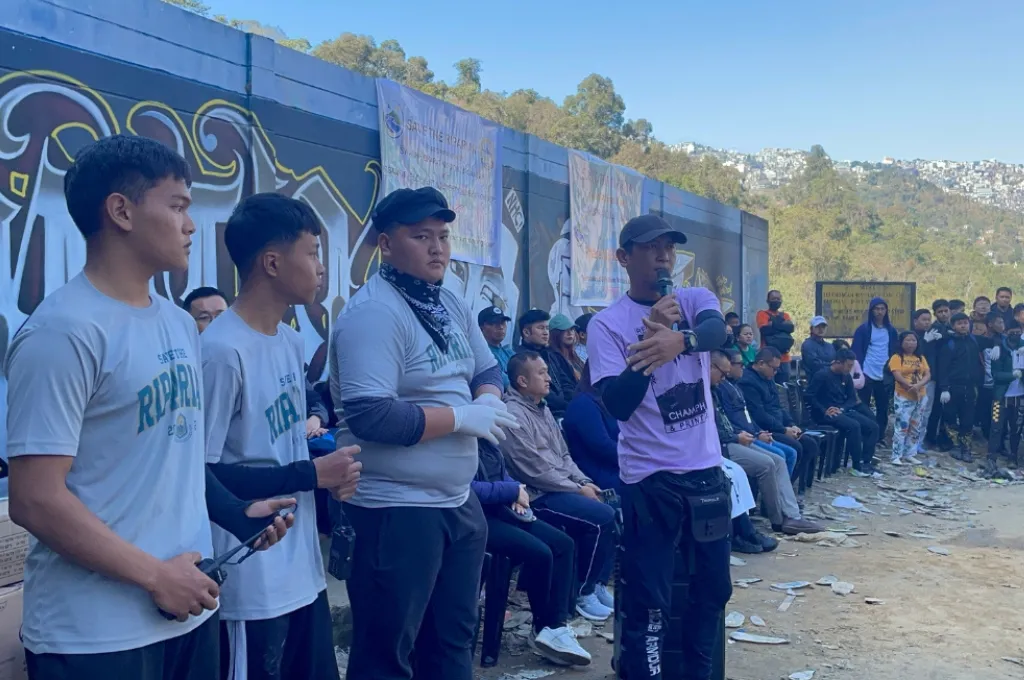
We have also had politicians turn up at our cleaning drives. After seeing our work, they have facilitated our funding through Public Health Engineering and Aizawl Municipal Corporation (AMC). But we don’t align with any particular political party. This is why, if one day a leader from the ruling party visits us, the second day an opposition leader might turn up at the same site.
We have also been invited by local MLAs to conduct workshops in the schools within their areas, which we love to do. This is because of our belief that younger people can be more easily influenced to be part of change.
Additionally, we spend time cleaning the rivers in those districts. While we travel and try to take up this task on our own, we cannot be everywhere all the time. It will take the community’s combined might to clean our water bodies. Therefore, eventually we would like to see similar projects being launched in different districts of Mizoram. However, there are some challenges.
Running an initiative, not an organisation
The problem with projects like ours is that Mizoram doesn’t have many solid waste management facilities. Even Aizawl, the capital city, has only one, which is located 20 km away in Tuirial. It costs approximately INR 6,000 per trip for a pick-up truck to reach the unit from the riversides where we work.
We document our work regularly so that we can plan our next steps, but we don’t want to spend money on hiring an external auditor.
Many organisations and political parties have told us to register our inititative as a society so that they can fund us properly. However, so far, we have stayed away from this because the general population in the state views societies and nonprofits with suspicion. We feel that if we become a society, we will stop being the collective that we have organically become.
Further, there are several overhead costs and liabilities that come with managing a society. At this stage in our work, we can’t afford to invest in the tedious process of running a formal organisation. For example, we document our work regularly so that we can plan our next steps, but we don’t want to spend money on hiring an external auditor.
The troughs and crests of campaigns
We have made peace with the way we run our initiative, but this doesn’t mean that we don’t plan our steps. When you are working in a state like Mizoram, which is prone to climate disasters such as flash floods and landslides, you have to take into account the volunteers’ safety. We cannot afford to work at the rivers during the monsoons and risk the lives of the young volunteers.
There are other contingencies too. In May 2024, when Cyclone Remal claimed many lives in the state, we consciously took the decision to pause our work.
We are focusing on outreach across villages in Mizoram and have been trying new methods to gain people’s attention.
But we also know that if we sit idle for long, we will lose our momentum and people will forget about us. In Mizoram, like in other places, news comes in cycles. Today, a major crime might have caught people’s attention, but tomorrow if there’s a bomb blast, they will forget about the crime and only focus on the blast. Therefore, even during lull periods, we continue our awareness programmes.
We are focusing on outreach across villages in Mizoram and have been trying new methods to gain people’s attention. For example, since people in rural areas are interested in snakes and some of the Riparian members are zoology students at Mizoram University, we often take monocled cobras, king cobras, and pythons when speaking to the communities. The snakes become our free influencers, who help us conduct our sessions on solid waste management in a more engaging manner.
Staying agile and eager to learn
We are still a small initiative run by a group of youth people who love nature and want to save what remains of it. When we see littering, we raise our voice even if the culprits are employed by government institutions. For example, Mizoram University had hired a contractor who collected waste in the morning to drop it off at the Tuirial waste management facility. However, this arrangement wasn’t working out.
One day, we followed the truck on our scooters and noticed that it was dumping the waste into a stream of the Tlawng. We used drone cameras to gather video evidence of this and submitted it to AMC, and they fined the contractor.
We continue to file such complaints. Often the government departments are quick to respond; however, the process slows down during election season.
Unfortunately, things will take a long time to change because people are used to treating the rivers as their personal garbage dump. Many households still don’t use a functioning septic tank and release sewage directly into the rivers, which turns the water hazardous for people who depend on it for drinking and sanitation.
As we clean the rivers, we learn every day. How would we have otherwise imagined the amount of fabric waste that gets thrown into them? We have for long believed that clothes disintegrate in water. Perhaps with the same hope, we also dump sanitary pads, condoms, diapers, and syringes into the river. For this behaviour to shift, we must witness what’s happening to our waters and understand how this directly affects our health and our environment. Campaigns like ours, that bring people face to face with the rivers, hope to spark a gradual change.
As told to Rodingliana, IDR Northeast Fellow 2024–25.
—
Know more
- Learn how a village in Nagaland manages its unique ecotourism model.
- Understand how water bodies carry cultural memories.