It is just past 10 in the morning when Meeta* begins her lesson. Children sit in neat rows, notebooks open. On the blackboard, she has written a short paragraph. She reads it aloud, her finger moving under each word.
“Now repeat after me.” The class responds together, their voices rising in unison. A few children are a fraction late; they watch her lips before joining in.
“What is the name of the boy in the story?” Several hands go up. She gestures for the whole class to answer. The answer echoes back and she nods.

“Now copy the story in your notebooks.”
At the back of the room, a smaller group of grade 1 children—part of the same multigrade class—sit with their slates. Meeta walks over to them and begins explaining a math problem. The older children continue writing. One girl looks up briefly, then lowers her eyes. Two children whisper in their home language before falling silent.
As the morning unfolds, there is little extended conversation, little writing composed by children themselves, and long stretches where some children wait while others work. Most children speak only when prompted and usually as a whole group. These ‘choral responses’ do not offer a clear picture of what each child is thinking, what questions remain unasked, or how deeply children understand the lesson.
Scenes like this—where children’s participation is largely choral, writing is predominantly copying, and long stretches of waiting punctuate the lesson—were common across several foundational literacy and numeracy (FLN) classrooms observed in the Teaching Learning Practices Survey (TLPS) 2025.
Over the past few years, FLN has moved to the centre of India’s education reform agenda. Through the National Education Policy 2020, the NIPUN Bharat Mission, and large-scale assessments, early learning has become a clear national priority. Learning outcomes are tracked against targets and gains are reported. Yet, alongside this momentum, a critical question remains: What is happening inside classrooms, day after day?

Led by the Language and Learning Foundation, with funding from Tata Trusts and implementation support from partner education nonprofits, TLPS 2025 was designed to generate systematic evidence on this question. Conducted across 1,050 grade 1 and 2 classrooms in nine Indian states, the survey offers a large-scale snapshot of how foundational literacy and numeracy are being taught on the ground. It examines what teachers and children are actually doing during instructional time—how they interact, how they use language, what kinds of tasks children are given, and how classroom time is organised.
What emerges from the survey is something very foundational: Many classrooms appear to be operating without the relational and pedagogical core that allows children to gradually become independent readers, writers, and thinkers. As India pushes to achieve universal FLN, these findings invite us to pause and ask whether we are building early learning on sufficiently strong foundations.
Learning begins in relationships
Developmental research has consistently reminded us that young children learn and grow in environments of relationships. These relationships are not peripheral to learning; they are its ‘active ingredients’. Secure, responsive interactions shape children’s well-being, motivation, confidence, and cognitive engagement. Teaching in early years, therefore, cannot be separated from the relational climate in which it unfolds.
Children who do not feel comfortable and heard are less likely to take intellectual risks, such as sharing their ideas and opinions.
The survey examined classroom environments through this lens, focusing on teacher-child interactions, opportunities for participation, and the use of children’s home languages. The findings indicate that children’s participation was frequently confined to brief or whole-group (choral) responses. In roughly 66 percent of observed classrooms, children remained mostly quiet, with limited opportunities for interaction and discussion or for learning from one another. Further, although 73 percent of teachers reported knowing children’s home languages, only 10 percent used them consistently to enhance children’s participation and comprehension.
Silence, in itself, is not a problem. But when silence reflects constrained participation, it may mean that children are not engaged in meaning-making.
There may be relational dynamics or caste, class, and gender biases that a survey like TLPS 2025 cannot systematically capture. Even so, it is clear that children who do not feel comfortable and heard are less likely to take intellectual risks, such as attempting unfamiliar words, asking and answering questions, and sharing their ideas and opinions. When participation is confined to listening and repeating, learning becomes mechanical rather than thoughtful.
The limited use of children’s home languages is particularly consequential. The emergent literacy perspective underscores that reading and writing develop on the foundation of oral language. When children’s most familiar language remains outside the classroom, they may not feel accepted, adversely affecting their participation, engagement, and comprehension.
Strengthening teacher-child relationships and drawing on children’s linguistic resources are not optional or secondary considerations. They are foundational conditions for early learning.
Reclaiming classroom talk as a foundation for learning
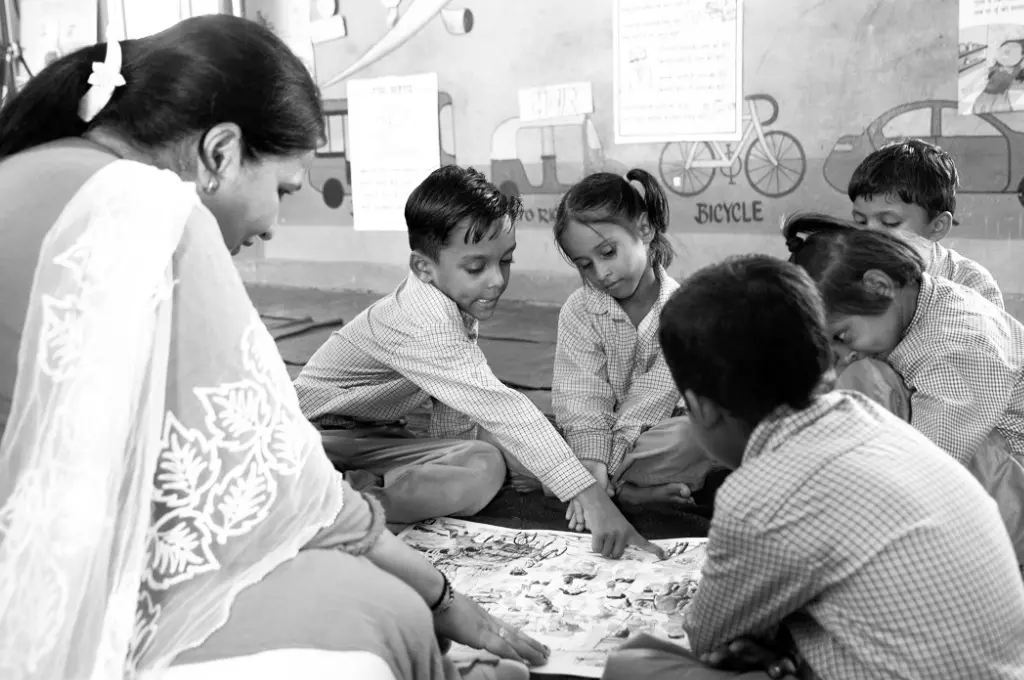
In many schools, talk is rarely valued, let alone deliberately structured and taught to young children. Yet talk plays a central role in supporting reasoning and comprehension and forms the foundation for much of children’s learning.
Through purposeful discussion, children learn to connect and refine ideas, draw inferences, articulate reasons, and connect texts to their own life. When conversations around texts and ideas remain confined to short factual exchanges (e.g., question-answer-evaluate sequences) rather than longer discussions of key ideas, children may not develop deeper reasoning skills.
Nurturing a culture of talk requires more than asking questions.
As per the survey’s findings, most instructional interactions followed a familiar pattern: teachers posed questions to the whole class, children responded in chorus, and the lesson moved forward. Choral responses can mask misunderstanding and do little to build individual thinking. Where teachers directed questions to individual children, they hardly waited for a response or built discussions further based on student responses. Teachers asked open-ended questions (like ‘Why?’ ‘How?’ or ‘What do you think?’) occasionally, but children participating in elaborate discussion was rare.
Nurturing a culture of talk requires more than asking questions. It requires teachers to allow time for thinking, to probe responses with ‘why’ and ‘how’ questions, to accept multiple responses and perspectives (grounded in the text or story or in mathematical facts for numeracy); and to encourage children to respond to one another to build their thinking.
If foundational learning is to include higher-order thinking skills like comprehension, application, and critical reasoning—as current policy frameworks suggest—then classrooms must create more deliberate space for sustained, meaningful talk.
Writing for expression is not an afterthought
The most striking finding concerned the nature of writing tasks assigned to children. More than three-fourths of teachers primarily asked children to copy letters or words from the blackboard or a textbook. Opportunities for children to compose their own texts, however brief or emergent, were limited.
This pattern appears to rest on two common assumptions:
- Writing follows reading: Children must learn the full script and decode fluently before they can be asked to compose meaningfully.
- Writing follows thinking: Thinking happens fully in the mind and writing is merely a way to record those ideas, instead of recognising writing as thinking in action.
Research challenges both these assumptions. Reading and writing, while distinct processes, have a close connections from the earliest stages. For instance, the knowledge bases children use to spell words also support word recognition during reading; composing connected sentences and texts strengthens reading comprehension. Reading, in turn, enriches knowledge related to script, vocabulary, syntax, and ideas that shape children’s writing.
The emergent literacy perspective views early reading and writing as developing gradually through children’s meaningful use of print. Such experiences with print may include hearing the teacher read a picture book aloud; observing the teacher write a description of the class visit to a local market using children’s inputs; moving their name card to the correct tray to mark attendance; or drawing a story or personal experience (even using dots, shapes, and emerging letter forms).
Further, Anne Dyson, a literacy scholar known for her work on children’s writing, reminds us that young children weave together speech, play, and print as symbolic resources for meaning-making. When children attempt to express their own ideas, say, through labelled drawings, invented spellings (approximations of words based on their emerging knowledge of letters and sounds), or short narratives dictated to a teacher or parent, they are not merely displaying or recording what they already know; they are shaping and extending their thinking.
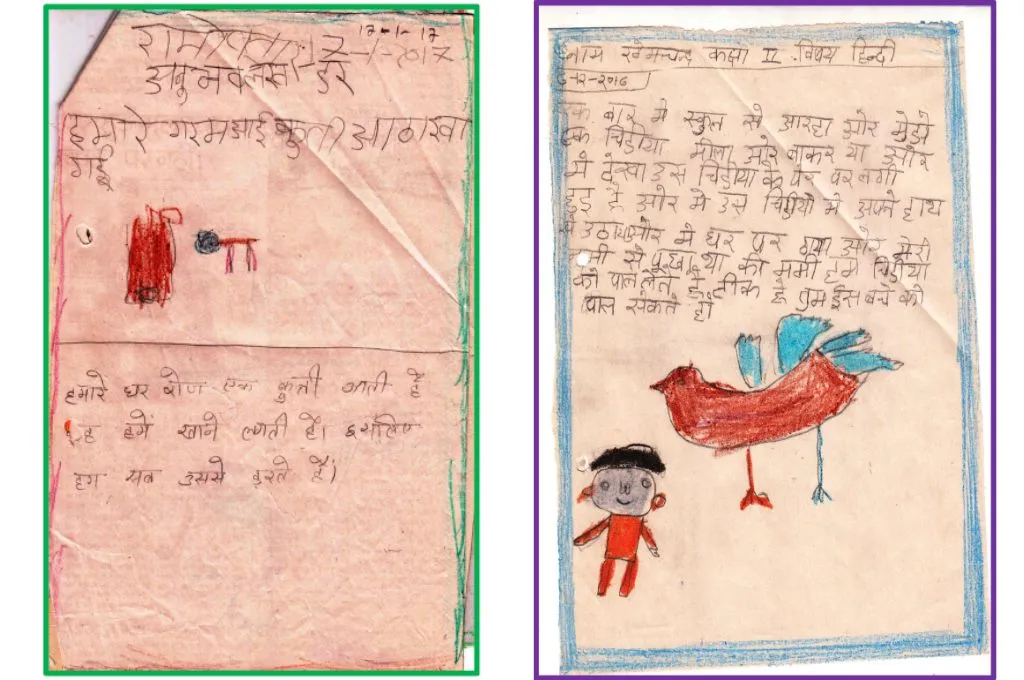
This is what happens when young children are invited to write about their thoughts, feelings, and experiences in response to stories, classroom conversations, or events in their lives, even before they have mastered conventions such as spelling, handwriting, and grammar. The writing samples below, from OELP, Rajasthan, illustrate how young children can be given such opportunities from the very beginning. Early on, teachers could write down children’s description of their own texts, supporting their efforts to communicate meaning. The emphasis is on the expression of ideas, imagination, and feelings, rather than on the accuracy of form.
Instead, when writing is reduced to copying, it becomes detached from the broader process of thinking through symbol systems. This is not to minimise the importance of practising letters and words as part of systematic decoding instruction. Strengthening sound-symbol associations, remains essential. However, decoding instruction without any opportunities for meaningful writing risks producing readers who can pronounce and spell words, yet struggle to generate and express ideas. If our vision is for children to become independent readers and thinkers, then writing must be positioned as central, not peripheral, to foundational learning.
Improving time use and engagement for learning
Time is the most finite resource in classrooms. The survey found that approximately 66 percent of teaching time was devoted to teacher-centred activities (such as explaining concepts, posing questions to children, writing on the blackboard, assigning homework), while only about 15 percent involved learner-centred engagement (such as supervising group work, responding to children’s questions or giving feedback). Notably, children were off task for roughly 27 percent of class time. In addition, a considerable portion of the remaining time was spent in largely mechanical activities such as choral repetition and copying. Taken together, this suggests that close to 45 percent of classroom time may be spent either disengaged or minimally engaged!
Even allowing for classroom constraints, this pattern warrants reflection and change. In early grades—where attention, language, and self-regulation are still developing—learning depends on active participation and purposeful engagement. Extended periods of disengagement or mechanical activity may weaken conceptual understanding.
Multigrade classrooms add another layer of complexity. Observed in nearly two-thirds of schools, multigrade teaching is a common reality in many government schools. Yet teachers’ planning for independent and small-group tasks in such contexts appeared limited, with little support from curricular resources and teacher handbooks to address this context.
Improving time use, therefore, is not merely a matter of efficiency. It requires rebalancing instructional approaches, incorporating more learner-centred activities, and planning deliberately for multigrade realities so that children remain meaningfully engaged rather than waiting or drifting.
Strengthening the ground beneath our feet
The TLPS 2025 highlights a crucial link in the FLN mission: Sustained improvements in learning outcomes depend on sustained improvements in classroom practice.
The findings suggest that many classrooms are functioning but not yet flourishing. Relationships are cordial but do not always inspire confidence and participation among children. Classroom talk is present but often not dialogic. Writing tasks are assigned but are frequently mechanical. Classroom time may be structured but is not always used to deepen learning.
However, these patterns do not indicate teacher indifference or lack of effort. They often arise within systemic constraints—multigrade classrooms, pressure to complete the syllabus, limited training and uneven academic support. Strengthening practice, therefore, requires attention both to classroom-level shifts and to the systemic conditions that support teachers in making them.
While the TLPS 2025 presents a comprehensive set of classroom- and system-level recommendations, it is also important for practitioners and leaders in the domain to pause and consolidate the foundations by:
- Ensuring that there are warm and trusting teacher-child relationships.
- Encouraging children to speak and think aloud.
- Using writing as a tool for meaning-making and expression.
- Organising instructional time in ways that sustain meaningful engagement, particularly in multigrade contexts.
Independent readers and thinkers grow in classrooms where relationships are responsive, talk is purposeful, writing carries meaning, and time is used with intention.
*Name changed to maintain confidentiality.
—
Know more
- Learn about why social-emotional learning is key to foundational learning.
- Read about how children’s foundational learning can improve through community-school participation.