“Calcium ki dawai morning mein or iron ki dawai dophar mein lene se problem ho sakti hai kya?” (Can taking a calcium tablet in the morning, and an iron tablet in the afternoon cause problems?)
This query was received by an AI-enabled chatbot focused on reproductive health. While this might be resolved through a medical examination by a doctor or physician in under 30 seconds, a lot of women across India still do not have access to proper health facilities and specialised sexual and reproductive care.
Though the country’s maternal mortality rate declined from 113 per 1,00,000 live births in 2014–16 to 88 by 2021–23, global estimates have consistently ranked India among countries with the highest share of maternal deaths in the world. While central and state governments have launched targeted schemes for maternal health and institutional deliveries, weak health infrastructure in rural and remote areas has meant that women from economically marginalised and rural communities still do not have access to the care they need.
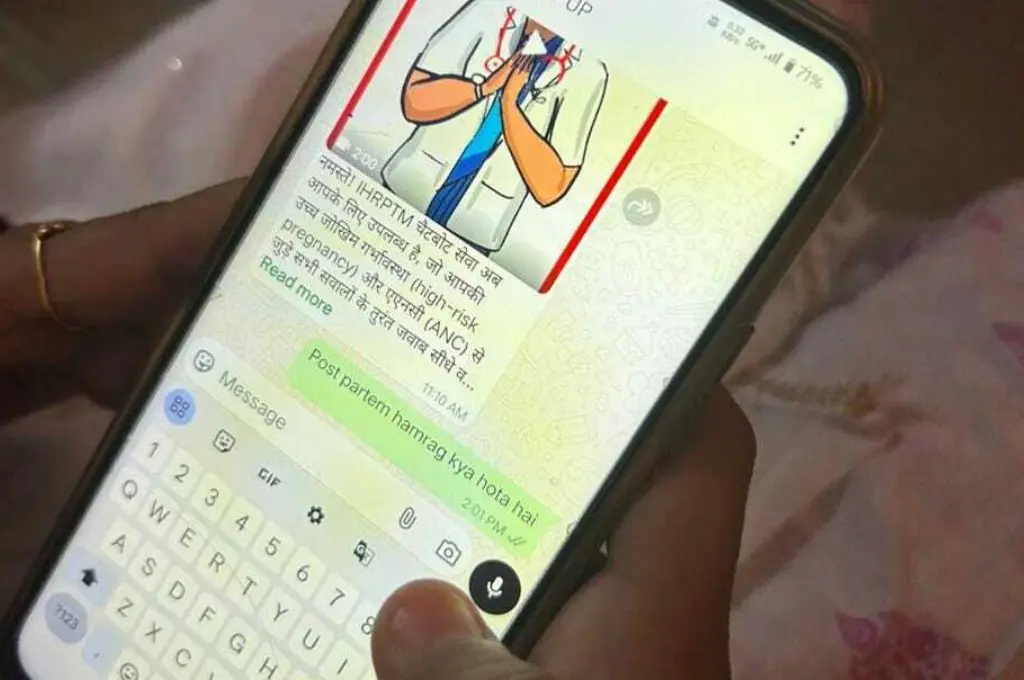
With frontline community health workers carrying the burden of last mile healthcare using meagre resources, new technological interventions have been rolled out over the past few years to bridge the healthcare gap. Among these are AI-enabled chatbots, which have been designed to give women access to health information directly through their phones. While such technologies can potentially offer women and community health workers access to timely information, especially where local health facilities are absent or lacking, their use raises significant questions on effective usage of AI, digital literacy, accuracy of information, and over-reliance on such tools.
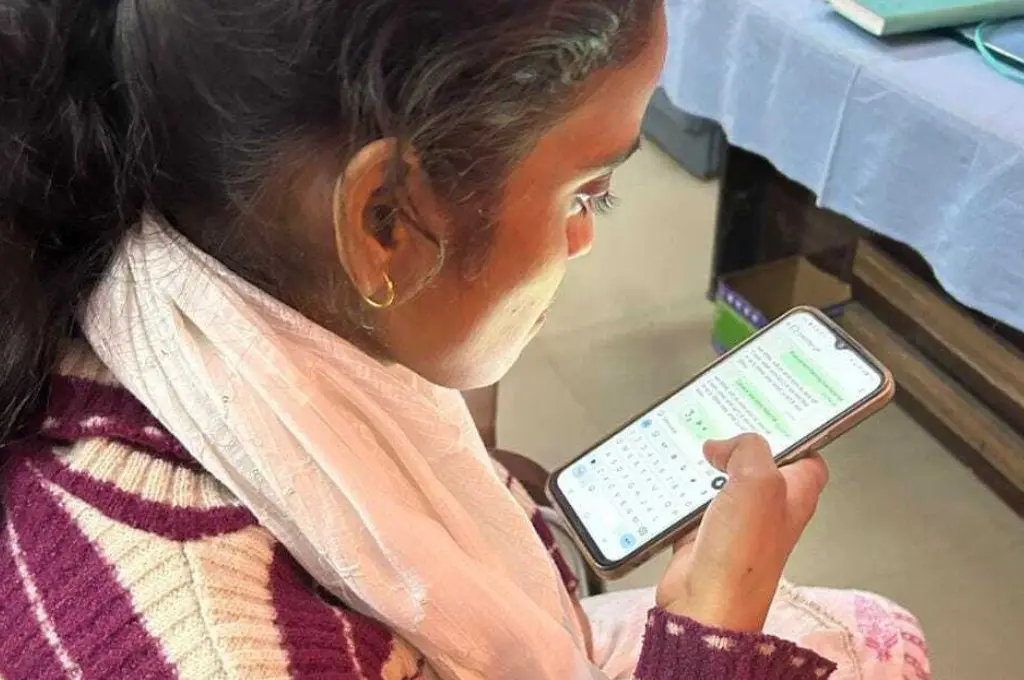
WhatsApp chatbots and AI in India’s rural reproductive health
For many women in rural areas, it is the Auxiliary Nurse Midwives (ANMs) stationed at the local primary healthcare centre (PHC) who are their first point of contact with the health system. According to the 2021–22 Rural Health Statistics report, there are more than two lakh ANMs working in PHCs and sub-centres across India.
A few years ago, ARMMAN, a nonprofit working in maternal healthcare, rolled out two chatbots: one for ANMs and another for pregnant women. The ANM-facing tool, called the ANM Support System, was built on government-approved maternal health guidelines and ARMMAN’s own medical training material on managing high-risk pregnancies. The tools are currently operational in 31 districts across Uttar Pradesh, Telangana, and Maharashtra, and were reviewed by the State National Health Missions prior to their rollout.
The questions ANMs raise reflect the pressures of managing large populations, often with limited specialist support and infrequent refresher training.
ANMs use the chatbot for real-time support in handling high-risk pregnancies that need immediate intervention. According to the organisation, the questions ANMs raise reflect the pressures of managing large populations, often with limited specialist support and infrequent refresher training. The ANM chatbot functions as an on-demand clinical reference. When a frontline worker or ANM encounters a query that they cannot confidently answer, they type it into WhatsApp. These queries include: when does high blood pressure in pregnancy become dangerous; how to respond to severe anaemia; when do symptoms like swelling, bleeding, or reduced foetal movement require urgent referral’ or even medicine-related doubts like spacing the intake of iron and calcium tablets. Queries that fall outside the scope of the chatbot are escalated to a human expert. These human experts are trained medical staff within ARMMAN’s programme team, including doctors and public health experts involved in maternal healthcare training.
While ARMMAN’s chatbots are largely focused on ANMs and pregnant mothers, other organisations are filling the gap in the domain of Sexual and Reproductive Health (SRH) among adolescent girls.

Launched in 2021, Disha Didi is another WhatsApp chatbot developed by Ipas Development Foundation, an international nonprofit working on sexual and reproductive health. This tool was built to educate adolescent girls on reproductive health.
Social stigma, restrictive family norms, and threadbare healthcare infrastructure mean that many adolescent girls arrive at adulthood underprepared and usually do not have anyone to ask questions. The gap between awareness and action is particularly stark with contraception: girls may know it exists, but not how to access it or use it safely. Disha Didi was designed to close that distance, and most users of the chatbot are adolescent girls and young women from rural and semi-rural communities seeking information on menstruation, puberty, contraception, infections, and pregnancy.
To build relatability and trust, the profile picture of the WhatsApp bot is that of a young woman in a salwar kameez, with her hair tied in a single braid.
The chatbot covers topics such as menstruation, contraception, pregnancy, abortion, and reproductive infection. Its menu-based structure means the girls never have to type a question directly. The users tap through options, select what applies, and receive information in Hindi or Bengali. Disha Didi currently operates in Assam, Madhya Pradesh, Jharkhand, and West Bengal.
The responses of the app were developed using information gathered from youth leaders, SRH educators, counsellors, and field interactions with adolescent girls and young women. A large question bank of nearly 20,000 real-world queries was created around menstruation, puberty, contraception, pregnancy, infections, and sexual health. Responses were then reviewed by programme experts and SRH educators using verified public health and counselling material, rather than just open source internet data, which runs the risk of being unverified.
And if a query falls outside the purview of Disha Didi, the user is connected to a helpline number where experts trained in sexual and reproductive health, along with programme staff associated with the organisation’s helpline support system help the user.
Privacy was kept in mind while designing. Using the chatbot does not need a lot of personal information from users. It sends no notifications. The user reaches out only when they have a question.
“In our area, mostly adolescent girls use this chatbot, because they tend to have more questions about puberty and menstruation. Men do not use it very much. However, there is one challenge. Many households only have one phone. If a girl searches for information related to periods or similar issues, her father or other family members may ask why she is looking for such things,” says Somshree Jana, a resident of South 24 Parganas district in West Bengal.
According to Jana and other field workers, girls commonly use the chatbot to ask questions about stomach pain during periods, irregular menstruation, bodily changes during puberty, white discharge, and menstrual hygiene. Volunteers mention that many girls were uncomfortable asking these questions openly at home or in school, making interactions with the chatbot feel more private and less judgemental.
Despite significant digital literacy gaps in certain regions, Jana says that the technology definitely reduces the need for girls to travel to sub-centres—the first level of rural healthcare before PHCs and Community Health Centres (CHCs)—allowing them to ask sensitive questions directly from their phones.
Where AI falls short
Medical practitioners say that such apps can serve as a primary tool to screen issues or notice patterns, and then present a more concise picture for a practitioner or a health worker to evaluate, potentially shortening turnaround time without missing significant diagnoses as well as reaching thousands of users at a time. However, they argue that these platforms must be used and positioned as support tools, and not as replacements for medical care.
The organisations working with these AI tools agree.
Any query that differs from the knowledge base on which they have been trained may be difficult for the system to interpret.
Moreover, access to AI chatbots in rural areas also comes with real constraints. Digital access is uneven across rural settings and among different user groups: phones are often shared, and internet connectivity is patchy. Older ANMs are less familiar with smartphones, and language barriers further limit who can use these tools. Organisations such as ARMMAN and Ipas have responded by building WhatsApp-based systems in local languages, designed for low-bandwidth environments, and supporting text interactions with voice features. Even so, uneven digital literacy and smartphone familiarity continue to limit how effectively these tools are used.
One of the very significant limitations that serves as a major constraint happens to be the fact that AI is limited by the information it has been trained on. While these AI-driven chatbots can process vast amounts of data and retrieve relevant information, any query that differs from the knowledge base on which they have been trained may be difficult for the system to interpret or answer accurately, and this calls for human intervention.
While local language options can enhance accessibility, variations also add another layer of difficulty from a design perspective. “Simply for menstruation, girls used different words and while we kept updating the questions bank with all variations that came our way, it was not possible to keep pace with them. So, the bot often ended up giving wrong responses,” informs Pallavi Lal from Ipas. To make it ‘less frustrating’ for the users, chat support was introduced where unresolved queries were picked up by a human counsellor over a chat. But the drawback in this approach was that the user was not always available when the counsellor came online. “We then later converted this into live helpline support available all days—from 7am to 7pm,” she added.
Concerns around AI usage in healthcare are echoed by international governmental organisations such as WHO, which has acknowledged the role of AI in delivering healthcare services in low resource settings, but has emphasised the importance of human autonomy, arguing that humans should remain in control of healthcare systems and medical decision-making to limit risks associated with AI.
The fact that both the AI chatbots have kept the human escalation point open suggests that AI is limited when it comes to handling more complex, unusual, or context-based situations (such as cases involving additional health conditions suffered by pregnant women, patients with prior medical history, or the availability of nearby healthcare facilities) call for human intervention.
And finally, if a user acts on information suggested by these chatbots and suffers a medical emergency, there emerges the question of accountability. Accountability “remains an evolving area in AI-enabled healthcare,” says Amrita Mahale from ARMMAN. As AI becomes increasingly relevant to healthcare delivery systems, these issues are likely to become even more important.
The way forward
AI chatbots in maternal and reproductive healthcare require constant oversight to make sure users are guided correctly. “At ARMMAN, chatbot outputs are reviewed by a panel of medical experts, including doctors and public health professionals, with structured audits and user feedback shaping ongoing improvements”, says Amrita Mahale. During the initial rollout in Uttar Pradesh and Telangana, the organisation reviewed 100 percent of the first 500 queries; that review rate now stands at five percent of queries every month. Sustained accuracy depends on continuous expert intervention, audits, and periodic upgrades.
As AI becomes more deeply embedded in India’s healthcare delivery systems, questions around accountability, data reliability, and digital access will only grow more pressing. For now, these chatbots work best as first responders, filling gaps in access and information for women who would otherwise have none. Success rests on AI remaining one part of a larger network of human expertise, alongside the doctors, counsellors, and frontline workers who continue to anchor care.
—
Know more
- Learn more about how AI is being used for mental health.
- Learn how India’s AI boom runs on women’s unpaid care and cognitive labour.
- Learn what nonprofits should look out for when leveraging technology.