Where does palliative care begin? When we think of treatment for someone with a serious terminal illness, what might come to mind is a hospital ward, multiple machines and tests, and a rotating team of doctors. But what happens to people who cannot immediately access a hospital when needed? In rural and remote areas, where the nearest medical facility is hours away, what does care look like in the absence of a cure?
In 1995, the Bangalore Baptist Hospital set up a palliative care department, primarily serving patients in the city. At the time, the hospital was seeing a rise in the number of cancer patients, many of whom were at a stage where curative treatment was no longer possible. A significant proportion was experiencing severe pain and distress but had little to no access to appropriate supportive care. This left many with only basic pain medicines available in local pharmacies and alternative treatments that were not tailored to palliative care needs.
From the outset, our approach to palliative care was community-based. Especially in cases where there was no cure, it was neither practical nor humane to keep people in hospitals indefinitely, where would be isolated and in an unfamiliar environment. We understood that care had to be embedded in the community so patients could live with their families and maintain a sense of routine in their everyday lives.
Over time, what began as a home-based palliative care programme for patients living around the hospital evolved into a broader initiative to address the unmet needs of vulnerable people outside city limits and in surrounding rural areas.
During visits to villages in the Bangalore Rural district in 2010, our team observed that many patients diagnosed with cancer were undergoing treatment in city hospitals. Once the disease progressed beyond active treatment, access to palliative and end-of-life care closer to home was difficult, since local public and private health systems had limited capacity. As a result, it fell on the families to provide care, who mostly did not have any information or resources to guide them. We often found patients living in extremely challenging circumstances, sometimes in a cowshed or isolated in a corner of the house.
Recognising this gap, we decided to extend our palliative care services to the Bangalore Rural district.
In the past decade, we have expanded the programme to four additional districts—Chikkaballapur, Kolar, Tumakuru, and Ramanagara. The field teams comprise a doctor, nurse, healthcare assistant, counsellor, and driver, enabling both clinical care and psychosocial support. They conduct approximately 4,000 home visits annually, working with 520–780 patients. This includes both children and adults; the majority of our patients are people with cancer. We also train family members to administer medications, manage wound care, and provide basic nursing support.
Providing palliative care in rural areas has meant working through complex systemic and community-level challenges. We have learned that care is not about creating a quick service. It is about strengthening local networks where formal systems are weak or absent, understanding context, and gradually building trust.

Using local networks to identify patients in need
The first step was locating patients in villages. At the time, the district did not have a cancer registry, and patient records were maintained at individual healthcare facilities. This made it difficult to identify people in need of palliative care.
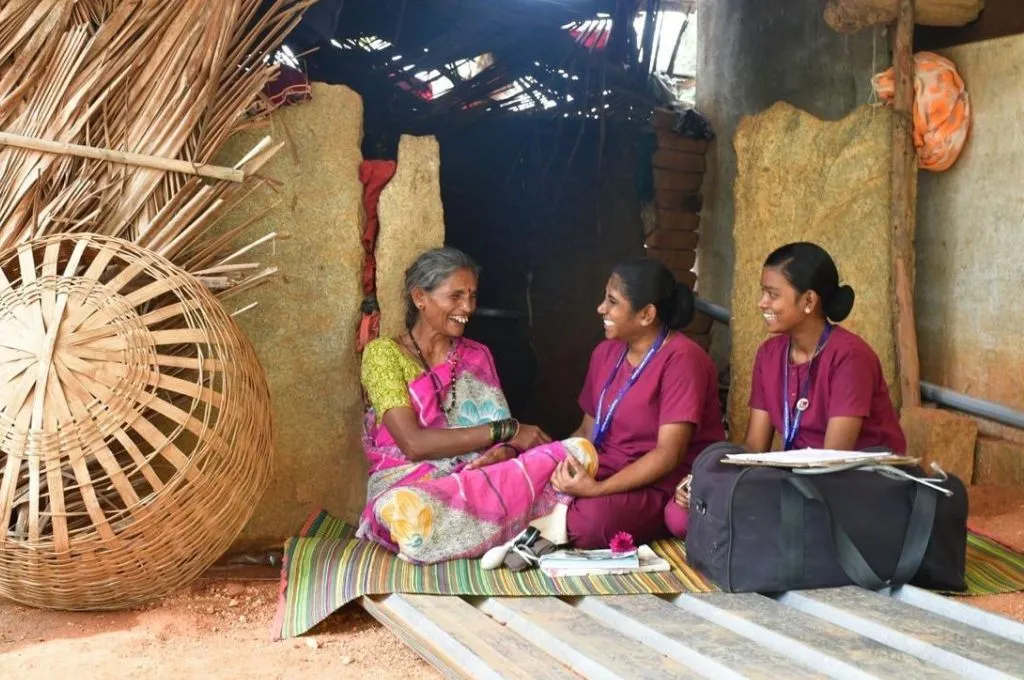
We started by sending social workers and field health workers from village to village to map key stakeholders including the panchayat, local self-governance bodies, and women’s groups. We built awareness among ASHA and Anganwadi workers about palliative care and how to identify patients, and also engaged with village residents at large. Instead of using terms like palliative care, we simply asked if they knew anyone who had a serious illness. We explained that we were offering a service to support patients, where a team of doctors would visit and provide care and comfort to improve their quality of life.
Some people would guide us to specific households, and that’s how we slowly began finding patients.
We also started to understand who held information in a village. While panchayats played a role, it was the local milk cooperative in each village where people gathered daily and discussed everything from crops and marriages to debts and illnesses. We put up posters at the milk collection points and spoke to people there. Similarly, local tea stalls and grocery shops that served as informal common spaces became important sites for us to share details about our work.
Addressing apprehensions and building trust
Before we started our programme in Bangalore Rural, the Bangalore Baptist Hospital had already been conducting outreach in the region, and this familiarity built initial trust. The district health authorities also gave us a formal letter of permission to provide palliative care services in underserved areas.
However, we still faced significant hesitation and scepticism from community members. In the initial days of the programme, people were apprehensive about a hospital actively seeking patients, and feared hidden costs or ulterior financial motives.
Another significant challenge was social stigma. Families were hesitant about home visits, worried about the repercussions of people finding out that someone in their house had a serious or terminal illness. They felt this disclosure could lead to social exclusion or impact marriage prospects. Some would request us to park our vehicles away from their homes and approach discreetly on foot. Our strategy was to remain flexible and responsive to people’s preferences. We adapted our approach to what families were most comfortable with, including visiting in smaller groups and ensuring confidentiality. Over time, this community-sensitive approach helped us gain acceptance and access across most areas.
The next stage of our work began once we entered a home and started talking about initiating palliative care.
Navigating conversations around care and mortality
We never use heavy medical language at the outset. Instead, we focus on understanding family dynamics, and once trust has been established, families tend to open up about the illness.
We have found that families and patients can have a different understanding of the illness, expectations from the treatment, and willingness to discuss the diagnosis and prognosis.
Many of our patients are aware of their diagnosis but choose not to disclose it, sometimes hoping for an alternative explanation. In some cases, relatives do not tell patients about the illness for fear of causing hopelessness and distress.
Prognosis, particularly concerns around time, is a sensitive topic. While many patients seem to have an intuitive sense that time is limited, they often do not explicitly ask questions about their disease progression or death. These conversations are shaped by broader social and cultural norms around not verbalising such realities. At the same time, families are operating under financial, physical, and emotional constraints that inform decision-making around care, including continuing hospital visits, pursuing further treatment, or focusing on symptom management at home. There is anxiety around suffering at the end of life, missed milestones and family events, unresolved conflicts, and the time to say goodbye.
In balancing medical care with social and familial dynamics, our priority has always been patient autonomy. For us, the question is not ‘Should we tell the patient?’ but ‘What does the patient want to know?’ Disclosure need not be all or nothing: Information can be shared gradually according to the patient’s readiness, coping capacity, and desire to know. Through dialogue and counselling, we work with families to disclose information in a way that is compassionate and culturally sensitive, and respects the patient’s wishes.
Moreover, given that we are a hospital-based programme with access to morphine and the necessary licensing needed for its prescription, we are also able to provide effective pain relief to manage patients’ physical symptoms. This was crucial when we first started, given that no other hospital in the entire district was registered to provide morphine at the time.
Providing palliative care where systems are weakest: What’s needed
Expanding healthcare services in rural areas where local systems are often weak has meant contending with layered challenges.
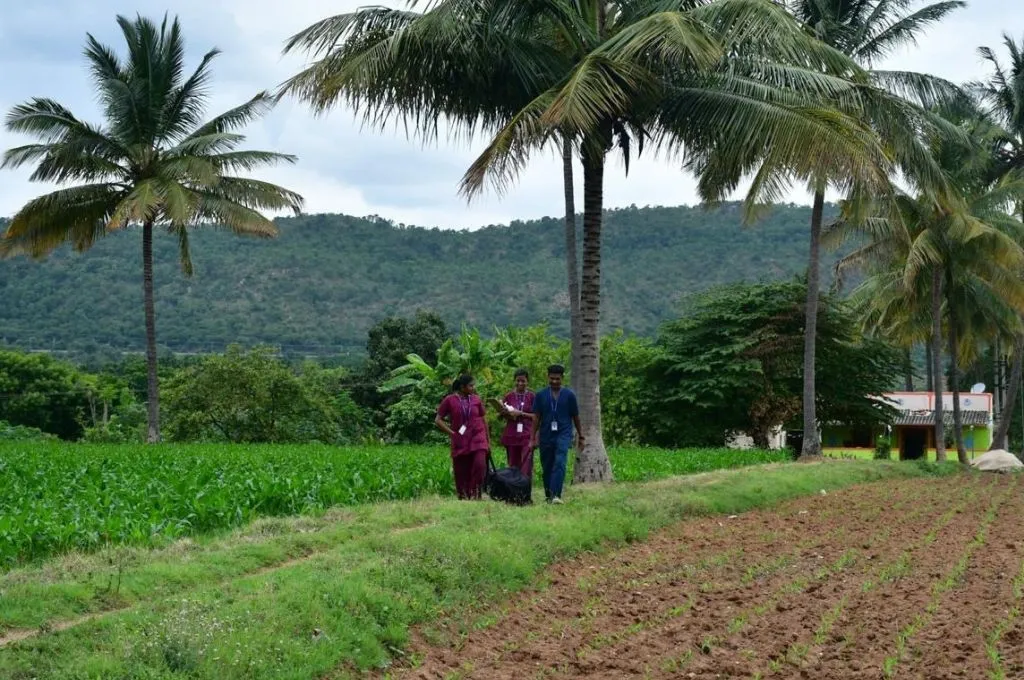
In our experience, identifying patients in contexts where there is both an absence of formal medical records and hesitation around public disclosures of illness has required our field teams to travel long distances, often spanning hundreds of kilometres, just to reach one or two patients a day. The efficiency, in conventional terms, appears low, but the need is high.
Moreover, beyond the complexities of providing care in rural and remote settings with scarce resources and systems, there is also the emotional toll of working with patients who are at the end of life. In these circumstances, building a resilient, motivated, and purpose-driven team capable of sustaining this work has not been easy. It is important that they find end-of-life care meaningful, which is difficult as it is against the basic tenet of medical education—prolonging life.
Navigating these challenges requires support on a systemic level. Since it is neither appropriate nor feasible to charge patients and families who have often already exhausted their resources, palliative care programmes depend heavily on external funding. However, in our conversations with funders, we often come up against the sentiment that funding care where the outcome is death is somehow less ‘worthwhile’.
It is important for money to be diverted not just towards curative care that can prolong life, but towards comprehensive end-of-life care that can ensure dignified death.
Our experience also emphasises the need for more integrated systems of support for both patients and care providers, so that efforts are not fragmented and reach those who are most vulnerable.
This would require:
- Stronger and clearer integration of palliative care into public systems and national health programmes. At present, primary health centres (PHCs) lack the resources to provide palliative care. These centres are often overstretched and understaffed and already have a broad mandate of covering services such as NCD care, maternal and child health, and immunisation.
- Community-level institutions and frontline health workers have extensive knowledge about local health needs that otherwise go unrecorded in registers or official dashboards. As such, while it may not be immediately possible to introduce palliative care at the PHC level, drawing on community-level networks and creating stronger channels between local and district-level health facilities can ensure that patients are not rendered invisible and services are provided at the nearest possible facility.
- Care providers often hesitate to prescribe morphine because of regulatory requirements and constraints in the availability of morphine, misconceptions regarding opioid use, and a lack of comprehensive training in palliative pain management. There is a need to simplify regulations for opioid availability while maintaining appropriate regulation to avoid misuse.
- Since families tend to become primary caregivers for patients who need palliative care, it is essential that there is formal recognition of home-based care models and policies are directed towards stronger resource allocation and awareness.
For patients in rural and remote areas, access to palliative care truly takes a village. From informal community networks stepping in to provide information that is not formally recorded to proper policies and support for programmes bridging the gaps in health systems, thsere is a need for much better integration and coordination between medical, governmental, and non-governmental actors to ensure comprehensive care at the grassroots.
—
Know more
- Follow a day in the life of a palliative care nurse and a counsellor as they help patients and families navigate illness and uncertainty.
- Learn more about the disparities in access to palliative care services in India.
- Read about the implementation of a community-based palliative care programme in rural Puducherry.