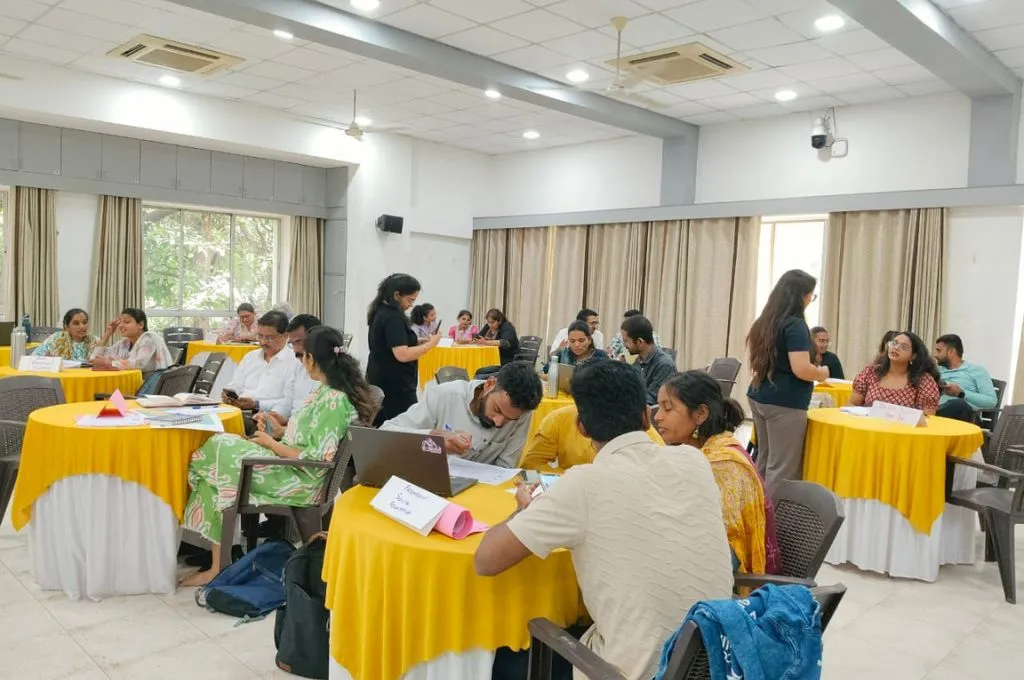
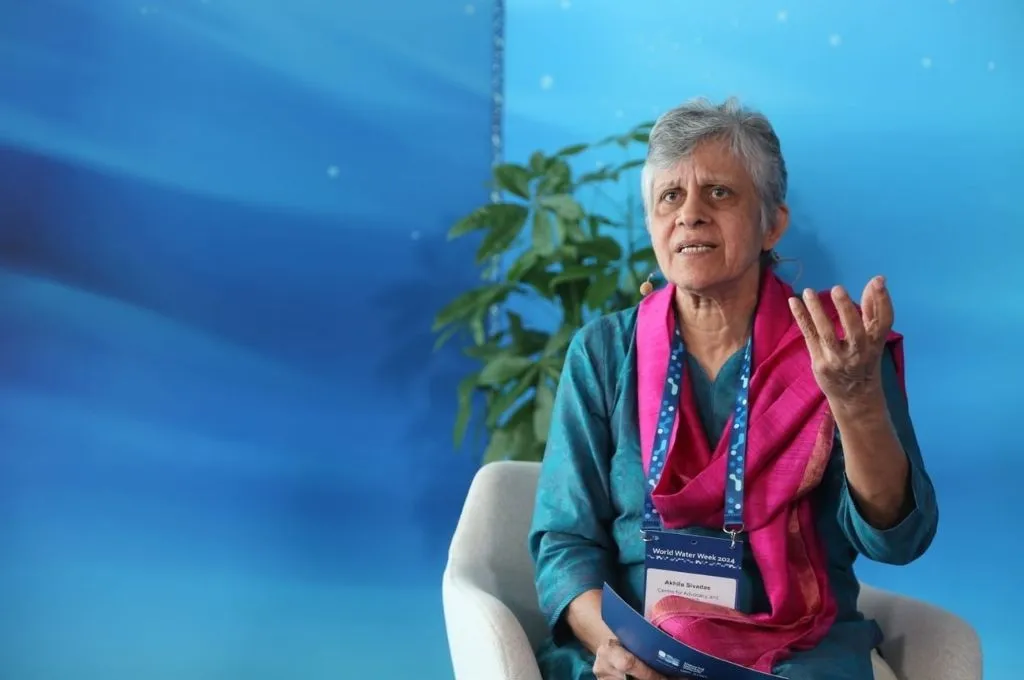
I watch 77-year-old Akhila Sivadas standing at the front of the crowd gathered outside a faecal sludge treatment plant just outside Bhubaneswar, Odisha. She is doing what I have often seen her do during field visits, conferences, and panels: asking questions. Even when her questions appear difficult, her presence is easy and gentle. She always makes time for conversation when I approach her between conference sessions or during Zoom calls that spill over.
Akhila Sivadas is a founding member of the Centre for Advocacy and Research (CFAR), a civil society organisation headquartered in New Delhi that focuses on greater inclusion and advocacy for marginalised communities.
As a twenty-something working in the development sector, I have often grappled with balancing hope and despair. While trying to make sense of my role and purpose, I turn to Akhila, who always appears steadfast in her willingness to hope. In conversation, she traces the evolution of civil society and its role, the challenges that have arisen in recent times, and the importance of practicing care, connection, and resolution every day.

What were the challenges you faced as a young person, and how are they different from the kind of challenges young people face today?
Akhila: Back in the late 1960s and early ’70s, when I was in my early 20s, there was a worldwide churning, not all that different from what we are witnessing today. Students filled the streets of Paris and young people protested the Vietnam War and US imperialism. Students across India, including those at Delhi University, were clamouring for a greater say in academic curricula. I, too, was witness to the hurly-burly of students’ movements. As President of Miranda House’s Student Union, I worked to affiliate it to the larger Delhi University Union.
The development sector, too, was just beginning to take shape. I realise now that at times I had dismissed it as ‘chiffon sari social work’, but the truth is far from it. The work was anything but superficial. There were some wonderful thinkers and institution-builders: Kamaladevi Chattopadhyay, who was deeply committed to artisans and their craft; Durgabai Deshmukh, who was fiercely passionate about women’s education; and Rukmini Arundale, who built the beautiful institution of Kalakshetra in Chennai. Thousands of professional women—working as teachers, social workers, trade unionists, doctors, lawyers, engineers—were shaping India’s social imagination.
Back then, most of us were expected to pursue medicine, engineering, or prepare for the civil services examination. My siblings were no exception to this. The humanities field was hardly seen as prestigious and there was little mentoring available to those of us who wanted to explore alternate pathways. Today, I feel young people have the scope to experiment and focus on what they perceive as their intrinsic strengths. There are academic pathways, entrepreneurial ventures, creative fields, and even interdisciplinary careers, which were barely available to us.
It’s possible to build networks, access knowledge, and develop professional skills and competencies by strategically using digital platforms. Having said this, the digital world also brings distraction, noise, and misinformation. It can distort one’s judgement. To distinguish what is real amidst this, one must closely observe what is actually unfolding around us.
How did you start your journey in social work?
Akhila: Perhaps the first stirrings to become a social worker came with discovering the difference between what I read and learned during my academic training and what I saw on the ground.

In 1971, I joined the very first batch of Jawaharlal Nehru University. We helped set up the hostels and installed streetlights. We were having conversations on academic democratisation. But it was in the mid-1970s that I had the opportunity to engage with the labour movements of both informal and industrial workers. Questions around social justice and the lack of it began to arise in me.
These were also fertile years for social movements in India. During the late ’70s and ’80s, women’s groups proliferated, environmental and agrarian struggles intensified, and organisations like SEWA Bharat under Ela Bhatt posited powerful models. Campaigns against dowry, violence against women, and objectification of women by advertisers and commercial media reshaped public discourse. Around the same time, public interest litigation (PIL) petitions were beginning to gather momentum, spearheaded by eminent jurists such as P N Bhagwati and V R Krishna Iyer. A rights-based approach felt essential to question and address systemic inequities.
I bore witness to these moments, and they shaped me. My own engagement with the social sector, however, took a little longer to commence, as my children were growing up and professional stability began to matter, too.
How did you come to establish CFAR?
Akhila: By the ’90s, the media was growing and we were coming to understand that our engagement with the media had to be intentional and sustained. As the media expanded, so did prejudice and misinformation.
Between ’92 and ’97, I incubated the idea for an initiative that would allow us to conscientiously monitor media narratives and enable communities to respond. In 1998, at the age of 50, I founded CFAR and entered my second adulthood.
We started viewer collectives across multiple cities—of persons with disabilities, middle class women, and people residing in bastis. It shaped a new kind of viewer activism where people moved from being passive viewers to becoming interpreters of media. People in the viewer collectives engaged in conversation and wrote letters to advertisers and producers.
For instance, facilitated by CFAR, a forum of women viewers initiated a dialogue with Neena Gupta, who wrote and directed the television series Saans, and played the lead role of Priya. In a face-to-face meeting, they asked her why Priya tolerated her husband’s infidelity, and how this made for a demeaning portrayal of women. After engaging in a long discussion, Neena decided to take the viewers’ feedback and let Priya’s character shape her individual identity, independent from the trappings of her decaying married life.
Discussions like this led to a larger conversation on the meaningful representation of women in media, from sensitive reporting on survivors of violence to a critique of the trivialisation of women in fiction or advertisements.
When we went to the viewers in the bastis, we were told that that the media must expose the indifference of the administration and bring to light the discrimination faced by women and communities living in bastis. There was a cry for inclusion in public discourse—that news platforms must include the voices and suggestions of people from marginalised communities.
There is a sense of despair among young people today. We feel like some problems feel too big to be solved. How do we tackle this, or channel it into purpose?
Akhila: I think you must pull yourself back to become a witness, an observer. Don’t entangle yourself completely. Step back and see what you can do, big or small, it doesn’t matter. It’s like unlocking an issue. You go layer by layer. You suspend judgment and say, “Karke dekhte hain (let us try and see).”
Some learning is spontaneous. For instance, soon after graduating from college, I boarded a train and toured the country. Back then, there were no mobile phones. We just took our chances and stayed wherever we could. We surrendered ourselves to the experience and learned a lot from it.
Some learning is calibrated. For example, when I began working with communities, it became clear that we had to patiently listen and learn from them before rolling out even the smallest of actions.
So, you have to know where you are and how to adapt to different realities. If you understand what you’re getting into, then, you can take small risks and even be spontaneous. You must be calibrated and open to scrutiny in situations where you are accountable or answerable. That’s how you handle it.

In your multi-decade career, how have you found the balance between making the perfect decision and the best possible decision in a particular scenario?
Akhila: While working with communities, we have to remain deeply sensitive to their lived realities.
One of CFAR’s first exercises in any community is not to identify potential benefits, but to anticipate possible harms. Even well-intentioned interventions can have unintended negative consequences. For instance, sending a child to school without ensuring a safe and empathetic environment may inadvertently expose the child to new forms of risk or harm.
This is especially important for groups that are still negotiating their rights—women, people of diverse genders, the elderly, persons with disabilities, and socially excluded caste communities—many of whom face stigma and discrimination based on gender, identity, disability, social location, or occupation.
One needs to create enabling conditions that safeguard their participation and rights in order to foster dialogue. As a result, they feel encouraged to articulate their concerns, challenge dominant narratives, and shape the terms of engagement. This includes building awareness of rights, strengthening access to redressal mechanisms such as complaints processes, helplines, legal remedies, and enabling engagement with institutions like the Legal Services Authorities. It also requires building support from a broad range of stakeholders and addressing institutional biases by increasing the involvement of marginalised communities in roles such as paralegal volunteers, and as members of local committees, so that they can speak assertively without fear of backlash. Every day, you’re torn between what you ought to do and what you can do. You don’t always resolve such dilemmas. You come to terms with them. You ask what is still possible within these constraints.
People often speak of burning out in the social sector. What has helped you remain active, curious, and hopeful?
Akhila: To age well, you must think, act, and speak in harmony. You cannot think of one thing, speak another, and act in an entirely different way. It doesn’t help to be multi-headed; you must be true to who you are. It is important to write down your feelings, reflect on them, and resolve those emotions. Your everyday unease, disquiet, and vagueness must be resolved each day, or else those feelings just go on sedimenting. You have to get it out of your system, and you must question it. Even intense bursts of energy must be examined. Strip away the adrenaline and attach yourself to what remains solid.
The second important thing is to be contemporary. If you keep harking back and saying, “I did it that way and I’ll stick to it,” there will soon come a sense of fatigue because everything around you will change. It is important to be agile and not get fixated on the past.
Third, see yourself as one of the many players. People are constantly learning and searching for answers. It helps to see yourself as part of the same search. Otherwise, you get bitter. You feel small, regardless of how big a change you’re working towards.
Lastly, don’t be competitive or acrimonious. Today, problems are more complex. Money is scarcer. Not everyone can make it on their own. In fact, more people are collaborating and learning together. The sector is shedding some of its earlier rigidity. What keeps you hopeful is knowing that even small actions matter. There is never a day when you haven’t done something useful, even if it’s small.
Is there anything you wish to tell young people in the sector?
Akhila: Community work can be fraught. Local dynamics are unpredictable. In centring others, we may become self-effacing and lose our sense of self. That is not healthy.
You can uplift others and yourself. Aspiration is not ego. You can pursue knowledge and specialisation beyond being the quiet backbone of community work. Continue the labour of love but allow yourself professional ambition too.
What matters is a quiet sense of purpose—not as resignation, but as mindful presence. Pause, reflect, and adapt. And when uncertainty arises, remind yourself gently: An ounce of practice is worth far more than a tonne of theory.
—
Know more
- Watch Akhila talk about collaboration between nonprofits and communities.
- Learn more about making social change viable for young people.