I recently attended a conference on fundraising for systems change, where one participant offered an astute and wry take on the fundraising ladder that nonprofit founders are expected to climb. They described a familiar path: Start with an incubation fellowship with X, then do the next two fellowships with Y and Z, followed by another accelerator. From there, secure an unrestricted grant from C, and you are then on a pathway to receiving significant funding from A and B.
What sounded like humour pointed to a deep and uncomfortable fact: This is how networks replicate patterns of access and privilege.
The limits of a funder’s field of vision
How much of what funders see is produced by the networks they already inhabit? And what can we do to widen this sphere?
Working in philanthropy, I have become increasingly conscious of how my own field of vision gets shaped. I often discover organisations through people and institutions I already know, through recommendations from trusted colleagues, or in rooms where many of us already share overlapping networks. There are good reasons for this. Our thematic and geographical strategies define where we look; institutional requirements such as due diligence, regulatory requirements, timelines, and capacity shape who is easier for us to engage with; and, like anyone else, we rely on relationships and routines that help us navigate complexity. But taken together, these forces can create an echo chamber that define not only whom we encounter, but what parts of the system become visible to us.
This is not just information asymmetry. Visibility shapes trust, which affects who receives introductions, meetings, and funding, which further concentrates visibility and resources among those already known to funders.
This turns a funder’s limited field of vision into a problem of power and resource allocation. The challenge is further amplified when funding processes are not transparent, outreach is limited, and communities and other stakeholders have little say in shaping philanthropic strategies.
When familiarity becomes a proxy for quality, funders may continue to validate what is already visible.
Networks are invaluable for navigating complexity and trusted referrals help funders identify credible organisations and reduce uncertainty. But networks can also create a self-reinforcing cycle. For example, a funder may recommend a nonprofit to two other funders, who go on to recommend the same nonprofit to others. These recommendations can appear to provide independent validation when in fact they emerge from the same interconnected network. This does not call into question the quality of the nonprofit’s work. The concern is what remains unseen. When familiarity becomes a proxy for quality, funders may continue to validate what is already visible unless they deliberately create routes to encounter different organisations, voices and perspectives. If our field of vision is bounded by our network, funding itself can reproduce that boundary.
This is why it is worth inducing conscious pauses to reflect on which ideas, leaders or forms of knowledge receive legitimacy and resources, and which remain outside.

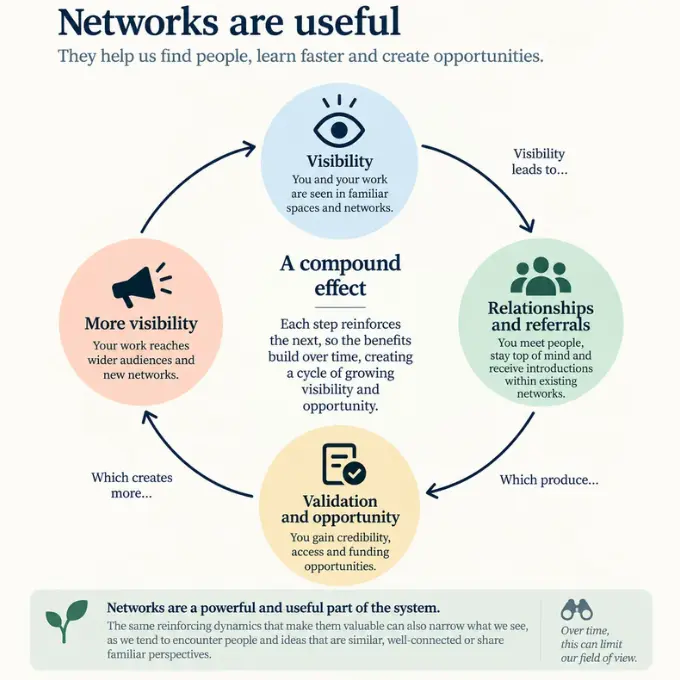
This compounding network is not just restricted to nonprofits that implement development programmes. It extends to organisations that provide infrastructure support in the sector, such as consultancies that work on organisational development, monitoring and evaluation, fundraising, facilitation, and more.
What keeps the echo chamber intact?
I have learnt that stepping outside of these networks is not easy. There are no structural incentives to do so. Rather, institutionalised disincentives stack up against this ambition.
Grant managers are often rewarded for moving grants on time, managing risks, meeting portfolio targets, and defining a clear logic of change to control uncertainty as much as possible.
Stepping into spaces that operate with different languages and norms can be uncomfortable, and gaining access to them may not be easy. When funding processes favour polished theories of change, familiar vocabulary, and confident presentation in an unfamiliar language, organisations that work differently struggle to be seen and heard. This is especially true when a funder’s own approval processes are top-down and deeply codified, making approaches such as participatory grantmaking difficult to embrace in practice.
Many organisations remain outside the networks through which funders usually discover and validate potential grantees. Who discovers these organisations, how, and when?
The argument I present is that it is not just about finding these organisations for grant making or other engagements. It is also about working with key players who can help us see the system differently. These players can help make visible the root causes that hold the existing system in place, including incentives, informal norms, and implementation constraints. I share a few examples from my experience of navigating this and invite ideas and reflections from others.

1. Recognise who is not in the room and explore ways of finding them
Having worked in the education sector for decades, I found myself meeting prominent education nonprofits. Their founders had strong credentials, often shaped by elite or private school education, or strong networks built through fellowship programmes. They brought valuable perspectives and credible ideas but also made me question whose perspectives we were missing. Where were the founders educated in government schools, practising teachers, administrators, and community members?
Systems work requires a multitude of viewpoints. Different forms of proximity reveal different parts of the system.
To my pleasant surprise, all it took was asking the question. I put out a targeted call on LinkedIn to find more diverse founders and practitioners. The network snowballed and I soon had leads on more than 40 people and organisations. I also discovered a collective of more than 14 organisations working in remote parts of India. Engaging with these organisations brough fresh energy and perspectives to our systems work.
Systems work requires a multitude of viewpoints. Different forms of proximity reveal different parts of the system. No single perspective is sufficient. Expanding whose voices are included is therefore a critical step.
2. Co-create your understanding of the problem and the response
I have come to see discovery as something broader than building a funding pipeline. It can challenge a funder’s diagnosis of a problem, not merely expand the list of potential implementers. Most strategic philanthropies operate within defined priorities. But there is often considerable room to shape how a problem is understood, how a strategy translates into action, which actors are brought together, and which assumptions are questioned. The aim is not necessarily to keep expanding the boundaries of a strategy, but to ensure that we do not view the system from a single vantage point.
I saw this in practice while working with a funder on a place-based approach to whole child development in Jharkhand. The process brought together more than 30 organisations, ranging from national players to those deeply rooted in a handful of districts or blocks. It created space for different forms of expertise and worldviews to come together, including an understanding of place and local rituals alongside technical expertise.
Organisations played varied but complementary roles in shaping the approach, nurturing ideas, and bringing in perspectives from beyond the immediate group. The process took several months, but it helped us move beyond a funder-defined strategy.
3. Find and embrace the critical friends who can be a mirror and cultivate space for disagreement
Positional power influences the information that reaches a funder. The power that a funder holds can distort what’s shared with them: People may soften disagreement, overstate the value of a funder’s contribution or present reality in forms they think will be rewarded. Critical friends are therefore not a personality preference; they are a correction mechanism. In my experience of working for funding organisations, I have been in rooms where you may have made a mediocre point, but it elicits a round of applause, and you have to snap yourself into reality: It is not about what you said but the result of the position you represent. Given this, it is essential that funders have critical friends.
Finding these people requires conscious expansion and discovery, and when you find them, recognise and engage them as your sounding board, as a thought partner for pressure testing, for arguments and, more importantly, for imagination.
I cannot emphasise enough how important it is for funding organisations to intentionally create an internal environment that supports change. Vision, clarity, articulation, and passion matter. But so do institutional validation and resources. As a colleague working on innovation within a UN agency once put it, the task is to find the ‘cracks’ in the system, nurture new ideas through them, and gradually widen those cracks so that others can follow with less resistance.
—
Know more
- Listen to this podcast episode on power and philanthropy.
- Read this article that questions whether the last three decades of philanthropy have been a failure.