On March 13, 2026, Union Minister Virendra Kumar introduced the Transgender Persons (Protection of Rights) Amendment Bill in the Lok Sabha. Less than two weeks later, it cleared both houses of Parliament, despite drawing widespread criticism from all quarters.
The bill was introduced without meaningful dialogue, including with statutory bodies like the National Council for Transgender Persons (NCTP). Since the passing of the bill in the Rajya Sabha, NCTP members Rituparna Neog and Kalki Subramaniam have resigned from their posts. They cited the amendment bill as the reason, calling it “a step backward for our fundamental rights to self-identification and dignity”.
The bill will become law once approved by the President. Meanwhile, a group of more than 140 lawyers, law students, feminists, and social activists appealed to the President to withhold assent and send the bill back to Parliament for reconsideration, the Times of India reported.

What is the amendment, and why is it objectionable?
The bill seeks to amend the Transgender Persons (Protection of Rights) Act, 2019, which emerged in response to the Supreme Court’s landmark 2014 NALSA judgement. The judgement affirmed that gender identity is self-determined, and that legal recognition cannot be contingent on medical examinations or biological tests that would invade transgender persons’ right to privacy. The 2019 Act attempted to translate this into law by recognising transgender persons’ right to self-identification and outlining protections against discrimination.
But the government claims to have faced difficulties in the implementation of the 2019 Act due to the wide expanse of the existing definition of transgender persons. Therefore, modifying the definition was considered necessary for ensuring the act could be streamlined to work only for “those who are in actual need of such protection”.
Statements emerging from the Northeast highlight how the bill overlooks region-specific identities and lived realities.
The 2026 amendment thus marks a significant departure from the earlier framework. One of its most consequential changes is to the definition of a ‘transgender person’. The 2019 Act adopted a broad, inclusive definition—explicitly including trans men, trans women (irrespective of medical transition), and genderqueer persons. The amendment, however, replaces this with a narrower, category-based approach. It retains certain socio-cultural identities such as hijra, kinner, aravani, and jogta, as well as intersex variations, but excludes a range of identities that were previously recognised. Grace Banu, a trans rights and anti-caste activist, pointed out to Queerbeat that the inclusion of these specific socio-cultural identities aligns with dominant-caste Hindu mythologies. She also highlighted the absence of terms that have evolved in other parts of the country, such as thirunangai and thirunambi for trans women and trans men, respectively, in Tamil Nadu.
Similarly, statements emerging from the Northeast highlight how the bill overlooks region-specific identities and lived realities, “making entire communities invisible and stripping away cultural specificity”. In an interview with the Leaflet, Rituparna Neog echoed this sentiment, “The Bill talks about recognised socio-cultural identities like kinner and hijra, but I could not see the name of nupa maanba or nupi maanbi, which are traditional socio-cultural identities existing in Manipur. Does this mean that in the Northeast, we are not found in the socio-cultural framework? Does it mean the entire Northeast’s trans people will be wiped out?”
Trans activist and organiser Jaya said to the Hindu, “The 2014 judgement gave us self-respect…This new Bill fundamentally robs us of dignity and sets us back many years. It makes us existential. ‘Am I not trans enough under this Bill?’ it makes us ask.”

The bill also alters how legal recognition is granted. Under the 2019 Act, individuals could apply for a certificate of identity through a largely administrative process. The amendment introduces a mandatory layer of medical scrutiny: Applicants must now obtain approval from a government-appointed medical board before the district magistrate can issue a certificate.
Gargi, a Kothi person and doctor, noted in an interview with the Leaflet that the proposed process is largely unworkable in practice. “Would these specialist doctors and surgeons go and save their patients on a day-to-day basis in emergencies, or will all these doctors convene together?” she said. “At maximum they will come together six months once, or yearly once and until then the trans person has to wait.” She also raised concerns about how such boards would assess gender in the first place. “There is no medical test to prove anyone’s gender. Additionally nobody on the board had to prove their gender to anyone. But we are asked to prove it before them.”
What impact will the amendment have?
The amendment reshapes not only how transgender persons are defined in law, but also how they are recognised, governed, and safeguarded from discrimination.
1. Restricting the right to self-identification
At the core of the critique is the dilution of a principle that has underpinned transgender rights in India since 2014: self-identification.
The amendment replaces a self-identification-based definition with one that is more prescriptive. While the bill’s accompanying statement claims that the revised definition of transgender persons is more ‘precise’, lawyers interviewed by Queerbeat argued that it remains ambiguous, especially in its inclusion of individuals who have been ‘compelled’ to present as transgender. “If someone has been forced to ‘become’ a transgender person, then they don’t actually identify as transgender, right? How do you then justify putting them here?” said Kanmani Ray, a trans woman and lawyer practising in the Supreme Court and Madras High Court. Tripti Tandon, an advocate with Lawyers Collective, shared this concern: “Those who want to identify as transgender are being denied, and those compelled are [being] considered [transgender],” she said.
Moreover, the bill collapses intersex and transgender identities into a single legal category, blurring the distinctions between them. Daniella Mendonca, a person with intersex variations and co-founder of Intersex Human Rights India, told Queerbeat, “The definitions and lived experiences of transgender and intersex individuals are different, and they should not be treated as interchangeable.”
This shift does more than exclude certain identities; it changes the nature of recognition itself. Identity is no longer something a person can assert. Instead, it becomes something that must align with state-defined categories.
2. Invading privacy through medical and administrative scrutiny
The introduction of a medical board as a gatekeeper to legal recognition marks another significant shift. Under the amendment, transgender persons must undergo evaluation by a government-appointed panel of medical professionals before they can obtain a certificate of identity.
Dr Aqsa Shaikh, a trans woman, activist, and community medicine professor in Delhi, told the Wire, “The Bill is an attempt to kind of remedicalise the aspects of gender identity and transness, which the NALSA judgement had rightly demedicalised.” As reported by NDTV, the speakers at a public hearing held at the Press Club of India described such provisions as institutionalising humiliation. Trans man and social worker Samar Sharma said medical boards “strip people of their dignity” and create “surveillance on our identity”, worsening mental health and deterring individuals from seeking legal recognition.
The bill also mandates that medical institutions report details of gender-affirming procedures to state authorities. This creates a system in which deeply personal medical information becomes part of administrative records, without clear safeguards on how such data will be stored, used, or protected.
These provisions risk transforming access to rights into a process of repeated scrutiny—where individuals must prove their identity not once, but multiple times, to different authorities.
3. Reinforcing harmful stereotypes and criminalisation
The amendment introduces four new offences centred on the idea of coercion into transgender identities, including severe penalties for kidnapping, injury, or inducement aimed at compelling someone to present as transgender.
While these are framed as protective measures, their design reflects and reinforces the long-standing stereotype that transgender identities are not inherent, but imposed or acquired through coercion. This sentiment is echoed in statements made by BJP MP Medha Vishram Kulkarni, who said “There are 1.4 lakh transgender persons in Uttar Pradesh, 43,000 in Andhra Pradesh, 40,000 (each) in Maharashtra and Bihar, and 30,000 in West Bengal. Can we see a natural selection in these numbers?…Based on these statistics, doubts of human interference can be raised. Are the youth being forcibly given transgender identities? Are people making fake identities to avail of jobs?”
Core forms of community support, including mentorship, guidance, or simply helping someone understand their identity, could be recast as ‘inducement’.
This is particularly concerning given the lack of evidence suggesting that such cases are widespread. Raghavi, a trans woman and lawyer practising in the Supreme Court, told the Leaflet that the Bharatiya Nyaya Sanhita, 2023, already addresses offences such as kidnapping. “Now when you specially deal with it within this legislation, you are actually portraying trans people as criminals, as kidnappers, as habitual offenders. This is a sort of narrative that frames transgender identity as criminal identity and carries on from the legacy of the Criminal Tribes Act.”
There is also concern about how broadly some of these provisions are worded. Core forms of community support, including mentorship, guidance, or simply helping someone understand their identity, could be recast as ‘inducement’. As Mridula Chari, an independent non-binary journalist, noted, “Shelter homes, government-run Garima Grehs, community-based organisations, and even individual transgender people who help others are vulnerable to this provision…Also at risk are chosen families and partners, both vital support systems for transgender people who already exist at the margins of society and have to leave their natal families just to survive.”
This concern becomes even more acute when viewed through the lens of disability. For transgender persons with disabilities, caregiving relationships are not incidental but legally recognised as essential support under the Rights of Persons with Disabilities Act, 2016. Any provision that criminalises such support structures therefore violates not only transgender rights, but disability rights as well.
In effect, instead of regulating harm, the proposed law majorly reframes support systems as suspect and views a marginalised community as one with an implied capacity for wrongdoing rather than one in need of protection.
4. De-recognising existing identities and creating uncertainty
One of the most destabilising aspects of the amendment is the uncertainty it introduces for those already recognised under the law. By stating that the category of transgender person “shall not include, nor shall ever have been so included” persons with different sexual orientations and self-perceived sexual identities, the bill opens the door to questioning existing identity documents issued under the 2019 Act.
According to the Leaflet, the government has issued more than 32,000 transgender certificates under the 2019 Act. Approximately 2,000 applications remain pending. The bill, however, offers no clarity on the status of these existing certificates or applications.
This has far-reaching implications. Legal recognition is often the gateway to accessing a range of rights and services, including healthcare, education, employment, and welfare schemes. If that recognition is undermined, so too is access to these entitlements.
The amendment thus not only redefines the future of transgender rights, but also casts a shadow of doubt on the past.
What happens next?
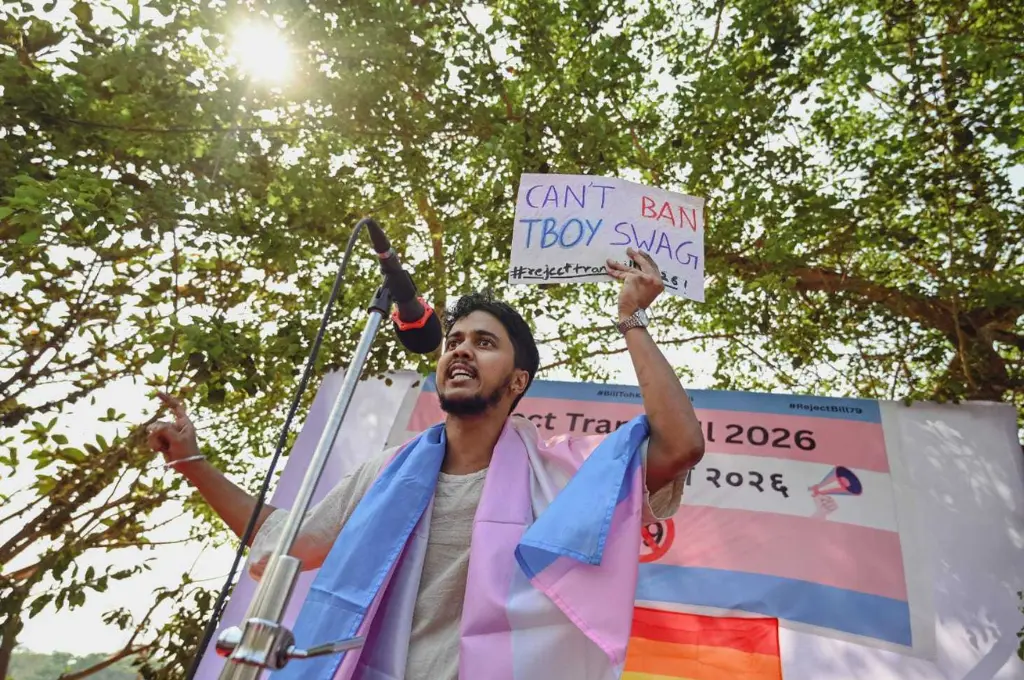
The legislative process is still underway, but responses to the bill have been taking shape. Across the country, transgender communities, queer collectives, legal advocates, and allies are mobilising in different ways. They are questioning the process, organising public resistance, and building support systems for those directly affected.
One strand of this response is focused on accountability. For instance, a recent filing by the Democratic Youth Federation of India seeks clarity on whether the Ministry of Social Justice and Empowerment followed the Pre-Legislative Consultation Policy before introducing the bill. By asking whether draft versions were made public, whether stakeholders were consulted, and whether feedback was incorporated, such efforts underline not just what the law contains, but also how it came to be.
Simultaneously, collective resistance and solidarity actions are gaining momentum. Groups across the country are issuing calls for withdrawal of the bill and restoration of the right to self-identification. A statement issued by a group of LGBTQIA+ and gender-diverse individuals, allied organisations, and healthcare professionals from Mumbai, Navi Mumbai, and Thane outlines that the bill is built on a lack of credible evidence and disproportionately harms Dalit, Bahujan, Adivasi, and working-class trans persons. The statement presents a list of 10 specific demands to the government, including mandatory community consultation for further legislative steps.
Similarly, a recent statement by the Joint Action Committee on Transgender and LGBTIQ+ Rights, Kerala, describes the amendment as a moment of ‘legal erasure’ and calls for unified opposition from community members and allies.
This moment is also marked by a widening ecosystem of information-sharing and mutual support.
1. For those seeking to stay updated or get involved
Community-led posts and campaigns are circulating widely online, including:
- A compilation of queer-affirmative organisations and helplines across India.
- A call to sign the Collective Statement (which has been translated into nine regional languages) on the bill.
2. For transgender persons navigating the emotional impact of the current situation
Access to affirmative mental healthcare is critical. This database of mental health professionals offering subsidised support may be a useful starting point.
3. For those seeking to participate in public demonstrations
Practical guidance is being shared to help people participate safely and responsibly. This includes information on preparing for interactions with law enforcement and ensuring both digital and physical safety while attending protests.
Taken together, these responses indicate that the conversation around the bill is unfolding in many spaces—on the streets, in courtrooms, within community networks, and across digital platforms. What happens next will not be decided by the legislature alone, but also by how these multiple forms of engagement continue to evolve.
—
Know more
- Read this article on how opposition to the bill was bulldozed in the Lok Sabha.
- Learn more about the need for structural inclusion for queer and transgender persons.