
Funders are growing increasingly interested in artificial intelligence (AI). Across the social sector, AI-powered solutions are being explored to improve learning outcomes, strengthen healthcare systems, support frontline workers, identify vulnerable populations, and make nonprofit operations more efficient.
But as more money moves towards AI, it raises an important question arises: Are funders paying only for technology, or are they funding everything it takes for that technology to create impact?
For most nonprofits, building an AI solution is only one part of the journey. The harder work often begins after the build: testing the tool with users, improving it based on feedback, strengthening the underlying data, training teams, changing workflows, generating evidence, and embedding the solution into government or institutional systems.

This is where many promising innovations stall. A short-term grant may be enough to build a prototype, but it is rarely enough to move from a promising tool to sustained adoption. For AI and digital transformation to create real impact, funders need to support the complete journey and not just the product.
Within this context, ‘patient capital’ becomes a condition for meaningful technological change. Patient capital broadly refers to funding that gives organisations the time, flexibility, and support to develop, adapt, and scale innovations. It does not mean lowering accountability; it means measuring the right things at the right time.
The disconnect between how AI innovation unfolds and how projects are typically funded emerges as a recurring theme in conversations with nonprofit leaders. Funding AI is not the same as buying technology. It involves financing the often long and uncertain process of organisational change.
Why AI needs patient capital
A prevailing misconception about funding AI is that the project is complete once the technology has been built. The build is often the most visible part of the work, but it is rarely the hardest. Rekha Koita, Director and Co-founder of Koita Foundation, notes that successful digital innovation depends on user-centric design, repeated testing, organisational buy-in, and continuous adaptation based on what happens on the ground.
“A short-term grant can only fund a build,” she says. “It can fund a single tech resource that can be added to a team. But it’s not going to fund the entire journey of the organisation—from ideation and discovery to a place where we have adoption.”

Funders acknowledge that supporting this journey is easier said than done. We say that we offer patient capital, we give multi-year grants, and then we expect our grantees to show progress and change every quarter,” says Gates Foundation’s Digital and AI Lead, Suhel Bidani. “Everybody wants to see results. But the reality is that it does not come in a few months or quarters.”
Before organisations can even begin on the path to AI-led innovation, they need to define the problem correctly.
Gayatri Nair Lobo, CEO of Educate Girls, describes patient capital as “the ability to go slow, to go fast.” It gives organisations the room to understand the problem they are trying to solve before rushing to build a solution. Shaveta Sharma-Kukreja, former Managing Director and CEO of Central Square Foundation, echoes this sentiment, noting that patient capital “asks all the tough questions, but stays with us till we arrive at the answers.”
These perspectives point to a different understanding of innovation. Rather than treating innovation as a product to be delivered, they recognise that lasting impact requires iteration, adaptation, and the willingness to stay with a problem long enough to learn what actually works.
But before organisations can even begin on the path to AI-led innovation, they need to define the problem correctly and determine whether AI is the right tool to solve it.
AI is not always the solution
Patient capital should not become a license to force AI into every problem. In fact, one of the most important uses of patient capital is to give organisations the time to ask whether AI is needed at all.
While nonprofits are increasingly encountering funders who want to support AI initiatives, Gayatri remarks that their enthusiasm can sometimes put the technology before the problem. She says, “Today when we talk to funders, they (immediately) tell us, ‘Let us help you build an AI tool.’ And it scares me because AI is not what we are solving for.”
The answer lies in first understanding the challenge that needs to be addressed and whether AI is the right tool to address it. “Sometimes the solution is tech, sometimes it might be people,” Gayatri says.
Speaking about contexts where AI can be an enabler, she points to Educate Girls’ own experience. The organisation traditionally relied on volunteers going door to door to identify out-of-school girls. This process would take years to complete across large geographies. The organisation therefore considered whether technology could solve this specific operational challenge. The resulting AI and machine learning model they developed helped predict where out-of-school girls were most likely to be found, dramatically reducing the time needed to identify them.
“We were able to do what would have taken us 45 years in five years,” says Gayatri. The lesson, according to her, is that successful AI projects must start with a clearly defined problem.
For funders, this means resisting the urge to ask, “Where can we use AI?” The better question is, “What is the problem, who experiences it, and what would it take to solve it well?” Sometimes the answer may be an AI model. Sometimes it may be better data, a simpler digital workflow, or stronger human capacity.

The biggest costs aren’t always technical
Every AI project has a technology cost. But the costs that determine whether it succeeds are often less visible: people, processes, data quality, governance, and sustained support.
Privacy, consent, bias checks, data governance, cybersecurity, audit trails, and grievance mechanisms cannot be treated as optional extras.
A common inference is that the success of an AI project depends less on the technology itself than on the people and institutions expected to use it. “Every tech project is a people project first,” says Rekha. While building better tools is important, organisations must also help people adopt new ways of working. This means redesigning workflows, training staff, strengthening data systems, testing tools with users, and building confidence among frontline workers who will ultimately determine whether a solution is used consistently. It also requires organisational leaders to champion the change and create an environment where teams are willing to experiment and adapt. “Transformation requires real change on the ground, and leadership needs to be driving it,” says Rekha.
Shaveta argues that while grants may support the development of a product, they often overlook the work required to embed it within organisations and systems. She points out that organisations don’t just iterate while building a product. “There’s an even more critical iteration that needs to happen in the field, where we want this to get used on a daily basis.”
User testing, training, workflow redesign, and change management are not ancillary activities. They are the work. If they are not funded, an AI solution may be built, but it is unlikely to be used consistently enough to change outcomes.
Responsible AI also has costs that are easy to overlook. Privacy, consent, bias checks, data governance, cybersecurity, audit trails, and grievance mechanisms cannot be treated as optional extras. If AI tools are being used in sensitive fields such as education, health, livelihoods, or access to entitlements, these safeguards are part of the core solution, not compliance overhead.
Scaling technology is not the same as scaling impact
A successful pilot proves that a tool can work somewhere. It does not prove that it can be adopted at scale, sustained by an institution, or trusted by the people expected to use it every day. Shaveta notes that scaling technology is often conflated with scaling impact. The latter, according to her, is determined by how effectively organisations navigate what comes after a successful pilot. This includes securing institutional ownership, supporting frontline adoption, and ensuring long-term sustainability. These factors become particularly important when organisations seek to work with government, which is commonly understood as the primary pathway to scale.
“At the end of the day, there is no scale in India unless we reach the government system,” Shaveta says. For governments, however, adopting a new digital solution requires confidence that it will work in real-world settings.
Why evidence matters
According to Suhel, philanthropy often does not adequately invest in the work required to convince policymakers and other stakeholders of the importance of a solution. “Evidence is one of the biggest areas where much more needs to be done,” he says.
Given that governments must constantly make difficult choices about how limited public resources are allocated, they need evidence that an AI solution is worth adopting. Generating that evidence requires investment in measurement, evaluation, learning, and continued engagement with policymakers. Suhel says, “Somebody needs to be going and spending time with key stakeholders, presenting reliable and relevant evidence, answering every single question that they may have. All this requires effort and somebody needs to fund it.”
Without investment in evidence, many AI tools remain impressive pilots and fail to become trusted public systems. Funders therefore need to support not only the development of the solution, but also the work required to prove where it works, for whom, at what cost, and under what conditions.
Funding partnerships, not just projects
Supporting a longer innovation journey also requires funders and nonprofits to approach their relationship with each other differently. According to Gayatri, one of the most valuable offerings a funder can provide is the space for honest conversations. This gives nonprofits the confidence to acknowledge challenges without worrying that it will jeopardise future support. “If the lens is judgment,” she says, “then nonprofits are going to feel very scared to ask for help.”
She also believes funders who spend time understanding the realities of implementation are better positioned to support meaningful innovation. “Funders who come to the field understand what the programme looks like. Then they come up with solutions which are super helpful.”
Rekha similarly emphasises that successful funding partnerships depend on clarity about the problem being solved, commitment from organisational leadership, and regular communication between funders and grantees. Building trust, creating opportunities for course correction, and recognising that innovation rarely follows a pre-defined plan are just as important as funds in this equation.
What needs to change
For AI investments to translate into impact, both funders and nonprofits need to change how they approach digital transformation.
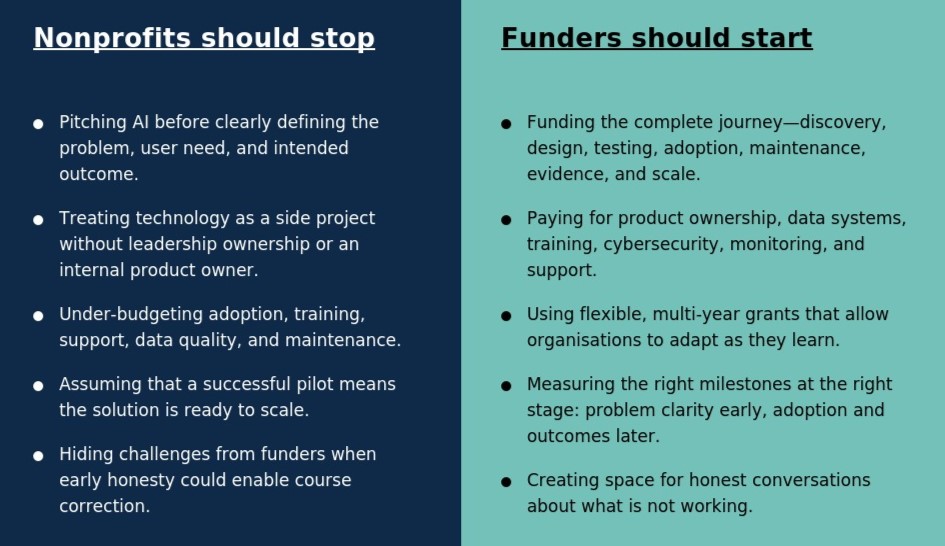
As philanthropy’s interest in AI grows, the sector must move beyond funding tools and start funding transformation. The question is not only whether an AI solution can be built, but whether it can be used, improved, governed, trusted, and sustained. Patient capital matters because the real promise of AI is not realised at the moment of deployment. It is realised when the technology becomes part of everyday work and begins to improve outcomes for the people and systems it was designed to serve.
The quotes used in this article are from a panel titled ‘Bridging the Gap: Patient Capital for AI & Digital Innovation’ at the Koita Foundation Tech Awards Ceremony held in collaboration with ILSS at the India Fundraising Conference, 2026.
—
Know more
- Learn more about building and deploying AI solutions for India’s public institutions.
- Read this article on how nonprofit leaders can ground their AI strategy in purpose, organisational capacity, and values.