Five rupees for foundational education in rural Tripura
 North Tripura, Tripura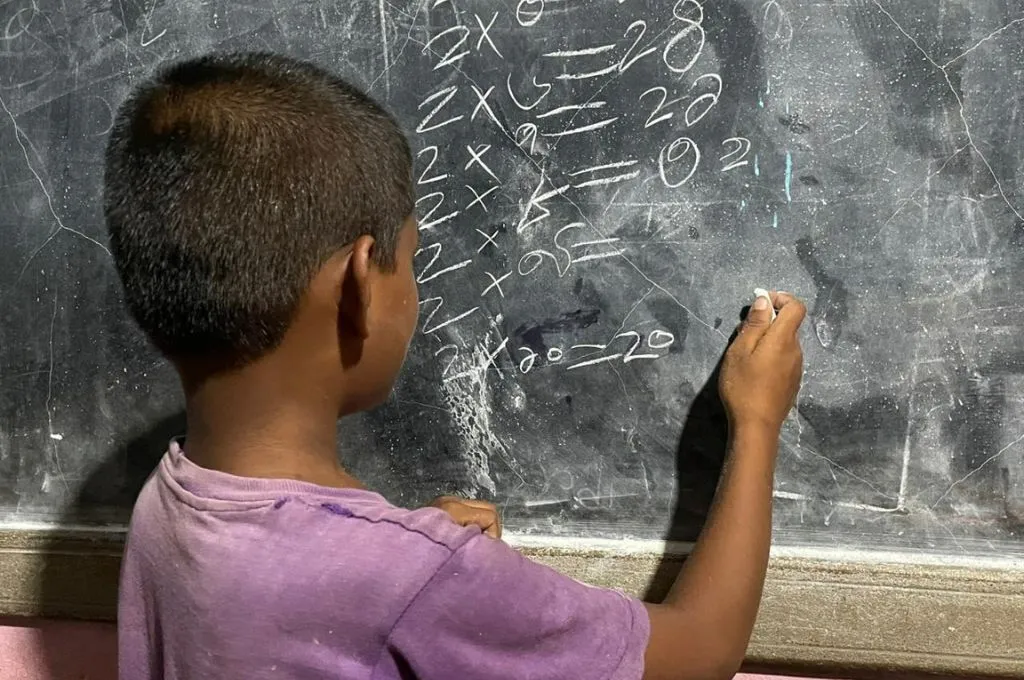
For daily wage workers in North Tripura’s Bish Ghar (20 households) Colony, which sits at the Indo-Bangladesh border, basic amenities such as food, shelter, and education are products of privilege. As parents grapple with the precarity of informal labour and lack of literacy, foundational education among the children suffers.
In July 2025, we borrowed a room in the local primary school building and set up a paanch takar pathshaala (five-rupee school), an initiative of the nonprofit Helping Hand Organization. The school operates on Tuesdays, Thursdays, and Saturdays. This small space caters to children of varying ages and diverse levels of education, including school students, dropouts, and kids who could never attend school. We teach them numbers, spellings, grammar, and literature, and also focus on sanitation, sex education, and psychological growth. A priority for us is to respond to the needs of the children.
Any given day involves checking English spellings and Bengali poetry assignments, and answering questions about decimal values. For us, it is organised chaos. In addition to their overlapping educational requirements, the children’s socio-economic realities show up inside the classroom and demand our intervention.
Crowding our learners into one space creates additional problems for them. We can only manage to solve some of their doubts in the limited time, and attending to every student in a satisfactory manner is hard, if not impossible. We need people, funds, and infrastructure to provide a holistic education that goes beyond the standard curriculum.
Currently, the school runs on Helping Hand’s limited funds and the INR 5 that we collect from each child who studies here. The village panchayat has been kind enough to let us use the classroom. But now, as more people want us to accommodate their children, we are struggling for space and capacity even with volunteers coming forward. The school in Bish Ghar is our second branch after the success of the same model, launched in 2021, in the neighbouring Sakaibari village. But initiatives like these need systemic and sustained support.
When we started this school, we had to invest close to INR 70,000 on books and stationery for the kids. After the National Education Policy 2020 was operationalised, many of these books ended up being completely useless. We had to absorb the loss.
Uttam Roy is the founder of Helping Hand Organization and Niramalya Deb and Saurabh Ghosh are teachers at the paanch takar pathshaala.
As told to Hansatanu Roy, IDR Northeast Fellow 2025–26.
—
Know more: Learn why farmers in Raishyabari can’t seem to find a stable source of income.
Do more: Connect with the authors at debnil266@gmail.com, saurabhghosh2003@gmail.com, and uttamray999ds@gmail.com to learn more about and support his work.