Women are at the forefront of Ken-Betwa protests
 Chhatarpur, Madhya Pradesh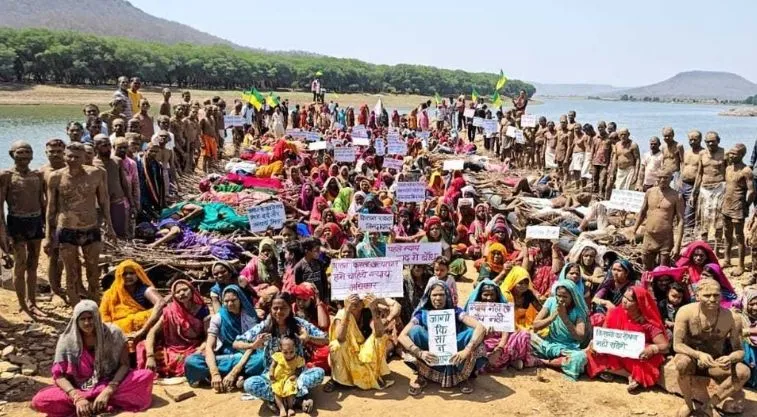
I am an elected councillor from Ward No. 9 of Bijawar tehsil, Chhatarpur district, Madhya Pradesh. This is the same region of Bundelkhand where communities have been protesting against the dam proposed under the Ken-Betwa Link Project. Approved in 2021, this project aims to transfer surplus water from Ken river in Madhya Pradesh to Betwa river in Uttar Pradesh through the construction of the Dhodan dam, which will result in mass displacement of people.
Despite assurances about proper rehabilitation and compensation, a large number of people have either been left out or have not been compensated adequately. At present, notices to vacate houses are being issued in several of the affected villages. Nearly half the houses in Dhodan village have already been demolished, while in Palkoha, one of the worst-affected villages in the Chhatarpur district, residents have received notices and some houses have even been razed. Panna district’s Gahdara village has been completely uprooted. In these villages, 30–40 percent of families have still not received compensation.
This displacement without proper rehabilitation has left families without homes. Amid the rains, many families are being forced to live under tarpaulins in their own courtyards. Their food rations are getting soaked, their electricity has been cut off, and they have been left without even basic amenities such as drinking water. Meanwhile, there has been no redressal for the lapses in the compensation plan.
Protests have been underway for several months, with women from our district leading this movement. Initially it was being led by men, but the momentum slowed down due to administrative challenges such as names being omitted from the survey lists and flaws in the distribution of compensation. At one point, it seemed the movement would entirely fall apart. This is when a series of dialogues and small baithaks with women began across villages.
This growing participation by women has made the administration uncomfortable and, as a result, legal pressure on the movement’s leadership has increased.
Amit Bhatnagar, a top leader of the movement, was first taken into police custody and later arrested twice and sent to jail. The administration believed that the movement would crumble without its leadership, but what happened was the exact opposite. On February 10, 2026, thousands of women from the affected villages mobilised resources on their own and travelled to Bijawar. Some sold wheat to cover the cost of the journey, while others borrowed money to arrange rented vehicles. Overcoming multiple attempts by the police to obstruct them, they surrounded the tehsil office by afternoon and demanded the release of the movement’s leaders as well as the fulfillment of their demands.
That same night, around 11 pm in the biting cold, the administration lathi-charged the protesters and used water cannons on women and children. Despite this, the protesters did not budge. Late at night, Section 163 of the BNS was invoked and force was used to remove the protesters, during which women and children were made to travel long distances in the dark.
And yet the movement continues peacefully, even as people are constantly being served notices to vacate their villages. When the administration arrived to demolish houses in Chhatarpur’s Dhodan village on May 14, for instance, the police were forced to retreat following opposition from the villagers.
Women in the Runjh Dam area continue to hold regular meetings to keep up their fight against the project. Women are also standing in the river as a part of a jal satyagraha, smearing mud all over their bodies, and laying on funeral pyres as symbolic acts of resistance. Their demands are clear: Ensure proper rehabilitation and rectify the flaws in the compensation process.
—
Know more: Learn why Kuki-Zo in Manipur negotiating for land.