Micro, small, and medium enterprises (MSMEs) are the backbone of India’s manufacturing economy and one of the largest sources of industrial energy consumption. They account for 35.5 percent of industrial output and employ more than half of the manufacturing workforce. Across nearly 400 industrial clusters, these enterprises consume roughly 25 percent of India’s industrial energy. Yet, in conversations on industrial energy efficiency and climate mitigation, attention usually gravitates towards large factories, heavy industry, and marquee infrastructure projects.
At Good Business Lab, we analysed the energy landscape of MSMEs by examining one of the most energy-intensive manufacturing processes: textile dyeing. The process relies heavily on steam, produced by heating water in large boilers using fuels such as wood, coal, or briquettes. Dyeing just one kilogram of fabric can require two to three kilograms of steam per hour.
We conducted free energy audits during 2024 and early 2025 in more than 60 dyeing MSMEs across Kolkata and Tiruppur, two major textile clusters. Most firms in our sample reported an annual turnover of less than INR 50 crore. What stood out, however, was their fuel consumption: each unit burned, on average, about 2,000 tonnes of solid fuel every year, primarily wood. This is enough wood to cover an entire football field with waist-deep piles of logs. Multiply this by the thousands of dyeing units operating in India, and the scale of fuel use becomes staggering.

Our audits offered a closer look at what this energy is consumed on the ground and what it means for both workers and the industry.
The energy intensity has direct consequences for workers
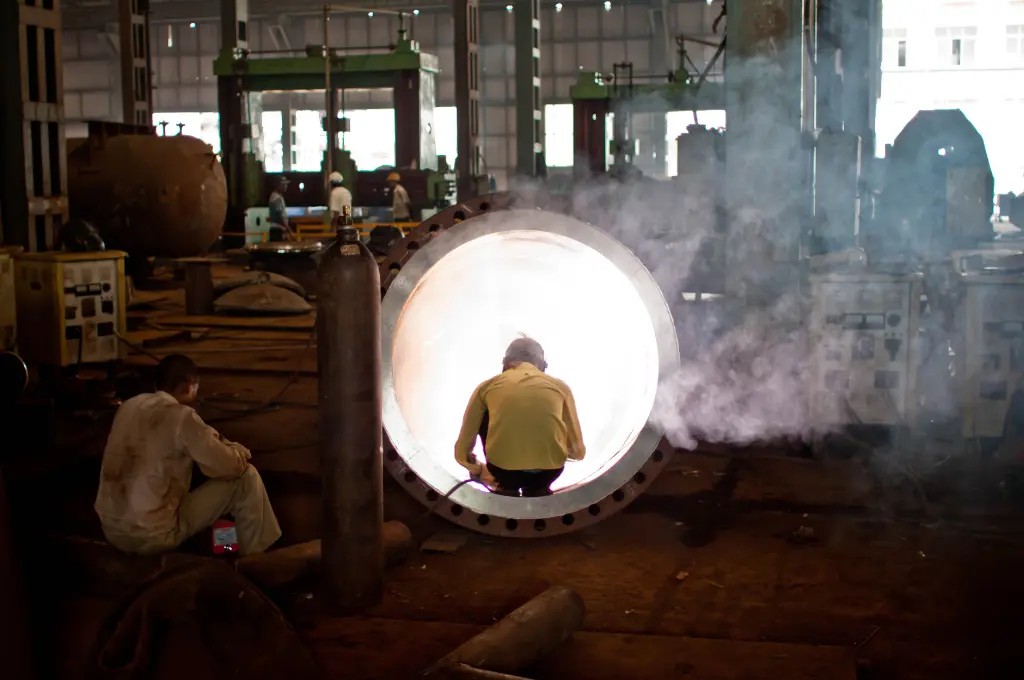
In textile dyeing units, steam is generated in boilers that release extreme heat, ash, and smoke into already stifling spaces. Inside many of these units, room temperatures often reach 45–50°C. Boilers are often placed indoors with little ventilation, trapping heat and pollution. Even when located outside, they are commonly covered with aluminium sheets that intensify heat retention. Workers near furnaces are exposed to radiant heat.
Existing research shows workers commonly report symptoms such as weakness, dizziness, headaches, and fatigue, but are less aware of long-term health effects like elevated heart rates, dehydration, and chronic exhaustion.
While conducting our audits, we found that personal protective equipment (PPE) offers little relief. PPE is uncomfortable in extreme heat, and many workers operate with minimal clothing, wiping sweat with towels to cope. We also observed gaps in basic safety practices. Essential safety gear, such as heat-resistant gloves or proper footwear, is often missing. In some cases, workers judge boiler temperatures by touching the surface with bare hands, unaware of the heightened risk of accidents caused by heat-induced fatigue and impaired concentration.
Is this scale of energy-use inevitable? Not quite
During our audits we found that much of the excess consumption is avoidable. It stems from outdated technology, poor maintenance, and low awareness of efficiency practices among owners. For instance, many micro units in Kolkata use inefficient, uncertified, locally made boilers; burn wet/high-moisture wood stored outdoors; rely on untreated hard water; and operate with little insulation. As a result, units burn more fuel just to produce the same amount of steam, reducing energy efficiency.

But this also means that there is enormous untapped potential for savings. Our audits show that simple energy-efficiency measures could help firms in Kolkata save about 260 tonnes of fuel each year, nearly 20 percent of their average annual consumption. Firms in Tiruppur could save nearly 400 tonnes, or about 15 percent.
Many recommended improvements, especially those related to boiler operation, require little to no investment. Simple monitoring practices, such as checking the moisture content of the wood, weighing the wood, and maintaining boiler logs to spot inefficiencies, can result in energy usage reduction.
Even low-cost upgrades deliver quick returns. For instance, improving airflow in boiler systems can cost around INR 10,000 but can help save more in the long run.
Which brings us to a critical question: if energy-efficient technologies can cut costs, reduce fuel use, and improve working conditions, why are so few MSMEs adopting them?
Our audits point to several barriers:
1. Access to information
On paper, energy-efficient technologies promise lower costs and better performance. However, many owners told us they simply don’t know enough about them to take the plunge. Even when they had heard of energy-saving options, their knowledge was often too limited to act on with confidence. Owners described audit reports as “too technical,” “too long,” or “not written for people like us.”
Additionally, awareness alone is not enough. Even after audits, many owners said they still had unanswered questions: Which vendor can be trusted? How often will the system break down? Will spare parts be available? What happens if production is disrupted?
Some owners worried that sharing details about energy practices could erode their competitive edge.
In clusters like Tiruppur, information sharing is uneven. Access often depends on firm size, participation in industry associations, and connections with suppliers or technical consultants. Owners involved in Common Effluent Treatment Plants (CETPs) or industry associations reported greater exposure to new ideas, suppliers, and discussions on costs and compliance. Others stayed away entirely, citing lack of time.
Some owners worried that sharing details about energy practices could erode their competitive edge. For instance, in Tiruppur, 68.63 percent of firms believed that peers withhold information on new technologies because of competition. Some owners reported not sharing knowledge simply because they were not approached or were unsure how their practices compared with others.
What owners repeatedly emphasised was the need for the full picture. Faced with uncertainty and the risk of disruption, many chose to wait. And even when owners are willing to adopt new practises, they often lacked the internal capacity to evaluate, implement, or monitor them.
2. Organisational constraints, decision-making, and survival mindsets
Whether firms adopt these practices also depends on who receives the information, how much they trust it, and whether they feel able to act on it.
In most MSMEs we visited, the owner sat at the centre of every major decision. Choices around equipment upgrades, fuel use, and boiler investments ultimately rested with them, even as many openly acknowledged their limited technical knowledge. Decisions were typically guided by experience, intuition, or advice from long-serving operators rather than structured technical assessments. Even when managers were convinced of the value of the recommended measures, owners remained hesitant to move forward. As a result, hesitation from either party could influence whether the recommended measures were adopted.
Teams were thin, and hiring specialised personnel was seen as expensive and impractical. Boiler operators were generally experienced but informally trained, often without licences. As one firm put it bluntly, “There are hundreds of boilers here, but maybe fifty good operators.”
Micro units, in particular, treated boilers as basic heating equipment rather than thermal systems requiring optimisation. “What’s there to think about?” one owner asked. “You put water, burn fuel, and get steam.” Standard operating procedures were rare, formal training even rarer. In one case, an owner said they learned how to operate the boiler through online videos.
These organisational constraints directly shaped owner behaviour. Time, more than money, emerged as a critical limitation. Scheduling meetings with the owners was difficult, calls went unanswered, and conversations were frequently interrupted by urgent operational demands. Even when energy-efficient technologies promised savings, many owners lacked the bandwidth to engage with something unfamiliar and potentially disruptive.
In addition, monitoring systems were weak. Most firms primarily relied on monthly electricity or fuel bills, with little measurement at the machine or process level. Basic efficiency data, such as water used, wood burned, and steam produced, was rarely recorded. When firms switched between fuels, such as wood, briquettes, or coal, adjustments were often ad hoc, with little systematic monitoring of performance. Without reliable measurement, owners could not verify savings or assess whether investments were working.
Over time, these frictions fed into a survival-oriented mindset. Market downcycles, shrinking orders, thin margins, and competition from larger firms made owners prioritise continuity over upgrading. New technologies, even when beneficial, felt risky.
3. Market pressure and financial constraints
Cash flow pressures loomed large. Payments from buyers were often delayed far beyond agreed terms, while raw materials had to be purchased on credit. At the same time, firms faced fixed costs, such as wastewater treatment fees, that they must pay regardless of production levels.
This left little room to respond to fluctuations, let alone invest in new technologies.
Many owners avoided formal loans altogether. Some had been rejected due to lack of collateral or low credit scores. Others feared repayment risks if orders dried up. “Taking a loan means stress,” one owner said. In several cases, firms were operating at half capacity or less, with orders confirmed only a few weeks in advance.
Even investments that were likely to be profitable on paper felt unaffordable when timing itself was uncertain. Energy efficiency was not rejected outright; it was postponed indefinitely.
4. Trust deficits and regulatory perceptions
Trust shaped every interaction. Many firms were hesitant to share data, fearing regulatory scrutiny related to labour or pollution compliance. External engagement was often interpreted as inspection rather than assistance. Vendors were seen as salespeople first and advisors second.
Many owners felt that Tiruppur faced stricter enforcement than competing clusters, especially around effluent treatment.
Trust, therefore, developed gradually. Repeated visits and consistent follow-ups signalled reliability and commitment, allowing owners to observe the credibility of the programme over time. Introductions through trusted intermediaries, such as cluster associations, CETPs, or respected peer firms, also played an important role in building confidence. As more firms in the cluster enrolled in the programme, participation itself became a signal of credibility.
Regulation was widely perceived as uneven. Many owners felt that Tiruppur faced stricter enforcement than competing clusters, especially around effluent treatment. This, they argued, raised compliance costs and reduced their ability to invest elsewhere. “We are following all the rules,” one owner said, “but others don’t, and they can sell cheaper.”
In this context, energy-efficiency initiatives are often viewed not as support, but as another layer of scrutiny.
Why systemic approaches matter for MSMEs
The barriers firms face in achieving energy-efficiency are not merely financial or technological. They are deeply shaped by how MSMEs are organised, how decisions are made, and the environments in which owners operate.
One-off external interventions, such as audits, information campaigns, or subsidies, which remain the most common policy tools, often fall short because they fail to account for these realities. This is rarely enough to trigger action.
What MSMEs need instead is sustained, hands-on engagement.
This requires moving beyond one-time information provision towards systems that help firms interpret and act on technical guidance. Firms often need more than just technical advice. They need practical support from people they trust. Sustained engagement can help them compare options, solve implementation challenges, and build confidence over time. Existing industry networks and civil society groups already working with these firms can help close this gap by turning audit recommendations into clear, actionable steps, and organising cluster-level demonstrations
Hands-on training through short practical workshops is particularly important for operational staff such as boiler operators and maintenance teams. It is also important to provide timely support when firms encounter operational uncertainties during adoption. Peer examples within the same cluster often carry greater weight than external advice alone.
Addressing behavioural barriers is also critical. Even when technologies appear profitable, firms may delay adoption due to risk aversion or uncertainty about returns. Complementary mechanisms such as ESCO (Energy Service Company) models, pay-as-you-save schemes, or on-bill financing, along with risk-sharing arrangements and demand-side incentives from buyers through ESG (environmental, social, and governance) and supply-chain decarbonisation commitments can help reduce perceived risks and accelerate adoption.
—
Know more
- Learn about the scope of electrifying India’s MSMEs.
- Learn how India’s manufacturing sector can be decarbonised.
- Explore this framework on responsible renewable energy deployment.