Bangude gassi, paaplet fry, and rice. Any of it, all of it, anytime and anywhere, is my mother’s comfort food. Food that brings the best afternoon naps; food that she cooks for herself and not because my father, or her mother, or her children, asked. This is food that she grew up eating, that transports her back to Surathkal in Karnataka, our home by the ocean.
Growing up in Mumbai, as we moved from a chawl to an apartment, I noticed my mother cooking less of what she loved and more of what others thought she should. These others were our watchdog neighbours, who believed that eating meat, eggs, and fish made people and homes impure. My friends wouldn’t drink water from our home unless they were dying of thirst and their parents were not watching through the windows. Both these criteria had to be met for them to forget, for a few seconds, that we were ‘macchi khanewale’ (fish eaters).
I remember the fish seller who taught us how to hold a fish without it slipping out of our tiny palms; whose hands skinned a fish like a sculptor’s glide through clay. He suddenly stopped coming to our house one day. Instead, he would sit outside the building, and then a year later, after Turner Aunty, Suvarna Uncle, and the Qureshi family moved to a different colony, he stopped coming altogether.

My dad would bring fish and, on rare occasions, chicken in black plastic bags. We would eat with the windows closed and the curtains drawn. The leftover bones were packed in the black plastic bags and disposed in a dustbin located outside our apartment—all evidence that we were macchi khanewale thus destroyed. There were days when I would cover my nose and cry as my mother would fry fish or make a bombil potato curry, yelling, “Everyone will come to know, and they will not play with me.”
As a child, one of the many things I was being taught was to hate my own food and to shame my own family’s ways of being. I grew up not eating fish and meat.
What kind of impact would this have had on my mother’s body? For her comfort and reminder of home to become a source of shame and exclusion, and a territory of scrutiny and conflict?
This is not just my mother’s story. It is the story of communities and people I have been alongside for the last 18 years as a mental health practitioner. In narrative practices, we believe that stories are alive, breathing and moving like ginger underground. They wrap themselves around our bodies and inhabit us, our languages, our homes, and our relationships—making us feel, think, move, talk, listen, and interpret in the way they want to.
The story of caste moves to kill. It’s precise, wears an invisible cloak, penetrates the body, disguises itself as care or brilliance, and convinces you that ‘you are not good enough’. Its ideas of purity and superiority, planted and reinforced through constant, everyday surveillance, rob us of our agency, and teach us how to hate and shame our own people. Would it then be fair to label my mother’s present exhaustion as simply ‘burnout’? Will this word tell the story of the everyday violence of Brahminical Patriarchy she has faced all her life?

The systems that define mental health
At the other end, a different story is being conjured.
Communities responding to structural violence, microaggressions, and everyday discrimination are told that ‘they are the problem’, and their symptoms are proof that they have ‘bad’, ‘not good enough’, ‘self-sabotaging’, or ‘self-harming’ behaviour. The casteist institutional murders of young students are classified as suicides—an internal failure of personhood that covers up the crime of a failed institution with the help of another casteist, failed institution: psychiatry. Women, Disabled, Queer, Bahujan, Dalit, and Adivasi folks protesting and rebelling against Brahminical Patriarchy are tucked away into neat psychiatric diagnoses such as ‘oppositional defiant disorder’ and ‘borderline personality disorder’.
The body becomes the site of problems. This story sustains the multi-billion-dollar medical-prison-industrial complex, turning mental health and well-being care into profit-minting machines designed to confine and isolate. People are told to learn ‘healthy coping strategies’, pay for therapy and doctor visits, and practice ‘self-care’.
When we experience hopelessness, we are told that we have reached ‘compassion fatigue’.
This story similarly envelopes therapists, social and community health workers, activists, and frontline workers responding to structural injustices. When we experience exhaustion or hopelessness, we are told that we have reached ‘burnout’ or ‘compassion fatigue’. These terms do more harm than they ever help. Because ‘burnout’ implies that there is something deficient in us, our bodies, and our practices.
In 2025, my dearest friend, who is an activist, couldn’t get out of bed for many days. She was told she was experiencing ‘burnout’ and she should ‘take care of herself’. One day, she texted some of us friends, “Can you all come? I can’t do this any more.” I remember how we took turns to be in bed with her, watching videos, cooking, wiping each other’s tears, holding hands, and laughing. My friend wasn’t experiencing burnout; she had put her heart in a bottle to protect it from the unbearable pain of watching the world break apart.
Vikki Reynolds, a social worker, uses the phrase ‘ethical pain’ in explicit rejection of ‘burnout’. It captures the pain we experience when we witness, every day, the failure of systems that are meant to care for and help people.
Who benefits by labelling a community health worker’s hopelessness as ‘compassion fatigue’ and telling her to ‘rest and take care of herself’ while her community continues to face violence? Someone does.
At Narrative Practices India Collective, we believe that communities and people are always responding, that we are never passive or using ‘bad coping mechanisms’ in the face of any violence. In our classrooms, we use a language of mental health and well-being that locates the problem as lying in violent and oppressive systems rather than in our bodies and identities. Where dysregulation is not a symptom to be treated, but a raging protest by our bodies.
Identity, history, and memory shape both crisis and care
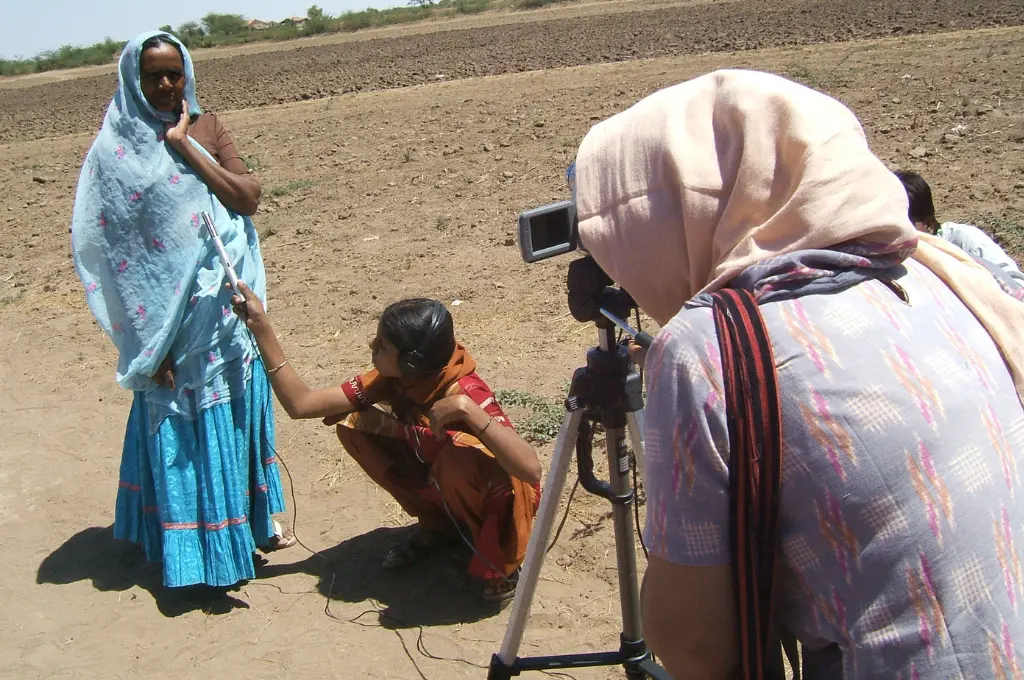
In 2017, my team and I were invited to a gathering of Adivasi women and youth in Dadra and Nagar Haveli. More than 100 women representing their respective villages travelled in the hope of ending the problems destroying their communities. They spoke of suicides among the youth, intimate partner violence, children dropping out of schools, and of finding ways to nurture one another.
As we started thinking collectively about what could be done, we decided to meet three days every month and raise certain questions. What stories are being told about Adivasis, and are they harming or nurturing us and our youth? What protests are the young people killed by suicide compelling us to join? Are children dropping out or being pushed out of schools? How do we remove the invisibility cloak off of the beast of caste and colonisation, which is forcing our youth to believe that they are not good enough? Who benefits when Adivasi young people die by suicide? Someone does.
How do we talk about mental health in our language and not that of the oppressors?
Every time we sat in circles to reflect, the room would fill up with laughter, tears of joy, ‘that happened to me too’, ‘we do that too’, sighs of sadness, shades of anger, whispered reminders of words, and hummed tunes from childhood. There were the songs that women sang with their parents while re-planting the rice crop, the stones that were planted in memories of ancestors who continue to live among them, and stories of love when it would rain.
Women described practices and rich Adivasi knowledge that had been passed down for generations on how to take care of the land, like a mother would. They condemned projects that displace them in the name of development; the pollution of their water; the theft of their knowledge, rebranded as ‘organic’ farming; and the killing of their youth through institutional practices of discrimination, and not because something was wrong with their brain or body or their Adivasi identity.
The discussions turned into questions: How do we talk about mental health in our language and not that of the oppressors? How are we already talking about mental health? What traditions allow men to violate intimacy? How do we invite others to join us in finding our way to love, warmth, and care? Where is the problem located?
There was a long silence in the room. We sat in this silence for as long as it took. It felt like a refuge created to hold each other and to look at the problem in the eyes. Only to know something that was always known—that we are not the problem, our body is not the problem, ‘the problem is the problem, and we need to name it’.
One of the women said, “My people talk about the body, health, and mental health in the language of the land. We are the land; the land is us. We should invite everyone to talk about land.” So, we decided to do just that.
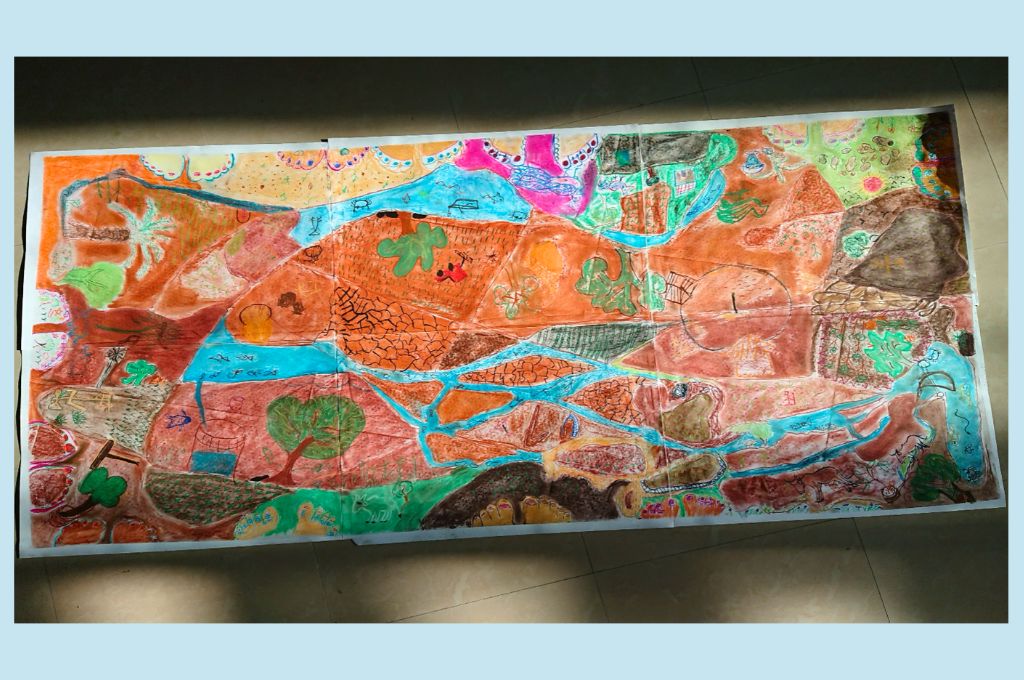
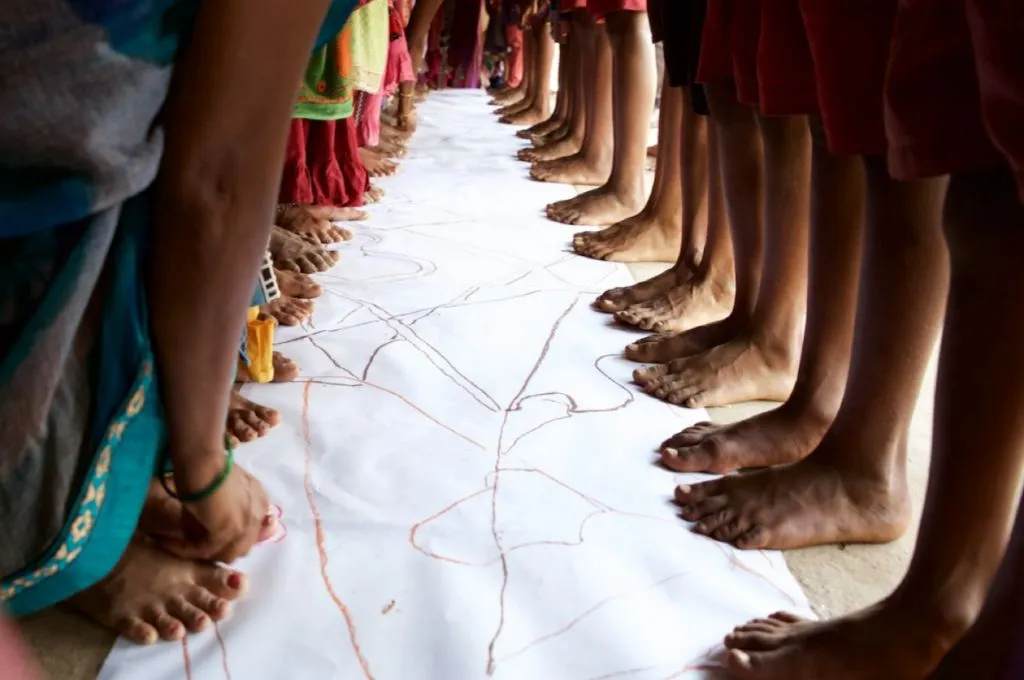
We drew a mural with stories of ‘what does the land mean to each of us’? and ‘what are practices that nurture the land and what practices cause it harm?’ People drew stories of times when the land held their bodies in love, rage, grief, and pain. Of the first time they participated in nurturing the land, songs they would sing, games they would play, and conversations they would have. What started as a drawing activity would lead into reauthoring of an ancestral story of the body and land as the site of wisdom, as a site of nurturance, as a site of protest, as a site of libraries filled with know-hows on navigating life, and as a site of resistance. Never a site of problems, never a site that turns against its own self, and never, ever a site of failure. From these stories we have built libraries, a nutrition programme, mental health programmes for schoolchildren, and an Adivasi youth centre.
This is what we do, and this is what we will do. This is what we learned from our mothers, our grandmothers, and all the people who came before and who fought for us. We are determined to never let someone be alone, and to always keep with us the reminder Rohith left for us, that ‘we are made of a glorious thing called stardust’.
Finding our way back
We are not machines or candles to burn out. What we feel is a pain that comes from experiencing and witnessing injustices and violence day after day, injustices that cannot be justified or solved through a day’s, a month’s, or years’ worth of our work. Ethical pain needs solidarity, not self-care.
I’m turning 40 this year, and my mother 67. This year, for the first time, I ate fish on quite a few occasions. Once on a date, because he promised to remove all the bones and feed me; a second time when a friend argued that if I don’t try the prawns, I will miss an extremely important experience in my life; and a third time, it was fish fry by a beach in Puducherry because it just looked so tasty.
I was sharing the story of eating prawn masala with my best friend Divya’s Amma, and she got so excited that she started sharing all the ways prawn can be cooked and how all of the recipes are delicious. She invited me over to eat prawn biryani, and it felt like she was celebrating a win. My mother did too when she heard that I had started eating fish.
I imagine a day when I can remember how to cook bangude gassi and paaplet fry, to skin and cut fish like the fish seller used to, where the crackle of pomfret in hot oil is a call that ‘lunch is almost ready’, where the fragrance moves around the house waking everyone up, to eat with open windows and no curtains drawn.
A day when our bodies return to the home by the ocean, to be held by the land and water as a glorious thing made of stardust.
—
Know more
- Understand the importance of situating mental health at the centre of struggles for dignity, justice, and liberation.
- Read these stories to know how mental health can be framed through a more inclusive and intersectional lens.
- Learn what it means to build and sustain a ‘counterculture of hope’.
Do more
- Participate in Chai, Kaapi, and Jugaad, the second International Conference of Narrative Practices, Mental Health, and Community Well-Being, on 5, 6, and 7 February 2027 in Puducherry.
- Learn more about the Foundation Diploma in Narrative Practices (2027).