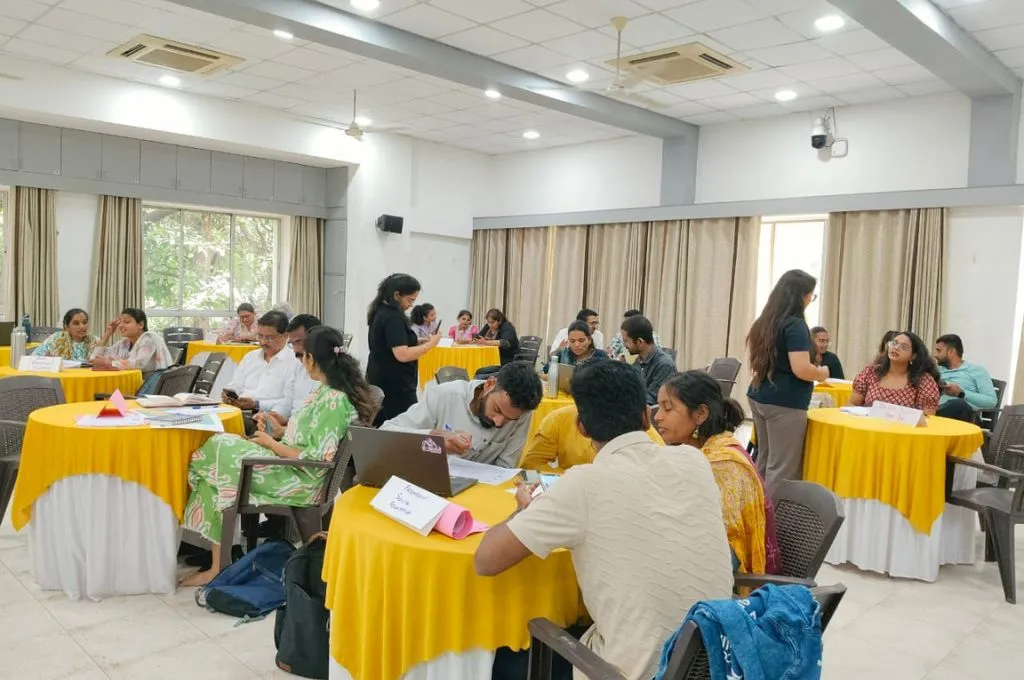
A CEO of a mid-sized nonprofit recently shared her frustration: after nearly two years of trying to hire for data roles, her organisation had little to show for it. Candidates were either unaffordable, inexperienced, or simply unavailable.
It’s an increasingly familiar story. Across the sector, organisations are struggling to attract and retain the talent needed to make better use of their data. At the same time, expectations around data have only grown. Funders want clearer evidence of impact and leadership teams want sharper insights for decision-making. But even as the need for data professionals has increased, the challenge of attracting and retaining this technical talent in the social sector is also now well documented.
A 2022 report by data.org and the Patrick J. McGovern Foundation, Wanted: Data Talent for Social Impact, identified several structural barriers: limited philanthropic investment in data infrastructure, an inability to compete with private-sector salaries, weak integration of social impact pathways within STEM education, and systemic inequities that exclude women and people of colour.
Closer home, the Bridgespan Group’s Pay-What-It-Takes initiative has long highlighted the chronic underinvestment in organisational capacity, including talent and infrastructure. More recently, a study on talent management in the Indian social sector by the Centre for Social Impact and Philanthropy and the Indian School of Development Management points to a lack of standardised compensation frameworks and a persistent knowledge gap in nurturing specialised roles. While India produces a large number of STEM graduates, there remains a shortage of professionals who can meaningfully apply these skills to social challenges.
The Indian social sector is eager to unlock the potential of data by hiring the right talent. But the CEO’s frustration points to something deeper than a recruitment problem. Even organisations that do manage to hire often find that the hire alone changes very little.
What are we hiring for?
Before asking how to solve the talent gap, it’s worth unpacking what we mean by “data talent”. Data talent is not a single role—it is a spectrum of capabilities required to design, manage, and use data effectively.
At one end are Monitoring, Evaluation, and Learning (MEL) professionals who define what data should be collected and how it aligns with programme design and decision-making. Then there are analysts who interpret this data—building dashboards, generating insights, and supporting reviews. Behind the scenes are those who build and maintain data systems: MIS platforms, databases, and pipelines. At more advanced stages, organisations may engage data scientists to explore deeper patterns and predictive insights.
Expecting a single hire to cover this entire spectrum is unrealistic. Yet many organisations implicitly do exactly this—hiring “a data person” and hoping it will solve all their data-related challenges. Across nonprofits at different stages of data maturity, a clear pattern emerges: the challenge is not just a shortage of talent, but how narrowly the problem is defined. It is often viewed as a hiring gap rather than an organisational one.

Hiring is necessary but not sufficient
Even where organisations are able to hire, the impact of that hire is often limited in the absence of complementary investments. Becoming data-driven is less about a single role and more about building an enabling environment.
Here are five shifts organisations can make alongside hiring:
1. Invest in mentorship, not just recruitment
Most nonprofits can realistically attract early- to mid-career professionals—individuals who are capable and motivated, but still developing their technical skills. Retaining them requires more than a job description; it requires a pathway for growth and mentorship can play a critical role here. However, mentorship is often mismatched in practice.
When early-career professionals are supported by practitioners who can engage with their day-to-day work, mentorship becomes developmental.
For instance, a senior, well-intentioned board member of a large nonprofit once offered to mentor a tech associate. But as a retired CEO, his guidance stayed largely strategic—focused on what data leadership would want to see or how to think about composite metrics. What the associate actually needed was far more tactical: support in cleaning messy datasets, reconciling multiple sources, and debugging a failing dashboard.
This gap is common. Effective mentorship requires clarity of roles and pairing for complementarity, not just seniority. When early-career professionals are supported by practitioners who can engage with their day-to-day work, mentorship becomes developmental rather than performative.
2. Upskill from within the organisation
Some of the strongest data practitioners in nonprofits emerge from programme teams. They understand the context, the constraints, and the decisions that data needs to inform. Structured programmes—such as the Data Catalyst Program run by our partners Dasra and Tech4Dev or India Leaders for Social Sector’s Digital Transformation Program—are helping build these capabilities. They expose participants to tools, frameworks, and peer networks.
But training alone is not enough. Organisations must create immediate opportunities to apply these skills. An education manager at a large nonprofit working on inclusion for people with intellectual disabilities transitioned into the role of MEL manager. She brought a deep understanding of the programme and its stakeholders, which shaped how she approached data. As she learnt about logframes and survey design, she was simultaneously developing them for her own organisation, grounding her learning in real decisions. Over time, she not only took ownership of these tools but also built dashboards that teachers could meaningfully engage with, rather than generic reporting tools.
When learning is paired with ownership and real application, internal talent can evolve quickly into effective data practitioners. Without this, even well-designed training programmes risk remaining theoretical.
3. Decentralise data ownership
A common mistake is to centralise all data responsibilities within a single team or individual. This not only creates bottlenecks, concentrates institutional dependence, and distances data from decision-making. Instead, organisations can distribute data responsibilities across teams. For example, programme leads can own key indicators; field teams can be responsible for data quality; and central teams can focus on system design and governance.
At Quest Alliance, an internal initiative that began with small, voluntary data projects evolved over time into a network of “data champions” embedded across teams. These individuals are not full-time data specialists, but they play a critical role in ensuring that data is used in day-to-day decision-making. This kind of decentralisation reduces dependency on a single hire and builds organisational resilience.
4. Prioritise documentation
Documentation is often overlooked because it can feel mundane. But its absence is felt deeply. Consider a common scenario: a key team member leaves, and suddenly no one knows how a critical metric is calculated or why certain data fields exist. Teams spend weeks reconstructing logic that was never documented.
Good documentation ensures continuity and enables new team members or external partners to contribute effectively without starting from scratch.
In practice, good documentation goes beyond static standard procedures. It includes simple but consistently maintained resources: an indicator directory that defines each metric and how it is calculated; short notes embedded within dashboards explaining data sources and how numbers are calculated; and clear data flow maps that show how information moves from collection to reporting. For example, some organisations build lightweight “data playbooks” for each programme, where programme leads and data teams jointly document key indicators, collection methods, and review processes. These are revisited and updated during monthly or quarterly reviews.
Good documentation ensures continuity and enables new team members or external partners to contribute effectively without starting from scratch. However, documentation should not be a one-time task assigned to a single individual. It must be a shared, ongoing responsibility embedded in how teams work with data.
5. Use external expertise strategically
There is often hesitation around engaging consultants, driven by concerns about cost or dependency. However, when used strategically, external experts can accelerate progress significantly.
For instance, an organisation may bring in a consultant to design a data architecture, set up dashboards, or clean and structure legacy data. Once these foundations are in place, internal teams can take over and build on them. In our experience working with multiple organisations over the past five years, repeat engagements have typically focused on solving new problems rather than extending dependency on earlier work. The goal is not to outsource ownership, but to access specialised expertise at critical moments—much like hiring an architect before constructing a building.
Beyond hiring: Building a data culture
At its core, becoming data-driven needs organisation-wide solutions, not merely a hiring one. It requires aligning incentives, building capabilities across teams, creating systems that are actually used, and embedding data into everyday decision-making. Hiring a data professional can support this journey, but it cannot substitute for it.
For organisations ready to take this on, the next step is often less about new solutions and more about asking the right questions:
- Are our teams clear on which decisions data should inform, and do they actually use data in those moments?
- Do our programme and field teams see value in the data they collect, or is it primarily for reporting upward?
- Do we trust the data we collect, and have confidence in how our indicators are defined and calculated?
- Where are the biggest bottlenecks today—data quality, access, skills, or alignment?
- Are we investing enough in applying and reviewing data, not just collecting it?
How leaders answer these questions often determines whether a data hire succeeds or fails. In organisations where data is embedded into decision-making and ownership is shared across teams, data professionals are set up to focus on generating insight and strengthening programmes. But where expectations are unclear, data remains siloed, or collection is disconnected from use, even strong hires can become trapped in operational firefighting or routine reporting.
The organisations that succeed are not those that simply hire better talent, but those that create the conditions for that talent—and everyone else—to use data meaningfully. The risk is not just in believing that hiring a data professional will solve the problem, but that it creates the illusion that the problem has been solved.
The organisations that use data well are not simply those that hire better talent, but those that build the systems needed to use data well. Hiring a data professional can support this shift, but the desired results will come only when organisations themselves reframe how they think, operate, and invest their resources.
—
Know more
- Learn more about building a robust data management system for nonprofits.
- Take a quiz to assess the data culture maturity of your organisation.