In October 2023, a glacial lake outburst flood (GLOF) tore through large parts of Sikkim and West Bengal. Naga, Tung, and Richu were among the worst-hit villages in the North Sikkim region. In Mangan district, routes from its eponymous district headquarters to its two major tourist villages, Lachen and Lachung, were severed, and it was difficult to reach Chungthang, the town where the 1,200 MW dam broke. Dzongu, the protected region of the Lepcha people, was also isolated from town centres such as Mangan and Gangtok.
Restoring these roads would take months, as it does anywhere in Sikkim, and the wait was made heavier by the anxiety of the people and their growing distrust of the systems meant to help them.
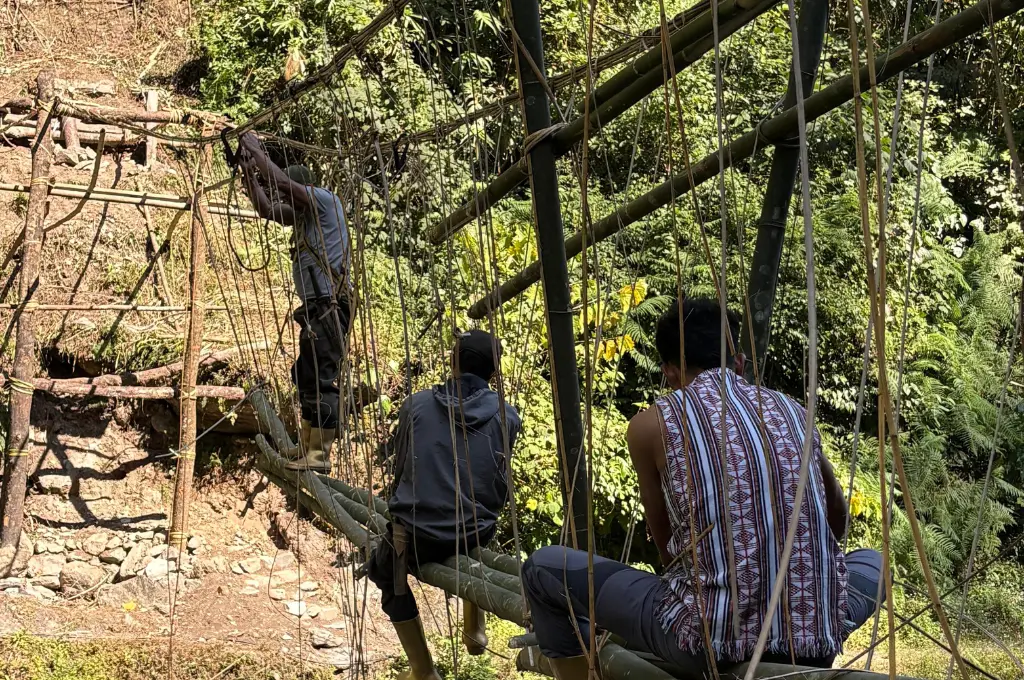
In this context, a much older technology came back into view. In the weeks following the GLOF, people from Dzongu came together to build a Ru-Soam that connects pieces of land separated by rivers or streams. The Ru-Soam, literally cane bridge in the Rong language, is an indigenous suspension footbridge made entirely of cane and bamboo, most closely associated with the Lepcha community. It is advised that only one person cross the bridge at a time due to its light weight and narrow soamtaalyong (walkway, made of three bamboo poles). The person using the bridge must also hold on to the soamtukpoal/katsaam (handrail) to avoid swaying against the movement of the bridge

Building the Ru-Soam
Dupden Lepcha, a master builder and trainer from Dzongu, says, “The Ru-Soam dates to the days before vehicles, when bridges were meant only for people, and is a familiar presence in parts of North Sikkim.”
However, its construction is not easy. To place the soamtaalyong, the chief builder walks on the bamboo pole, over the river, to secure it with the soamglyaang (cane suspension vines). A misstep and the builder risks falling into the river below and hitting a boulder.
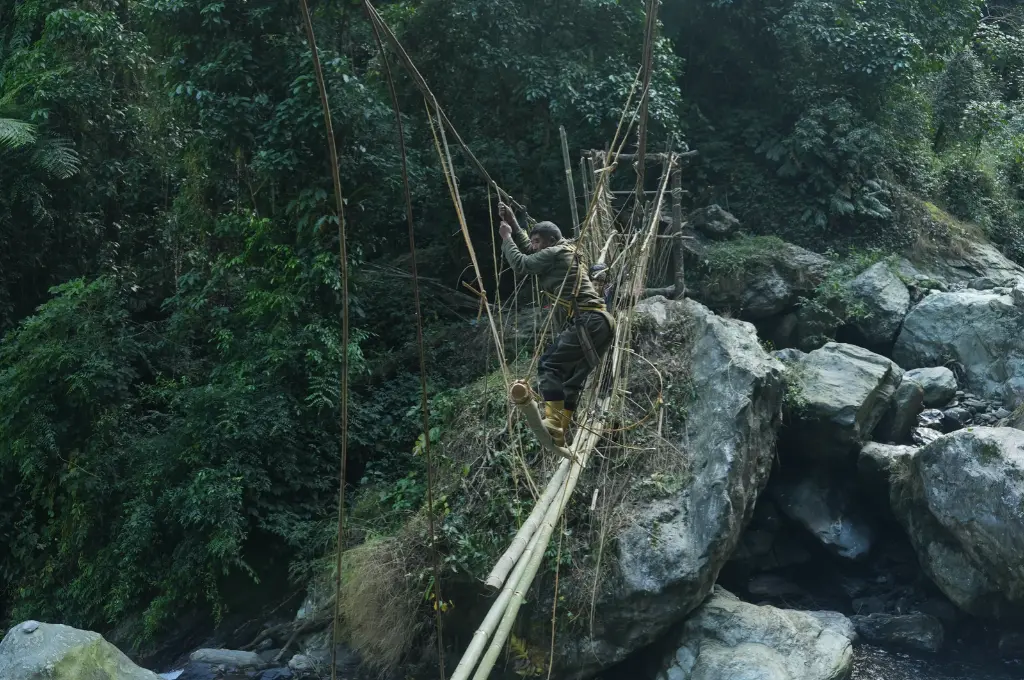
Ren Dupden* remembers that while building the Ru-Soam, he was asked to wear harnesses by the State Disaster Management Authority. He says, “When I set out to build a Ru-Soam, I accept that I might die in the process. Courage plays the most important role in its building. If risking my life helps people stay connected, I am happy to do so. During the 2023 GLOF, when I was building the Ru-Soam in Sangkalang (one of the points on the Mangan–Chungthang route), my family would scold me out of concern for my life.”
The revival of a tradition
Winona Lepcha, community coordinator for the recent Ru-Soam revival training (and Ren Dupden’s daughter), says, “The Ru-Soam has played a crucial role in connecting villages, especially in Upper Dzongu, where people own lands that are accessible only by crossing rivers. Due to this, many people in Upper Dzongu know how to build the Ru-Soam, while in Lower Dzongu, the younger generation were relatively unfamiliar with its technology.” Out-migration and other factors had led to the knowledge being concentrated in far fewer hands than most people might have assumed. This, however, is changing.
Winona adds, “After the GLOF, many people in Lower Dzongu learned the process. The documentation programme by the Department of Science and Technology [in partnership with UNESCO] also got a lot of people here interested in the technology.

“While people are now documenting the Ru-Soam’s engineering marvel, not many know of the trauma that it carried during the GLOF. People travelled with the dead bodies of their loved ones, and pregnant women fearfully crossed it. People who are afraid of heights and water bodies have had to cross it too.”
A sustainable solution
A Ru-Soam takes much less time to build than a steel-and-concrete bridge. “It takes five to seven days to construct, against the few months of work required to build a modern bridge for a comparable crossing,” says Ren Dupden. In a landscape where landslides and floods regularly cut off settlements, how fast a connection can be restored decides how long people stay stranded.
The Ru-Soam’s raw materials are locally sourced and renewable. Because of this, it avoids the supply chains that disasters tend to affect first, such as steel, cement, and heavy machinery that must travel on these broken roads. Along with being quick to make, a Ru-Soam leaves little waste behind. It can even be rebuilt without delay if the river takes it.
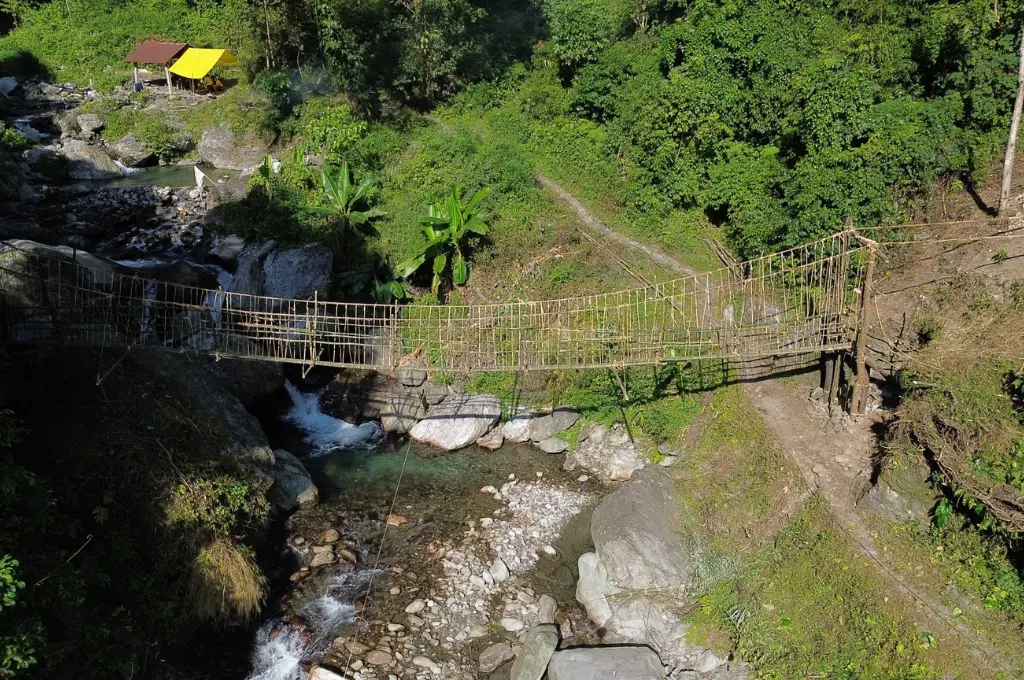
Despite being a tradition that goes back centuries, Ru-Soam building is an ever-evolving process that doesn’t shy away from adapting to the immediate needs of the communities.
Ren Dupden says, “[During the GLOF], many hesitated to step onto it because they feared the height and the river beneath them.” He and other builders responded by making minor changes to the design. Wooden planks were laid to widen the walkway, and agro-nets were added on the sides so people could not see the roaring river they were crossing.
By continuing to be the lifeline of the communities even as modern and more expensive constructions fail, the Ru-Soam has proven that indigenous knowledge, ecological sustainability, climate resilience, and cultural survival are not separate concerns, and therefore should not be treated as such.
*Ren is an honorific title given to elderly Lepcha men.
—
Know more
- Learn how three years after the GLOF, communities are still struggling to get back to normal.
- Read about a people’s march to save the Teesta river.
Do more
Connect with the author at [email protected] to learn more about and support her work.