Getting to work, moving goods, and meeting everyday mobility needs in India’s cities depend overwhelmingly on petrol, diesel, and fossil fuels. As a result, transport accounts for around 14 percent of India’s energy-related CO₂ emissions, making it one of the country’s fastest-growing sources of emissions. A joint report by GIZ and NITI Aayog shows that emissions from the sector have risen sharply over the past three decades and are expected to keep growing. With over 95 percent of transport energy still coming from oil, cutting emissions from this sector remains one of the toughest challenges on the road to net zero.
In response, policy conversations on cities have largely focused on technological fixes such as electrification and expanding electric public transport. Electric vehicles are expected to reduce emissions and transform urban mobility. But this approach often treats electrification as a universal fix, assuming that cities function in similar ways and that people already have access to reliable, safe, and affordable mobility systems.
In practice, however, mobility systems function quite differently across cities. In 2025, we at The Climate Agenda set out to better understand transport patterns and behaviours in Patna and Lucknow, both tier-2 cities where reliable mobility data remains limited. Through a participatory process, we invited residents to map their daily journeys, identify chokepoints, and describe what safe or unsafe movement feels like from where they live.

Alongside this, we conducted two studies drawing on field surveys and secondary data, which resulted in published reports on mobility in Patna and Lucknow. Participants represented a range of age groups, genders, and occupations across both formal and informal work, though participation skewed male—reflecting wider inequalities in mobility, access, and visibility.
The studies captured both everyday commuter experiences and broader trends in traffic, air quality, and vehicle growth.
This was the first hyperlocal study of its kind led by civil society in Bihar and Uttar Pradesh.
Here are some insights from what we learnt:
1. Cities aren’t designed for everyday movement
In Lucknow, the study found that 63 percent of residents walk nearly a kilometre just to access their first mode of transport. Raziya, a 34-year-old construction worker, for instance, leaves her home in the informal settlement of Mawaiya, Lucknow, before sunrise, walking 2–3 kilometres to save a few rupees before catching an auto.

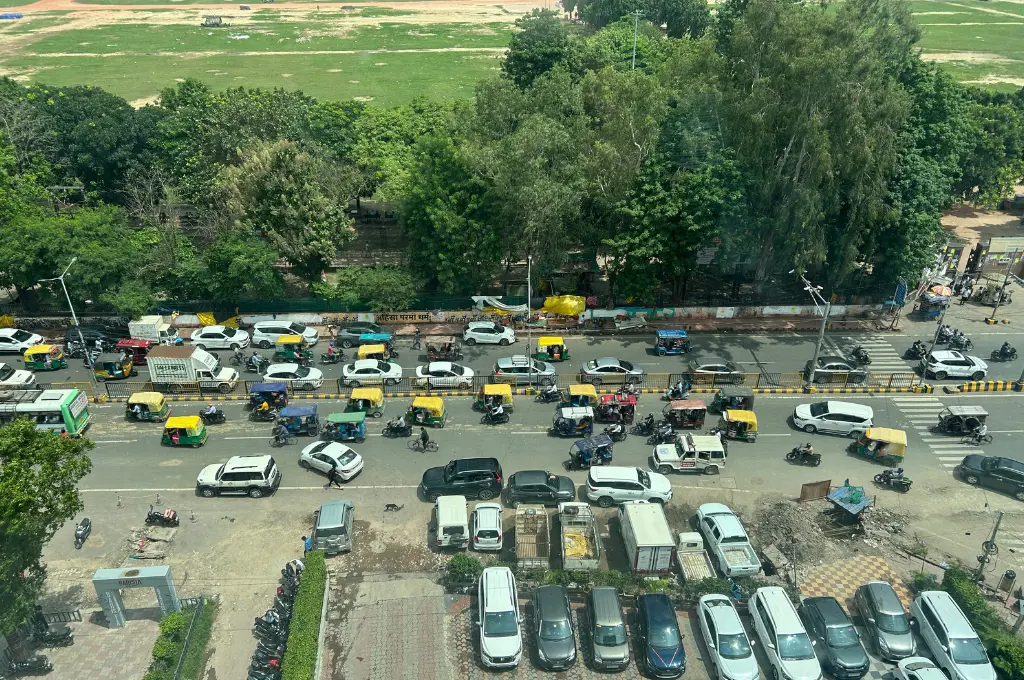
Traffic congestion and high costs also emerged as key concerns for many respondents, along with existing gaps in infrastructure. On key stretches in Lucknow, speeds fall to just 11–14 km/hr, which is close to walking pace. Only 8 percent of respondents said that walking and cycling infrastructure is well developed, and inadequate public transport further exacerbates this. Lucknow had just 254 registered buses in 2023–24, far below what a city of 4 million requires. Similar patterns are visible in Patna, where only 13 percent of residents believe that non-motorised infrastructure is well-developed.
For many, this means navigating daily travel without safe or reliable options. During the mobility mapping exercise, Sunita Devi, a 45-year-old widow, mother of four, and person with a physical disability from Mawaiya, Lucknow, shared that she travels 3–4 kilometres each day to reach households in Rajendra Nagar, Motinagar, and Aishbagh, where she works as a domestic helper. She does this while navigating high-speed traffic, broken pathways, and public spaces without ramps.
2. Those most dependent on public mobility are most affected
In Patna, marginalised caste groups own just one car per 1,000 people. SC/ST communities account for only 6 percent of four-wheelers and 11 percent of two-wheelers, despite making up more than 21 percent of the population. In Lucknow, 43 percent of people do not own any vehicle, leaving them dependent on unreliable public and informal transport.
For many, this means navigating overcrowding, unpredictability, and delays daily. But these challenges extend beyond inconvenience—they shape dignity, safety, and everyday experience. Nirmala, a transfeminine respondent from Kanpur, described being asked to sit in the front seat “like baggage,” overcharged, or avoided by fellow passengers. Her experience highlights how mobility is shaped not just by distance, but by discrimination and the constant struggle to be treated with basic respect.
3. Mobility constraints are shaping urban emissions
As mobility systems remain unreliable and inaccessible, those who can afford to do so shift towards private vehicles, contributing to rising fuel consumption and vehicle growth.
In Patna, petrol consumption increased by 177 percent between 2010 and 2023, while diesel use rose by 34 percent over the same period. Annual vehicle registrations doubled from 79,000 in 2010–11 to 158,000 in 2023–24, with 82 percent comprising private two-wheelers and cars.
Similar trends are visible in Lucknow. Petrol consumption increased by about 224 percent between 2010 and 2024, while diesel use grew by 54 percent.
These shifts are also reflected in air quality. In Patna, PM2.5 levels remain nearly twice the national standard and more than 15 times the WHO guideline. While levels in Lucknow have declined slightly over time, they continue to remain far above national limits and around 12 times the WHO guideline.
Reframing the mobility question
Addressing transport emissions, therefore, cannot be reduced to electrification alone. It requires examining who can travel safely within cities, and who remains excluded from these systems.
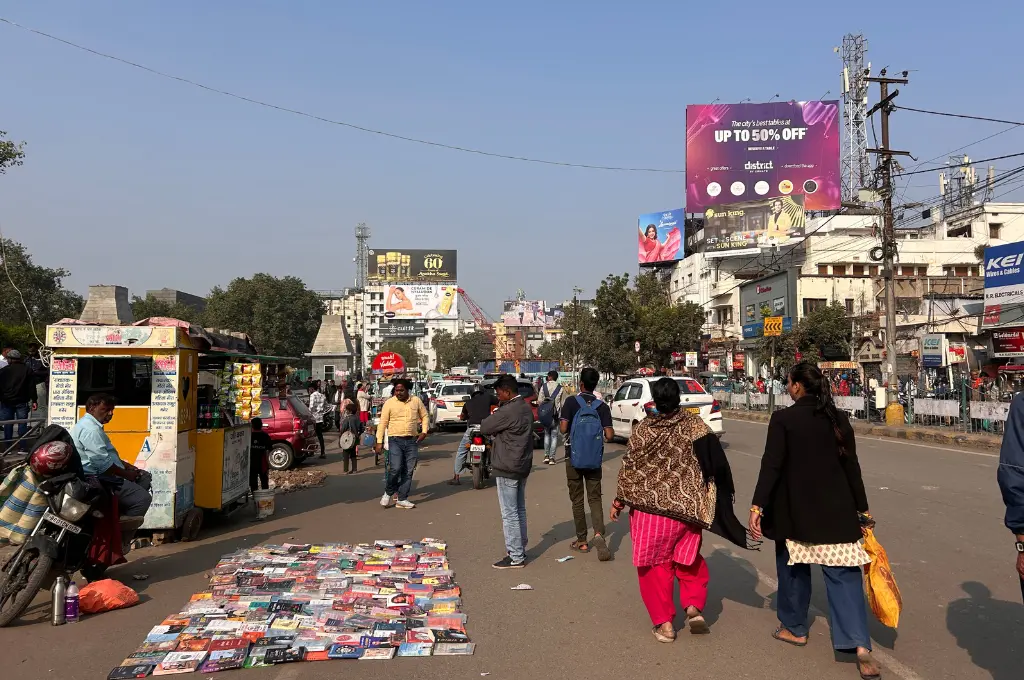
Mobility needs, and the systems that support them, however, vary widely across and within cities. A single street often performs multiple, overlapping functions throughout the day. Early in the morning, it carries sanitation workers, for whom the road itself is a workplace, along with vendors setting up stalls and children walking to school. By midday, it becomes a workspace for street hawkers and a caregiving route for women travelling to markets, clinics, and anganwadis. For transgender persons, these streets are also sites of daily negotiation, where movement is shaped by visibility, safety, and the constant risk of harassment. In the evening, the same stretch must accommodate returning workers and informal commerce.
However, planning approaches rely on standardised models that overlook differences in scale, density, and how people actually move. This becomes particularly evident in smaller and emerging urban centres such as Lucknow and Patna, where mobility systems are still evolving, and in many cases, solutions designed for larger metropolitan contexts are replicated without sufficient attention to local needs.
The metro rail is a telling example. It requires enormous capital investment, and while it can transform mobility in large, dense cities, smaller urban centres often stand to gain far more from targeted investments in last-mile connectivity, walkable and safe street infrastructure, expanded bus networks, and fare-free or subsidised travel for socially excluded communities. Yet metro projects continue to be adopted across cities of varying scales.
The consequences are visible in cities like Lucknow and Kanpur, where metro systems currently serve only limited corridors, leaving large parts of the city dependent on conventional modes of transport. As a result, many residents continue to rely on buses, and other everyday transport systems that remain more accessible for shorter and dispersed journeys.
An example from Varanasi further illustrates this challenge, where an electric bus service connecting the city to Kaithi was launched with considerable public messaging and promise. Despite consistently high ridership, the service was abruptly discontinued within a year, leaving daily commuters stranded. Kaithi is not only a religious centre but a densely populated riverine settlement along the Ganga, where residents depend on the city of Varanasi for work, education, and services. With the buses gone, passengers were forced to rely on costly and informal transport arrangements. The service was later restored after sustained efforts by local groups who engaged with the district administration.
What mobility planning and investment must shift towards
The challenge, it turns out, is not the absence of solutions. Expanding bus fleets, improving footpaths, ensuring last-mile connectivity, making fares affordable for those who can least afford them—none of this is beyond reach. However, urban transport planning and investment often remain oriented towards large-scale infrastructure, even though everyday commuter experiences are shaped by more routine systems and services. Addressing this gap does not require reinventing urban planning. It requires listening to local evidence and acting on what it shows.
Based on our findings, a few priorities emerge for building more inclusive mobility systems.
1. Build mobility systems that people can rely on
Affordability, reliability, and safety should be treated as core outcomes of transport planning, not secondary benefits. This means investments must be evaluated not only on ridership or emissions reduced, but also on whether they reduce wage loss, shorten unpaid travel time, and improve access for women, elderly people, persons with disabilities, and informal workers. For example, adding more buses or expanding routes matters little if services remain unreliable or last-mile connections are missing.
Expanding and electrifying public transport must therefore go hand in hand with ensuring affordability and last-mile connectivity. Walking and cycling infrastructure is equally critical for short-distance travel, especially for those who rely on it the most. Without safe and continuous routes, even short daily trips can become time-consuming, costly, or unsafe.
2. Prioritise mobility infrastructure
Roads and footpaths are spaces of movement, work, caregiving, commerce, and social interaction. However, footpaths are frequently built and then removed, encroached upon, or repurposed for vehicles and parking, undermining access for those who depend on walking the most.
Planning and investment therefore need to prioritise streets that remain usable and safe over time, not just projects that are built and showcased. This requires design that reflects how streets are used, and systems that ensure they are maintained as shared public spaces.
3. Leverage existing initiatives
Crucially, the policy and financial architecture to act on this already exists. Under the PM e-Bus Sewa scheme, Uttar Pradesh is working towards integrating around 8,000 electric buses by 2030, while Bihar has received sanction for 400 electric buses across six cities. Uttar Pradesh’s CM-GRIDS, which received a combined allocation of INR 1,300 crore in the 2024–25 budget for road infrastructure and bus fleet enhancement, also has potential. Bihar’s Pink Bus Scheme, which introduced women-only CNG buses across six cities in its first phase, is another example of a scheme with a clear inclusion mandate already in place.
4. Move away from private vehicle-centred planning
Currently, mobility systems continue to be shaped around private vehicle use, often at the expense of shared and non-motorised modes. Shifting this requires reducing dependence on private vehicles through better parking management, demand regulation, and stronger incentives for public and non-motorised transport.
Several cities have demonstrated that this is workable in practice. London charges private vehicles a daily fee to enter its central zone, a model that has reduced traffic and generated revenue reinvested into public transport. Stockholm uses a congestion tax that varies by time of day, making peak-hour private travel costlier while keeping public transit accessible. Singapore has long managed private vehicle ownership through steep registration costs and a quota system, deliberately keeping private vehicle numbers in check. These are not fringe experiments; they are sustained policy choices that have reshaped how people move. The tools exist. The question is whether cities are willing to apply them.
Ultimately, the future of low-carbon mobility in India’s tier-2 cities will depend not only on cleaner technologies, but on whether mobility systems are designed around how people actually move through cities every day. Reducing emissions and improving access cannot be treated as separate goals. Inclusion, in other words, cannot be a secondary concern; it is a precondition for climate outcomes.
—
Know more
- Explore all mobility studies by The Climate Agenda in Patna and Lucknow here.
- Read about the Dilli Charter by the Sustainable Mobility Collective which calls for systemic solutions including sustainable mobility, safer streets, and inclusive public spaces here.
- Watch this this video unpacking key trends shaping urban mobility in India’s cities.
Do more
- If you use public transport, pay attention to who is missing from it, which routes remain inaccessible, and who is walking because they have no other option. Raise these concerns with local municipalities and elected representatives, and demand that mobility and climate plans prioritise safe, affordable, and accessible transport.
- If you work in urban planning or policy, push for data collection that captures how people actually move through cities, especially women, informal workers, low-income commuters, and persons with disabilities, rather than focusing only on vehicles and road infrastructure.
- If you are part of a civil society organisation, consider building or joining local mobility coalitions that connect transport access with climate, health, safety, and equity, as groups across Uttar Pradesh are already doing through the Sustainable Urban Mobility Collective.