This is the story of a jan sunvayi in Naraina Village in Delhi.
On an otherwise unremarkable summer day in June 2025, the office of the Sub-Divisional Magistrate (SDM) issued a notice announcing a public hearing in the village. The news spread rapidly on WhatsApp, and the next day, residents gathered near the Ram Dvara Mandir on the Delhi Ridge. Questions circulated: ‘why now?’ and ‘what would come of it?’. Yet beneath the uncertainty lay a palpable determination to be heard. By the time the SDM arrived—two hours late—the crowd had thinned, but around 50 residents remained. Even the officials appeared taken aback by the turnout.
“We’ve never had a hearing like this in our lifetime. We won’t leave until we are heard,” said Ramesh,* a resident in his 40s.

It was clear that what may have been a routine exercise for the administration felt like a rare, perhaps singular, opportunity for residents to confront decades of exclusion from planning and governance in the country’s political and administrative capital.
I was in the village that day for a routine community mapping exercise as part of City Sabha’s work with the youth in Naraina. As people gathered near Ram Dvara Mandir for the meeting, I walked over and stayed to witness the unfolding events.
Nowhere to go but up
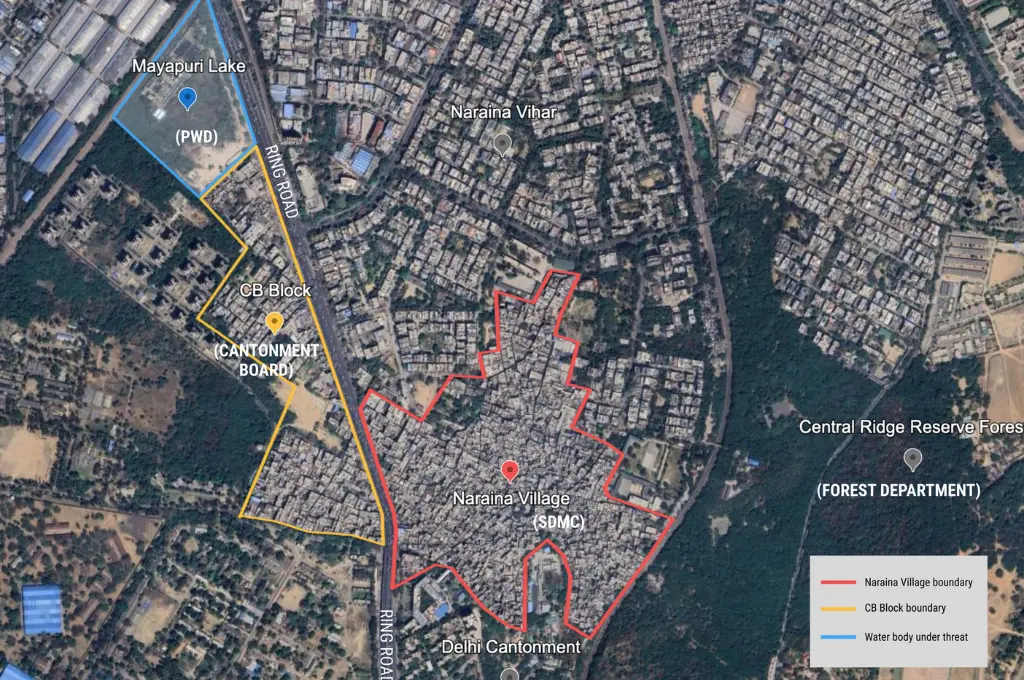
Bound by the Ridge and the Delhi Cantonment on one side, and the planned colony of Naraina Vihar and the Industrial Area on the other, Naraina Village occupies a particularly constrained geography.
It is one of the many villages in Delhi that hold remnants of its rural past while being excluded from its ‘developed’ or ‘modernised’ present. These are spaces that are neither rural enough to sustain agrarian or forest-based livelihoods, nor totally severed from the commons, and not urban enough to access basic civic infrastructure.
Before Independence, Delhi was largely rural in both form and space. However, in the decades that followed, the state acquired vast tracts of agricultural land to build public institutions, formal industries, and planned residential colonies. Post Independence, Delhi’s villages were classified as urban on paper, but remained suspended in a governance limbo—too rural for municipal systems, too urban for gram sabhas.

Much of this uncertainty was also rooted in the colonial Lal Dora framework of 1908, which demarcated inhabited villages from surrounding agricultural land. Over time, these areas were exempt from building byelaws, with post-Independence notifications (notably in 1957 and 1963) reinforcing the absence of regulatory oversight.
In many urban villages, this ambiguity gradually translated into institutional neglect. Naraina is one such example. Originally home to pastoral and farming communities for more than a century, Naraina underwent rapid urbanisation in the late 20th century. Villagers began turning to other economic activities in the surrounding areas, taking up work in government, the informal economy, and the service sector. Inside the village, landowning families rented out land and commercial space to small workshops and industries, and constructed rental accommodation for incoming urban residents.
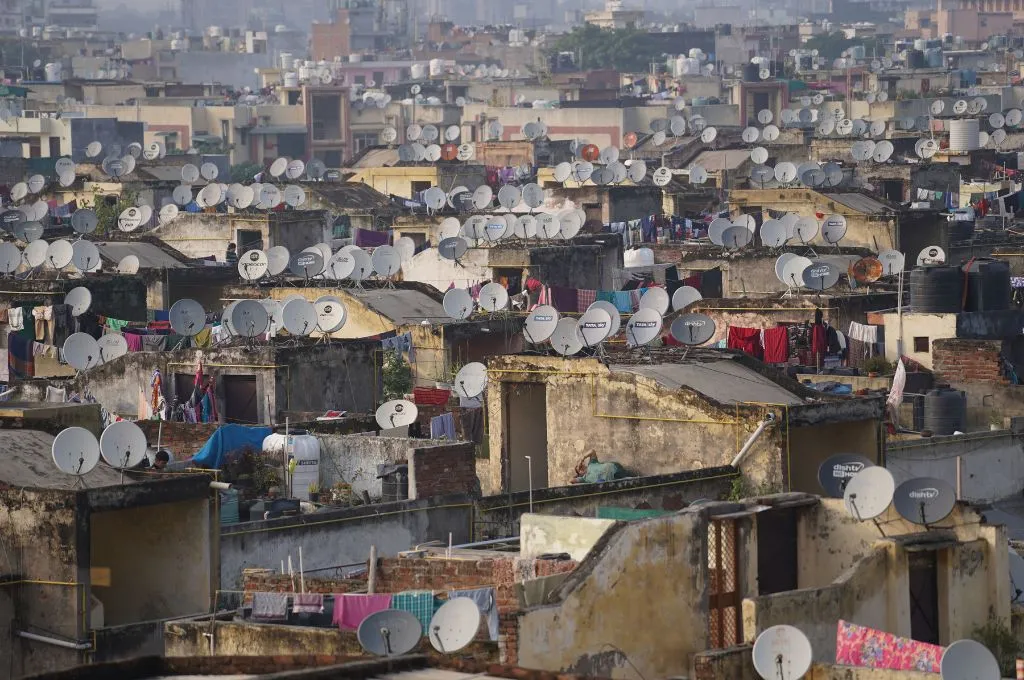
Today, more than 50,000 people live in Naraina, a settlement originally planned for roughly 5,000 residents in the 1970s.
With little to no room to expand outward, growth in the village has inevitably been vertical. This expansion has also occurred largely outside planning frameworks, constituting an unaccounted-for trajectory in most urban villages of Delhi.
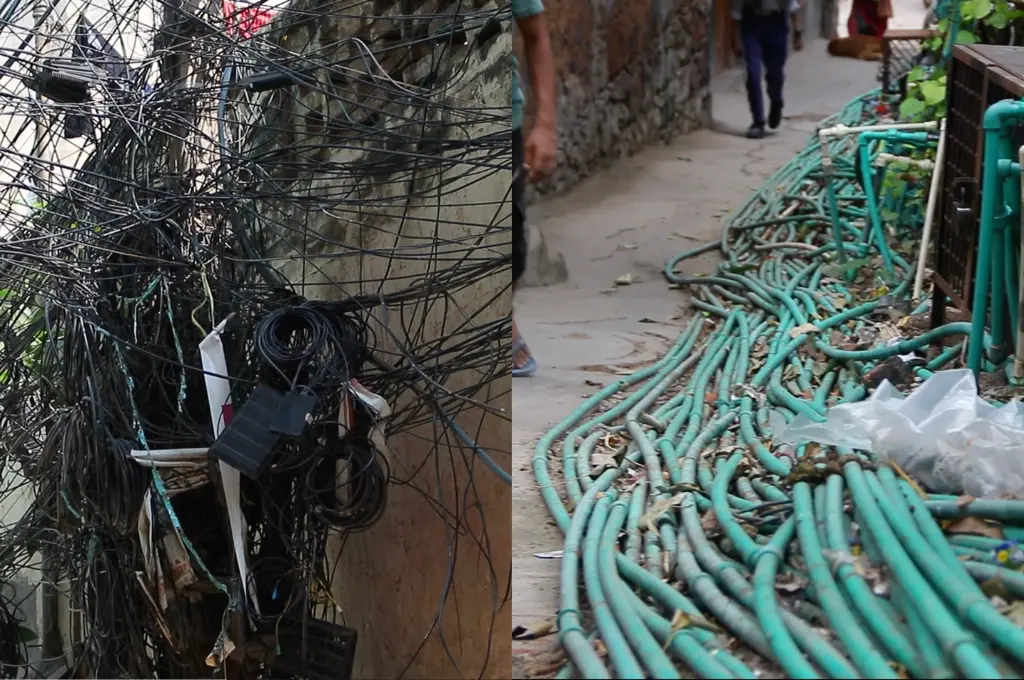
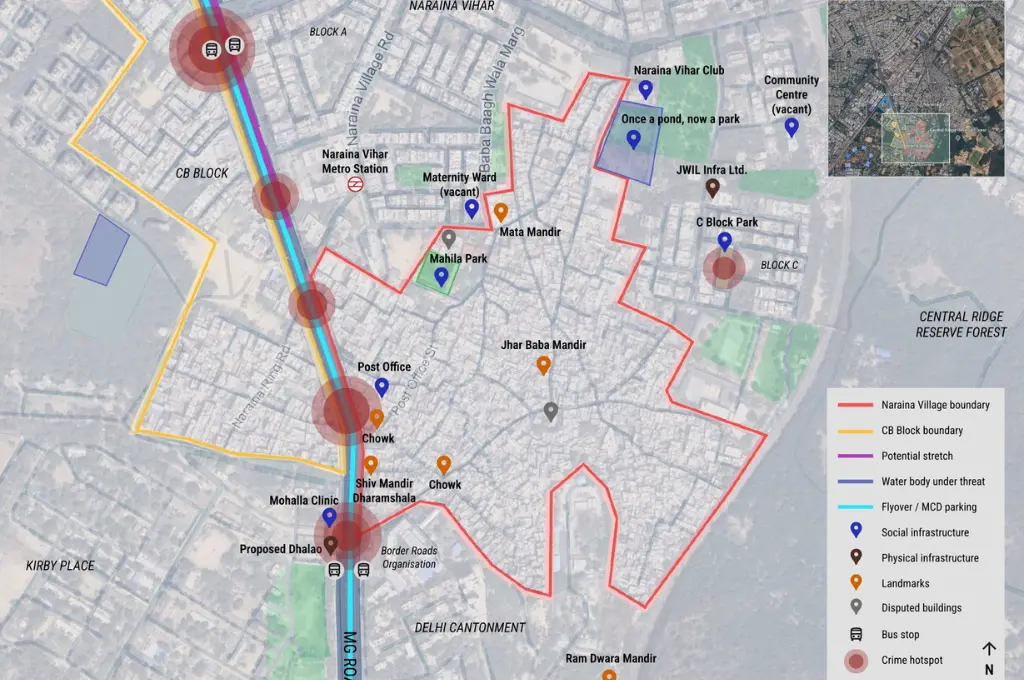
While surrounding neighbourhoods underwent planned urbanisation, Naraina itself remained excluded from municipal service provision, development regulation, and long-term planning by agencies such as the Delhi Development Authority. Although the village was eventually incorporated into the municipal system, many of these historical exclusions continued to shape everyday life. As a result, basic civic amenities—schools, health centres, parks, and playgrounds—are largely located outside the village, making them inaccessible to residents.
Disappearing commons and customs
All of these issues were brought up during the jan sunvayi. The meeting was attended by officials from multiple departments, including the Delhi Jal Board, Horticulture Department, traffic police, a representative from the One Stop Centre (OSC), and the SDM.
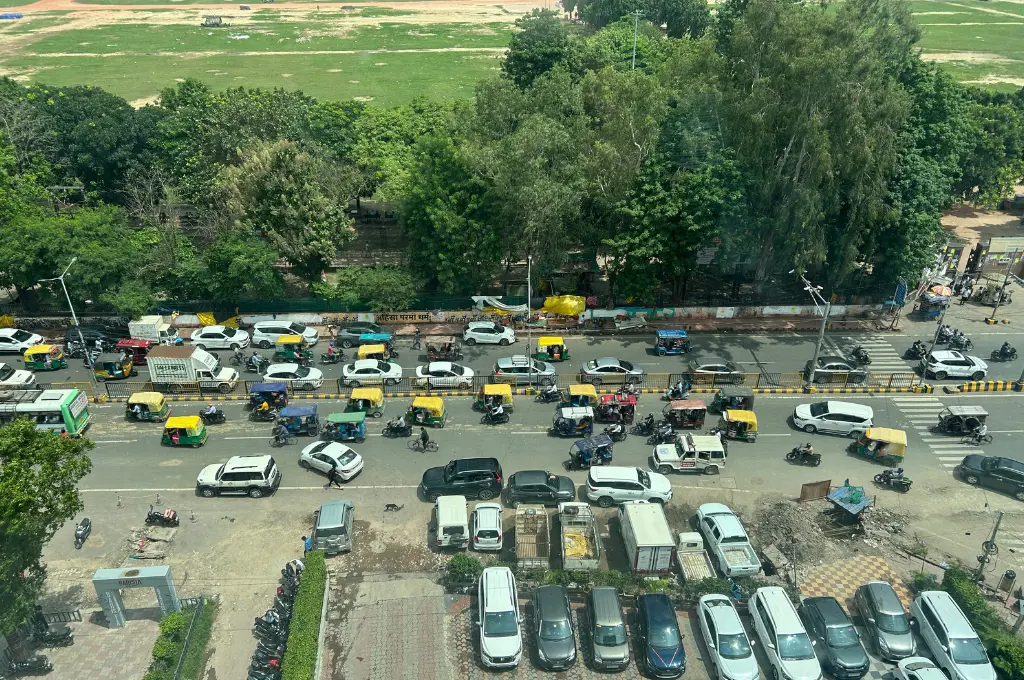
Residents spoke of inadequate basic infrastructure, lack of social amenities, water inequities shaped by the ridge’s topography, and streets that were too narrow (under three meters) for disaster management and preparedness.
They raised questions around land ownership. “How will you determine ownership of a plot which is shared by multiple people]?” said Sameer*, a resident, referring to properties that have been sub-divided floor-wise among family members or sold to migrant households over time. His question echoed a common frustration.
Residents also complained about the loss of natural resources and commons, which had once shaped social life in the village.
“We have lost our water bodies,” said Naresh, 67*, pointing to long-standing demands to rejuvenate and protect water bodies that have been encroached upon to build parks for neighbouring colonies and buildings.
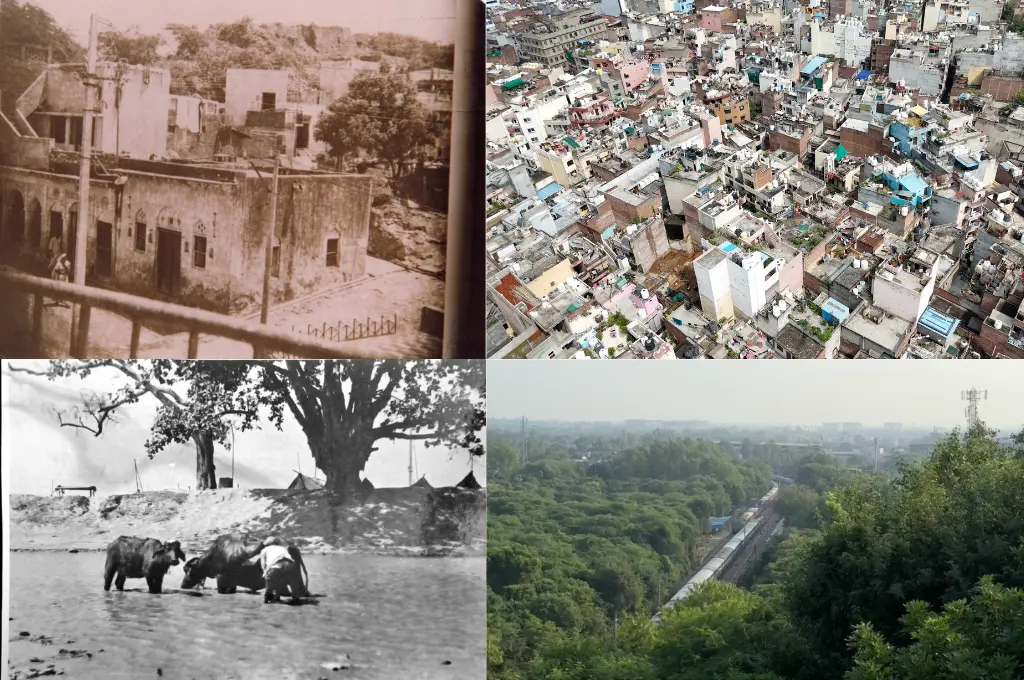
The issues raised during the hearing also highlighted the lack of public and recreational spaces, such as parks and sports areas, within the village, and how residents often had to go to neighbouring colonies just to access common facilities. Imagine if your neighbourhood had cramped living quarters and barely breathable streets, and if you had to walk to an adjoining neighbourhood for greenery or to enjoy a game of evening cricket in areas which had belonged to the village in the past. Here, inter-colony politics, social stratification, and questions of inclusion and belonging are disregarded.
In the Ridge villages such as Naraina, wrestling (pehelwani or kushti) was once deeply embedded in everyday life, with akharas serving as a collective space for players and spectators. However, all akhara spaces within the village have either been encroached upon by commercial or temporal activities or acquired by the government. There is only one akhara inside the Ram Dvara Mandir now, which is sponsored and maintained by the community.
Meanwhile, there has been a delay in the construction of the proposed indoor sports facility under the Naraina flyover. Traditional spaces like chaupals—where raagnis were sung and nagaras were played during celebrations—have since disappeared due to development pressures and land acquisition, forcing festivals to be held under the Ring Road flyover with little to no state supervision.
As residents spoke about these experiences during the jan sunvayi, a deeper resentment revealed itself: that surrounding areas, such as the planned colony of Naraina Vihar, had been systematically provided for, while the village had been overlooked.
Waiting for an answer
During the jan sunvayi, residents were asked to raise only “public complaints”. The proceedings largely took on an almost procedural tone, with the SDM asking residents to identify to which department each complaint belonged, as though governance was a matter of categorisation rather than resolution. People were asked to submit their complaints in writing to ensure departmental action.
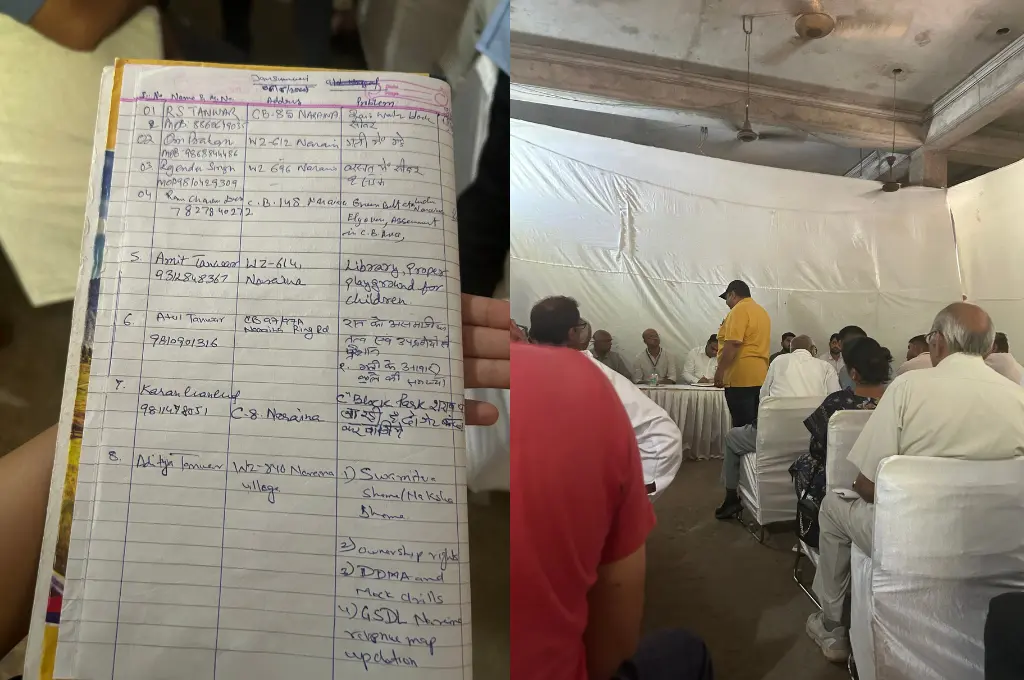
However, no steps were taken.
A few days later, a follow-up meeting was held at the SDM’s office, where a smaller group of residents was invited to decide how the village’s issues should be prioritised. The matter was subsequently escalated to the office of the District Magistrate (DM), who met the group the following week. The once-alien format repeated itself: departments were summoned, issues discussed, and assurances made.
A key outcome was the promise of karyavahi, or on-site inspections, to verify and act on complaints addressed by the community. Yet, as of writing, these have not materialised.
How youth in Naraina are claiming space and citizenship
While institutions have been slow to respond, residents, especially the youth, across Delhi’s urban villages (including Naraina), have developed their own ways of confronting chronic governmental neglect in different ways.
Over the course of our interactions with communities in Naraina, I have observed a key shift in the vocabulary used by young people. From conversations about political representation and participation in explicitly caste- and kinship-based terms among older generations, youth in the Jat community, for instance, have begun placing a much stronger emphasis on rights, legality, governance, quality of life, and claims to urban citizenship.
This transition is accompanied by new forms of everyday resistance, both spatial and discursive. Against the backdrop of longer struggles over land ownership by dominant-caste, landowning communities in Naraina, youth from these communities are now participating in collective mobilisation such as CYCLE, The Dilli Dehat Project, Delhi 360 Urban Dehat, and Bhashakosh to actively construct digital repositories of village histories to assert their visibility within broader public imaginaries. They capture the aspirations shaping Delhi’s imagined future—‘world-class,’ ‘sustainable,’ ‘walkable,’ and ‘mixed-use’—which were once embodied by these villages themselves. Moreover, there is also growing recognition among these initiatives for the need to expand advocacy and inclusion across communities within the village.
In Naraina, the youth are deeply engaged in archiving their village’s past through maps and oral histories, filing petitions against illegal land acquisition or governance-related mismanagement, and monitoring local actors to ensure they do their job. During City Sabha’s interactions with them, they facilitated several OpenStreetMap training sessions so that the community can own their spatial data and use it as a fact-finding tool to support legal discourse. This is particularly important given that no land ownership documents have been issued in Naraina so far, as the Geospatial Delhi Limited (GSDL) portal has not yet updated the revenue map. The community has previously also organised around other issues, including a protest outside the village where a waste point was being constructed on a footpath, leading pedestrians to avoid the passage.
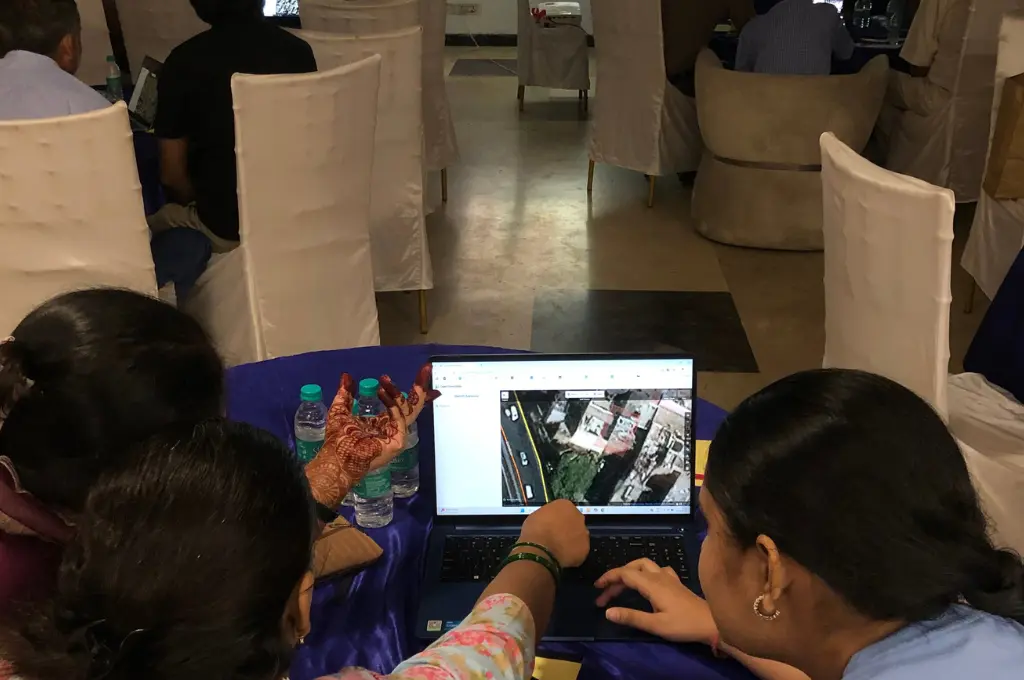
Naraina continues its generational practices of resistance and mobilisation, despite several roadblocks, as they hope for justice and accountability one day. Their liaisons with the state are multiple and frequent, spanning generations.
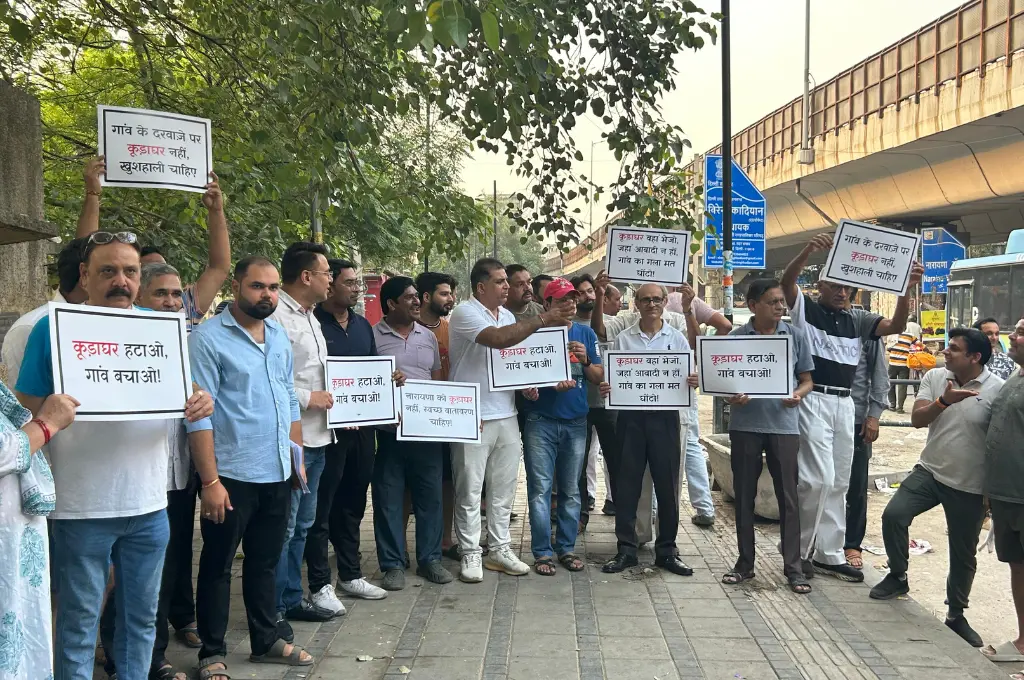
It is often said that democracy functions best when there is an active citizenry. The expectation is that this will lead to the deliberation and prioritisation of citizens’ demands for rights or services by the state. However, in practice, participation alone can feel unequally burdensome and function as a one-way street, especially for people relegated to the peripheries of formal governance systems.
Naraina village’s experience reveals a structural imbalance: citizens are expected to perform democracy, while the State’s response remains inconsistent and opaque.
It is clear that citizen participation alone cannot compensate for a lack of administrative clarity, accountability, or political will. If democracy is to function meaningfully, it must move beyond mere citizen activation and procedural box-ticking toward a model of relational accountability— where governance is not merely responsive but structurally aligned with the lived realities it seeks to serve. If the governance of urban villages and the possibilities for their future concern you, it is time to translate concern into collective citizen action—one story at a time.
All images, maps, and audio recordings featured courtesy of City Sabha.
*Names have been changed and anonymised to maintain confidentiality.
—
Know more
- Learn more about the spatial and developmental trajectory of Delhi’s urban villages.
- Read this report on the availability and accessibility of green spaces in Delhi.
- Learn about the importance of a citizenship approach in supporting grassroots leaders in Mumbai’s informal settlements.