In Chhattisgarh, Baiga Adivasis map their food, forest, and fires
 Gaurela-Pendra-Marwahi district, Chhattisgarh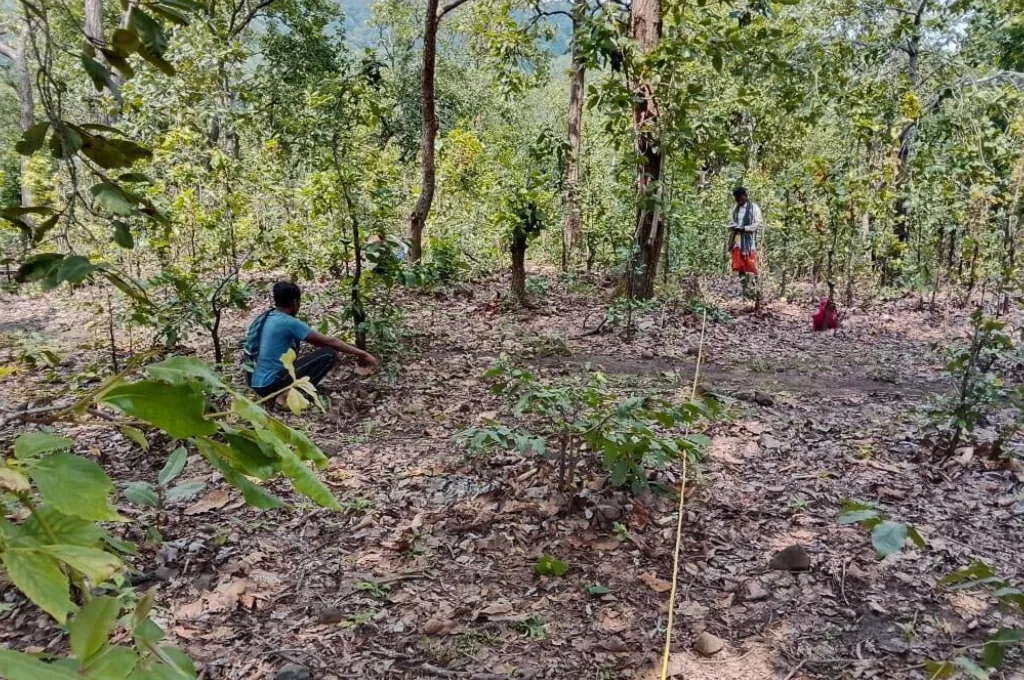
In Chhattisgarh’s Gaurela-Pendra-Marwahi district, the Baigas—a Particularly Vulnerable Tribal Group (PVTG)—primarily reside in 19 villages (tolas/paras) across 13 gram panchayats of the Gaurela block. The lives of the Baiga people are rooted in the forest, from which they obtain resources such as traditional agricultural produce, medicinal herbs, timber, fruits, vegetables, and other necessities. Under Section 3(1)(e) of the Forest Rights Act (FRA), 2006, the Baiga tribe was granted Habitat Rights in 2023; this has changed their relationship with the forest.
Nineteen villages came together with Nav Nirman Chetna Manch, an organisation working on FRA awareness, for recognition of their habitat rights, which grant tenure over ancestral lands for sustainable use and cultural preservation to PVTGs and other forest dwellers.
With legal recognition in place, community members began discussing how to contribute more effectively to strengthening the forest and its structure. People from five villages started documenting and managing forest resources to preserve traditional knowledge and understand the changes that have occurred in forests and resources over the years.
As part of this effort, community members collectively initiated seasonal resource mapping.
The villagers mapped the areas by dividing them in plots of 40×40 metres. Instead of using the compartment number allotted by the forest department, we follow a traditional method of naming areas to map them. For instance, an area frequently visited by a bear, or bhalu,is called bhalumara.
We document which pulses, leafy vegetables, and medicinal herbs are currently available during different seasons.
Over the past five years, climate change, irregular rainfall, reduced precipitation, and the community’s discontinuation of shifting cultivation have led to the gradual disappearance of some pulse varieties as the forest is unable to regenerate naturally. Today, this practice is no longer as prevalent, and along with it many traditional food items have also declined.
Earlier there were five varieties of arhar (pigeon pea) lentils, which have now reduced.
Similarly, dodde bhaji—a leafy vegetable collected in winter and eaten during summer to keep the body cool—has become increasingly scarce. While sal trees are relatively abundant, species such as gujja, sejha, and dhawa are found in much smaller numbers. Certain medicinal plants—such as teen paniya, gauther, dudhiya, chirayta, hasiyadebo, gul sikri, and badka dawa (a medicine used to treat anaemia)—are still not found.
However, some small plants have started regrowing; an example is bahri (broom grass), a plant used for making brooms. Forest fires have also reduced since everyone considers it their responsibility to monitor the areas.
We maintain detailed records of resources extracted from the forest, which has created a clear understanding of how much of each resource exists. Earlier, people simply collected what they needed without such awareness. Information about resources on the verge of extinction has reached everyone, and people have become more conscious about conserving them.
This also helps us document how the community maintains ecological balance through culturally embedded practices. For instance, clans play an important role in Baiga culture. Each clan is associated with a particular animal, bird, or plant. The Korcho clan in the Baiga tribe does not consume bamboo shoots, although people from other clans do. Similarly, members of the Khoriya clan do not eat turtles.
Both women and men are involved in this work; women in particular also manage the responsibilities of the core committee. The belief that ‘the forest cannot exist without us, and we cannot exist without the forest’ has grown stronger.
Chandra Pratap Singh works as a programme manager with Nav Nirman Chetna Manch. Premlal Baiga is president of the Community Forest Resource Management Committee.
—
Know more: Read more about Baigas’ search for identity and livelihood in Chhattisgarh.
Do more: Connect with the authors at navnirmangbd3411@gmail.com and baigapremlal881@gmail.com to learn more about and support their work.