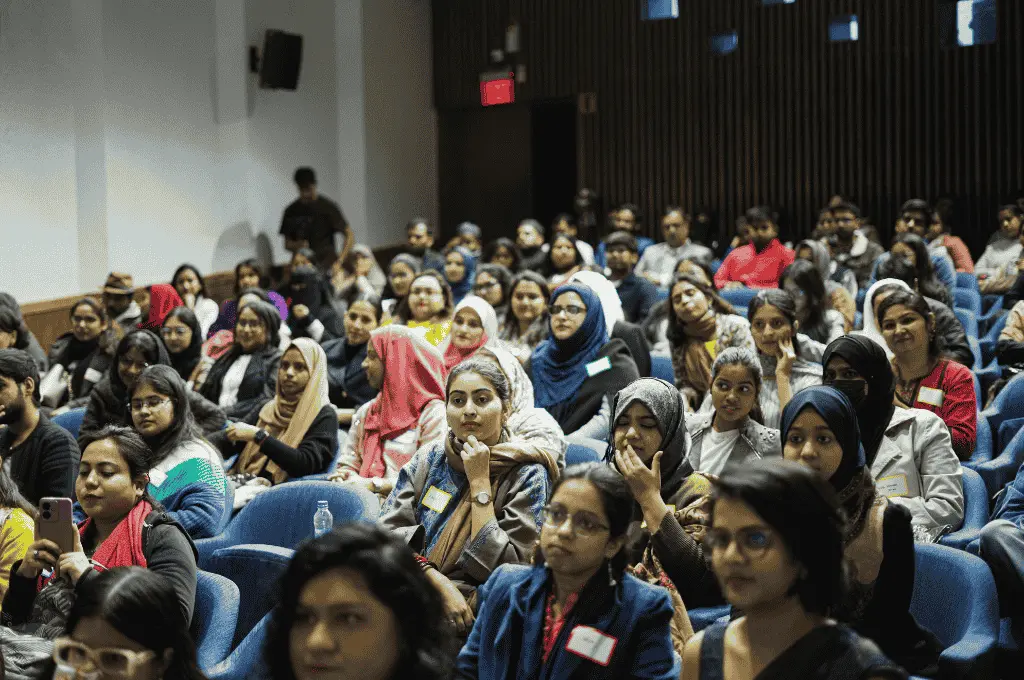
“I travelled all the way from my village to attend this conference in Delhi. Our organisation is small and has limited funding, so they could just about afford to send me. The hope was that I would meet people here who could support our work. But there’s barely any time between panels to speak to anyone. Even when there is, everyone already seems to be in groups. They all seem to know each other, and I don’t feel confident approaching them. English is also not my strong suit, and everyone here talks in English. I keep wondering whether anyone here would even understand me, or want to listen. I’m so worried. What will I say when I go back?”
This was a conversation Unnayan had with a project coordinator from a grassroots nonprofit at one of India’s largest social sector conferences in Delhi in August 2025.
Experiences like this are not exceptions. Across the development sector, countless events and conferences are organised around themes such as philanthropy, governance, education, health, livelihoods, water and sanitation, climate change, agriculture, women’s and child rights, disability, and citizen engagement—covering nearly every issue the sector works on.

In principle, these spaces are designed to foster learning and reflection, enable connections, and generate value for a wide range of practitioners, many of whom travel long distances to attend. In practice, however, they often fall short of those intentions.
Panels are dominated by funders and large nonprofits; sessions centre more on showcasing organisational achievements than on collective learning. Networking is squeezed into ten-minute breaks, and conversations unfold almost exclusively in English.
The result? A massive and disquieting gap, between what the sector claims to value—inclusion, equity, and representation—and what actually plays out at these conferences. Who gets to speak on whose behalf, who gets to truly participate, who feels welcome and respected, who is seen as an expert, and how much space they are allowed to occupy are determined by the language they speak, the cities and towns they come from, the positions of power they hold, and the networks they already belong to.
The power play
Inclusion and exclusion are rarely binary; they operate through layers of visibility, access, and authority. In theory, conferences are a way to flatten these hierarchies by bringing people from vastly different backgrounds into a shared space, positioning them as equals, and enabling interaction that may otherwise be impossible.
In practice, however, these spaces are anything but neutral. Far from suspending hierarchies, conferences often make them more pronounced. Recurring patterns around who speaks, who listens, who moves comfortably through the room, and who remains on its margins reveal how unequal these spaces can be. These inequalities are shaped by entrenched power imbalances among participants, rooted in geography, socio-cultural background, organisational visibility, positional authority, and, most critically, language.

While everyone may technically share the same venue, they do not enter with equal legitimacy, confidence, or capacity to be heard. Consequently, what is framed as an equal platform often functions as a stage where existing hierarchies of money, language, location, caste, and class are rehearsed and reaffirmed, rather than questioned or dismantled.
Here’s how these exclusions show up:
1. Who gets to speak
When a panel on women farmers’ lack of recognition features only men, it signals more than poor curation. It actively alienates the women farmers in the audience and raises a basic question: Why are they not trusted to speak for themselves? Similarly, when a male farmer is invited to describe how a nonprofit’s technological intervention improved his yield, his decades of farming knowledge are treated as anecdotal evidence rather than expertise. These are real examples we have witnessed at two different conferences.
Within organisations, those selected to attend conferences are often coordinators perceived as comfortable in elite spaces.
When conferences repeatedly centre the same kinds of ‘experts’—English-speaking, elite, typically from upper castes and the upper classes who design and implement programmes to ‘empower marginalised communities’—they send a clear message about whose knowledge is considered legitimate.
These choices are rarely accidental. Within organisations, those selected to attend conferences are often programme managers or coordinators perceived as articulate and comfortable in elite spaces, while frontline workers and community members remain absent. Discussions on field-level challenges are frequently led by speakers with limited engagement in day-to-day implementation. This hierarchy becomes even more visible when panels are interrupted to accommodate the arrival of a government official, who is immediately given the floor while others are sidelined.
Such practices divide participants into those who instruct and those who are expected to learn. When community members are invited on stage only to briefly share how an intervention changed their lives, often in their regional language, before the discussion resumes in English, their role is clearly constrained. They are positioned as evidence of impact, not as contributors to knowledge. Reduced to subjects rather than participants, their presence serves to legitimise the event rather than reshape it.
2. Who gets to participate—and how
Even when people are nominally included, the conference design often determines who can meaningfully participate.
Language: The dominance of English functions not just as a communication barrier, but as a marker of prestige and authority. While conferences increasingly invite representatives from community-based organisations, many participants told us they feel anxious and intimidated at these events. They worry about not fully understanding discussions or being unable to respond fluently in English. This often produces a sense of guilt, nervousness, and insecurity, leading people to question the legitimacy of their own knowledge, despite being closest to the realities under discussion.
Location and cost: Most conferences are held in metropolitan cities, making participation financially unviable for many grassroots organisations, especially if they want to bring community members along. Even when travel and accommodation are covered, hidden costs are rarely accounted for—caregiving responsibilities, language support, and the physical and emotional labour of navigating unfamiliar urban spaces.
Time: How time is structured shapes whose voices are heard. Well-known panellists are often allowed to overshoot their time as they detail their initiatives, while the token grassroots leader or community member is expected to perform a narrowly scripted role that serves to demonstrate inclusion and thoughtfulness on the part of the event host.
Audience members are rushed to ask their questions, discouraged from sharing their own work and experiences. This moves the format away from the dialogue spaces that conferences have an opportunity to be. At one event, state-level groups implementing a programme on the ground were given space to speak only on the final day, when they pointed out that plans discussed over the previous two days were not feasible within the funder’s mandate. By then, the agenda had already been set.
Consent: As conferences increasingly record sessions and circulate them online, consent from participants is rarely sought. Not everyone can afford to have their identity made public, especially participants with sometimes vulnerable or contested identities. Moreover, when recordings are shared, accessibility features such as subtitles and audio descriptions are often treated as optional rather than essential.
Food: Even meals reproduce hierarchy. At several events, we’ve seen funders and conference partners being served separately, in exclusive rooms, while others queued elsewhere. For instance, Adivasi participants at one event were directed to a different line altogether. In another, participants were served curated ‘Adivasi food’ on leaves as a cultural exhibit—yet the very communities whose food and culture were showcased were segregated and treated differently.
3. Who gets accessibility
Accessibility is often narrowly understood as physical infrastructure—ramps, elevators, proximity to venues—and usually only prioritised at events focusing on disability. In most other cases, it is an afterthought. Everyday requirements such as accessible washrooms, seating, navigation, and signage, which determine whether someone can actually participate are routinely overlooked.
When adequate breaks, quiet spaces, and flexible participation are absent, conferences end up reinforcing the idea that access is an individual burden.
At a conference attended by our team, transgender participants were not informed in advance about available accommodations. The venue had only cisgendered washrooms, and a participant was confronted simply for entering one of them.
Accessibility is also shaped by time and sensory design. Eight-to-ten-hour conference days, packed with back-to-back sessions, can quickly become overwhelming, especially for people with neurodivergences and invisible disabilities. When adequate breaks, quiet spaces, and flexible participation are absent, conferences end up reinforcing the idea that access is an individual burden rather than a collective responsibility.
Conferences don’t have to be this way
Conferences are meant to be—and can be—inclusive, engaging spaces for learning and exchange. While there are many examples, especially at large annual flagship events in Delhi and Mumbai, where gaps are glaring, there are also instances where organisers have made thoughtful design choices. These moments demonstrate that exclusion is not inevitable, and that gaps can be addressed with intention.
At one event in Hyderabad, networking and meals were closely interwoven. The venue was a large hall with only floor seating. When everyone sat together to eat and chat, it automatically brought people together. The shared physical space broke barriers of uncertainty and insecurity.
Similarly, at another event, there were no panels at all. People presented their work through art, such as plays, paintings, and other tangible products related to their work. Attendees could see, feel, and interact with the work, rather than simply hear about it. Another conference had dedicated spaces for organisations with similar challenges to talk to each other, exchange experiences, and learn collectively.
Even within the traditional panel formats, some organisers made room for care. One conference designed the space so attendees could leave the room quietly if they felt overstimulated and needed to decompress, without disrupting the conversation. It acknowledged that participation does not have to be constant or performative to be meaningful.
If conferences are meant to be spaces of learning, exchange, and collective imagination, rather than a funding mandate, then inclusion must be treated as a core principle, not an afterthought. Intentionality goes beyond ensuring the presence of marginalised voices in the room. It requires designing the room itself so that people can speak, listen, disagree, rest, and belong. Lived experience is not anecdotal evidence to be displayed; it is a form of knowledge that deserves to influence how policies are imagined, implemented, and evaluated in relation to the realities people inhabit.
IDR team members contributed to this article.
—
Know more
- Read more about how conferences can be inclusive for persons with disabilities.
- Understand how social exclusion impacts a person’s sense of agency.