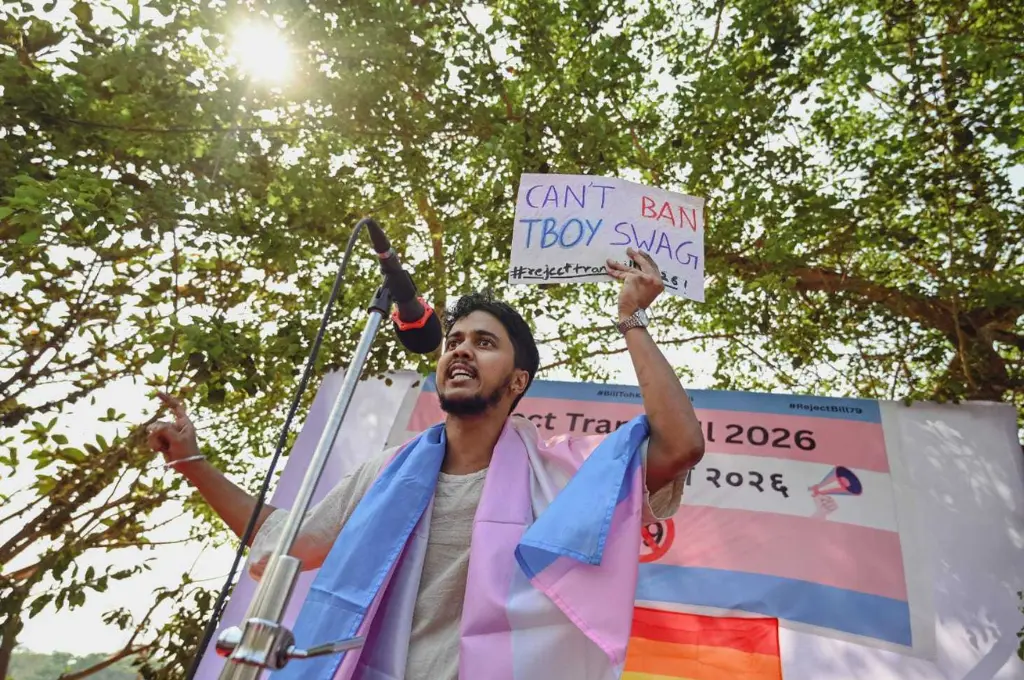
We are a collective of Transgender, Intersex, Gender Diverse and LGBQA+ individuals—including transgender persons with disabilities—parents, healthcare professionals, women’s rights groups, disability rights advocates, and human rights organisations from Mumbai, Navi Mumbai, and Thane. We condemn the Transgender Persons (Protection of Rights) Amendment Bill, 2026, which threatens the rights and dignity of our communities, and urge the public and policymakers to stand with us in opposition.
This Bill does not protect transgender persons. It surveils them, criminalises supporters, and erases entire communities from legal existence. It flagrantly violates Supreme Court judgments such as NALSA 2014 and Puttaswamy 2017, undermining our legal rights and the rule of law.
The Bill was drafted without adequate community consultation and without a credible research base. Its bureaucratic and medical gatekeeping falls hardest on gender diverse persons from historically marginalised communities—Dalit, Bahujan, Adivasi, and working-class individuals—whose intersecting identities already make them more vulnerable to state surveillance and institutional exclusion.
It also erases the distinct struggles of Intersex people, many of whom do not identify as transgender and face their own specific battles against discrimination and harm. And it removes the Section 7(3) proviso that protected trans persons who had already updated their documents under the 2019 Act. People who built their lives around a legally recognised identity now have no legal category that protects them. They cease to exist in law.
This Bill does not arrive in isolation. It arrives in a healthcare system that has treated transgender persons as suspect bodies for years: since 2017, the National Blood Transfusion Council has permanently banned transgender persons from donating blood—a policy with no scientific basis. This Bill extends that same institutional logic, building a state-controlled surveillance mechanism around transgender healthcare that no other patient group in India faces.
The mandatory reporting of gender-affirming procedures to the District Magistrate—without patient consent—directly violates Section 23 of the Mental Healthcare Act, 2017, which guarantees every person the right to confidentiality in their healthcare. Section 21 of the same Act explicitly prohibits discrimination in mental health services based on gender or sexual orientation. This Bill is discriminatory under the very statute that governs mental health practice in India.
Our specific demands to the Government of India
1. Immediate withdrawal of the Bill
We demand the immediate withdrawal of the Transgender Persons (Protection of Rights) Amendment Bill, 2026. The legislation is unconstitutional, lacks evidentiary support, and poses a direct threat to the safety and dignity of our community.
2. Referral to the Standing Committee
If the government will not withdraw the Bill, we demand its immediate referral to the Parliamentary Standing Committee on Social Justice and Empowerment for a rigorous, transparent, and evidence-based review—one that mandates substantive participation from the communities this Bill seeks to address.

3. “Nothing about us without us”—Mandatory community consultation
The language and framing of this Bill make it clear it was not written with the community in mind. We demand that no further legislative steps proceed without a formal, nationwide consultation—one that centres transgender, non-binary, intersex, and gender diverse individuals, including transgender persons with disabilities as a distinct voice, not a footnote, alongside their families and healthcare providers. This inclusion is vital to building trust and ensuring fair representation.
The government must publicly clarify which mental health professionals, medical experts, disability rights advocates, and transgender community members were consulted during the drafting of this amendment. Legislation that makes clinical and psychological claims without consulting the relevant professions has no evidentiary foundation to govern a marginalised population.
India endorsed ICD-11 in 2019, which explicitly removed gender incongruence from the chapter on mental disorders. The WHO’s reasoning was clear: classifying gender diverse identities as conditions of mental ill-health causes enormous stigma. This Bill reinstates that stigma in law, seven years after India itself endorsed the framework that rejected it.
4. Restoration of self-identification and abolition of medical boards
The Bill takes away the right to self-determination, handing the determination of gender identity over to medical boards and bureaucratic scrutiny. This directly violates the NALSA 2014 judgment and the right to privacy in Puttaswamy 2017. Gender identity belongs to the domain of personal psychological experience. It cannot be validated or invalidated by a state-appointed body. Medical professionals exist to provide care—not to act as gatekeepers of personal identity.
The privacy violation does not stop at identity certificates. The amended Section 7(1A) requires hospitals to report the details of every gender-affirming surgery to the District Magistrate and a medical board—without patient consent, without clinical justification, and without any restriction on how that information is subsequently used. No other surgical procedure in India is subject to this kind of mandatory state reporting. Singling out gender-affirming surgeries for government surveillance is discriminatory on its face.
5. Scrapping of punitive amendments to Section 18
The proposed changes to Section 18 introduce imprisonment of up to five years for ‘alluring’ or ‘forcing’ someone to ‘become transgender’—with no empirical evidence that this occurs in India. The vague framing ties transgender identity to criminality, echoing the logic of the colonial-era Criminal Tribes Act of 1871, which classified entire communities as inherently criminal based on identity alone.
Mental health professionals have specifically flagged this as a conversion therapy pipeline: a gatekeeping body with no requirement for trans-affirmative practitioners and no prohibition on coercive ‘watchful waiting’ approaches.
Criminal liability under this clause does not only apply to medical professionals. It extends to anyone who affirms a trans person’s identity—a parent who uses their child’s chosen name. This friend accompanies them to the hospital, a teacher who offers support, a member of a chosen family who stands by them. For transgender persons with disabilities, caregivers are not optional support. They are legally recognised as essential infrastructure under the Rights of Persons with Disabilities Act, 2016. Criminalising that caregiving relationship is not only a transgender rights violation—it is a disability rights violation.
Chosen families and caregivers are a survival structure for many transgender persons in India, not a social preference. Criminalising them is not protection. It is cruel.
6. Inclusive legal recognition
The Bill collapses intersex and transgender identities into a single definition—treating two distinct experiences as interchangeable. It then narrows legal recognition to four specific socio-cultural identities: Hijra, Kinnar, Aravani, and Jogti. Trans men, trans women, genderqueer, gender-diverse and non-binary persons are excluded entirely, in direct violation of the self-determination mandated by NALSA 2014.
It’s important to name what this narrowing actually does. These four categories are drawn predominantly from dominant-caste Hindu mythological and cultural frameworks. This is not a neutral administrative choice. Transgender persons from Muslim, Christian, Sikh, Dalit, Bahujan, and Adivasi communities—whose gender identities exist within entirely different cultural vocabularies—are rendered invisible in the Bill’s own definitional architecture. Legal recognition must not require a person to adopt a cultural framing that is not their own.
The assumption embedded in the Statement of Objects—that gender-variant identity is a Western import requiring legislative correction—has been systematically dismantled by historians and anthropologists working from Indian archives and communities. Hinchy (2019) demonstrates from colonial records that gender-variant communities had established cultural formations and public roles long before British contact, and that it was colonial law, not indigenous society, that criminalised them. Dutta and Roy (2014) show that “transgender” as a transnational label is itself the import—the experience and community formation preceded it by generations. The commentary by Shankar, Rajaraman [Kondaiah] et al. (2022), published in The Lancet Global Health, states directly that rigid gender binaries were introduced under British colonial rule, and calls on India to reclaim the gender diversity that historically characterised it. To apply the “Western import” claim selectively to transmasculine identities while exempting transfeminine ones is both arbitrary and internally inconsistent: if hijra and kothi formations are recognised as indigenous, transmasculine identity cannot simultaneously be framed as foreign. Community-based empirical research with 377 transmasculine participants across 22 Indian states, conducted in Hindi and Marathi (Chakrapani et al. 2024), corroborates this: these identities are articulated in Indian languages, within Indian social structures, and long before any foreign vocabulary existed for what people were already living.
The government is not correcting a definition. It is deciding that certain people; people who exist, who work, who are raising families, who are in our communities right now, do not have a legal category.
7. Protection of ongoing medical care
This Bill’s surveillance architecture and mandatory reporting requirements will interrupt ongoing hormone therapy for people already mid-regimen. Gender-affirming hormone therapy is associated with documented reductions in depression, anxiety, and gender dysphoria, and improvements in quality of life (Baker et al. 2021; Garcia Gutierrez et al, 2024). Abrupt interruption of established treatment has been clinically documented to cause resumed gender dysphoria, mood disturbance, and psychological distress (Eckstrand et al. 2025), and long-term effects on bone density (Giacomelli and Meriggiola, 2022).
An Indian government study at Government Rajaji Hospital, Madurai—tracking 842 transgender individuals over 3.5 years—found that gender-affirming hormone therapy measurably reduced depression. A Bill that interrupts that care will produce the opposite. We demand that no legislative framework place any person’s ongoing medical treatment at risk.
The human cost here is not hypothetical. 31 percent of transgender persons in India die by suicide, of whom half have attempted suicide before the age of 20—not because of their gender identity, but because of legal exclusion, documentation barriers, and denial of care. Across 29 peer-reviewed studies involving 2,789 participants, gender-affirming care significantly reduces depression and suicidality. Every protection this Bill removes is a suicide prevention mechanism being dismantled.
8. Evidence before legislation
The government’s justification rests on a narrative of welfare misuse. Its own data contradicts this.
These are not our numbers. They are the government’s own:
- Approximately 30,000 identity certificates have been issued for a community that the 2011 Census counted at nearly 490,000—less than 10 percent of the estimated population.
- 800 transgender beneficiaries were recorded under PMAY across multiple states and financial years, despite trans persons being listed as a priority group.
- Of the INR 365 crore allocated under the SMILE scheme between 2021 and 2026, less than INR 6.8 crore had been utilised as of April 2025 (Digital Sansad, 2025).
These figures do not describe a community hoarding benefits. They describe a community being systematically denied access to schemes that exist on paper and nowhere else. The crisis is not excess access to welfare—it is the near-total inaccessibility of welfare that was promised. If the government has evidence of fraud at scale, we demand that it publish that data publicly before any further legislative steps are taken.
9. Preservation of the right to residence and family
The 2019 Act gave transgender persons the right to reside with their family and, where that was not safe or possible, the right to be placed in a rehabilitation centre by court order. The Bill’s redefinition of who qualifies as transgender strips this protection from anyone it no longer recognises. For those persons, there is no longer a legal right to remain in their home, no recourse against eviction, and no institutional alternative.
We demand that any revised framework preserve and strengthen—not remove—the right to safe housing for transgender persons.
10. Protection of transgender persons with disabilities
The Rights of Persons with Disabilities Act, 2016 guarantees accessible services and individual autonomy—including the freedom to make one’s own choices—for all persons with disabilities, in line with the UN Convention on the Rights of Persons with Disabilities. This Bill directly contradicts those protections.
The multi-layered certification process—requiring validation from medical doctors, the District Magistrate, and a medical board—creates compounding barriers that fall hardest on transgender persons with disabilities. Many cannot physically appear before multiple authorities. Many cannot access the medical procedures tied to legal recognition under the Bill. Rather than streamlining access as the RPWD Act requires, this Bill multiplies the number of gates a disabled person must pass through to be recognised in law.
The Bill’s narrow, medicalised definition of transgender also excludes transgender persons whose disabilities prevent them from accessing or completing the procedures the Bill treats as proof of identity. This is not an unintended consequence. It is the structural result of treating a legal category as a biomedical checklist.
We demand that any revised framework comply fully with the RPWD Act 2016, ensure that certification processes are physically and procedurally accessible, and guarantee that no transgender person is excluded from legal recognition on grounds rooted in their disability.
Trans people already live with severely limited access to fundamental rights. This Bill compounds that. We cannot claim justice while denying people autonomy over their own bodies and identities.
“Trans Rights are Suicide Prevention. Every legal protection this Bill dismantles is a life at risk.”
We demand the preservation of our constitutional dignity, our right to privacy, and our rightful inclusion in the democratic process. We stand with every transgender, intersex, and gender diverse person whose existence this Bill seeks to erase in law.
We are on the streets because the law must not be used as a weapon against the people it claims to protect. Rights once won cannot be taken back without a fight. #NoGoingBack
—
Know more
- Read more about how the Trans Amendment Bill 2026 erases those it claims to protect.
Do more
- Send an email to your Member of Parliament here.