“Jhum was great for our forefathers, the pressure on the land was less. Now, the quantity of rice produced has reduced, and we are facing issues with cultivating vegetables as well. We also want to cultivate closer to the village, which is why we come back to the same plot within seven to nine years,” says Aling,* a farmer from Aben village in Manipur’s Tamenglong district, who has been engaged in jhum for more than 30 years.
Otherwise known as shifting or slash-and-burn cultivation, the practice of jhum in the northeastern states including Manipur, Nagaland, and Mizoram dates back centuries. At the end of January, farmers start to cut the vegetation over a selected area, and the underlying soil is allowed to dry. This is followed by controlled burning of the dry, residual vegetation before the monsoon arrives. Done cyclically, the land is cleared for cultivation, and ash from the burnt crops and plants provides nutrients for new crops that are planted during the monsoon. Jhum has primarily been a method of subsistence. Farmers have used their own seeds, passing them down from generation to generation, and have not relied on external inputs or machinery.
Traditionally, they would prepare the land to grow crops for a year or two and then leave the plot fallow for anywhere between five and 30 years so that it could recover, before resuming cultivation.

However, the practice has undergone significant transformations over the years.
Uncertain weather conditions and growing sustenance pressures on land
A key challenge that farmers have been facing is the shortening of the fallow period, which has disrupted the relationship between village communities and the land. Several factors have driven this shift: People now prefer to farm on lands closer to the village, causing farmers to keep returning to the same piece of land—a departure from the ‘shifting’ nature of traditional jhum. Moreover, growing village populations have led to an increase in the demand for farmland, leading to the division of parcels among families. The expansion of other activities such as timbering, terracing, and sedentary agriculture has added further pressure on the land. As a result, there has been an overall decline in the amount of land left idle.
“With shorter fallow periods, the soil doesn’t recover as well, so fertility has reduced and crop yields aren’t as good as before,” says Thoiba,* a farmer from Puichi village in Noney district, who has been practicing jhum for two decades.
Aning,* another farmer from the village, adds, “Earlier, long fallow periods allowed the soil to regenerate, restoring fertility, and ultimately, leading to better yields. Shorter fallow periods weaken and loosen the soil. This has reduced productivity. The weather is also becoming unpredictable, and our crops are damaged by animals and rodents. Since we do not use any chemicals or fertilisers, we also depend entirely on natural processes, and the work is very labour-intensive.”
He adds, “If productivity falls, the yield is not enough for us to sustain our families. The rice we grow does not last the whole year, and any potential income we could have earned by growing and selling vegetables also vanishes.”

This loss of income has become much more detrimental over the years, especially given that tribal communities in rural parts of districts including Tamenglong, Noney, and Churachandpur (also known as Lamka) are now increasingly dependent on cash and markets to fulfil their daily needs.
While farmers are already contending with declining soil fertility and its impact on jhum practices, the past few decades have also seen some families adopt monoculture, plantation-style farming.
Moreover, while farmers are already contending with declining soil fertility and its impact on jhum practices, the past few decades have also seen some families adopt monoculture, plantation-style farming, which has made this crisis worse. The challenges are two-fold: first, we have found that monoculture plantations tend to leach nutrients from the soil, disrupting its balance; and two, because farmers are only planting one crop, a failed harvest can be devastating.
Jhum remains the predominant mode of farming in these areas—particularly among socioeconomically vulnerable, marginal cultivators who rely on these practices to grow rice and vegetables for household consumption. But the broader ecological impacts of plantations, especially on soil, have made livelihoods more uncertain for the village community as a whole.
In this context, for the past few years, Sunbird Trust has been working with farmers in Puichi to develop Sloping Agricultural Land Technology (SALT) techniques. Given that jhum is still widely used, our approach so far has been to position SALT not as its replacement, but as a supportive practice to stem soil erosion and improve water conservation and crop yields.
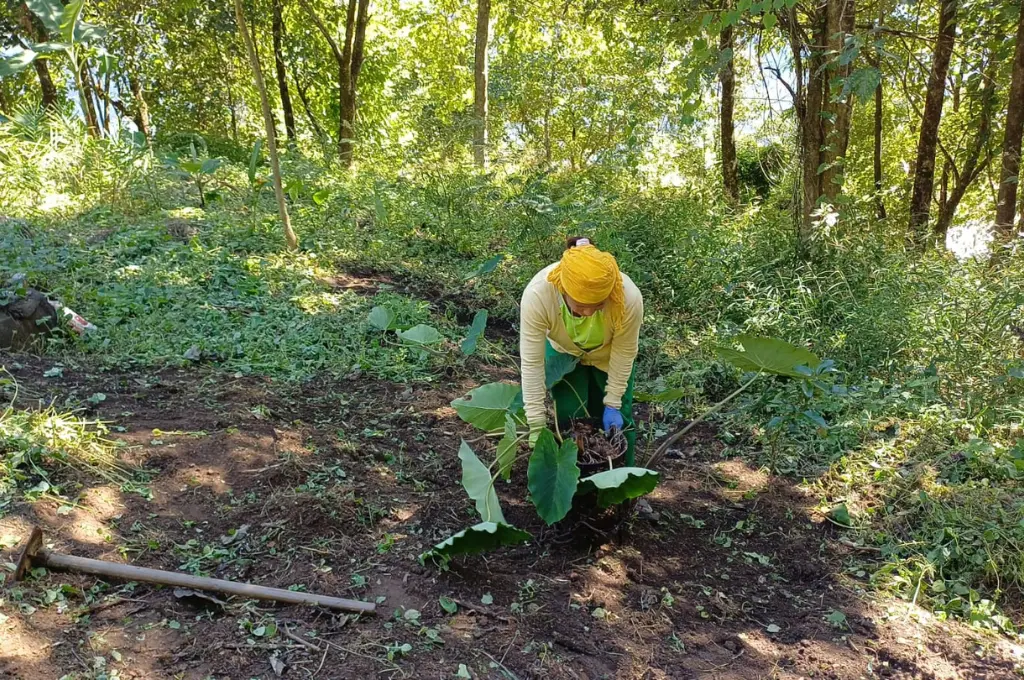
SALT as a sustainable farming option
Originally developed by the Mindanao Baptist Rural Life Centre in the southern Philippines in the 1970s, SALT is a sustainable cultivation method for sloping lands in high-rainfall areas. It involves planting a series of hedgerows of nitrogen-fixing plants along the natural contours of the elevated terrain to control soil erosion and improve fertility. The hedgerows are pruned regularly, and the clippings are used as mulch. Field crops, vegetables, and tree crops are cultivated between the hedgerows. Small livestock are also incorporated into the system, both as a source of additional income in the short-term, and to use their droppings as manure for the soil.
The introduction of SALT farming in Manipur is due, in large part, to the work of David Gandhi, an agricultural expert. In 2016, farmers in Aben told David about an old SALT programme which had been set up by a nonprofit in 1995–2000. However, a decade later, the SALT farms were abandoned, and the farmers reverted to jhum cultivation. David began working with local farmers to start a new SALT experiment as a sustainable alternative to traditional jhum cultivation. The pilot SALT farms were set up in the monsoon of 2017 with three farmers.
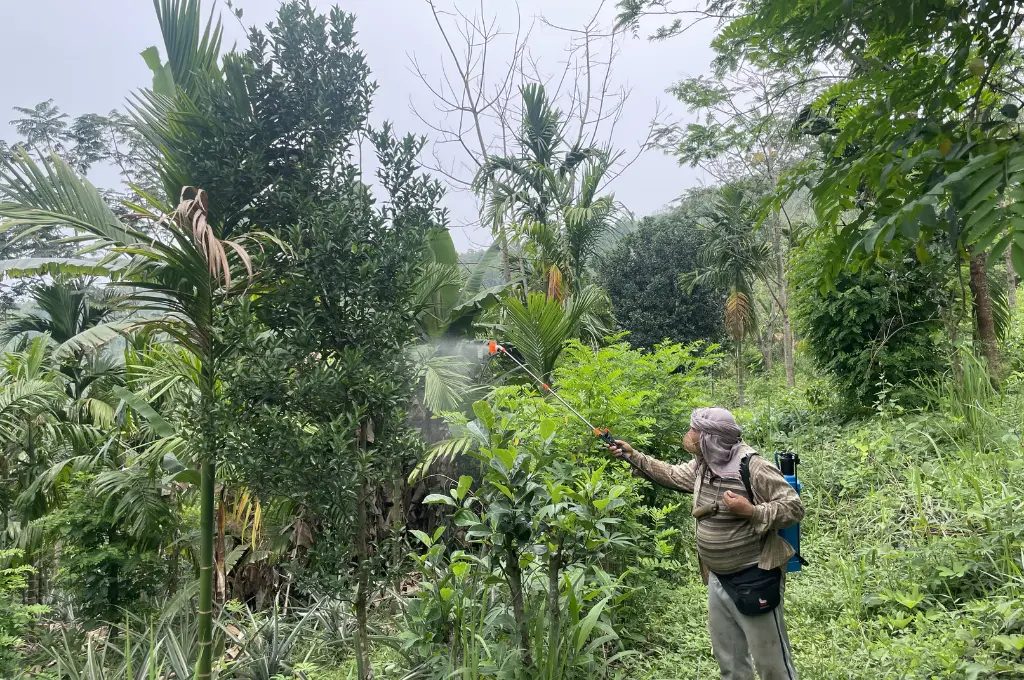
We connected with David in 2019 to explore the idea of implementing SALT with farmers in Noney, and sent members of our team to train with him and the SALT Development Committee (SDC) in Aben. In 2021, we set up a demonstration farm in Puichi. Spread across four acres, the farm has 37 types of short-term vegetables, eight types of medium-term, and more than 400 saplings of long-term varieties. The farm is also host to different livestock activities, including a poultry unit with 50 broiler chickens, a goatery unit with 12 goats, a bee unit, a fishery unit, and an upcoming duck unit.
We are currently working with 172 farmers across seven villages in the Puichi cluster. In 2025, we also started working with 30 more farmers in the Singngat subdivision of Churachandpur.
While SALT is a sustainable agricultural system in the long term, its benefits usually take a few years to fully materialise. For instance, returns from seasonal and short-term plants can take up to a year to come in and typically range from INR 5,000 to 10,000. For long-term plants, income is also dependent on land size. This is why we also support farmers in purchasing livestock, since these returns usually begin within one to three years, and can fetch up to INR 20,000 annually.
As such, supporting smallholder farmers, who are dependent on each agricultural cycle for their subsistence needs, to adopt SALT has required building trust, consistent support, and additional avenues for income generation.
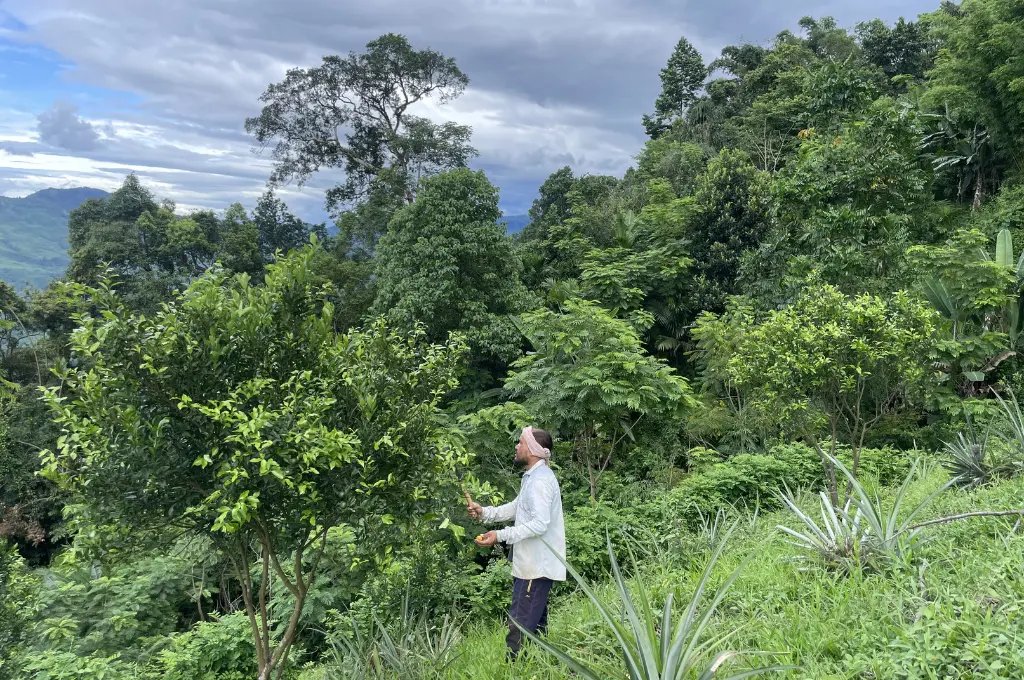
Bringing farmers on board requires a collaborative approach
SALT is a sedentary form of agriculture and is a completely new system in Noney. We have been careful to introduce it as a complementary method integrated into the village agriculture system. Financial aid, including a revolving fund to purchase livestock, is also provided to farmers during the initial period.
Through SALT, we work on in-situ soil-water conservation and on improving the nitrogen, phosphorus, and potassium levels of the soil. Nitrogen levels are built up by nitrogen-fixing plants, Tephrosia and Indigofera, that form the hedgerows; phosphorus through compost made from livestock droppings; and potassium through the ash of firewood used in kitchens. The aim is to nurture the soil without disturbing the top layer.
Farmers begin by clearing a small parcel of about one acre, and cutting and burning the vegetation similar to how they would under jhum. This is done in January and February. By April, before the monsoon, they plant the hedgerows; and between May and July they plant the saplings. The farm is cleaned (which includes weeding) four times a year. Under SALT, farmers have been able to grow a wider variety of crops including chillis, beans, bananas, papaya, orange, pineapple, and jackfruit.
Over the course of this work, our focus has been on encouraging farmers to try SALT practices and assess the benefits themselves. While the demonstration farm is one way to tangibly demonstrate the impact and tailor SALT practices to local needs, we have also worked closely with communities to address questions and build awareness.
SALT cannot be imposed as a top-down solution. Farmers are part of this process, and we learn and adapt to challenges in collaboration with one another.
We start by building farmers’ knowledge and skills of SALT through hands-on training and farm visits. We have conducted five training sessions for farmers in the Puichi area, two exposure visits—one to Aben and one to Lucknow in Uttar Pradesh (for goat management)—and two external training sessions for civil society organisations in Manipur and Nagaland. Aside from regular meetings and learning sessions, we also organise farmers’ days, where all SALT farmers are invited to the farm in Puichi for shared activities, peer learning, and experience sharing.
Along with this, we have also adopted participatory learning methods for the sustainability of the programme. In Puichi, farmers came together to form a local SALT Development Committee (SDC) even before implementing the programme in the village. The body is responsible for addressing any challenges that farmers may be facing, organising meetings, and monitoring the farms. Participatory programmes and the SDCs have since been set up in every village, with the latter acting as a nodal agency to train farmers as well as other nonprofits in SALT techniques.
As we continue our work in Puichi and other villages, we have learned that SALT cannot be imposed as a top-down solution. Farmers are part of this process, and we learn and adapt to challenges in collaboration with one another.
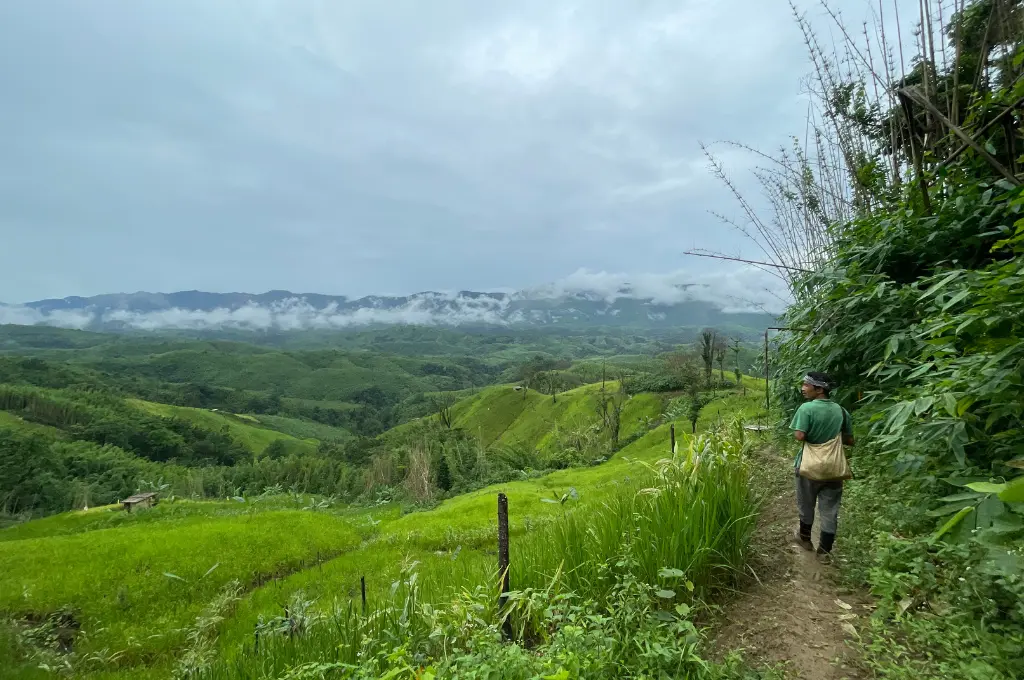
At the same time, since this system is still in its nascent stages in Manipur, there is also a need to create a broader system of support:
- Integrating SALT into formal education: At present, SALT is not included in college-level agricultural programmes, which means that these practices are currently being taught in SDCs such as the one set up by David. Existing curricula must be revised to include training students in the scientific study and practice of SALT. So, instead of a limited number of nonprofits training people from scratch, often with time and resource constraints, teaching SALT in colleges can help build larger cohorts of trained people who can support on-ground implementation.
- Building a local pool of practitioners: To effectively scale SALT, it is also important to have people in rural areas who can work with farmers. At Sunbird, we are working with young people from local communities, including students interested in agriculture, to build their skills and understanding of SALT.
- Stronger government support and convergence with existing programmes: SALT should be integrated into horticulture and agriculture policies. Local government bodies can also play a key role in supporting farmers in accessing good-quality saplings and seeds through public systems and purchasing livestock through state-level schemes. Additionally, there is also potential for convergence in developing SALT farms at the village level through programmes such as MGNREGA (now Viksit Bharat-Guarantee for Rozgar and Ajeevika Mission or Gramin). For instance, the initial work that farmers need to do to set up SALT farms could be recognised and compensated as labour days under the Mission. Similarly, grants or loans could be extended to farmer self-help groups (SHGs) to set up SALT farms under the State Rural Livelihoods Mission (SRLM).
- Better funding support in the social sector: While SALT can result in more sustainable farming incomes, the system takes between six to eight years to fully take root and provide sustainable incomes. The first year is entirely spent on training. As our experience has demonstrated, farmers need consistent support during this period. For nonprofits to be able to do this work, we also need more flexible and long-term funding so that the medium- and long-term results of SALT can be fully realised. For instance, within multi-year funding, some parts such as inputs could be covered under fixed support, with flexible funding available in times of emergency.
For generations, jhum has sustained communities in Manipur, shaping people’s livelihoods and their relationship with the land. Yet changing environmental conditions, shrinking fallow cycles, and increasing economic pressures are making it harder for many farmers to rely on the system in the same way that they once could.
In this context, approaches such as SALT can build on existing agricultural knowledge and offer additional ways to improve soil health, conserve water, and strengthen livelihoods over time. Supporting farmers to adapt these practices to fit their local realities will require long-term commitment and collaboration from governments, civil society organisations, and funders alike. The challenge ahead is not only to make agriculture more productive, but also to ensure that communities can continue to farm in ways that are both environmentally sustainable and economically viable.
*Names changed to maintain confidentiality.
All featured pictures courtesy of Sunbird Trust.
—
Know more
- Learn how jhum farmers in Mizoram are contending with changing climatic conditions, rodent attacks, and a shift to plantation crops.
- Read about how farmers in Nagaland are combining jhum cultivation with pollarding for sustainable land management.