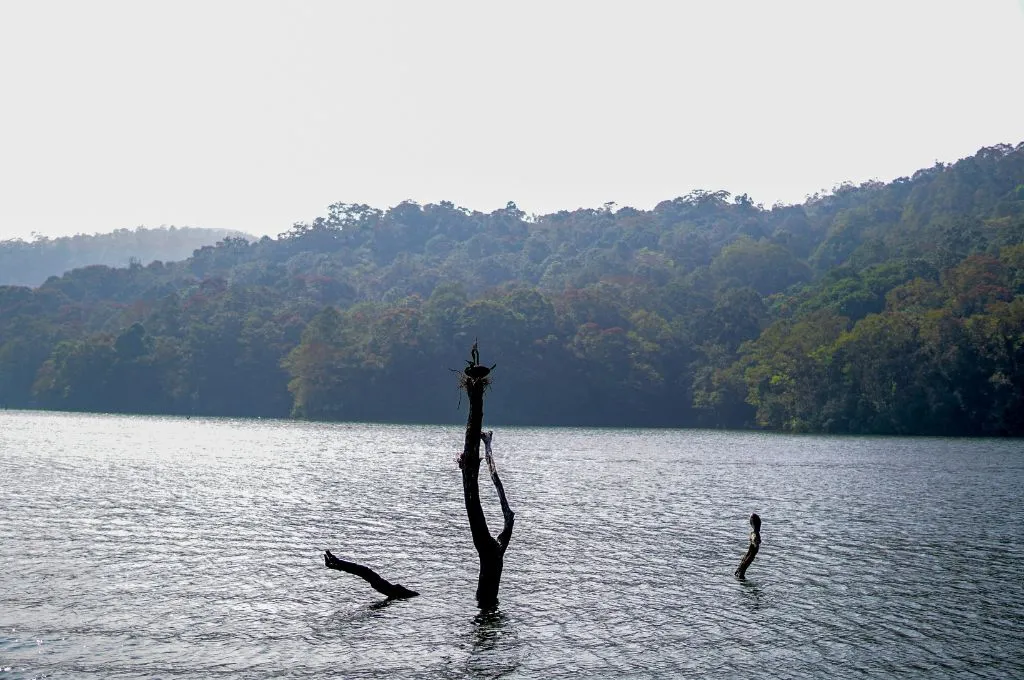
“We spend three to four hours in the forest every day… we know which leaves and flowers to pluck, and how many tubers to uproot,” Shanti,* a woman from Sahala village in north Odisha, told us during a conversation in 2023. Her statement captured the ethic of care that shapes how people in the village attend to the forest’s needs along with their own.
These slow, careful, and dexterous everyday actions practised by women in tribal and forest-dependent communities have shaped forests across India for generations—improving biodiversity, reducing fire risks, and sustaining ecosystem service flows.
However, over time, these knowledge practices have been dismissed and sidelined as ‘unscientific’. This has happened through both dominant state models of forest management and emerging climate discourses, policies, and crucially, ‘nature-based’ solutions such as carbon markets. Valued at USD 10 billion in 2025, voluntary carbon markets (VCMs) function by putting a price on carbon, allowing countries, companies, and individuals to offset their carbon dioxide emissions by buying carbon credits from projects that reduce or remove CO2 from the atmosphere. Forest carbon projects, such as REDD+ initiatives, which claim to reduce emissions caused by deforestation and degradation, are seen as central to climate finance and biodiversity conservation.

As these markets evolve, a crucial blind spot remains: the invisible labour of frontline communities that sustains forests.
To understand the scale and shape of this invisibility, we went beyond assessments of carbon tonnes and hectares of forest cover to ask: Who actually performs the skilled labour that keeps forests thriving, and why is this labour missing from market mechanisms driving climate action?
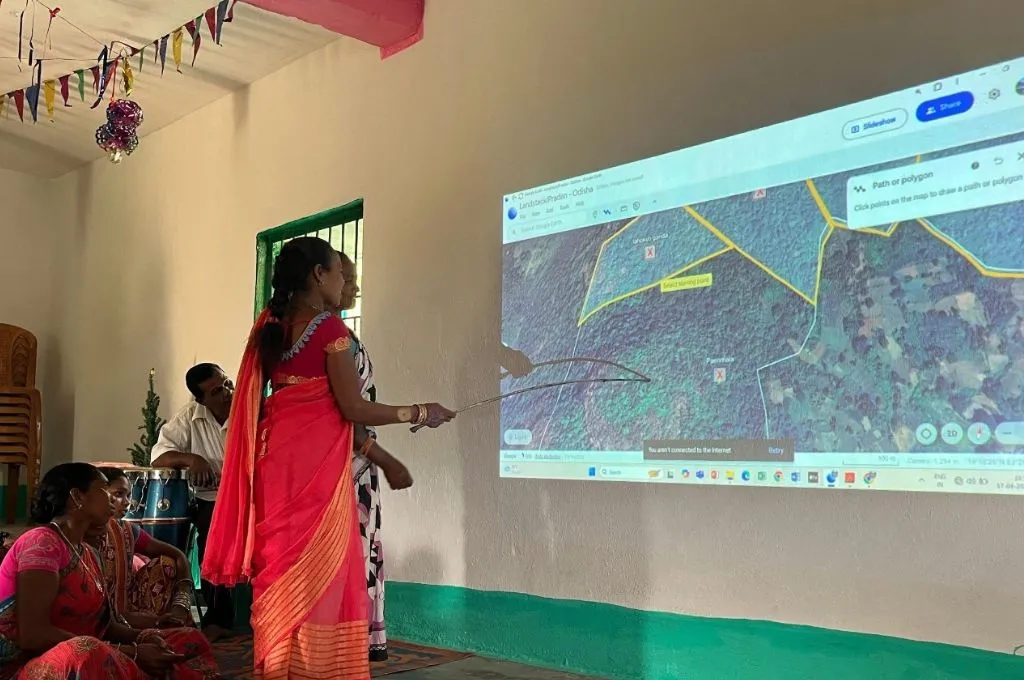
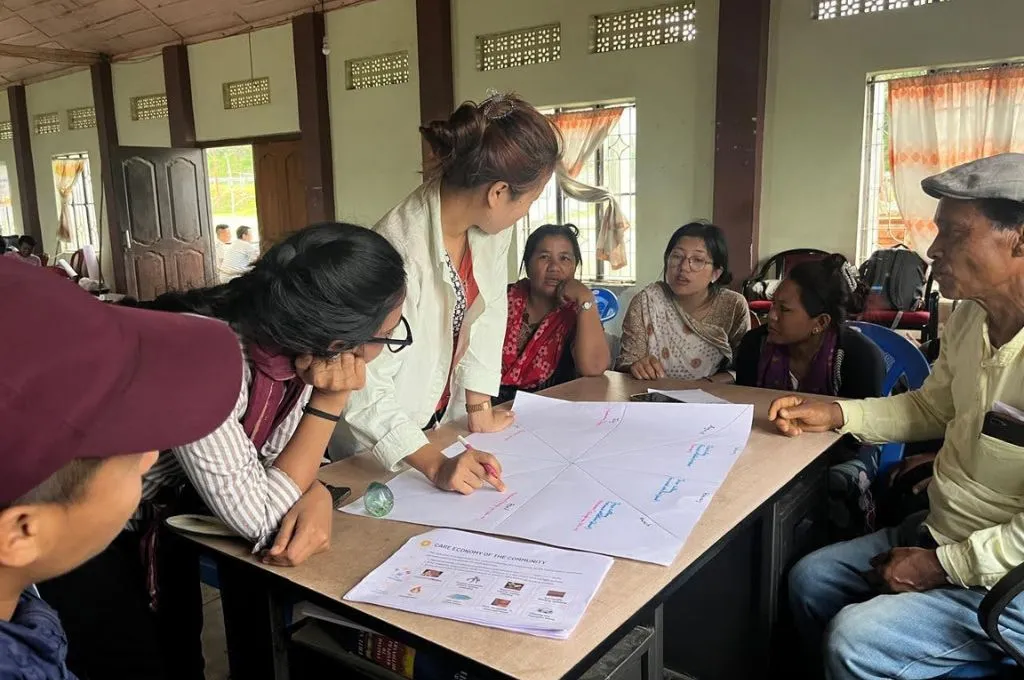
Drawing from field research across villages in Odisha and Manipur, we documented and quantified the time that communities, and specifically women, spend on different forest-related tasks. Using methods including GIS-based resource mapping, knowledge mapping, and forest walks, our research brought to the fore an otherwise invisible economy of care. While the complete findings are captured in a chapter we contributed to Gender and Development: Perspectives from Australia and the Pacific, we break down some of the key learnings from our research in this article.
Naming the invisible: What is ecological care labour, and who does it
Built on our understanding of forestry practice, we define ecological care labour as the unpaid, often invisible activities performed by people in forest-fringe villages to regenerate, tend, and sustain forests. In our research, we have categorised this labour into four broad activity types: regeneration (seed collection, wildling plantation, assisted natural regeneration); tending (weeding, thinning, lopping, coppicing, climber cutting); sustainable harvesting (mushrooms, tubers, leafy vegetables, fuelwood, fodder); and ecosystem maintenance (fire control, soil and moisture conservation, forest patrols).
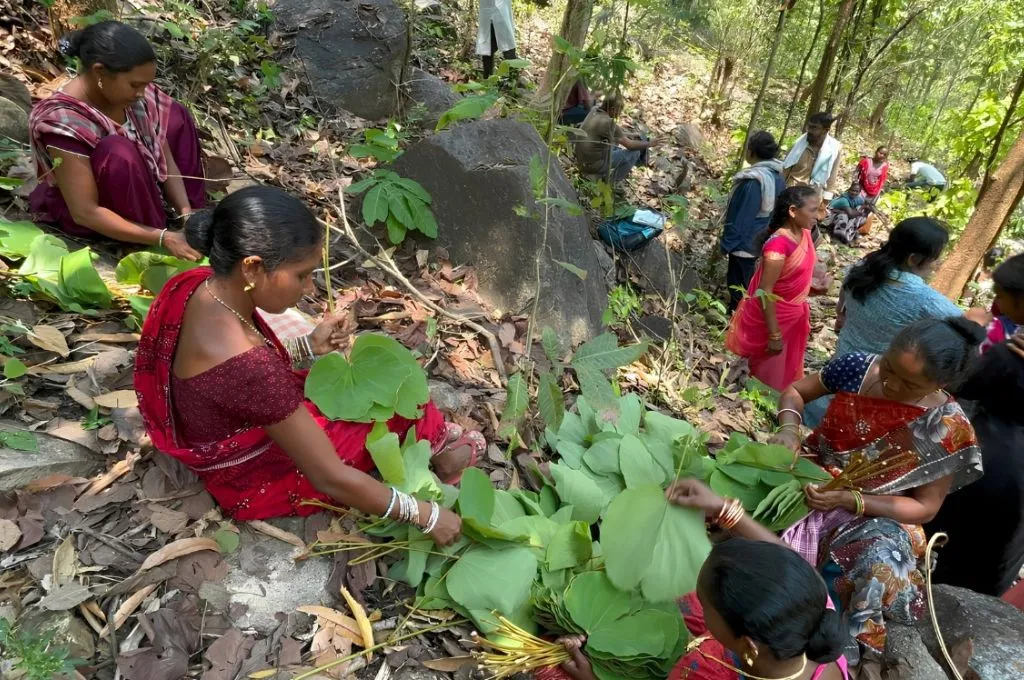
As Shanti and other women walk long distances to collect firewood, fodder, and vegetables, they weed around cluttered saplings, cut climbers, protect seedlings, and disperse seeds—small actions, repeated daily, that cumulatively shape the forest and build a resilient ecosystem. We refer to this expression of ecological care labour as ‘soft-touch forestry’: the quiet, diffused, and continuous work of caring for the forest through everyday practice. This is in sharp contrast to contemporary forestry operations such as block plantations, forest floor cleaning, fireline cutting, cattle-proof trenches, and water harvesting structures, which are concentrated and more starkly visible interventions carried out on defined patches of land. These interventions are often rolled out en masse, without adequate attention paid to local ecologies and the customary ways in which surrounding communities have traditionally guarded and managed forests.

Knowledge, not just labour
The ecological care performed by communities is rooted in their intimate knowledge of forests, much of which was held by women in the villages where we worked. During forest walks, women could identify 25–30 species of edible leaves, compared to fewer than 10 recalled by men. Women spoke about how different species of trees are used, and when they should be harvested. For instance, coppicing—cutting the stem near ground level—is timed differently depending on need and season. Spring coppicing, for instance, supports faster regrowth and branching. In the dry season, branches are cut mainly for firewood, while spring coppicing supports faster regrowth and branching. Women also distinguished between firewood species, noting which ones burn better, which are suitable for charcoal, and when collection should take place for household use.
What is lived and relational is often treated as anecdotal, even when it is ecologically precise.
This in turn shapes how women make decisions about the forest itself. In Balikuma village of north Odisha, women argued to bring back grazing in their newly titled Community Forest Rights (CFR) areas. Contrary to the dominant conservation perspective which typically calls for grazing closure to protect forests, women explained that cattle grazing supports seed dispersal, pollination, nutrient cycling, and soil moisture retention through hoof depressions, while also improving both forest and grass biodiversity through selective browsing. This is sophisticated forestry—an ecological understanding grounded in lived experience, which is often missed in linear thinking and extractive forest management models.
However, this local ecological knowledge is excluded from top-down prescribed activities that are based on the same flawed methods of formal forest management and scientific forestry rooted in timber-focused French and German models. It also rarely enters discussions on carbon credits and carbon verification frameworks, which are dominated by remote sensing and biomass equations aimed at measuring wood biomass.
What is lived and relational is often treated as anecdotal, even when it is ecologically precise. This dismissal of community knowledge is not just an intellectual oversight. It has direct consequences for how forests are measured, valued, and ultimately sustained, as the ecological evidence from our study shows.
The ecological evidence
Across our study sites, forests actively cared for by communities consistently outperformed those without such investment in terms of structure, function, and biodiversity values. To make this comparison, we used standard quadrat sampling, a method used in ecology to systematically measure plant species, density, and age distribution across defined forest patches. We assessed stewarded forests (those with active ecological care labour investments) against sites having similar terrain and forest type dominated by state or private management.
In Manipur’s Taudaizaeng village, stewarded forests showed particularly strong regeneration patterns, with thicker humus layers and healthier young stems as direct outcomes of sustained tending. Across study sites more broadly, we found 25–36 percent higher variety of plant species, higher number of trees, more balanced growth across different plant age groups, and stronger signs of regeneration in actively stewarded forests.
Given that many tending operations—weeding, lopping, climber cutting, pollarding—are performed primarily by women, it is clear that women’s labour leaves a measurable ecological imprint on the forest itself. Crucially, carbon and biodiversity credit markets depend on precisely these outcomes. However, they do not acknowledge and compensate for the labour that ensures the health and stability of forests.
The numbers reveal just how stark this gap is.
What is the value of ecological care labour?
Having understood the importance of community stewardship, knowledge, and care practices in maintaining and regenerating forests, the next question we sought to address was whether these could be quantified in a way that makes them legible and recognisable to dominant methods of understanding and measuring not just forests, but the labour that goes into preserving them.
In terms of the time spent maintaining forests, we found that, on average, women contributed 38 person-days annually to ecological care labour, compared to 25 person-days contributed by men. Moreover, the division of work followed gendered patterns as well. Much of women’s time went into tending (15 days per household annually compared to 6.9 by men) and sustainable harvesting (17.4 days compared to 11.9). These activities form the backbone of the everyday care that shapes and nurtures biodiverse and ecologically healthy forests.
Communities, especially women, are investing more value in sustaining forests than carbon markets are likely to return to them.
Meanwhile, men were more involved in ecosystem maintenance tasks such as building small structures for water harvesting. Time contributed to regeneration-related activities was more evenly distributed between women and men. Overall, on average, men and women together were investing more than 8,000 person-days per year in ecological care. In Taudaizaeng, for instance, every household was contributing 95 person-days to ecological care every year.
This is all unpaid labour.
To further understand what this meant in monetary terms, we estimated the economic value of ecological care labour using wage equivalents. Our estimate suggests that communities invest approximately INR 2.3 million per village per year, or around INR 3,765 per hectare annually, in ecological care. By comparison, expected income from voluntary REDD+ carbon credits, which specifically deal with forest carbon, is currently less than INR 2,040 per hectare annually. This estimate is based on the average REDD+ credit price reported by Ecosystem Marketplace and the average carbon sequestration rate from REDD+ projects listed in India. However, this is not the amount that the communities receive. Project development, registration, monitoring, verification, and intermediaries all take up a share before any benefits reach people, and an even smaller fraction ultimately reaches women.
This reveals a stark paradox: Communities, especially women, are investing more value in sustaining forests than carbon markets are likely to return to them. Not only that, this exclusion also reflects a deeper design flaw in how these markets are structured.
The flawed design of carbon markets
In voluntary carbon markets, particularly REDD+ projects, payments are tied to the idea of additionality—wherein carbon credits are issued only when emissions reductions or removals would not have happened without additional investment. In practice, this often means that areas showing visible change—such as newly restored or previously degraded forests—are the ones that usually qualify for carbon credits. However, forests that have been sustained through long-term ecological care, performed over generations by local communities, rarely meet this definition of additionality unless a verifiable threat, such as incidents of fire, grazing, or wood extraction, is identified. The continued health of these forests is treated as a given or ‘business as usual’, even though it depends on ongoing care investments by communities.
Attention to the problems in this approach is growing. Investigations, including a widely cited analysis of REDD+ projects, have raised concerns about inflated baselines, overestimated carbon benefits, and the credibility of some forest carbon credits. These issues highlight the limits of how carbon credits are currently allocated.
In response, carbon markets are trying to course-correct by strengthening standards and focusing on ‘integrity’, often making additionality definitions even stricter. However, this makes it even harder for community-managed forests—where conservation is deeply embedded in everyday care—to be recognised and fairly compensated by carbon market mechanisms.
This exposes yet another fundamental disconnect: the very practices that sustain forests such as wildling regeneration, daily tending, rotational grazing, and sustainable harvesting are excluded from the market systems seemingly designed to reward forest conservation. Carbon markets, much like contemporary and scientific forestry, promote plantation-based forestry and don’t recognise or prescribe soft-touch forestry.
At its core, the real issue lies in this disconnect between communities’ ecological care investment and credit allocation. Carbon markets focus on measurable carbon outcomes, often treating forests primarily as carbon stocks. But forests are not sustained by carbon alone; they are shaped by communities’ generational stewardship of their resources. These practices are often treated as ‘co-benefits’, when in reality they are foundational to carbon sequestration. Without recognising ecological care labour, carbon sequestration itself cannot be sustained or made truly additional over time.
What would it look like to count care?
If climate action is to be just and effective, we need to shift from carbon-centric accounting towards systems that recognise care.
In practice, this could begin with small but important shifts.
- Carbon projects must recognise as well as compensate communities’ ecological care labour and investments in soft-touch forestry activities. Importantly, these are not informal forms of labour—they are the key socio-ecological processes that sustain forests and ensure carbon and biodiversity outcomes. Carbon projects must recognise and build on these practices, rather than replacing them with externally designed activities that are easier to measure and sell as ‘additional’.
- Carbon Monitoring (MRV) frameworks need to incorporate gender-disaggregated data on who actually performs this labour, and ensure that benefit-sharing reaches those engaged in everyday ecological care.
- The ways in which communities interact with and shape their forests should no longer be treated as threats to conservation, or be subjected to top-down conservation policies that seek to displace and dispossess them.
In this context, it is equally important to consider the ethical questions that arise when we talk of assigning monetary value to ecological care. While these measures can help make this labour visible and recognised, financial incentives also risk reducing complex relationships between communities and forests into mere financial transactions. For many communities, care is not simply labour—it is part of cultural practice, emotion, responsibility, and identity. The challenge, then, is not just to put a price on ecological care, but to recognise and support it without eroding the relationships that sustain it.
If we continue to count carbon while ignoring the labour that nurtures it, we risk undermining both equity and ecological integrity. Forests do not sequester carbon alone. They are sustained by care, and this care must be recognised and respected, though not necessarily incentivised through market mechanisms.
*Name changed to maintain confidentiality.
—
Know more
- Read about the procedural lapses in India’s Green Credit Programme and their impact on communities’ rights.
- Learn more about the importance of women’s ecological care labour in biodiversity conservation, ecosystem services, and climate resilience. (Authors’ note: This is an earlier, pre-publication version of the chapter, Carbon Credits and Crediting Women: Understanding the Gender of Ecological Care Labour in Forest Stewardship Projects in India for Fairer Payments, cited in this article. For academic access to the final, full chapter, readers are welcome to write to the authors at anjali.aggarwal@landstack.org.)
- Learn how existing climate policies overlook the importance of commons, and the role of communities in preserving them.