“One sari costs around INR 18,000,” said Chand Mohammed, a kantha artisan from Shantiniketan, West Bengal. “It takes months for our artisans to produce the kantha work. How do we pay them?”
“These were temporary structures and our products there were not insured,” said Manzoor Khan, from Blossoms of Heaven, an artisan community from Kashmir.
An early morning blaze on March 15, 2026, engulfed the Dastkar Nature Bazaar in New Delhi, destroying 42 stalls in minutes.

The fire also destroyed equipment, display infrastructure, and months of preparatory work by marginalised artisans. Peak-season inventory—built over months and timed for the lucrative pre-summer and festive window—was wiped out in hours.
Twenty-one of the stalls that burnt down belonged to Gali-e-Khas, a group of permanent stores that sold handcrafted products; pashmina and crewel carpets from Kashmir, kantha from West Bengal, konna grass products from Manipur, Lambani embroidery from Karnataka and many more. For the permanent stall owners, the loss was more than just inventory. They lost the ‘built infrastructure; of the shops themselves, which stored much of what they needed to run their businesses, from cash to receipt books to information on clientele.
Naqib, an artisan selling crewel carpets from Kashmir, was operating from one of the open structures that was destroyed in the fire. He points to the vulnerability of such spaces, where formal protection is limited. “No one will insure open structures, even though for us it was closest to a permanent shop,” he said.
Who bears the cost?
While Dastkar had nominal insurance coverage on its operable infrastructure, this amount will not even cover the rebuilding costs. Additionally, the artisans’ products can only be insured at source, where they are produced, not in an open-structure sales outlet. The fact that Dastkar had to launch a relief fund after the fire suggests a lack of comprehensive business interruption or fire insurance that typically covers standard commercial spaces. In the absence of such ‘risk-proofing’, the financial burden of rebuilding and the loss of ‘additional business assets’ falls directly on the organising nonprofit and the artisans themselves.
In an informal sector where cash flow is seasonal, sudden capital destruction can push entire craft clusters towards distress migration.
The fire had a catastrophic ripple effect on the village economy. For every artisan selling products at the Gali-e-Khas, there is a network of weavers, embroiderers, potters, and their families back home who have already put in their efforts and are awaiting payment. And it doesn’t stop there. Zahida Amin of Naie Kiran pointed out that there is a community of packers, transporters and other workers involved in transporting stock from Baramulla, Kashmir or Sandur, Karnataka to Delhi.
However, with the entire product inventory wiped out, the capital intended to pay these rural families was wiped out too. In an already informal sector where cash flow is seasonal, and middlemen often take a cut, such sudden capital destruction can push entire craft clusters toward distress migration or to abandon their traditional skills. Unlike corporate retailers, these micro-producers rarely have access to formal credit or risk-mitigation tools, making recovery painfully slow even with community support and Dastkar’s fundraiser.

In the immediate aftermath, Dastkar’s relief fund raised INR 39 lakh in five days, making it possible for them to give out small amounts ranging from INR 1–2 lakh to the artisan communities to cover immediate cash flow issues. A similar payment was made by the end of the second week. Dastkar took other steps as well, such as returning two weeks’ worth of rent paid for March 2026 and releasing all security deposits to the affected artisans.
The broader craft community, including well-known designers, social influencers and organisations like Creative Dignity also mobilised to amplify the relief response and support artisans’ efforts.
These efforts notwithstanding, the dependency of the nonprofit sector on public charity rather than institutional financial shielding is cause for concern. While this depicts the goodwill and support by urban consumers, it also points to the critical need for systemic support for a sector that represents Indian ethos and aesthetics so vibrantly.
United we stand
Despite the devastating loss, artisans quickly helped each other contribute to the recovery process by documenting and calculating their losses. This helped Dastkar assess the total financial loss, arriving at a figure of INR 12 crore within days. Artisans told their representatives that they don’t need immediate payment for rebuilding their stock and will wait to be paid as and when the stock gets sold. The community of artisans stood by Dastkar and each other by appealing to the public for contributions to the relief fund.
The seven artisans I spoke to all had this to say: They will be back, like the proverbial phoenix. They just need some guidance on how. Artisans have survived the Latur earthquake, the COVID-19 pandemic, and demonetisation. As the Dastkar team mobilised support, and Creative Dignity affirmed their commitment to help artisans “recover, restart, and move forward”, one truth became painfully clear: Resilience alone is not protection. India’s crafts economy needs structural safeguards—now.
Unity cannot be confined to moments of crisis. It cannot be limited to artisans, nonprofits, and well-meaning consumers coming together after loss has already occurred. It must extend to policymakers, insurers, aggregators who retail artisanal goods, and others who have a role to play in sharing the responsibility for protection and sustained growth.
Deep-rooted thinking and actions are needed, as craft activists have shouted themselves hoarse about for decades. The time for sympathy is over; the time for systematic protection is now. This protection must rest on a few non-negotiables.
Risk protection
The immediate need is mandatory group insurance for craft bazaars and melas, fire-safety audits, and retrofitting of venues like Nature Bazaar that give artisans identity, earning potential, and respect. Government schemes that already support artisans must evolve to include risk mitigation.
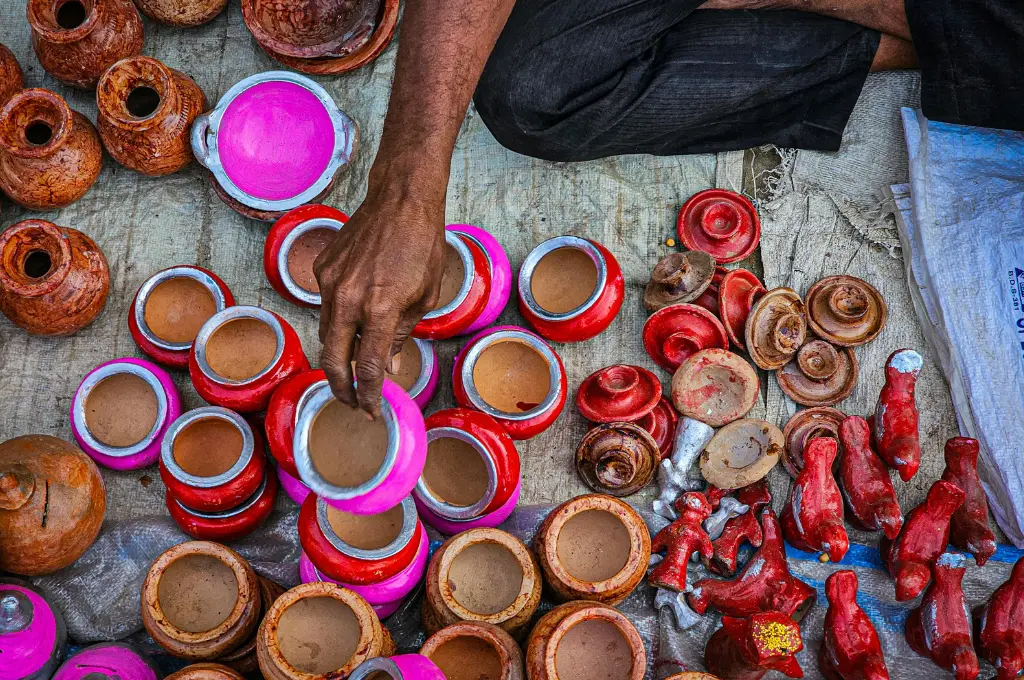
Take the One District One Product (ODOP) scheme, which aims to transform every district into an export hub, identifying one unique craft or product per district. This includes blue pottery from Jaipur, brassware from Moradabad, and more. The current focus is on branding, global market access, and subsidies for artisans to scale production. While the scheme focuses on a craft’s journey from local to global it does not account for the reverse—how a fire at a central warehouse or cluster can take a global enterprise back to zero. Funding under ODOP could be made contingent on insurance. For a district to qualify as a global hub, its central processing or storage units must meet fire safety standards.
Tweaking existing government policies can provide the artisan community with much more long-term benefit than it does currently.
Similarly, the Pradhan Mantri Kaushal Vikas Yojana is the government’s flagship skill development scheme. For artisans, it often operates under Recognition of Prior Learning, wherein their existing skills are certified to help them acquire formal credit. While the scheme focusses on short-term training, toolkit distribution, and certification, it can be expanded to teach artisans how to manage business risks. Skill training modules could include disaster readiness for micro-entrepreneurs, where artisans could be taught digital inventory management so that they have proof of stock for insurance claims and basic fire safety as part of their certification.
Handicraft clusters like the Ambedkar Hastshilp Vikas Yojana already group artisans into self-help groups (SHGs) or producer companies to provide them with common facility centres and create shared infrastructure—like raw material banks and design studios—so that individual artisans don’t have to bear the cost alone. Every cluster funded by the government could have a mandatory group insurance policy. By pooling thousands of artisans into one policy, the premium becomes negligible (micro-insurance), but the coverage becomes lifesaving.
These are just a few examples of how tweaking existing government policies can provide the artisan community with much more long-term benefit than it does currently and build the safety nets required to survive disasters.
In the absence of relevant insurance products for artisans, cooperative-led, micro-insurance products also offer a practical pathway. Cooperatives offer a mutual aid model that bridges the gap between the informal set ups in which artisans operate and the rigid corporate insurance world. Being part of a cooperative gives artisans better negotiating power so that they can negotiate for a floating cover policy where the insurance follows the inventory and not the location. Cooperatives also provide social capital and mutual verification services—artisan communities know each other and their production capacities. By acting as single entities, cooperatives can cut down on administrative costs that insurance companies may incur trying to insure one artisan at a time.
Access to credit and financial support
Short- and long-term loans must be available to artisans so that a single disaster does not wipe out years of labour. As Meeta Mastani, the founder of Bindaas Unlimited, points out, access to credit is as critical as insurance. Mastani, for instance, works with printers and vegetable dye workers in Rajasthan, and has herself been a guarantor for artisans who received loans of INR 2 lakh from Dreams Foundation to build their stock with payments starting six months later.
There are other emerging models to build on as well. Social enterprises and craft-first lenders that focus on creative manufacturing, for instance, increasingly view artisans as people with scalable businesses rather than as charity cases. In doing so, they can become an important source of credit and financing for them. The Kula Conclave, an initiative by 200 Million Artisans, is one such platform. It is a convening that brings together craft-led enterprises, investors, policymakers, and ecosystem actors to unlock inclusive capital, build networks, and enable collaborations within India’s creative manufacturing and handmade sector.
Public institutions can also play a stronger role. NABARD (National Bank for Agriculture and Rural Development) already has the infrastructure to reach the last mile; it can expand its ‘off-farm sector’ lending specifically for disaster-struck craft clusters. CSR and philanthropy can help artisan groups by being guarantors for first-time loans and donating the amount to the artisan groups in case they fail to pay back the amount on time.
Markets and digital security
Artisans can also be introduced to digital payment and inventory platforms to reduce physical stock vulnerability. Most inventory tools are built for standard retail products which are bar-code ready. However, craft items are made by hand —they are ‘unique’ items—and existing cataloguing tools are either complex or not suitable. As a result, artisans fall back upon manual ledger-keeping.
This physical inventory needs to be complemented by digital tagging, that is, creating consistent SKU (Stock Keeping Unit) numbers using barcodes or QR codes for tracking. Along with this, there is a need for more visual-first tools that allow automatic tagging, which could involve simply taking a photograph and assigning a price. This could then function as a visual ledger. However, artisans need training to do this efficiently, which is currently lacking.
Permanent, climate-resilient craft hubs and public-private partnerships are also necessary for better market access beyond fairs. The Dastkar Nature Bazaar venue is much-loved, but its temporary nature should not become a hindrance. The Kunj, a recently built handicrafts market in New Delhi is an excellent example of a permanent, year-round destination where the brick-and-mortar structure fits safety standards better. Public-private partnerships with the tourism department and the ministry of textiles, along with organisations such as Dastkar or Creative Dignity can promote infrastructure for similar permanent structures that follow all safety protocols and sell authentic crafts. Artisans then become stakeholders in long-lasting, cultural go-to hubs.
Strengthening institutions
Globally, models like the International Folk Art Market (IFAM) in Santa Fe demonstrate what institutional support can look like. IFAM supports the work of artisans serving as entrepreneurs and acts as a catalyst for positive social change. Their mission is to create economic opportunities for and with folk artists worldwide who celebrate and preserve folk art traditions. Its annual event brings together over 100 artists from nearly 60 different countries. It is a transformative experience that cannot be found anywhere else in the world. Mastani is a regular participant and says, “IFAM has insurance for everything, including the health and well-being of the participants”.
It is not an unfair demand that organisations like Dastkar are strengthened through policy recognition and capacity-building grants to be able to perform like an IFAM. The fire took material wealth, but it could not crush the spirit and the skill of the artisans it affected. This resilience must be strengthened by policy and not left to chance, where another fire, another flood, another earthquake can break them.
—
Know more
- Read about how artisans can be better supported in transitioning to e-commerce.
- Explore insights on financing, market access, and systemic gaps in India’s handmade sector.