India set out on its outcomes-based finance (OBF) journey in 2015 with the Educate Girls Development Impact Bond. Since then, at least USD 59 million[1] has been mobilised through various OBF initiatives across sectors such as health, education, employment, and livelihoods.[2] OBF is broadly defined as a flexible set of financing mechanisms and organisational strategies that link payments to the achievement of pre-defined and verified outcomes. All OBF mechanisms are defined around three principles: the extent to which funding is tied to results, the balance between outputs and outcomes used to trigger payments, and allocation of performance risk among stakeholders.
Discussions around scaling and mainstreaming OBF have recently gained momentum. This has been bolstered by the success of early initiatives and the government’s promotion of OBF for skilling and livelihoods. One of the ways in which OBF can be scaled is by ensuring that a larger number of donors and implementation partners (IPs) can participate, which is critical for the approach to gain credibility and evolve.
While OBF may not be a silver bullet, scaling it can democratise the development financing space in India, making its benefits — improved accountability, programmatic innovations, delivery efficiencies, monitoring and evaluation, among others — available to a broader range of organisations. Democratisation also matters because many of the most innovative and contextually grounded solutions come from smaller, community-based organisations (CBOs), who are generally left out of OBF.

Who is currently participating in OBF?
To encourage participation from more stakeholders, it is important to understand the current lay of the land and entry barriers.
Across the USD 59 million mobilised for nine OBF initiatives, we have seen participation from a total of 25 funders so far. Half of these are non-domestic, and five have participated in more than one initiative.
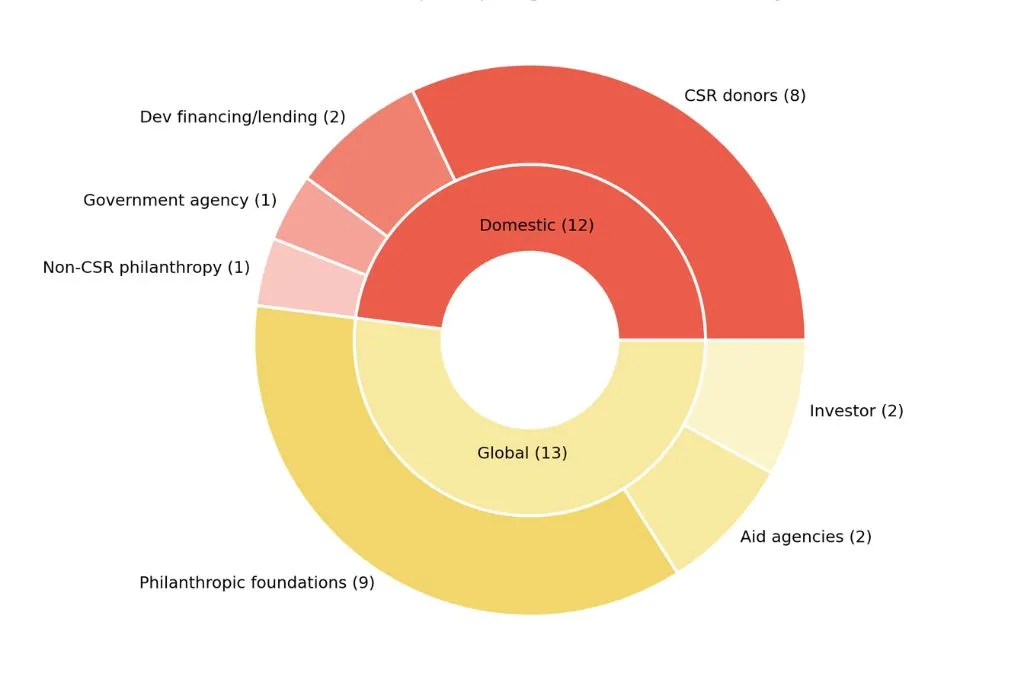
On the implementation side, only 19 for-profit and nonprofit organisations have participated in these initiatives as implementation partners.
It is thus evident that the OBF space so far has been limited to a handful of stakeholders. This is not unusual for a new approach in its early stages. New financing models often depend on global donors willing to provide high volume, patient, and risk-bearing capital needed to catalyse and demonstrate new ideas. Similarly, established IPs have the organisational set-up and balance sheets to experiment with new approaches. The question now is whether OBF can go mainstream if domestic donors and smaller implementation partners, who make up most of India’s development sector, can’t participate in it or benefit from it.
What impedes stakeholder participation?
The barriers to entry for both domestic donors and smaller IPs can be broadly classified into demand and supply side issues:

1. Misunderstandings concerning OBF
Donors and IPs alike often confuse OBF instruments, which could be complex and prescriptive, with the principles of OBF, which are more flexible and widely applicable. This confusion feeds into a wider set of concerns about OBF, particularly around complexity, transaction costs, and value for money, that come up repeatedly at panels and convenings. Thin data to counter these doubts only adds to the confusion and leads to disengagement with the idea.
2. Lack of responsive and flexible design
OBF initiatives so far have been designed as proof-of-concept pilots involving a single, closed transaction, that deploys only one type of OBF instrument, such as an impact bond. These can be rigid in choices of geography and intervention, and allowing new donors and IPs to join on an ongoing basis or accounting for varying working capital needs. This ‘take it or leave it’ design treats partners as dispassionate buyers and sellers of outcomes, failing to account for their objectives, insights, choices, and preferences.
3. Lack of implementation partner-centric models
Much of OBF’s practice and early theory evolved in public-sector procurement and contracting systems in European economies, which is why it often tends to be commissioner-led. This can be slow, bureaucratic, and centralised. While it may be large scale, it struggles to unlock participation in a fragmented OBF ecosystem, where the building blocks, such as evidence, data, networking forums, spaces for learning, deal aggregation, and handholding support are scattered and emerging.
4. Limited organisational readiness
Lack of readiness significantly constrains both donors and IPs in OBF. For donors, barriers often include rigid grant-making processes, inflexible budgets and timelines, risk-averse funding culture, excessive compliance requirements, micromanagement, reluctance to pay for all necessary inputs, and insufficient resources for evaluation and learning. For IPs, readiness requires additional competencies beyond core organisational and programme capabilities. They need systems built around outcomes, the ability to measure them, and a culture that treats performance and learning as ongoing work.

What can be done to address these barriers?
Addressing the barriers to participation in OBF requires a deliberate shift in how these initiatives are designed, sourced, and supported. Two emerging examples offer useful direction.
The NEST Outcomes Facility: The Nano Entrepreneurship Sustainability & Transformation (NEST) Outcomes Facility, convened by the British Asian Trust and 360 ONE Foundation, is an OBF initiative for nano entrepreneurs. The facility uses OBF to bring higher accountability to end outcomes of improved incomes, credit readiness, and enhanced resilience. Rather than selecting a fixed number of donors and IPs, the facility has defined four key aspects in a uniform manner: the outcomes framework, incentive structure, third-party evaluation, and performance management support. Any donor or IP that aligns with these four can participate, allowing flexibility on geography and delivery model.
Project Maitri: This is a collective of small, grassroots-based organisations brought together by Educate Girls as an expansion of its work on the girls’ education impact bond. The project works with 17 partners across Bihar and Haryana, and does not prescribe a specific intervention approach. Instead, Educate Girls established a common definition of success and used outcome-based payments to incentivise local organisations to create impact in their communities. Payments were disbursed to these community-based organisations (CBOs) only if pre-agreed outcomes had been achieved. Simultaneously, the CBOs received support with implementation, monitoring and evaluation, and performance management throughout the delivery period.
Both these initiatives yielded a common set of learnings:
1. Moving toward multi-instrument and modular designs lowers barriers to entry
Rather than relying solely on one complex mechanism like impact bond, OBF initiatives can mix tools such as pay-for-results agreements, impact-linked incentives, among others tailored to different partner needs and risk appetites.
Globally, the concept of ‘outcomes funds’ has been used to facilitate the establishment of multiple outcomes contracts, scale OBF, and increase the value of funding and number of stakeholders reached by OBF initiatives.
Both of the aforementioned initiatives apply the principles of outcomes funds by contextualising their use for India. NEST Outcomes Facility uses OBF instruments calibrated to different levels of organisational maturity and risk tolerance, providing risk capital only where IPs need it. Similarly, payments under Project Maitri were structured in tranches aimed to reduce initial pressure on CBOs and increase the chance of meeting outcomes, without creating cash flow strain, or a need for pre-financing from an investor.
This flexibility in geography and intervention models, along with the ability to onboard funders and partners over time, helps shift OBF from a one-off transaction to a more inclusive and platform-based approach.
2. Co-creation with implementation partners improves ownership and engagement
Both initiatives engaged IPs andCBOs early in defining outcomes, metrics, and delivery models to ensure that expectations on targets and results reflect not only local realities and knowledge but also their organisational capacities.
Under NEST, end outcomes were commonly defined for all IPs, but outputs were customised to their individual interventions. Under Project Maitri, CBOs proposed their expected outcomes, which were validated by Educate Girls, thus preventing them from assuming excessive risk through overly ambitious targets.
Co-creation helps demystify OBF, build trust, and tailor the instruments so they aren’t punitive, or unwieldy for IPs. This enabled them to co-create milestones, timelines, outcome indicators, and payment structures leading to more clarity, control, and consensus to participate in OBF. However, structuring outcomes this way can be demanding in terms of time, effort, expertise, and costs and may benefit from mission-aligned intermediation from more experienced organisations.
3. Creating smaller, modular entry points broadens participation
Large, multi-million-dollar OBF transactions often lack means to include donors who like to start small, especially when supporting new ideas. Aggregated platforms such as outcome funds and pooled funds address these gaps by offering smaller contracts that donors can fund incrementally, bringing in portfolios of IPs, and phasing engagement over time. NEST, for example, defined a minimum fund size that was palatable for individual donors to participate over a multi-year term.
While these measures can facilitate participation from a wider set of donors, it is also important to strike the right balance between the number of small contracts under a platform and the efficiency and transaction cost of managing these.
4. Sustained investment in capacity building is essential
Both initiatives helped their IPs and CBOs strengthen their data and measurement systems, financial management, micro-innovation, and delivery capabilities. NEST also worked with donors to build an outcomes orientation, flexibility in funding approaches, support with Board approvals, and comfort with performance-linked payments. Capacity building must be viewed as an integral part of OBF design that unlocks the benefits of OBF for both donors and IPs.
Together, these shifts—from rigid, transaction-led structures to flexible, partner-centric platforms—can make OBF more accessible and inclusive. As India begins to see early signs of broader and more democratic participation in OBF, there is a valuable opportunity to generate evidence on how these models shape not only outcomes for communities, but also the capabilities, confidence, and resilience of the organisations and funders involved.
—
Footnotes
- The authors arrived at this number data compiled from Government Outcomes Lab, Ministry of Skill Development & Entrepreneurship (2025), Convergence & Palladium (2018), and ANI (2025).
- Includes Educate Girls DIB, QEI DIB, Haryana Early Literacy outcomes guarantee, LiftEd DIB, Utkrisht DIB, NEST Outcomes Facility, PAL Lab, Varthana Social Success Note, Skill Impact Bond. While these initiatives have been publicly and explicitly labelled as OBF by their participants, we acknowledge that there could be many more such initiatives that follow the principles of OBF without explicitly using the label.
Know more
- Learn more about how nonprofits can capitalise on development impact bonds.
- Learn whether an outcomes-based approach fits your intervention or issue area.