India is home to millions of persons with disabilities and more than 62,500 disability-focused nonprofits. These organisations provide various services, including early intervention and therapy, education, advocacy, and caregiver support. Yet disability remains one of the least funded areas in the social sector.
Why does this gap persist? And what can funders and nonprofits do address it?
A recent report by Bengaluru-based think tank Pacta argues that disability work is caught in a ‘low-funding equilibrium’—a self-reinforcing cycle in which poor funding weakens organisational capacity, weak capacity reduces funder confidence, and low confidence further depresses funding.

The following findings from the report explain how this cycle operates and the actions that both funders and nonprofits must take to break it.
1. Disability is highly represented among nonprofits, but barely visible in funding
Approximately 10 percent of India’s nonprofits work on disability. However, disability receives only 0.9 percent of total corporate social responsibility (CSR) spending, amounting to approximately INR 234 crore out of a total CSR expenditure of INR 26,000 crore in 2022.
This gap suggests a disconnect between the scale of work on disability and the funding available to support it. Many funders continue to treat disability as a specialised issue rather than a cross-cutting one that intersects with education, health, and livelihoods. As a result, disability often struggles to compete for resources against causes that funders are more familiar with.
The numbers clearly emphasise the need for better funding for disability. The report notes that 64 percent of persons with disabilities are unemployed and the literacy rate among persons with disabilities is 52.2 percent, compared to the national average of 72 percent.
2. Government signals on disability remain weak
Government priorities frequently shape philanthropic ones by signalling which issues deserve attention and investment. However, India’s combined disability budget is estimated to be around 0.04 percent of GDP, significantly lower than that of comparable countries. Additionally, funding for key disability-related schemes has declined in recent years.
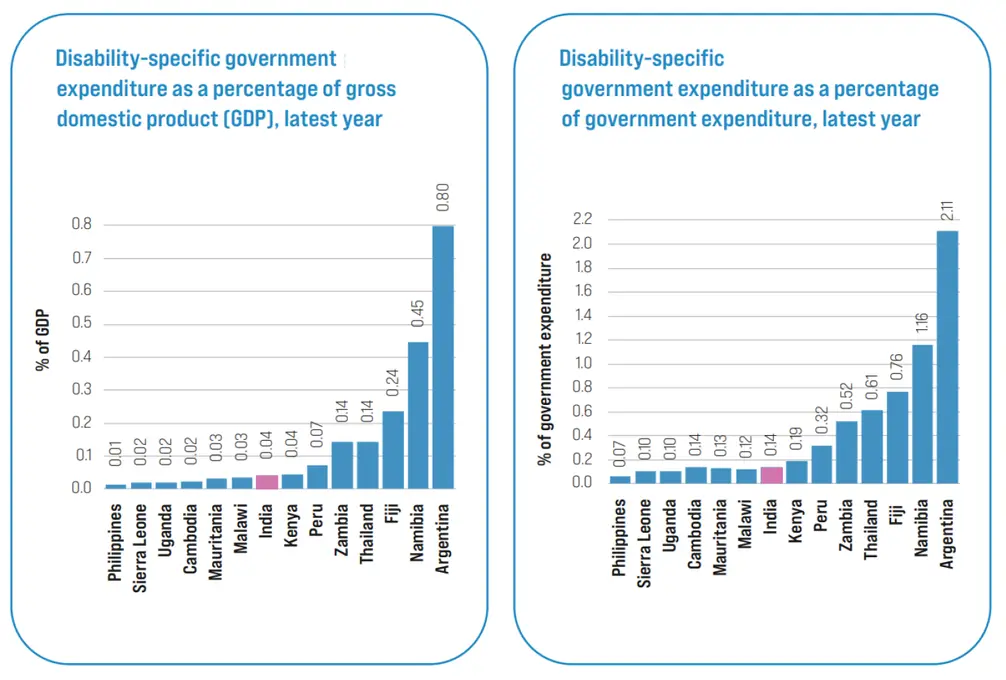
Only one state (Assam) and three central ministries publish disability-disaggregated budgets. When disability is not clearly reflected in public spending priorities, it becomes harder for funders to identify it as an area requiring sustained investment.
3. The way funders assess organisations disadvantages disability-focused nonprofits
The report identifies a mismatch between what funders look for and how disability work unfolds. Funders primarily prioritise measurable outcomes, scalability, strong organisational governance systems, and clearly defined reporting frameworks. These expectations help funders assess risk and allocate resources effectively.
But disability interventions often produce outcomes that are difficult to capture through conventional metrics. For instance, a child learning to communicate, a family experiencing an attitudinal shift, or a person with disability securing employment after years of support are meaningful outcomes—yet they are rarely linear and often take years to materialise.
As one nonprofit leader quoted in the report notes, disability interventions require “high-touch, long-term, and holistic engagement.” However, funding systems frequently reward rapid, measurable, and easily comparable results.
4. Underfunding prevents organisations from becoming fundable
Organisations often fail to secure funding due to barriers emerging from underfunding itself. Funders often look for organisations with strong compliance systems, dedicated fundraising staff, robust impact measurement processes, and professional governance structures. But building these capabilities requires resources.
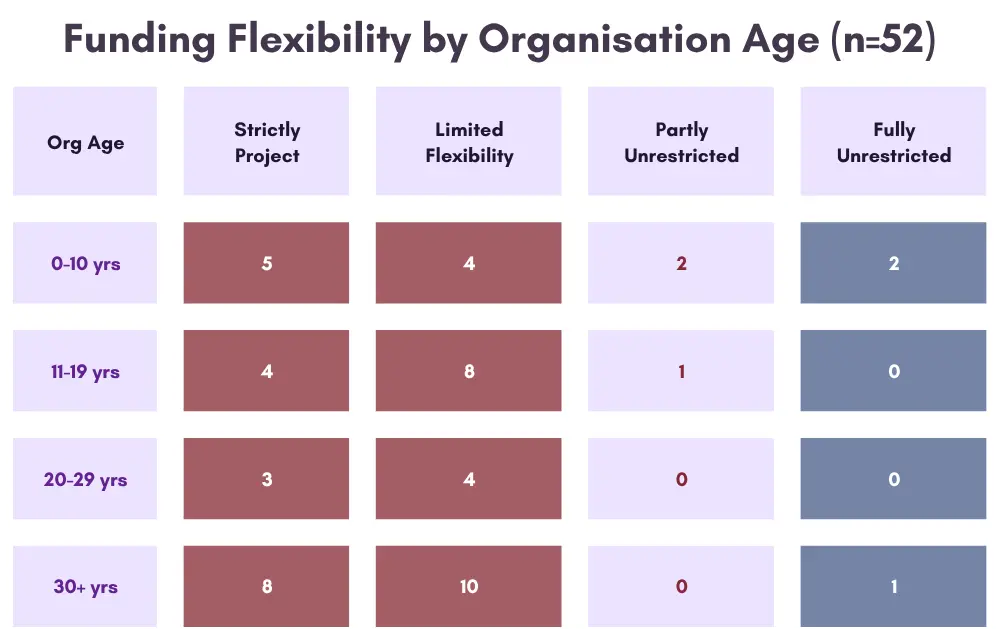
Many disability organisations operate with small teams and restricted funding. They struggle to hire fundraising staff, build impact measurement systems, or strengthen governance structures because their funding is restricted to programme delivery. In other words, the very organisations most in need of institutional support are often least able to meet the requirements attached to funding opportunities.
In effect, underfunding prevents organisations from becoming the kind of organisations funders say they want to support.
5. Access to funding is shaped as much by relationships as by programme quality
Access to funders remains a major challenge for many disability nonprofits. Thirty-five of the 52 organisations surveyed reported limited donor access, while 38 reported limited donor interest in disability.
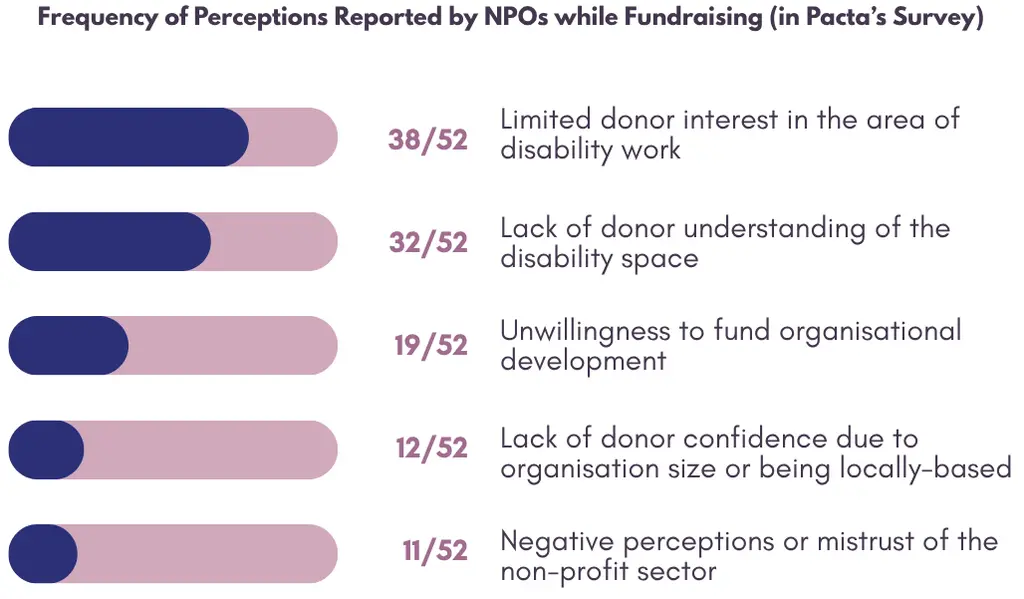
These barriers are especially pronounced for organisations in smaller cities, Northeast India, and aspirational districts. Many funders continue to rely heavily on personal networks, referrals, field visits, and existing relationships when making decisions.
Organisations with established networks, recognised leadership, or influential board members are often better positioned to secure introductions and build donor confidence. For newer and smaller organisations, getting the first meeting with a funder is itself one of the biggest challenges.
Some funders are already experimenting with different approaches
The report highlights examples of funders that have consciously moved away from conventional approaches and are focusing on funding disability in a more purposeful way.
Bajaj Finserv CSR has built one of India’s largest dedicated disability portfolios, supporting more than 60 nonprofit partners. Rather than treating disability as a subcategory within a broader social impact agenda, it has made disability a strategic priority. They invest in partner capacity, work with nonprofits to strengthen documentation systems, and renew support over long periods wherever possible.
Similarly, funders such as Mariwala Health Initiative and the Upadhyaya Foundation place greater emphasis on trust, community representation, and depth of intervention than on scale or short-term performance. These examples indicate that many of the barriers facing disability organisations are products of funding design, which can change.

Breaking the equilibrium requires changing how both funders and nonprofits operate
The report argues that the low-funding equilibrium can only be upended through the efforts of both funders and nonprofits.
For funders, the recommendations include providing multi-year and unrestricted funding, simplifying compliance requirements, and being more transparent with nonprofits—particularly about timelines and selection decisions. The report also encourages funders to look for disability within the portfolios they already support. Rather than creating entirely new disability programmes, they can deepen their impact by identifying grantees working in education, health, or livelihoods whose work already intersects with disability.
For nonprofits, the report highlights the importance of strengthening compliance governance systems, diversifying funding sources by simultaneously pursuing CSR, HNI, philanthropy, and user-fee models. Outlining the example of a collaborative project undertaken by five nonprofits operating in one state, the report also suggests collective fundraising as a strategy. By working together, organisations can show funders how their individual efforts contribute to a larger vision, while avoiding overlap in their work.
A particularly interesting recommendation concerns narrative reframing. Several organisations reported that they received sustained support from funders when they framed their work through themes that funders already understood, such as education, livelihoods, or mental health, rather than leading with disability alone. The report recommends treating impact not just as something to measure, but as something to communicate. By documenting the experiences of persons with disabilities, caregivers, parents, teachers, and employers, organisations can help bring the realities of disability-focused work to life for funders who rarely see it up close.
By exploring the low-funding equilibrium for disability, the report shifts the conversation away from individual funding decisions and towards the system that shapes them. Showing how funding practices and organisational capacity reinforce one another, it underlines the need for a different way of thinking about disability work.
—
Know more
- Read the report this article draws from.
- Learn more about the shrinking budget allocations for disability welfare.