India’s private philanthropic capital stands at approximately USD 15 billion according to a 2024 report. Two years later another study found that start-ups in India raised USD 16 billion that year. There is a crucial difference between the two similar amounts. Start-up funding is largely unrestricted, with founders allowed to deploy the capital however they see fit for the company. This helps them to invest money into recruiting the best talent, building technology, running experiments, and pivoting when necessary.
On the other hand, most nonprofit funding is programmatic and restricted, tightly linked to specific programmes or line-item budgets. For example, if a nonprofit seeks to raise capital to do an upskilling programme for youth, it is common for funders to insist that most of their money be deployed for covering only the cost of that training. Everything else—the technology platform, content development, and the central data and tech teams—is classified as overheads that need to be limited. As a result, nonprofits are cornered into scaling programmes that do not work, with no room to innovate.
Anecdotally, this is common knowledge in the sector, but hard data on the dearth of flexible funding has been scarce. Change Engine’s latest research attempts to measure the flexible funding gap in India, identify why it persists, how to address this issue, and could be unlock by solving it.

Our study surveyed more than 145 nonprofits and social enterprises across organisational budgets and sectors. Small organisations with an annual budget of less than INR 1 crore and medium ones with a budget of INR 1–5 crore constituted 40 percent each of the sample. Large organisations made up the remaining 20 percent. There was an almost equal split between organisations eligible for foreign funding. Fifty-one percent had FCRA or US 501(c) and 49 percent did not.
The flexible funding drought
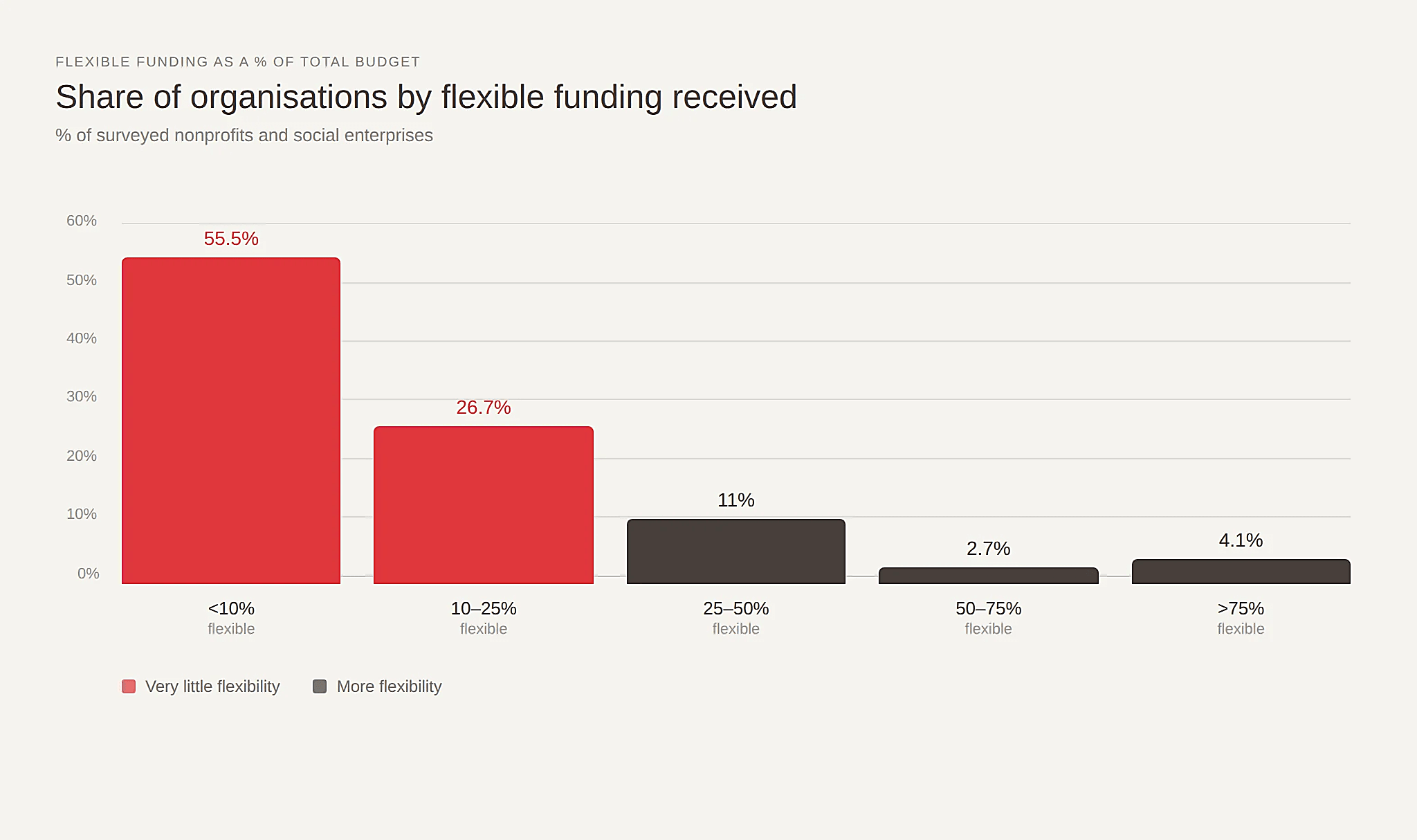
Flexible funding is limited regardless of the size or age of the organisation. Around 80 percent of the surveyed nonprofits reported that less than 25 percent of their funding was flexible. Flexible funding formed only 10 percent of the budget of more than half of the surveyed organisations.
Adding to the challenges for founders, we found that donations are small, take a long time to come through, and are often one-time grants. Sixty percent of the founders reported typical cheque sizes of less than INR 10 lakh, and about 40 percent of organisations had never received a multi-year flexible grant. This vicious pattern of small and restrictive one-time grants means that founders are fundraising throughout the year, leaving them with not enough time to focus on their programmes or impact.

In our work with nonprofits, we met founders running large-scale programmes with budgets exceeding INR 25 crore who were unable to raise INR 3 crore to cover their core tech, content, data, and fundraising teams. Fifteen percent of the founders we spoke to reported spending 75 percent of their time on fundraising.
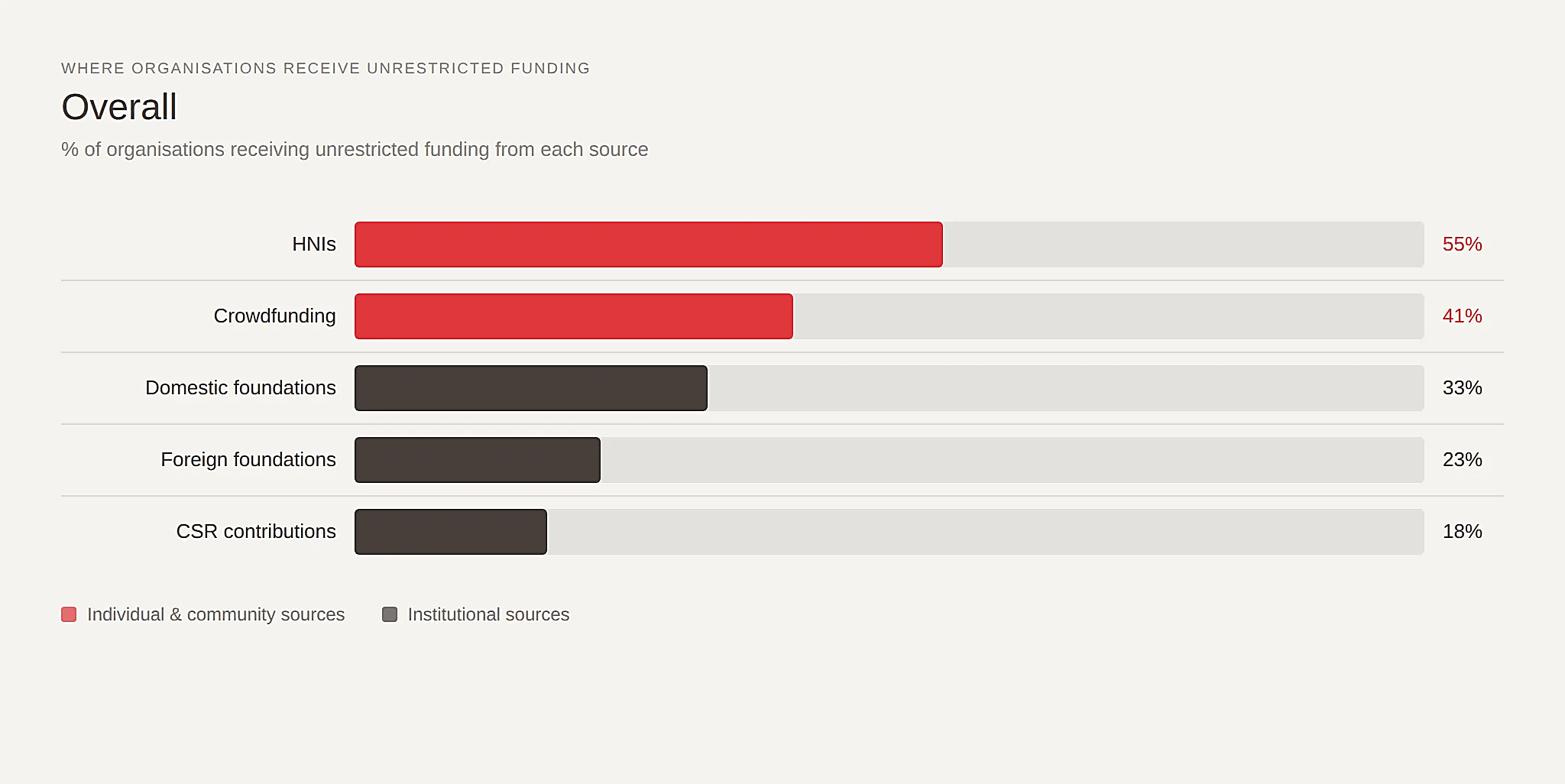
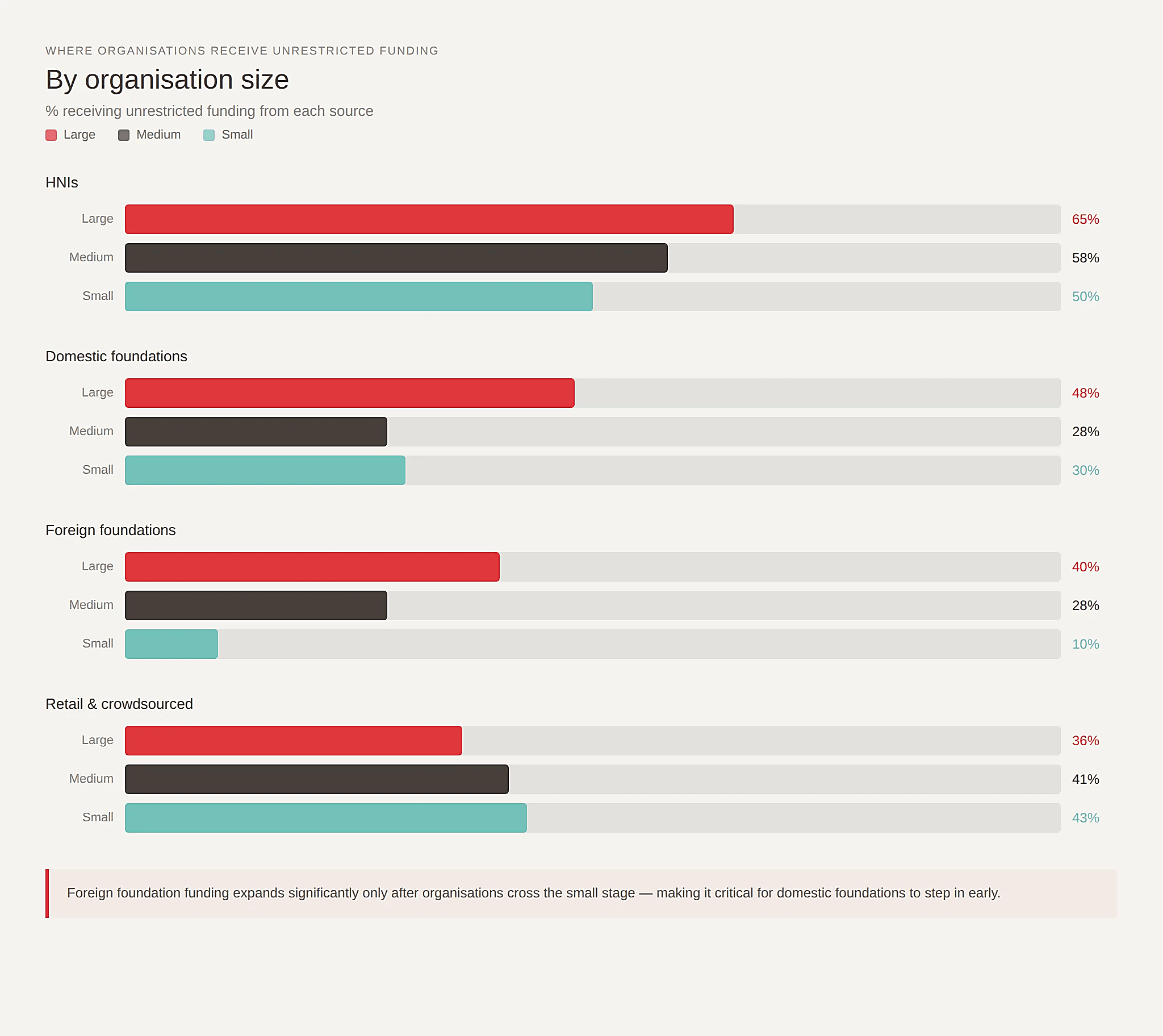
Domestic foundations are under-represented in providing flexible, unrestricted grants. Fifty-five percent of the organisations raised flexible funding from high-net-worth individuals (HNIs), while 41 percent used crowdfunding. Only 33 percent raised it from domestic foundations. Most institutional funding by domestic and foreign foundations is skewed in favour of large organisations, with smaller organisations primarily having to rely on individual donors. This lack of institutional support in the early stages compels founders to be risk-averse and under-invest in the ability to innovate.

The investments nonprofits are unable to make
It is difficult to scale up nonprofits without flexible funding. Eighty percent of the surveyed organisations reported that they felt constrained in contemplating expansion due to the lack of flexible funding.
An organisation we surveyed told us, “Indian funders obsess over ‘measurable impact’, but they interpret it narrowly, as short-term project wins rather than long-term change. So they resist funding [administrative] costs, even though operations are what make impact possible.”
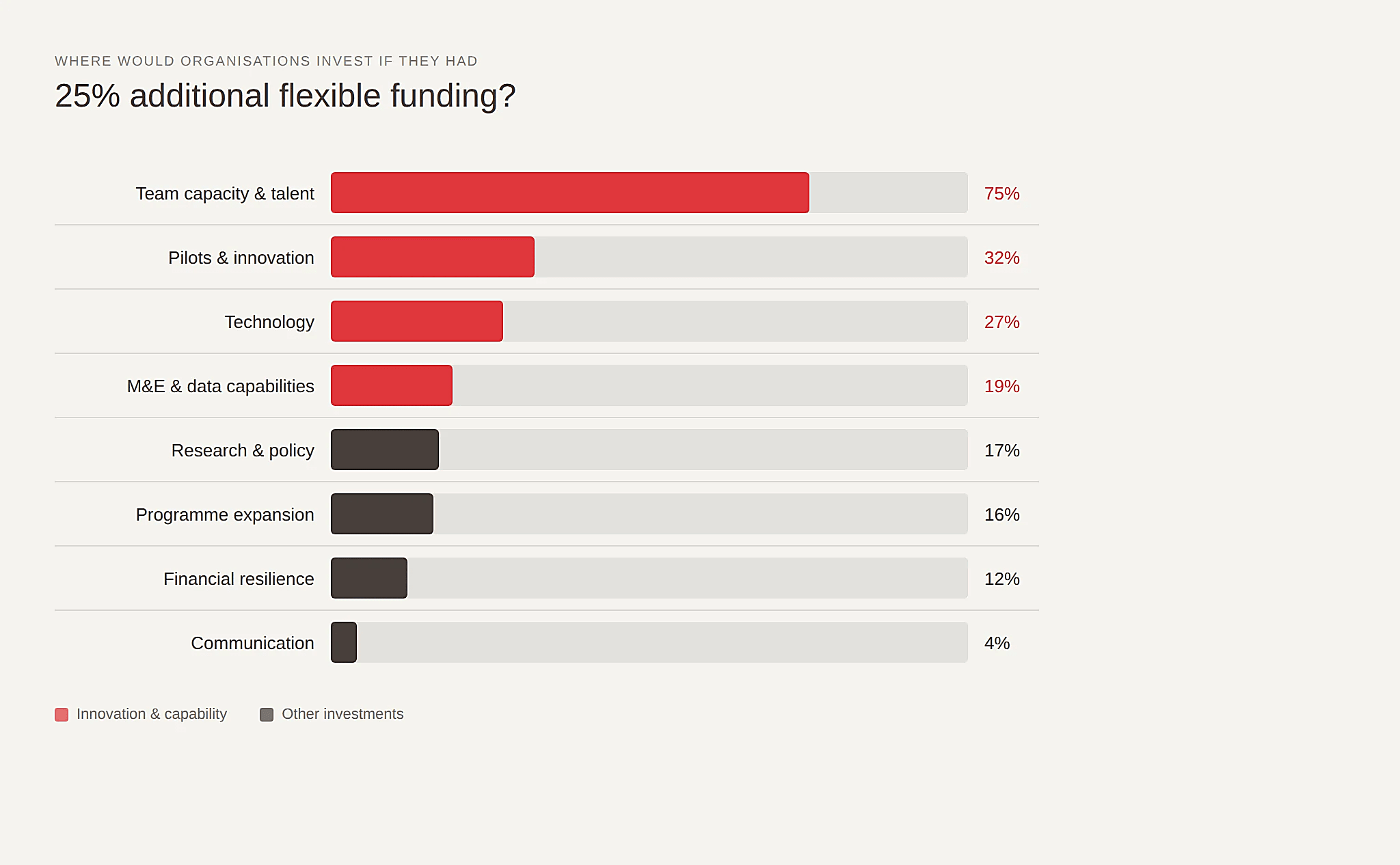
Founders also shared where they would allocate funds if they were to receive 25 percent more flexible funding. Seventy-five percent of them said they would invest in building a strong team by hiring for key vacancies in monitoring and evaluation, research, fundraising, and programme leadership, and offering fair compensation to the current core team, which is chronically underpaid.
Thirty percent of them report that they would invest in running pilots and testing new models, 27 percent would invest in technology, and 17 percent would allocate funds to research and policy advocacy. All these are investments that will lead to more innovation and ultimately growth.
A roadmap to unlocking flexible funding
Our research estimates that India needs to unlock about USD 750 million in flexible funding over the next five years to create 100 nonprofit unicorns (organisations that can impact lives of either one million people or at least 5 percent of the people afflicted by a said problem). This is approximately USD 150 million in annual funding. It might seem like a large amount, but it is just 1 percent of the current philanthropic donation of USD 15 billion. The donors therefore do not need to increase their giving but change the design and nature of it.
Tapping into the potential of flexible funding will require three clear shifts:
1. Build a stronger ecosystem of angel investors
India’s startup ecosystem has been supported by angel investments that have crossed USD 1 billion in commitments. These angel investors take early bets and provide the risk capital that startup teams need to find product-market fit. It is time for these investors to provide the same support to nonprofits. India has a growing class of 3.3 lakh millionaires and 4,290 ultra-HNIs. They can easily unlock early-stage innovation funding for nonprofits.
Our previous research suggests that high-potential nonprofits need roughly INR 1.5 crore per year in their first three to four years to find their model and build their team. This is not a large demand for most HNIs. They can do more than just writing cheques. They can help founders identify the right north star metric that captures the core value of the offering, recruit for key gaps in teams, and make introductions to potential government or corporate partners to unlock scale.
2. Promote multi-year, unrestricted grants
Foundations, especially domestic ones, can shift from one-year to three-year grants as a default and set targets to move 90 percent of grant-making to unrestricted funds. Unrestricted funding does not mean no accountability. We need different metrics and benchmarks to track progress and move away from line-item budget tracking. For example, we find it meaningful to track progress based on the following parameters:
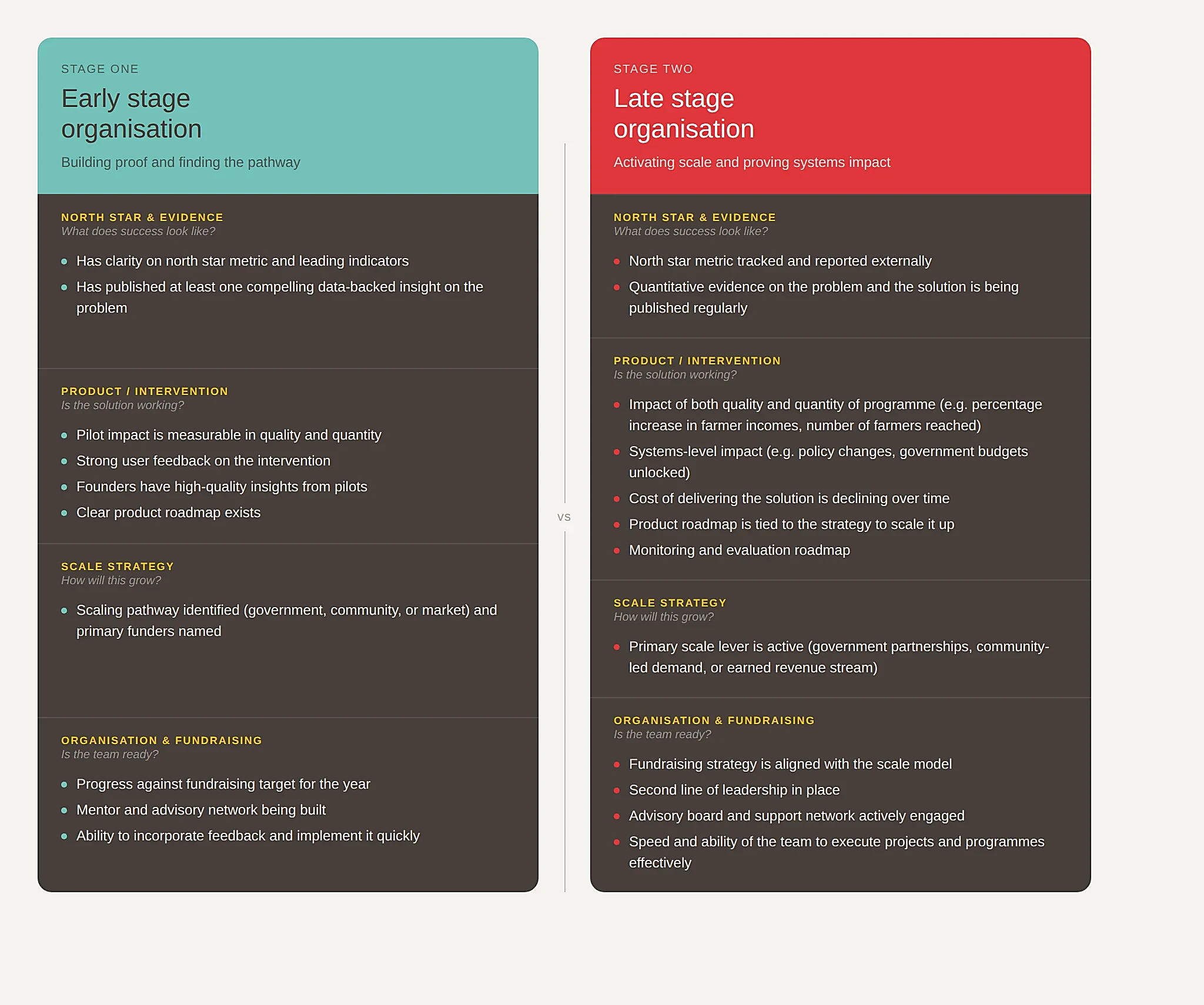
Foundations can share best practices with the funding ecosystem so that they can have accountability without stifling innovation.
3. Use CSR capital to fund innovation
Even though there are tight restrictions around how corporate social responsibility (CSR) funds can be invested, CSR teams can still fund innovation within the current regulatory framework. They can set targets to allocate 25 percent of their grant-making for research and commit to funding the full cost of delivery, including the cost of the core team, technology, and monitoring and evaluation infrastructure. All this can easily be done within the current CSR rules.
The Ministry of Corporate Affairs has explicitly confirmed that research and studies in the areas specified in Schedule VII of the Companies Act qualify as valid CSR expenditure. In the same circular, it even states that “the entries in Schedule VII must be interpreted liberally so as to capture the essence of the subjects enumerated in the said Schedule. The items enlisted in the amended Schedule VII of the Act, are broad-based and are intended to cover a wide range of activities.” This guidance has been consistently reaffirmed, most recently in MCA General Circular No. 14/2021.
Schedule VII is broad by design and regulation therefore isn’t a barrier. CSR committees can easily fund research, evidence gathering, monitoring and evaluation, and technology costs within the current CSR rules.
To build 100 nonprofit unicorns, funders need to alter how they deploy their capital to take big bets and allow for more innovation. But for this to happen, nonprofit founders also need to shift how they think about the impact of their own work. For instance, a nonprofit that has demonstrated that it can create employment pathways for rural youth should not be asking how to grow from a cohort of 200 to 500. Better questions to ask would include: Is government buy-in or training community champions better to distribute the programme at a higher scale? How can technology reduce the cost of delivery? Who pays when the programme is scaled up? Are government budgets available? What policy levers could open up entry-level jobs and internships for these youth? Founders need to stop focusing on simply scaling their own programmes and find ways to leverage their work to effect systemic changes.
—
Know more
- Read the report that this article draws from.
- Learn more about the diverse methods of scaling impact.