In Bhuj, Gujarat, 314 families living in three informal settlements – Ramdev Nagar, Bhimrao Nagar, and a Gujarat Industrial Development Corporation (GIDC) settlement – faced insecure and inadequate housing conditions. Starting in 2013-14, under the Rajiv Awas Yojana (RAY), they received government support for redevelopment, by constructing or improving their homes following an owner-driven approach. The process enabled the families to move into homes with better physical infrastructure and greater tenure security.
Importantly, residents were directly involved in decisions concerning the planning and construction of their homes, rather than being passive recipients of housing units. Community organisations and women’s savings groups helped facilitate community participation and strengthen collective action. This was complemented by local organisations providing technical support and engagement by municipal officers. By 2021, all 314 homes were completed and occupied. This milestone matters not simply as a project completion date, but because it was the culmination of a process involving land disputes, delays in government approvals and subsidy instalments, and delays in infrastructure works.
The RAY approach in Bhuj attempted to address one of the most difficult issues facing informal settlements: land. The land occupied by the communities was transferred to the Bhuj municipality on a 99-year lease. Families were to receive individual allotment certificates for their plots and ownership of their houses. Housing subsidies were deposited into individual family accounts as construction progressed, rather than being channeled entirely through a private developer.

Gujarat’s experience with PMAY
This RAY-supported process in Bhuj was implemented by 2015, and the programme was thereafter replaced by the Pradhan Mantri Awas Yojana (PMAY) – introducing a new national framework for addressing urban housing needs. While RAY focused primarily on slum-free city planning, community-led slum surveys, and land tenure rights, PMAY shifted the national focus toward standardised, market-driven mechanisms – expanding coverage to broader income groups alongside direct technology-based targeting.
PMAY had four principal verticals: (i) In-situ Slum Development (ISSR) involving redeveloping of existing slums on the same land, using land as a resource and involving private participation where appropriate. The objective was to provide improved housing to eligible sum-dwellers without necessarily relocating them. (ii) Credit-Linked Subsidy Scheme (CLSS) involving interest subsidy on housing loans for eligible households, enabling them to purchase, construct, or enhance housing. (iii) Affordable Housing in Partnership (AHP) wherein housing projects are undertaken by public or private agencies, with central assistance for EWS (economically weaker sections). Projects generally require at least 35% of houses to be for EWS households. (iv) Beneficiary-Led Individual House Construction/Enhancement (BLC) whereby central assistance is given to eligible EWS households to construct a new house or enhance an existing house on land available to them.
Residents often did not want to move away from existing homes, livelihoods, and social networks.
The subsequent experience under PMAY raises a different set of questions about how housing programmes address land, tenure, finance, and community participation. This was studied by ‘Homes in the City’ and partners across Gujarat’s small- and medium-sized municipalities. Covering 1,534 slums and about 216,351 across 83 Nagarpalikas, 90.5% of the households were assessed as eligible under PMAY. Yet, substantial unmet demand remained. The study identified gaps in the four verticals of PMAY.
The BLC component was particularly relevant to slum households: 66% of BLC demand in the sampled municipalities came from slum households. But many could not proceed because they lived on public land without formal land rights. Under PMAY an individual should hold the legal land title to be considered as beneficiary for BLC, which is not possible in case of informal settlements. In contrast, under RAY, the Bhuj Municipality gave the land on 99 years lease to the beneficiaries after execution of the project.
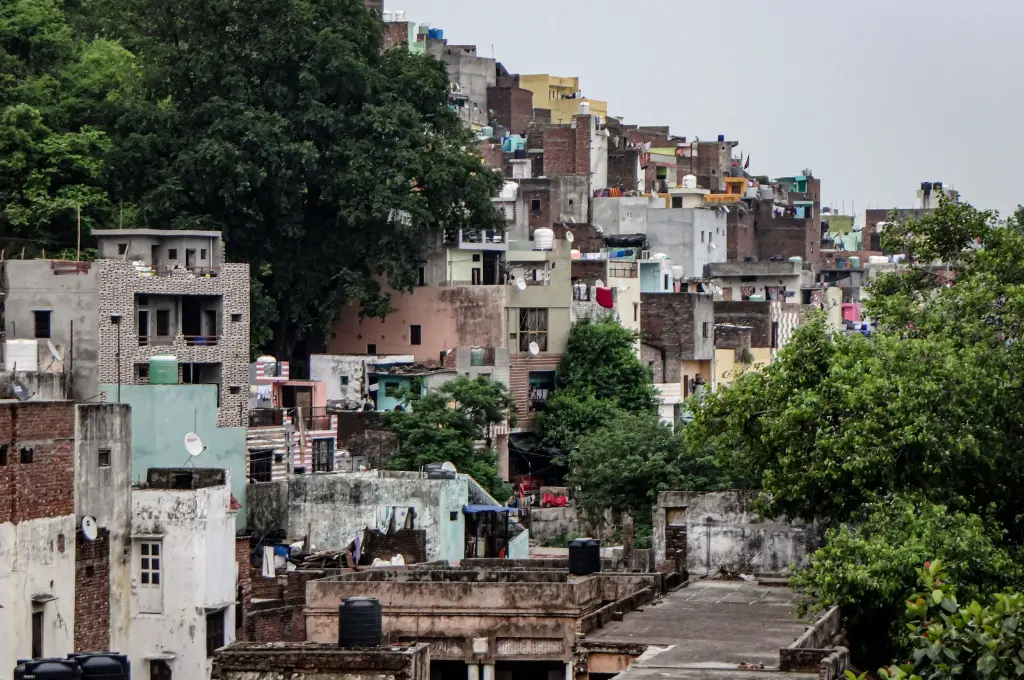
The ISSR component depended on economics that often did not work in smaller cities, particularly where land values were insufficient to attract private developers. The AHP component faced similar problems of developer interest and municipal capacity.

Relocation created another difficulty. Residents often did not want to move away from existing homes, livelihoods, and social networks. The result was a three-way impasse: BLC could not proceed because people lacked land rights; in-situ redevelopment could not proceed because the economics did not work; and relocation did not correspond to residents’ social and economic realities.
Getting the design of housing policy right
This points to a deeper problem with how housing policy is designed. A household may be poor enough to require housing assistance but still be unable to access assistance under PMAY-U’s BLC component if it does not have land available in its name on which the house can legally be constructed. This creates a significant barrier for many households living in informal settlements, where residents may occupy land without formal or recognised tenure. In Bhuj, about 83% of the slum households identified in the 2018 Housing for All Plan of Action were living on public land, highlighting the scale of this challenge.
Tenure security should be treated as part of the housing intervention rather than as a condition that poor households must resolve independently.
The contradiction is clear: the people most in need of housing improvement may be precisely those excluded by a system that treats formal land rights as a prerequisite. This is why housing policy cannot be reduced to a question of how many houses are constructed. For small- and medium-sized cities, government programmes need to connect five things: land, tenure, finance, housing, and community participation.
Where settlements have existed for decades and residents have established livelihoods and social networks, improving existing settlements may sometimes be more realistic than relocating people or replacing their homes with standardised apartments.
The Bhuj experience suggests several practical directions. First, tenure security should be treated as part of the housing intervention rather than as a condition that poor households must resolve independently. Second, national programmes should allow greater flexibility for owner-driven and incremental construction. Third, municipalities need technical and institutional support to facilitate community-led processes. Fourth, residents should be treated as rights-holders and co-producers rather than simply beneficiaries. Finally, housing programmes should measure more than houses sanctioned or completed. They should ask whether residents have secure tenure, whether livelihoods and social networks can be maintained, whether people participated in decisions, and whether neighbourhood infrastructure has improved alongside housing.
Conclusion
The lesson from Bhuj is therefore not that India should return to RAY or abandon PMAY. It is that national housing programmes need to create an enabling framework in which the State provides rights, land, finance, and institutional support while communities and local governments have meaningful roles in determining how housing is planned, built, and managed. For India’s small- and medium-sized cities, recognising poor households as partners and rights-holders in the production of the city, rather than merely beneficiaries of housing schemes, may be the key to making the right to adequate housing a reality.
The experience of the 314 families in Bhuj provides a concrete local reference point for examining what can be achieved when national housing support is mediated through community participation and locally responsive institutions, and what may be lost when such processes are replaced by top-down, standardised programme implementation. The challenges encountered in implementing PMAY in Bhuj and other small- and medium-sized towns in Gujarat highlight the continuing gap between rigid national frameworks and the locally specific conditions required to realise adequate housing.
This article was originally published on Ideas for India (I4I).