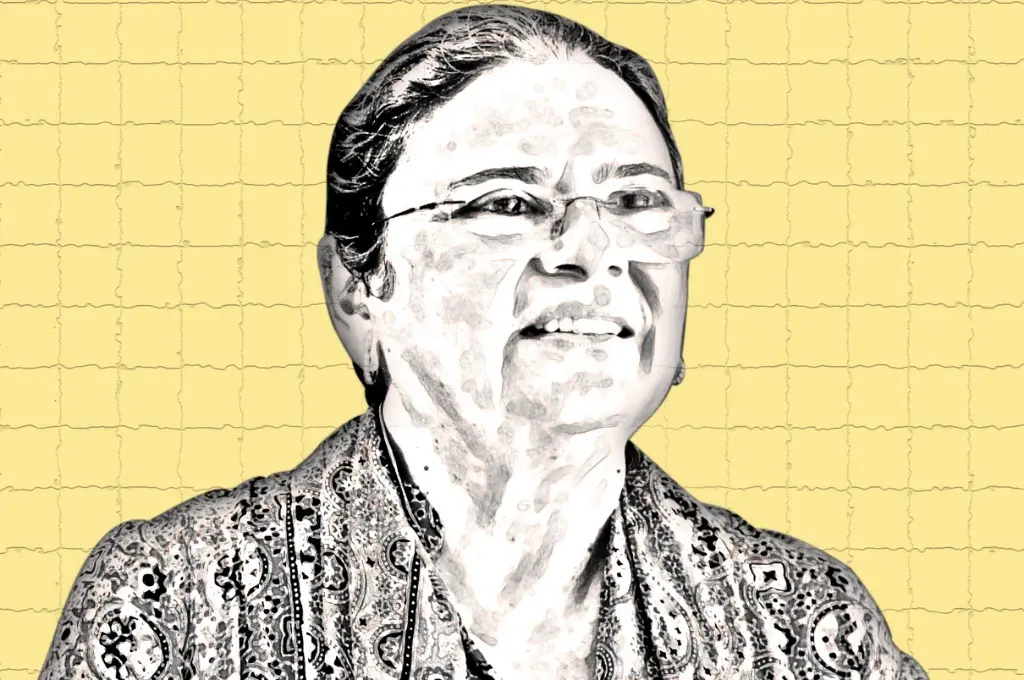
Sheela Patel is the founder and director of the Society for the Promotion of Area Resource Centres (SPARC), Mumbai-based nonprofit that has worked on housing and infrastructure rights for the urban poor since 1984. She is also the co-founder and former chair of Slum Dwellers International, a global network of community-based organisations of the urban poor across Africa, Asia, and Latin America.
For more than four decades, she has worked with communities living in informal settlements to organise around their needs and claim their rights. Her work has helped bring issues of urban poverty, housing, and infrastructure to the attention of governments and international institutions. In recognition of her contributions to addressing urban poverty, she was awarded the David Rockefeller Bridging Leadership Award in 2009 and the Padma Shri in 2011.
In this interview with IDR, Sheela reflects on how her early experiences shaped her approach to development, explains why building trust and putting women at the centre are essential to community-led change, and discusses the challenges of creating more inclusive cities as urbanisation and the climate crisis intensify.

How did you find your way into social work, and what early experiences shaped your understanding of what meaningful development work should look like?
I began working in this field in 1974, but everything that led me here was circumstantial. I didn’t start out with a particular passion for or a sense of dedication to social work. I came from a middle-class family, was interested in sports, and went to Baroda to study child development. After returning, some of my friends applied to the Tata Institute of Social Sciences, so I did too.
My father had been involved in the freedom movement, but that wasn’t what drove me towards this work. I say this because I think young people today are often burdened by the expectation that they must have a deep commitment to a cause from the outset. That wasn’t my experience.
After graduating, I joined the Nagpada Neighbourhood House, a community centre associated with the Tata Institute, where I worked as a counsellor at a child guidance clinic. Working there exposed me to communities and circumstances I knew very little about. You can live in a city and remain entirely within your own bubble. I had grown up in a middle-class bubble, and this work brought me into contact with people whose lives were very different from mine.
One of my earliest lessons came from working with children referred to us by the juvenile court for smuggling. We were supposed to counsel them and help them leave that line of work. But when I spoke to their mothers, many explained that their sons’ earnings were what kept the family fed. One mother, a divorced woman, told me that her son brought food to the table and that, whatever we did in counselling, he would have to return to that work. That experience began my journey towards understanding people’s circumstances and taught me not to be judgmental about the choices they make.
Another incident that stayed with me involved pavement dwellers who were being evicted by the municipality. One woman asked whether she could leave her peti—a small box in which she kept her belongings—in my office if she were to get evicted. I agreed, and before I knew it, my office was filled with these boxes. It was a glimpse into to the insecurity of their lives and the lengths they had to go to protect what little they owned.

In 1978, I started managing the community centre. Over the next four years, my understanding of the work changed considerably. I began to realise that, although we were working with women, we rarely listened to them. We told them what was good for them, what hygiene meant, what they should eat, and how they should care for their children. But we seldom asked what they wanted or took the time to understand their problems. Many of our programmes existed because we had the funding to deliver them, not necessarily because they addressed what women needed.
Once we began listening, the work changed. We started a daycare centre and a feeding programme, and changed the timings of the health centre to better suit people’s lives. When women questioned why sterilisation programmes focused on them rather than men, we began facilitating vasectomies instead of tubectomies.
Eventually, however, the organisation’s governing body curtailed my authority. And as a result, I left and, along with some friends, established SPARC in 1984. We wanted to develop an approach in which organisations went into neighbourhoods rather than expecting communities to come to them, creating spaces where people could come together to discuss their problems, with women at the centre.
We began by working with some of the most vulnerable people in Mumbai: pavement dwellers. The central question was how to help communities understand their circumstances, organise around their needs, and claim their entitlements.
I didn’t enter the sector with a predetermined vision. My understanding developed by listening to people and learning from them.
You mentioned how important it is to listen to the communities you work with. How do you build the kind of trust that enables people to engage with you meaningfully?
Initially, it took us a long time to build trust. When we started working with pavement dwellers in the 1980s, people were used to organisations coming in and giving them something. We told them that we didn’t have money or goods to give them. We were there to understand their problems and work out how to solve them together.
Poor people, especially women, think very carefully before changing the routines and arrangements that help them get through everyday life.
It took time for people to understand what we were trying to do. But gradually, we began helping them address the problems they faced in their everyday lives. I think we were the first organisation in Mumbai to help pavement dwellers get ration cards. We would take ten women with us whenever we went to a government office or police station, so they could learn how to navigate these institutions themselves. We also introduced them to hospitals and helped them understand how to access emergency services and obtain the necessary paperwork.
We didn’t promise them any particular outcome. Instead, we accompanied them through the process, helping them acquire the knowledge and confidence to navigate them independently.
Once the first group of women saw that it worked, we asked them to help others. When one woman tells another that something works, it’s magic. We no longer needed to convince people. This is how we built trust and expanded the work.
This experience also taught us something important about how people make decisions. Poor people, especially women, think very carefully before changing the routines and arrangements that help them get through everyday life. They have worked out ways of surviving within difficult circumstances, and they are understandably reluctant to do anything that might create new problems for them. We cannot assume that they will embrace an intervention simply because we believe it is good for them.
But when they see other women trying something and benefiting from it, they begin to feel confident enough to try it themselves. As more people experience the benefits, they become part of the effort to bring others along. The work grows not because an organisation has convinced everyone, but because communities themselves have seen its value.
You’ve spoken about the importance of putting women at the centre of development work. What is the shift that this creates?
A lot of our early work went into demonstrating to families that the changes women were bringing about were useful not only for the family, but for the neighbourhood as well. These contributions had to be recognised as an asset.
We also found that when women begin taking charge, they can be more difficult to intimidate. Consider what happens when the police arrive to demolish a house. They often bring women police officers, and the women in the settlement negotiate with them. They say, “We have a lot of things here which are important. Let us take them out. Then we’ll help you break the house.” They negotiate the demolition in a way that allows them to put the house back together afterwards. The men in the community came to appreciate this strategy. They could see that the women were not simply resisting or creating conflict. They were finding practical ways to protect the family’s belongings and interests. As a result, the men began supporting the women.
We also learned that the solutions women develop for their own circumstances may be very different from those that outsiders assume will work. For instance, there was a movement to establish shelters where women experiencing domestic violence could stay for two or three months. But women pointed out that they would eventually have to return home. They wanted ways to address the problem within their own circumstances, rather than a solution that offered temporary respite without changing what happened afterwards.
Women understand their circumstances, can devise strategies to navigate them, and know what kinds of changes are possible within their families and communities.
Some of the strategies they developed were remarkably simple. Three older widows suggested that if a woman was being abused by her husband, one of them would take her cot and place it outside the woman’s house. The husband would be less likely to abuse his wife in front of an older woman who was there to observe if not to intervene. The women would also threaten to call me or the police if their husbands became violent. I never received a call, but the important thing was that women knew the organisation was on their side and could intervene if necessary.
These were strategies that the women themselves came up with, and we supported and institutionalised them. Many of the approaches coming from mainstream feminism at the time were not working for these women, because those strategies did not necessarily fit the realities of their lives.
Putting women at the centre, therefore, changes both the way interventions are designed and the kinds of solutions that emerge. Women understand their circumstances, can devise strategies to navigate them, and know what kinds of changes are possible within their families and communities. Our role is to recognise that knowledge, support it, and help create the conditions in which it can bring about wider change.
Mumbai has changed rapidly over the past few decades. How have these changes affected informal settlements in the city and your work?
There have been many changes, but a significant one is the growing influence of the real estate industry, which has close ties with politicians. The expansion of floor space index (FSI) and the increasing value of land occupied by informal settlements has transformed the financial viability and physical scale of real estate projects. As a result, areas such as Dharavi are being redeveloped to create commercial opportunities and housing for the more affluent. Cities are increasingly being developed around the interests of a relatively small section of the population.
At the same time, cities continue to depend on people living in informal settlements. More and more young people are finding opportunities in cities, particularly through the gig economy. Many of them live in informal settlements. Yet, their needs remain unacknowledged, let alone central to how cities are planned.
In many ways, the challenges facing slum dwellers have remained the same. What has changed is the way the housing market operates, and how little attention we pay to it. Take the housing built under slum rehabilitation schemes. As families grow, the homes developed under the scheme may no longer have enough space for everyone. So, they rent out or sell their homes. This is often treated as an aberration, when it is actually a response to a straightforward problem: people’s housing needs have grown, but they have not necessarily gained access to adequate housing.
This has created a new rental market serving middle- and lower-middle-income households in the city. Meanwhile, older buildings are being redeveloped into much taller structures, sometimes 30 or 40 floors high. These changes are transforming the housing landscape, but they do not necessarily address the needs of the people who originally lived in these settlements.
Another major concern is climate change. Everyone is talking about it, but we are not adequately connecting climate with development. There is a lot of discussion about environmental interventions, such as planting trees, without enough attention to whether they will survive.
Ultimately, cities have grown as has the value attached to urban land, but the fundamental question remains: who are we planning cities for? Unless we address how housing markets work and recognise informal settlements as an integral part of the city, urban development will continue to fail to serve a large proportion of the people who live and work in cities.
What needs to change in the social sector to enable young people to engage meaningfully with communities?
First of all, I feel that the age of people like us giving our entire lives to this work is gone. There will always be some people who dedicate their lives to it, and we should ensure that they and their families are adequately supported. Philanthropy needs to recognise that paying rent and sending children to school cost much more today, and that grassroots professionals need to be paid accordingly.
I believe we need a sustained campaign so that everyone who goes to university can be supported to give at least 10–15 percent of their time something that addresses challenges in their neighbourhood. The amount of work that needs to be done is far beyond what nonprofits alone can manage.
At SPARC, we encourage university professors and students to treat working with communities as fieldwork that exposes them to a different way of relating to people who live informally. The idea is to give young people opportunities to explore, examine, and build relationships with communities from whom they can learn.
I also believe that organisations need to adapt to the realities facing young people today. Those of us who began this work 50 years ago did so in a very different historical and political context. Young people today are different, the sector is different, and the politics are different. We have to keep asking ourselves how we can create relevant opportunities for young people.
Meaningful engagement with communities should not be restricted to those who choose to spend their entire careers in the social sector.
As urbanisation and the climate crisis reshape cities, what gives you hope that cities can be more inclusive?
Today, four-fifths of the world’s population live in urban areas. Yet, we invest in development with the assumption that it will keep people in their villages. But now villages themselves are being absorbed into urban conglomerations, and future planning has to be based on the reality that more and more people will have to find refuge in cities as the climate crisis intensifies, given its impact on agriculture and rural livelihoods.
Formal institutions and planning systems often ignore the fact that urbanisation will only continue to increase. As the late Jockin Arputham, my colleague and a leader of the National Slum Dwellers Federation, used to say, “You can make whatever plans you want, but if that does not work for the poor, they’ll find ways around the blockages and come into cities, and you will have to bear the consequences.” People don’t encroach on land because they are vicious. They come to cities to work and provide services. But when cities don’t give them a place to live, they will find somewhere else to stay.
We are still planning our cities using systems inherited from the British. We need to change how we think about urban development and recognise the realities of the people who live in our cities. We need to rethink the way we plan cities, understand the people who sustain them, and create systems that accommodate their needs. If we continue to exclude the poor from our planning, the consequences will be felt by everyone. The challenge is to ensure that our institutions and cities evolve to reflect the world we actually live in, rather than the one our planning systems assume we have.
Sneha Philip contributed to this article.
—
Know more
- Watch this interview with Sheela Patel to learn more about her journey and advocacy.
- Learn more about the decades-long fight for water in Mumbai’s informal settlements.