Three years ago, Vinod Kumar Maurya (33) travelled village to village in Uttar Pradesh’s Sitapur on his two-wheeler to inform farmers about an upcoming carbon project in their region. Maurya’s tasklist was long, and so he packaged the information in simple terms: “Farmers who don’t burn their crop residue and plough it back to the soil instead, and who use minimal chemical fertilisers, will receive some subsidy.”
Maurya did not have an answer to the follow-up questions of “when?” and “how much?”
In Uttar Pradesh, carbon farming projects owned by private companies as part of Voluntary Carbon Market are onboarding wheat, paddy and sugarcane farmers for agricultural land management. Officially identified as VM0042 by Verra Carbon Registry, this methodology includes reduced tillage and improvements in fertiliser application, biomass residue and water management, cash and cover crop planting and harvesting practices, and grazing practices.

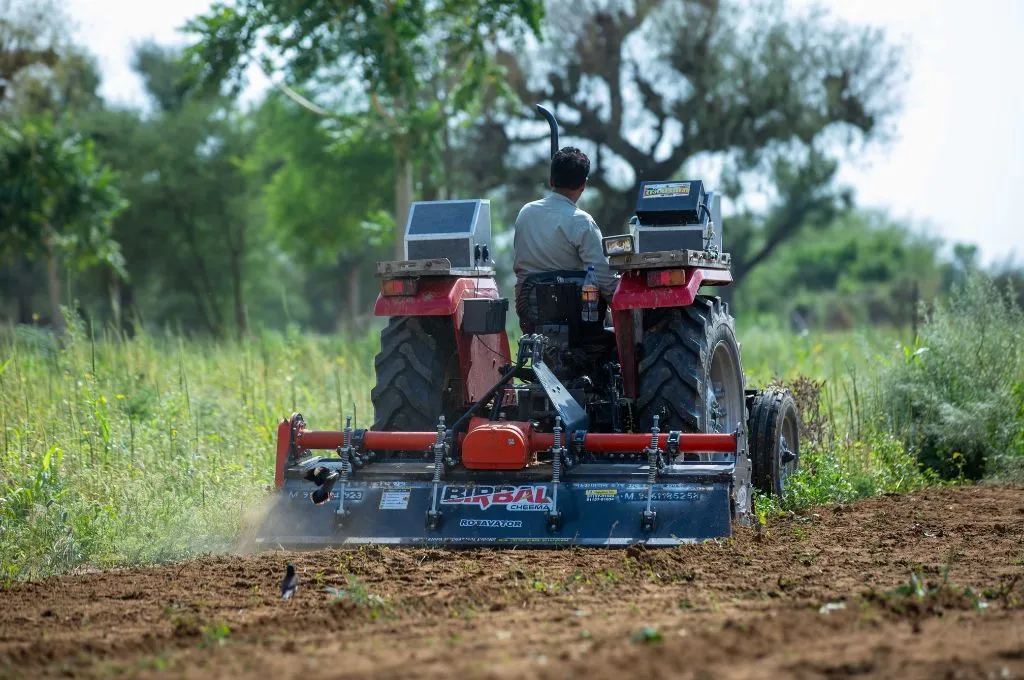
These projects are centred around avoidance, as ISignal explained in the first part of this series. One initiative is getting farmers to eschew burning crop residue to avoid emissions. Companies are supporting farmers by facilitating the use of superseeder machines which help sow the wheat crop by mixing the crop residue into the soil. Another initiative is direct seeded rice (DSR), a technique that replaces flooded transplanting and reduces emissions.
The resulting reduction in emissions, and the increased organic soil carbon are then used to generate carbon credits. These credits are bought by companies looking to reduce their own carbon footprints.
One carbon credit typically represents one metric tonne of carbon dioxide equivalent (tCO₂e) reduced or removed, or the amount of emissions from a car on a road trip from Kanyakumari to Leh and back.
The agriculture sector is responsible for 15% of India’s annual greenhouse gas emissions. As of July 2026, Verra has 42 agricultural and forestry projects registered in India, of which four use VM0042 methodology. ISignal looked at two of these projects—one by Boomitra, a climate-tech company based in San Mateo, California, and another by Varaha ClimateAg Private Limited, a climate-tech start-up based in Gurugram. The second project now lists Kheti Pte Ltd. as the project proponent, which is a subsidiary of Varaha, as confirmed by Shantanu Jain, who leads the latter’s CEO’s office.
Boomitra’s project is structured as a grouped project including Uttar Pradesh where it is “under verification”, Abhinav Gupta, Director Project (APAC), Boomitra said. Varaha’s project is also registered as a grouped project, generating credits for Punjab-Haryana, planning to expand to wheat-rice cropping systems in the Indo-Gangetic belt including Uttar Pradesh.

Taking the leap
Maurya opened an application on his phone that flashed 5,970 acres on its home screen—the acreage he had onboarded under the project between April 2023 and April 2026. “The mammoth task,” as Maurya described it, had begun after Ozone Farmer Producer Company joined Varaha as a channel partner. Their primary job is to collect data and act as a bridge between the company and the farmers.
“Initially they were indecisive on which farmers they wanted to work with, so we [Ozone] onboarded everyone who was interested. Then they asked us to shortlist farmers growing wheat and paddy,” he told ISignal.
Using his 15 years of expertise in the field, he identified 1,250 farmers who stuck to growing the two crops due to geographical reasons such as low-lying land or soil quality. One of the firsts in the list was Subeg Singh (27) from Saraiyan Kaysthan village in Parsendi block in Sitapur district.
Much before Varaha’s intervention began, Singh was using a Rs 2.5-lakh worth superseeder machine. The soil quality for his 30 acres’ land improved and wheat production rose by 2.5 quintals per acre, he told us.
About 12 km away in Musepur village, the subsidy promise made Babloo Rajput (40), who owns 2 acres, to switch to superseeder in 2024. “For two consecutive years, I have produced 4.5 quintals of wheat in 1 bigha (0.2 acre here), as compared to 3 quintals earlier. The soil has definitely become more fertile,” he told ISignal.
Singh explained that Varaha had initially promised a subsidy of Rs 1,750 to switch from crop-residue burning. “We received it in 2024. But the next year, they reduced it to Rs 700,” he told ISignal.
While Singh spent a one-time cost of Rs 1.6 lakh on his superseeder machine in 2019, with the rest coming from a government scheme, other farmers pay Rs 1,700 per acre to rent it. Varaha’s subsidy is aimed at reducing this cost.
“I remember them telling me that by selling carbon credits we might receive Rs 2,500-Rs 3,000 per acre, but when the initial subsidy itself has been reduced, how do we expect that we will get the carbon credits payment or not?” Singh said.
He had heard about direct seeded rice (DSR) earlier, he said, but it was not until farmers from Punjab and scientists from the Krishi Vigyan Kendra answered his doubts—during a training by Varaha-Ozone—that he considered it. In 2025, he made the shift.
“It is difficult to find labourers in the village for transplantation, and water requirements are too high. This will only increase in the future and DSR solves that. More farmers in the village are now interested,” Singh explained. He did see a small production drop the first year, he said, but it still made sense to continue as the overall cost was less, considering his large landholding.
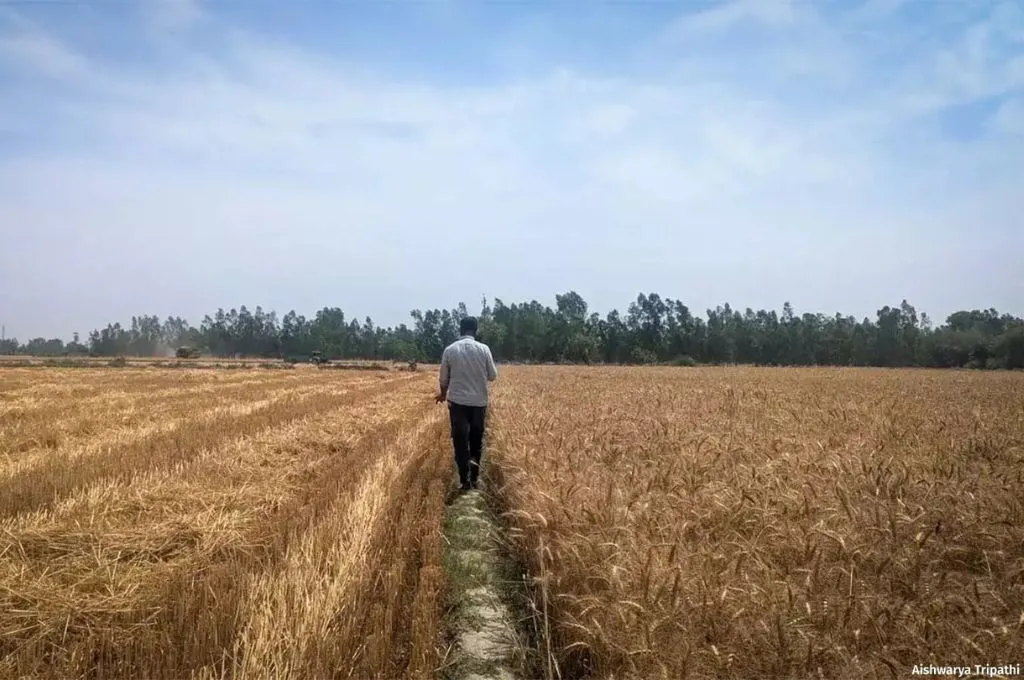
Close to his house, Kuldeep Singh (43) was overseeing wheat harvesting on his 15 acres of land under the sweltering April sun, with his turban doubled by a gamcha (cotton cloth). In his first DSR attempt, paddy production dropped by 2-3 quintals per acre “but at least we don’t need much water and labour for the job. It is difficult to comment how successful this might be in just a year”. He wants to fix probable mistakes in his method and try again.
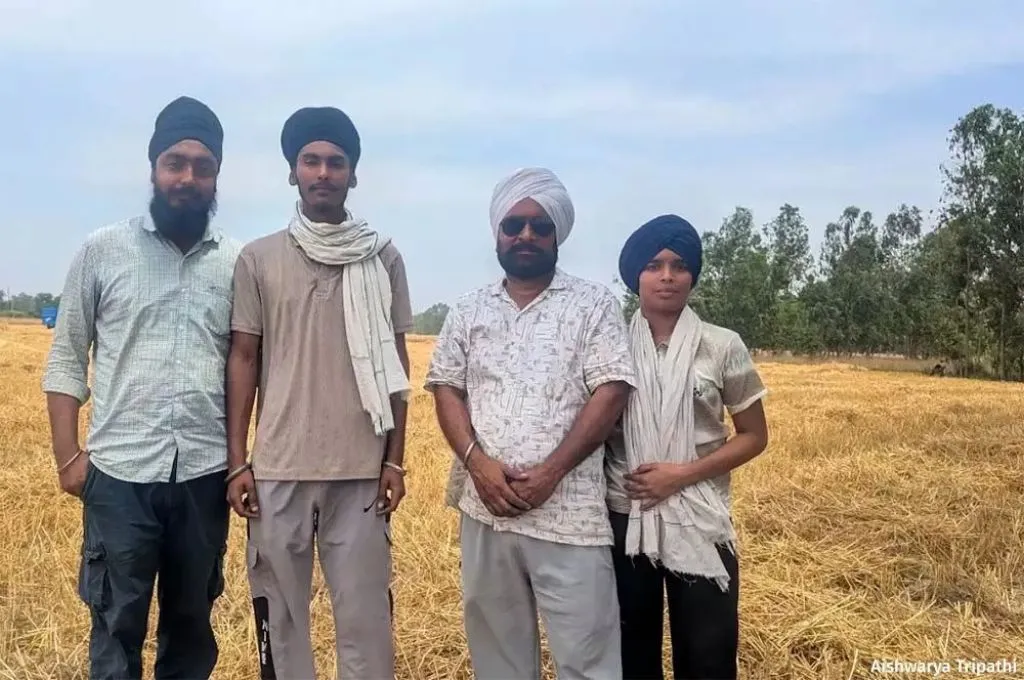
“Labour migration is the primary reason why farmers are finding DSR convenient,” underlined Shailendra Singh, senior scientist and agronomist at the Krishi Vigyan Kendra, Bahraich. “There are times when a farmer would have planted a nursery and is unable to find labourers in the village for 35 days.”
However, he cautioned that while this makes sense for farmers with large holdings, small farmers who mostly depend on their families for transplantation may not see economic benefits.
About 69% of India’s 146 million operational holdings are marginal (below 1 hectare), while nearly 18% are small (1-2 hectares), government data show.
Rajput agrees—he is awaiting more DSR success stories before giving it a shot.
The hurdles
In 2025, when Kuldeep Singh tried DSR, his crop didn’t germinate. In a hurry, he ploughed the land and sowed a second time. This meant extra expense. “How will a six-monthly meeting address all our problems? It’s trial and error for us. Probably, the seed went too deep in the soil that’s why it didn’t germinate,” he reckoned.
He is ready for another try only due to “labour shortage and water costs involved in transplantation.” In the next two years if he doesn’t see a yield improvement, he “will go back to transplantation”.
Across the region, farmers complain of excessive weeds when using DSR and are unsure how to tackle it without overspending on herbicides. Subeg Singh is waiting for the next meeting to ask for a solution.
Despite the gaps, Ozone’s Maurya is confident that more and more farmers will be drawn to DSR in coming years. “…even if there is labour availability, why would anyone take up the tedious work of monitoring it when there is a solution available which ensures equidistant plantation with pre-determined quantities of seeds and fertilisers?”
Referring to the yield drops that farmers are experiencing, he elaborated on the technique precision Subeg Singh had spoken about. “DSR techniques vary depending on the soil. For instance, in sandy soil, the seed must be sown at the depth of 1-1.5 centimetres, whereas for clayey soil, it should be 1 cm or less; for clay-loamy soil, 20% of the seed must be visible outside the soil.”
Dayashankar Srivastava, senior scientist at the Krishi Vigyan Kendra in Sitapur, believes the weed problem could also be attributed to inadequate training. “DSR is promising and it gets associated with excessive weed growth because farmers do not receive sufficient guidance in the initial stages,” he argued.
Sandeep Tiwari, regional manager of Varaha for Uttar Pradesh, said machine availability can be a challenge. “Superseeder is not a problem but for DSR we have only three machines in Sitapur as of now and it becomes challenging for all farmers to get it on time. Government’s help in subsidising the DSR machine could help solve this,” he said.
Adeeth Cariappa, associate scientist – environmental and resource economist in the Sustainable Agrifood Systems Program of CIMMYT (International Maize and Wheat Improvement Center) argued that project design must take into account local realities, climate vulnerabilities and the level of development in a region.
“These projects are complex and need to be thought of holistically. Farmers should not be left to manage the transition on their own. Different institutions need to work together to create that ecosystem,” Cariappa added.
The information gap
The efficiency of carbon farming projects is measured using soil organic carbon (SOC), either through physical soil sampling, satellite-based model or a mix of both. The samples collected prior to the start of project activities mark the baseline against which subsequent readings are measured. The increase in SOC is used to calculate emissions reduction. This is then converted to carbon credits. The project developers make a 20-year projection of GHG emissions reduction.
Before the project started in 2023, Maurya’s team collected about 1,000 soil samples from random fields chosen by Varaha, across seven blocks in the district—an activity annually thereafter.
“Har saal mitti lekar jate hain, reports ka kuch ata-pata hi nahi hai [They collect samples every year, but there is no word on the reports],” Subeg Singh rued. Field staff say they will discuss it with the higher-ups.
“We have stuck to the recommended practices. If they would have informed us how much carbon has increased in the soil or how many carbon credits are we able to generate, it would have pushed us to be more diligent,” Kuldeep Singh said.
Tiwari told ISignal that Varaha is working on providing access to soil reports, although he could not say when that will happen. Varaha’s CEO Madhur Jain is yet to respond on the issue of soil report access and if anything is in process of solving this.
Boomitra depends on geospatial techniques to monitor the soil up to a depth of 20-30 cm. “(Physical) soil testing needs to be done at minuscule levels to train our models and we are able to map individual farmland as a separate polygon, with individual calculations [for carbon emissions],” Gupta told ISignal in a Zoom interview.
The communication gaps extend beyond soil reports. Rajput recalled signing a form by “the company” and providing his land documents for registering, but he knew nothing about carbon credits or any additional income he might have in the future, if he were to continue with land management practices.
“Our focus is to motivate farmers to improve soil health and reduce carbon emissions. The idea is to strengthen these practices to a level that they become a norm. We definitely convey that if you continue doing this for a long time, you might receive some additional benefit but it depends on their continuity,” Tiwari told ISignal. Tiwari said that the ground staff and official channel partner are the first in line with farmers’ communication.
Maurya from Ozone felt that lack of awareness is the biggest problem with carbon farming projects. “There need to be thorough efforts to disperse information to more and more farmers, otherwise it’s difficult to scale,” he suggested.
Before the wheat-paddy shortlist, sugarcane farmers too signed the consent form for the project, and some farmers said they had provided documents for registration, but were not informed that they did not make it to the final project.
The continuity conundrum
In villages across Sitapur and Bahraich that this writer visited, farmers are motivated to make the transition to DSR and superseeder machines, but not for carbon credits. In Kaimhra Madarpur, farmers’ interest is the result of a peculiar monkey conflict.
“For the last few years, monkeys have been destroying the sugarcane crop causing losses. We are shifting to paddy as we have no option and DSR seems like a viable option due to labour shortage,” Uttam Kumar (45) explained. He confirmed that if this conflict was to be resolved in future, he would switch back to sugarcane.
“It [sugarcane] gives us money even if climate conditions are not favourable,” Tulsiram Verma (68), standing next to Kumar, remarked. “This year when wheat was almost harvest-ready, it rained for several days. Our hearts were pounding; farmers couldn’t sleep imagining the losses.”
“Farmers can change practices anytime based on what they find suitable in that particular moment. This is why it is difficult to generate credits from regenerative agriculture projects,” Tiwari argued.
Subeg Singh said that in his village, “farmers wrapped up wheat sowing in 10-15 days last year. Climate was not favourable—moisture was less and if they had gone through the cycle of mixing the crop residue in the soil and then irrigating it, the fasal [crop] would have been delayed.”
“Logon ne kuch nahi dekha ki Rs 700 milenge ki Rs 1,750. Aag lagao, paira hatao aur gehu bo do [Nobody bothered about whether they are getting Rs 700 or Rs 1,750 in subsidy. They burnt the residue and sowed wheat],” Singh explained. “Nature ke sath samjhauta karna pad jata hai [One has to compromise with nature],” he added.
More than the subsidy, it is the “the strictness of the government in the last few years that we avoid crop residue burning. Many FIRs have been lodged against farmers,” stated Kuldeep Singh.
Cariappa of CIMMYT warns that this compromise with nature is a challenge that carbon farming projects must address head-on. “Ideally, carbon credit projects cannot be just factories for reducing greenhouse gas emissions. They also need to create an enabling environment that helps farmers continue these practices over the long term,” he said.
According to Cariappa, farmers need access to climate-resilient crop varieties, quality seeds, information, training, credit and insurance. “Insurance is seldom discussed, but it is critical. If crops fail due to weather or any other reason, farmers should have something to fall back on,” he said.
Subeg Singh emphasised that adherence to the practices depends on the “support and training we receive from these companies. Ultimately if the harvest is not good and the expense is higher, any farmer will drop the activity irrespective of the hope of carbon credits.”
Of the 19 farmers ISignal interviewed, 15 reported lower yields after adopting DSR the first time, while four said yields remained unchanged. In contrast, all the farmers who had shifted away from crop residue burning reported improvements in yield.
A study by CIMMYT found “a clear correlation between training and communication with continued adoption—in which 25% of farmers associated with core carbon projects discontinued the practices in the second year due to lack of information”.
Subeg Singh spent about Rs 880 per acre on diesel for the superseeder that he owns, for land preparation and sowing.
The economics of carbon farming projects
For farmers interviewed by ISignal, the shift away from residue burning appears to make economic sense, particularly when combined with higher yields and improving soil health.
Maurya from Ozone FPO confirmed that the subsidy was reduced from Rs 1,750 to Rs 700 in 2025. Varaha’s Tiwari said it was a consequence for farmers who did not follow the practices well.
“It was reduced for some 12-14 farmers out of 1,250. We need to try different things on the field to make practices sustainable. It isn’t easy to generate credits from regenerative agriculture,” he added. Why Subeg Singh has received a reduced subsidy, despite diligently following the practices, is beyond his understanding.
For farmers like Rajput who rent the superseeder, the subsidy reduced the rental expense to Rs 1,000 per acre. Before adopting the practice, he would engage labourers to prepare the soil after crop burning, at the rate of Rs 1,900 per acre—Rs 900 more than the current method.
Over the last two years, he estimates that wheat production has increased by around 1.5 quintals per acre. At an average market rate of roughly Rs 2,328 per quintal, this works out to an additional Rs 3,492. Combined with his savings on labour, his net profit per acre came to Rs 4,392.
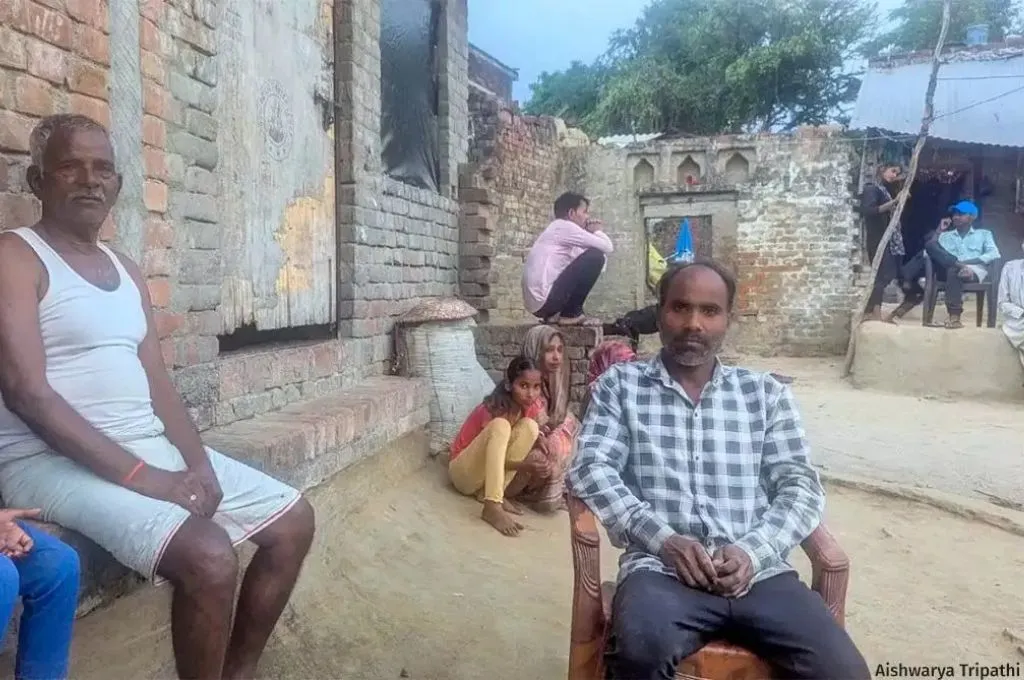
The economics of DSR, however, are less straightforward.
Under conventional paddy cultivation, farmers reported spending around Rs 7,000 per acre on labour and irrigation. Through the carbon project, DSR machines are made available free of cost by Varaha’s partners, although farmers still bear diesel expenses of around Rs 700 per acre. To tackle the excessive weed challenge, an additional Rs 800 per acre is spent on herbicides, bringing their input costs down to Rs 1,500 per acre.
However, most farmers said they experienced an initial decline in yield, which almost cancels out these savings: On average, farmers reported a reduction of around two quintals of paddy per acre, equivalent to roughly Rs 5,000.
Trishant Dev, programme officer for climate change at the Centre for Science and Environment, underlined that the primary question to ask must be whether “it is making economic sense for farmers to adopt a new practice and if it is incentive enough for them to make this behavioral change permanent”.
While Varaha promises 70% of the net revenue generated from carbon credit sales to farmers, Boomitra offers 55% of the total revenue generated. However, none of the companies can currently tell farmers how much that income will eventually amount to, as it depends on the volume of credits generated and the price at which they are sold.
The ground allies’ dilemma
On average, Maurya spent 20 minutes explaining the project to each farmer and another 30 minutes uploading Aadhaar details, land ownership documents, bank account information, signatures, and geotagging fields with clearly demarcated boundaries that appeared as neat polygons on the partners’ mobile app. Collecting nearly 1,000 soil samples was another massive exercise.
After onboarding, Maurya was required to click photographs, record videos of farmers practising DSR and incorporating crop residue into the soil, and upload the evidence to the platform. For this work, Varaha agreed to pay Rs 27 per acre.
“But we were paid only for the final acreage under wheat-paddy, even though the work had been done for a much larger area,” Maurya said.
After the sale of carbon credits, Ozone FPO is expected to receive 5% of the net revenue. But for Maurya, the issue is also about trust. The lack of communication and changing subsidy amounts have left him worried that years of relationship-building with farmers could be undermined.
“We don’t have answers when farmers ask why the subsidy was reduced or when they will receive money from carbon credits. Ultimately, a start-up based in Gurugram can leave whenever it wants. But what about us? We have to face these farmers every day,” he said.
This article was originally published on ISignal.