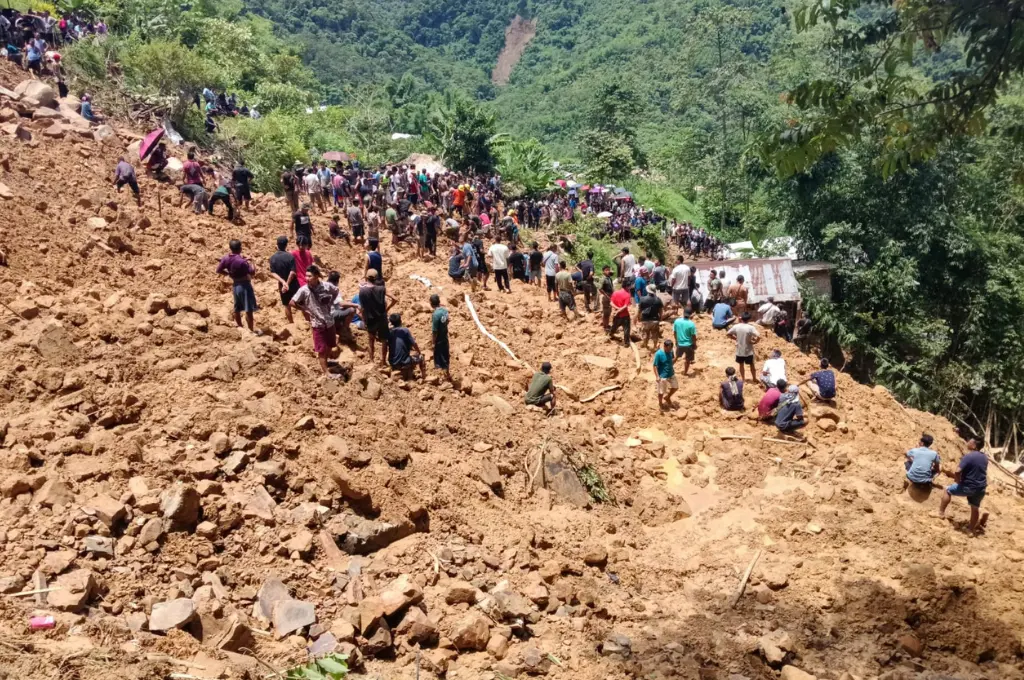
On the morning of July 19, at around 6 am, a landslide hit Mon town in Nagaland. According to reports from the end of July, 11 people lost their lives, and the calamity impacted over 28,000 families across 280 villages and wards, damaging 1,746 houses and destroying 1,593 acres of cultivated land.
Mon was among several districts affected by persistent monsoon rains, flash floods, mudslides, cloudburst and landslides across Nagaland, including Mokokchung, Longleng, Meluri, and Noklak.
These districts of Nagaland experience a difficult monsoon every year that leads to transportation, accessibility, and livelihood issues for the residents. However, the scale of the disaster was particularly difficult this year compared to anything they have experienced before.

Mary*, a journalist from Dimapur said, “This event does feel unprecedented. Residents in Mon and flood affected areas like Tizit and Naginimora described flood levels and a landslide frequency that they have not seen in their lifetime. The scale of road and bridge washouts cut off entire villages from district headquarters.”
As extreme weather events such as landslides, floods, and cloudbursts leave a devastating impact on Nagaland, it is important to understand the scale of the disaster, the kind of support communities are getting, the role of government and community institutions in emergency response, how infrastructure impacts access to relief in remote areas, and how visible the disaster is.
Not much data to use
The disaster has raised questions about what caused this much destruction and whether communities were adequately warned.
Mary* stated, “There is a clear need for expert assessment to understand why the destruction is so extensive this time. An assessment should address rainfall and terrain data, if this rainfall intensity was truly outside norms for Mon, if roads, bridges and habitations were built in high-risk zones, and if there were early warning systems in place.”
She added that authorities should find out which villages were at risk of further landslides should rains continue.

Manno Wangnao, an independent journalist from Mon, said, “Everybody is busy responding, but nobody is taking stock of the situation. Will this happen again? There should be a committee by now.”
Residents interviewed for this story said they did not receive any weather alert from the Nagaland State Disaster Management Authority (NSDMA) before the landslides and floods. At the time of writing, no expert inquiry had been publicly announced to examine why the destruction was so extensive.
The effects of the disaster have also extended beyond the immediate loss of life.
No way out in emergencies
W Wangjin, an assistant professor at Wangkhao Government College, Mon, recalled how his father fell seriously ill during the landslide. Under normal circumstances, travelling from his village, Chingphoi, to the District Civil Hospital in Mon would take around three hours. This time, landslides had severed the roads.
In a place where road connectivity is already fragile, a landslide can create emergencies beyond the immediate disaster.
His father had to be transported using four different vehicles. At every point where the road had collapsed, villagers carried him across the damaged stretch on a makeshift stretcher. Another vehicle waited on the other side and continued the journey until they reached the next roadblock, where the process began again.
“My father survived because I was able to coordinate transport through personal contacts, and I had the resources to do so. Many families do not have those same resources and networks,” Wangjin said.
In a place where road connectivity is already fragile and healthcare facilities are limited, a landslide can create emergencies beyond the immediate disaster. Relief, meanwhile, has relied heavily on community institutions.
Relief through the community
The Konyak Union, together with the Konyak Students’ Union and the Konyak Nyupuh Sheko Khong (or Konyak women’s association), constituted a joint committee to coordinate relief arriving from within and outside Nagaland from people and other organisations.
S Keyeang Olieang, social and cultural secretary of the Konyak Students’ Union, said this response reflects a wider culture of community participation. “In our community, in difficult times, people don’t really wait for the government. People step up on their own and help.”
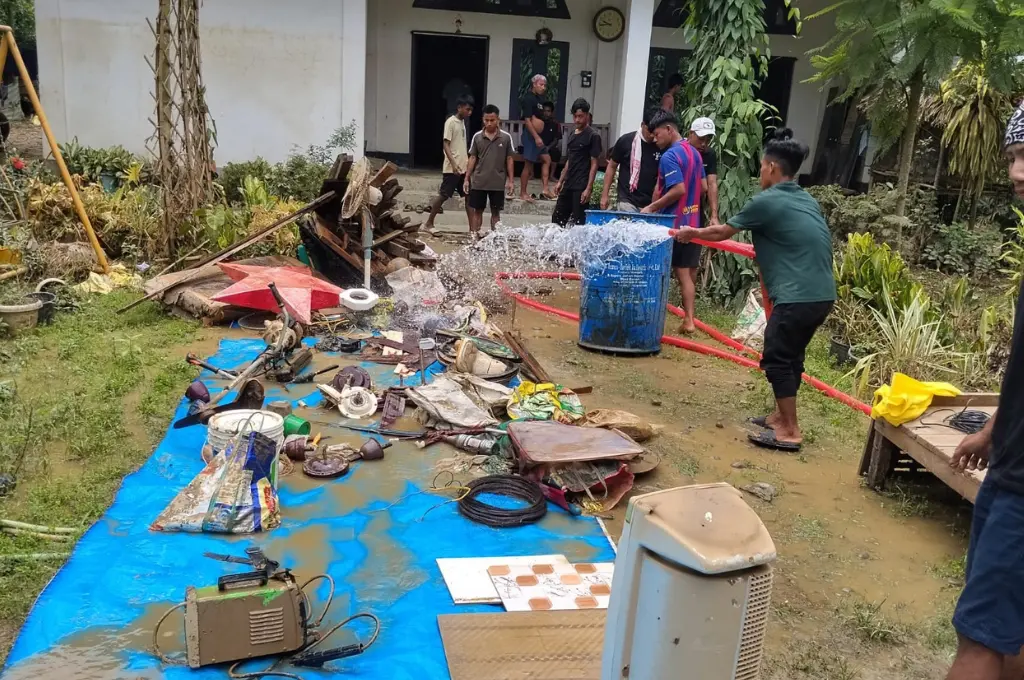
Community-based organisations have sent rice, milk, sugar, clothing, kitchen utensils, medicines, and other essentials to affected communities while, as needs change, financial contributions from civil society allow relief committees greater flexibility on spending. “When everything is gone, you cannot make a list. People have lost their homes, clothes, food, farming tools, and documents. At that point, almost everything becomes a necessity,” says Olieang.
Landslides swept away paddy fields, jhum fields, and perennial cash crops such as tea and areca nut. For farming households, the loss is not limited to this season’s harvest. In some cases, years of investment in crops that take time to mature have also been lost. Some mountainsides are taken away completely, while some fields are covered with mudslides. Families are uncertain if they can return to these fields since it will take a few years to clear the land to make it cultivable again.
The Government of Nagaland has sanctioned INR 70 lakh as immediate relief. Wangjin says the government assistance needs to be understood against the scale of destruction. “The amount sounds like a lot but based on the extent of the destruction, it is very little.”
Sethrichem Sangtam, the founder of The Better Life Foundation (TBLF), whose staff are stationed in Mon and assisting the District Disaster Management authorities with data collection, says, “It is important for any organisation, government body, or agency engaged in relief work to go beyond the quick fix. We need to see relief from the perspective of the people who are affected and understand what is most crucial for them, even if we’re able to provide just 10 percent of it.”
Some organisations have offered tarpaulins as temporary shelter, he added, but affected families do not necessarily need tarpaulins since families whose homes were destroyed are largely staying with relatives or in rented homes. Instead TBLF has asked for tin sheets because that can contribute to more durable resettlement. However, those needs could not be met.
For him, the question is not whether there is immediate relief, but whether it contributes to a long-term solution.
The disaster is unevenly visible
While Mon and Mokokchung towns have understandably drawn attention because of fatalities and rescue operations, villages across the Wakching and Tizit areas of Mon, as well as parts of Longleng, Tuensang, Meluri, Mokokchung, Kohima, Phek, and other districts, have also experienced extensive destruction.
However, reports from these areas have been limited, which is partly shaped by the realities of working in Nagaland.
What was missing or underreported was the village-level impact of the places away from district headquarters.
Rita Krocha, a journalist who has covered the state for several years, said that the cost of travelling within the state, poor road infrastructure, and communication gaps means reporting areas get impacted, and maintaining correspondents becomes difficult. “Journalists do try to travel beyond Kohima and Dimapur but it is difficult because travelling within Nagaland is expensive and the roads and communication infrastructure are unreliable,” she said.
Mary* described the specific gaps during the current disaster. “As a reporter, the disaster has been covered since day one, with visuals of landslides, road damage and flood, damage to schools and homes, loss of lives and affected family stories. But what was missing or underreported was the village-level impact of the places away from district headquarters because the point of contact was missing and inaccessible.”
She adds, “There were no updated lists of damaged houses, crops, livestock, or displaced families. The biggest challenges for journalists covering Mon or remote villages were accessibility, network issues which limited immediate updates which meant we were relying on delayed information.”
She also pointed to the lack of verified information available to journalists.
“There was a lack of current, verified data on damage and needs. No contact numbers of DDMA were circulated to the media, so we did not have a direct line to get block-wise reports or confirm figures,” she said. “Without DDMA contact points it is difficult for the media to even request it formally. Because of this, reporting was slow and often based on second-hand information rather than on-ground verification.”
Manno further mentioned that in the context of Nagaland in the national and regional media, the problem also raises a broader question about who gets to tell the story of Nagaland.
She argued that “the existing narrative on the Naga is made by the outsiders” when “the narrative about the Naga people is supposed to be made by the Naga people themselves.” She said this becomes particularly visible when events elsewhere begin to shape how Nagaland is discussed nationally and regionally.
For instance, in the context of the Assam floods, some social media users and politicians from Assam attributed the flooding to factors in Nagaland, including mining and deforestation. For her, the lack of response from the Nagaland government or other agencies exposed the absence of a stronger narrative from within Nagaland itself. “We need voices from within the state that could add context, complexity and perspectives to such discussions.”
Within the state, Rita Krocha also pointed to the concentration of local media in Kohima and Dimapur, because, “newspapers or media organisations cannot afford correspondence in every district.” This makes it harder for stories from districts such as Mon to become part of sustained coverage.
Even after the disaster is ‘over’, communities continue to deal with lost lives, damaged roads, disrupted access to healthcare and education, destroyed farmland and homes, and the possibility of further losses.
For now, the questions extend beyond the immediate response: What remains unrecorded, what remains unexplained, and what will happen to communities whose homes, fields and roads have been swept away? And if it happens again next year, will the state be prepared for it?
*Name(s) changed to maintain confidentiality
—
Know more
- Learn why the recent floods in Assam require new relief methods.
- Read how climate change affects lives and livelihoods in Nagaland.