What does development mean for a place like Lakshadweep? On paper, the islands do considerably better than most of India on development parameters such as literacy and women’s land rights. It is also largely a middle-class society. But this picture sits alongside a set of ecological and economic shifts that are reshaping how people live.
Since the 1960s, the primary source of livelihood for the islands has been pole-and-line fishing for tuna, a practice that is low-volume and inherently sustainable. Over the last decade, however, fishers have been moving toward reef fishing, which is far less sustainable and can undercut the resilience of the reef itself.
Addressing climate change presents a complex challenge in this landscape. The developmental planning administration is currently tasked with addressing immediate, pressing development priorities, which can deviate from long-term climate-adapted planning strategies. For the local community, climate change is lived through declining freshwater, shrinking land, and changing food availability. Several of these islands could become uninhabitable within decades, making this community among the first climate refugees in the country.

Nature Conservation Foundation (NCF) has been working on the islands for three decades now. While our work originally started with research in marine biology, we soon realised that we needed to expand our focus to understanding how a changing ecology could influence the overall habitability of the island. And this required us to engage much more deeply with island societies to understand what habitability meant for them, and how it linked to their island identities.
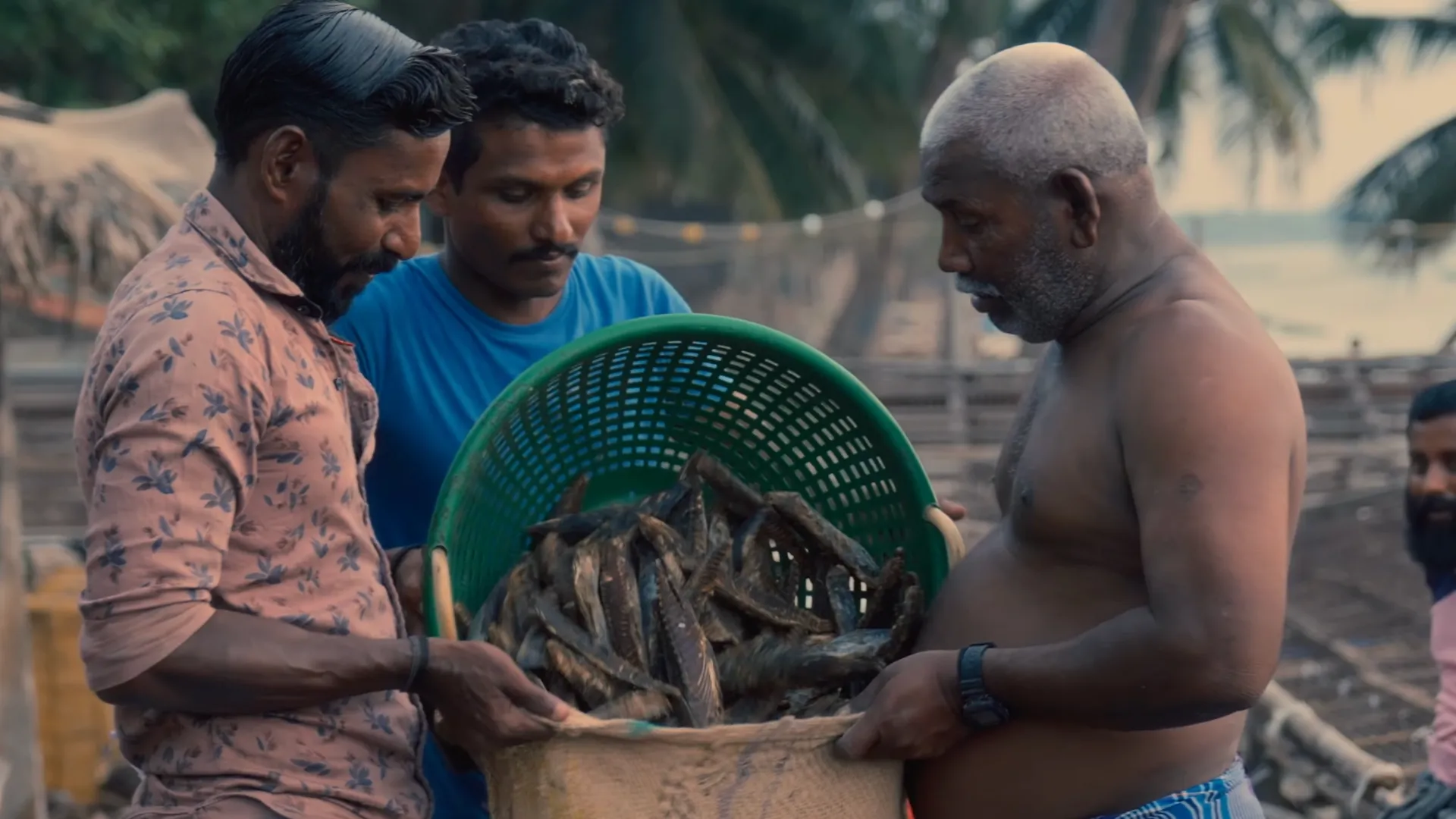
Our first attempt at engaging with the community was a failure, conducted with all the naïve hubris of conservation certainty. When we started our work on the islands, we repeatedly heard fishers describe a decline in fish catch in the lagoons. We convened a panchayat meeting and suggested setting up a marine protected area to help fish stocks recover, drawing on our marine biology training. But local fishers pushed back immediately, explaining that the decline had nothing to do with fishing itself. Instead, Instead, it was on account of green turtles devastating seagrass meadows, which support thousands of fish species and act as crucial nurseries, shelters, and feeding grounds for many commercially important fish on which the people of Lakshadweep depend.
That conversation was a wake-up call for us. The lived experience of ecological decline is much richer than many of our scientific certainties, and engaging with this experience can make us better allies for the societies we work alongside. That meeting set us on a long-term research programme that continues today and focuses on the relationship between green turtles, seagrass meadows, and fishing communities.
One with the people of Lakshadweep
Trust is hard won and easily lost. Our group is always mindful that, no matter how long we have lived and worked in Lakshadweep, we are here because of the good graces of the people of Lakshadweep.
When we arrived in 1996, researchers from the Indian mainland were few, and far fewer spent months together on the island every year. The community was warm and welcoming, treating us with typical island hospitality and curiosity about our scientific project. Once a connection was made with someone, it tended to hold. What has also worked for us is that we came without an exit plan and, for three decades now, are a part of the community. Having an embedded presence has done more for trust than any outreach could have. This is something that we have come to believe strongly. Communities see us as strong allies when they know we have our stakes in the ground and will be with them in good times and in bad.

In addition, we also make sure we always platform and prioritise traditional knowledge, find the right messaging, and work within existing systems on the islands. So far, we have managed to do this through:
1. Comics, festivals, and film screenings
When thinking about how to engage respectfully and meaningfully with island communities, it became clear to us that identity was everything. Much of ‘nature education’ focuses on biodiversity, ecology, and the crises of our times, but leaves out why it should matter to individuals living multifaceted lives. We have attempted to break down the divisions between ecology, economy, culture and history, since they are part of a braided identity, rich in fable, memory and experience.
The idea is to share the same content in different media and languages, so that it reaches many more people.
Our early efforts at this were not very effective, as we tried to reach everyone across the islands at once through broadcast and social media campaigns. We found that this approach excluded people who were not active on social media or did not engage with that language and format. This led to a shift towards more targeted, relatable communication, including an island-wide festival that combined public events, film screenings, and direct interaction with multiple stakeholder groups. The idea is to share the same content in different media and languages, so that it reaches many more people.
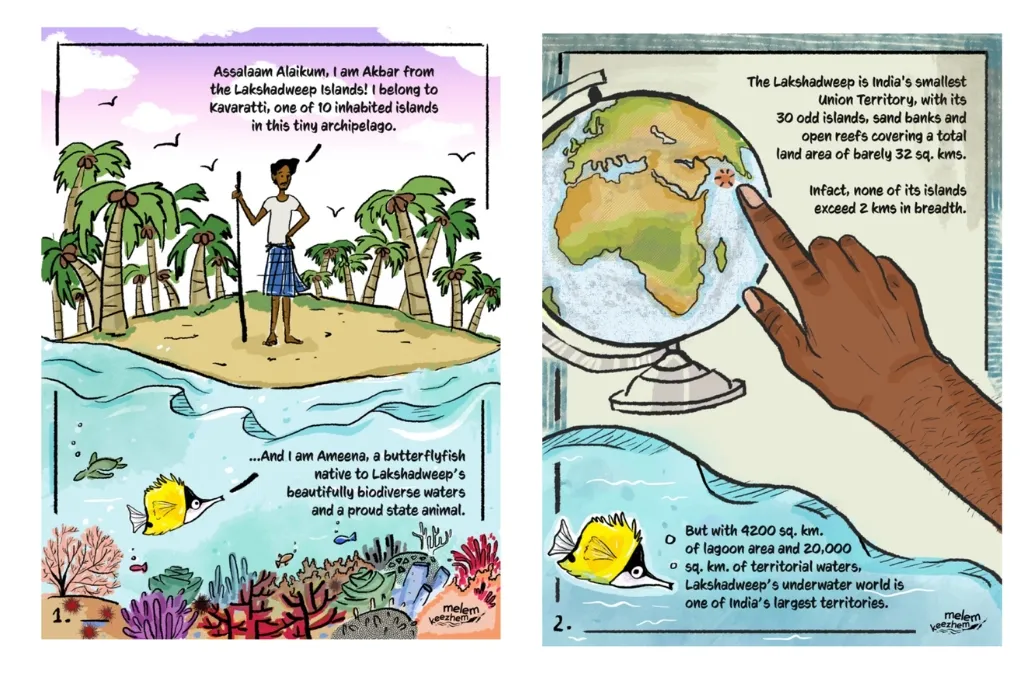
We began a comic series, Melem Keezhem (‘above and below’ in Malayalam), first as an experiment to explore this braided reality of ecology, history, and culture. It has fast become one of our most universally relatable ways of engaging with people in Lakshadweep. Its protagonists, Akbar, the fisher, and Ameena, a long-nosed butterflyfish, develop a friendship and, together with their friends and other characters, explore the islands’ life from land to underwater. The focus here is on identity and pride, and on finding resilience in the face of the various shared challenges people and ecology face on these islands.
Our engagement with island societies has deepened with time, and our communication has evolved into a genuine and productive dialogue. We are learning what it means to live well on small islands. Having lived for at least eight centuries on these islands, Lakshadweep’s people know a thing or two about resilient living, and much of our engagement is a journey of discovery, as we document these resilient ways of life. Sustainability is often communicated as requiring some grand sacrifice, but what Lakshadweep shows is a different way of living within bounds. There is an abundance and a celebration in sufficiency, a principle around which much of island life is organised. There is a larger lesson here that “enough is a feast”. It’s a lesson that we have learnt from Lakshadweep, and it flows through our engagement with the islands.
2. The divers and the women’s collective
More recently, we are exploring working directly with a few key groups in Lakshadweep. For example, we have had a long working relationship with local dive operators. They have been our partners ever since we first began our research here and have been critical in making our work possible. They have accompanied us on our scientific expeditions and have facilitated most of our in-water work. We also know that they observe reef changes daily and more closely than even NCF’s own researchers. In fact, divers are often the first point of contact between the reef, the islanders, and the tourists.
We worked with these dive operations to build an association so that rather than working as individuals, they could come together to share their learnings with each other and shape their own livelihoods. We co-designed workshops and planned activities together that further enhanced their internal collaboration. For example, many of these divers had their secret underwater locations that they wouldn’t reveal to each other. But over time, as part of the collective, they started sharing these details with each other.
The purpose of the Lakshadweep Diver’s Ecology Network is twofold. The first is to create a platform where dive operations from Lakshadweep can agree on how to promote ecologically sustainable best practices for diving tourism. Every diving tourist who visits Lakshadweep is a potential ambassador for Lakshadweep’s biodiversity and an advocate for more careful developmental planning for the islands. The network’s role is to help dive operators curate ecologically meaningful dive experiences for visitors, to make that vision a reality. The second function of the network is to advocate for fair engagement practices within the group itself, and to self-regulate diving across the island chain, so that local dive operations can cooperate more openly and equitably among themselves. This becomes particularly important as tourism opens up to operators from the mainland whose deeper pockets and more ‘sophisticated’ business models could easily overwhelm these local operations.
Across every island, women gravitated toward the same topic: freshwater.
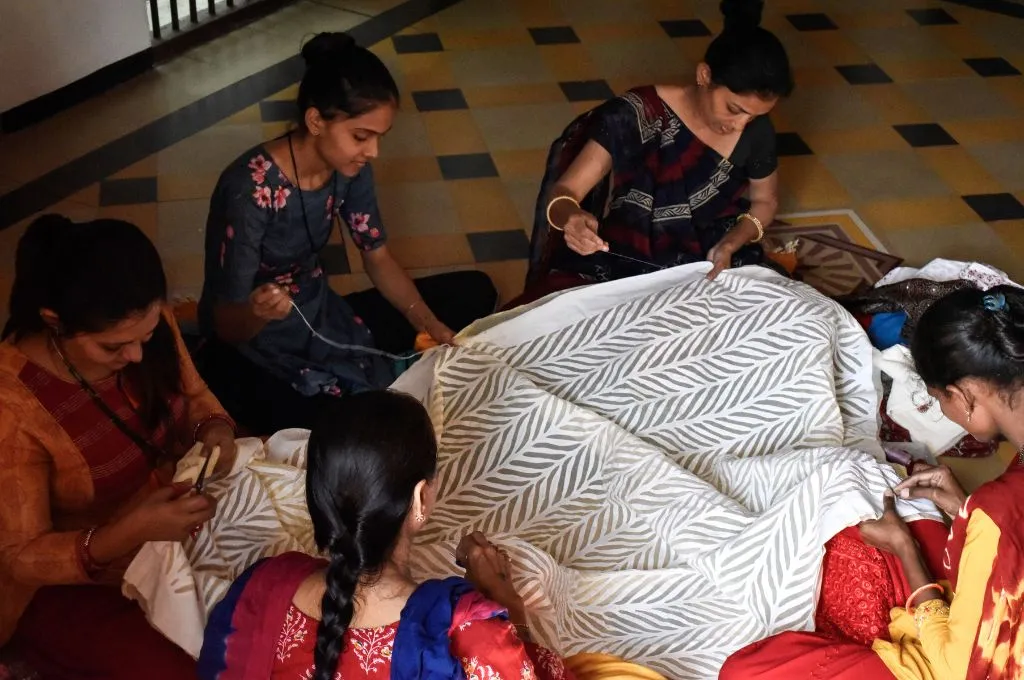
Similarly, talking to the women, who are actively engaging in community activities with a neighbourhood collective called Dweepshree, which is like the Kerala Kudumbashree model, opened a different perspective on what matters to people and how the community is organised. Across every island, women gravitated toward the same topic: freshwater. This was different from the men, who were more interested in climate change as a concept.
When we followed up on why, the women told us that they manage water at the household level as much as men do; they felt they had real control over how much of it was used and wasted. Until then, we were only talking about freshwater being a limited resource; the women encouraged us to also start focusing on freshwater management. They identified where water was being wasted at home and proposed changes on their own.
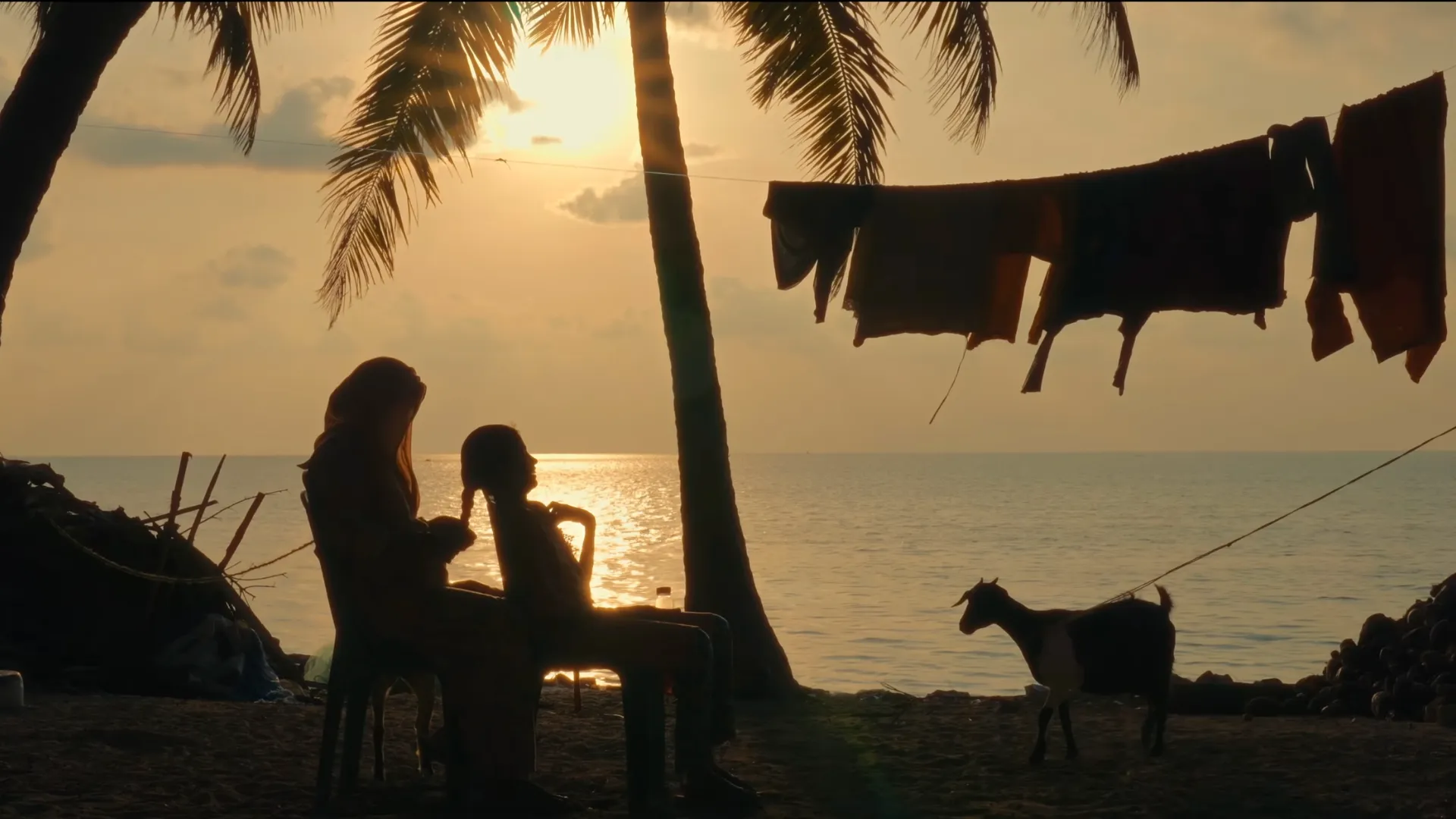
In talking to women, we also realised how traditional knowledge about fishing is gendered. When men talk about fishing, they talk about it only in terms of livelihood, but if you talk to a woman, she will point out how it is primarily nutrition because they put the food on the table. Fishing is also often seen as men’s domain. However, once we started actually documenting where the traditional knowledge lies, we found that foraging and gleaning are often entirely ignored. Women are the ones who go out catching octopus from shorelines and foraging for shells. For many young boys, foraging for fish with their mothers is their first experience of fishing. This was eye-opening for us.
Sustained development and unsustainable funding
Over the years, we have understood that building resilience in Lakshadweep comes down to land, food, water, economy, and infrastructure—the basic pillars that keep the island habitable. Our engagement with Lakshadweep is organised around the key challenge of keeping the archipelago habitable well into the future, given the challenges of climate change and unsustainable development.
We are frequently asked by funders to outline our exit plan. We have none.
It is not as though the island speaks with a single voice—it would be naïve to believe that. Many community members see rapid development as economic promise, while others see it as danger to the ecology and culture. More importantly, people across the board worry about how benefits get distributed among them. We don’t claim to have solutions to these tensions. But we try to stay involved in the conversation, so that we can keep participating in discussions about both the risks and the opportunities that these changes bring.
However, this kind of work requires long-term engagement. We have worked here for three decades, and we have no plans of moving out. But not many funding organisations see the value in this kind of commitment. We are frequently asked by funders to outline our exit plan. We have none. We believe it is simplistic to frame conservation problems as a particularly complex puzzle with a solution at the end, after which you can move to the next. The framing of conservation stories as failures and successes is unhelpful and does not acknowledge the rich and evolving realities of conservation journeys on the ground.
Ironically, the hardest thing to fund is the primary research that underpins everything else: Three decades of continuous reef monitoring that some potential funders now term unnecessary, even as climate change continues to worsen.
Our earlier funding came mostly from international research foundations and government grants, but as we expand the scope of our work, we are required to convince CSR foundations that often define impact narrowly and only in terms of numbers. That definition sits uneasily with work that is systemic by design.
We are determined not to give up because we are aware of the inherent power imbalance between an organisation that can always choose to leave and a community that cannot. As we work with the locals to address climate change, we also aim to communicate a cross-sectoral understanding of Lakshadweep beyond white sand beaches and blue lagoons and towards the lived history and generational wisdom of the residents.
—
Know more
- Learn about Spiti Valley from the narrative of a woodcrafter.
- Read the comic Melem Keezhem in English.