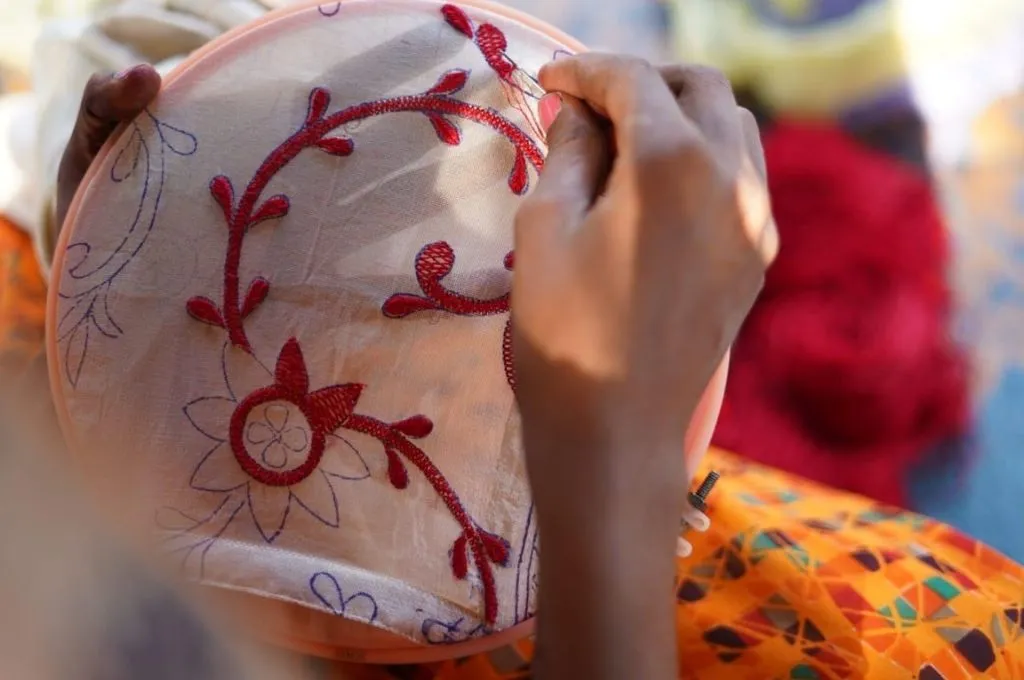
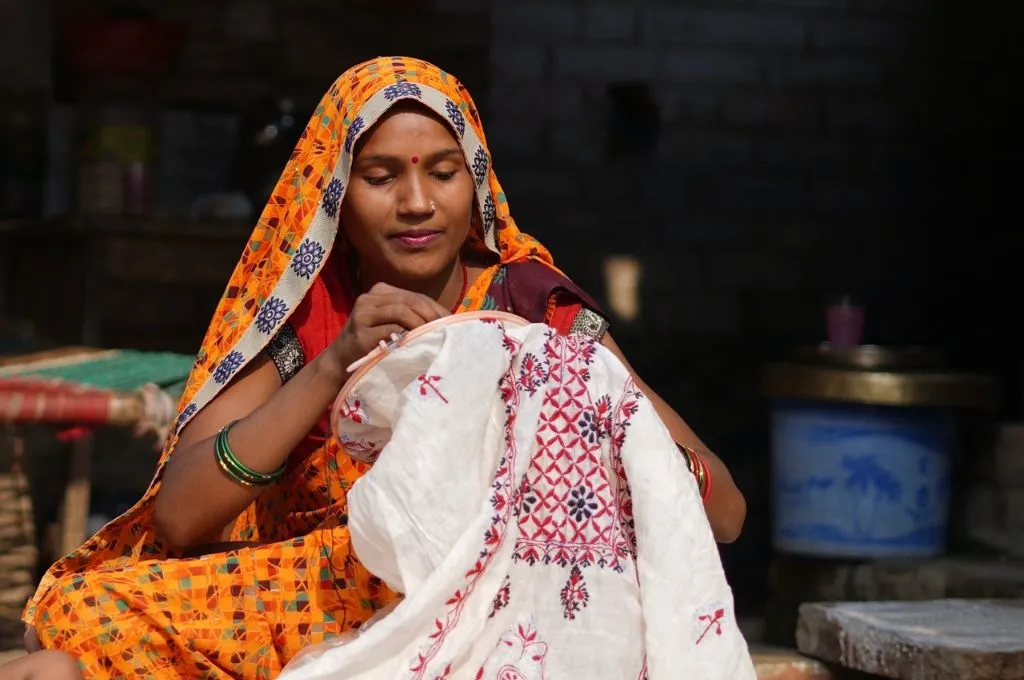
Having lived in Lucknow all my life, I have been surrounded by the sight of the hand-embroidery tradition of chikankari. However, about six years ago, when I was asked to set up a skilling programme and social enterprise for chikankari artisans, I realised how little I knew about the process behind these intricate designs I had grown up wearing.
The task before me was twofold: First, to train women in Lucknow and surrounding rural areas in stitching and provide them with a stable livelihood; and second, to create a business model that was sustainable, without compromising the welfare of artisans.
In 2019, Safe Society launched SHWET as a skilling programme for chikankari. But soon, the nationwide COVID-19 lockdown was imposed, bringing our work to a halt. We used this time to form connections with women in the area and assist them in accessing social security schemes and food rations.

After restrictions were lifted, we began our skilling sessions in two batches, working with approximately 60–62 women. The participants were mostly domestic workers who were either currently employed and could only spare about two to three hours a day for training or had lost their jobs during the pandemic.
From the start, we were clear that skilling alone was not enough, and that we must also provide an assured source of income. In 2020, women in our programme made protective masks and sold them outside SHWET’s office, each woman earning INR 200–250. Near Diwali, we held an exhibition and sold around a hundred tops, kurtas, and dupattas. By our second year, our numbers grew to about 240 women, and we started organising them into self-help groups (SHGs). By year three, we had 320 artisans organised into 23 SHGs. As of 2025, these collectives had more than 1,000 members, and women had set up mechanisms for saving and inter-loaning.
Although women were willing to work with us, some were hesitant to join an SHG. They felt that the meetings would be cumbersome; they were unsure about the savings system, or they had interpersonal conflicts with other artisans in their locality. As a result, we gave women an option to join an SHG, or to be individually associated with SHWET. Even then, we were only addressing a part of the challenge.
Building an enterprise from the ground up
In the outskirts and rural areas surrounding Lucknow, you will find at least one or two women in each household who know basic stitching. However, they are not able to find work. Even if women are making chikankari, they are paid anywhere between INR 20 and 50 for a kurta, because the middlemen take a cut. Moreover, manufacturers do not want to spend the time and resources to go to artisans directly and collect products from house to house.
When we approached women for training, we assured them that they would be able to get consistent, year-round work as part of SHWET. So while we focused on bringing in more women into the skilling programme, we had to make sure that we had reached a stage where we could consistently sell products in the market and create a flow of income for the artisans. In 2021, we formally launched SHWET as a brand. Here’s what our journey looked like:

1. Understanding the market
To determine prices, we needed to first understand the various elements of chikankari, including the different types and levels of complexity of stitches and whether rates were set per frame or per motif. All of this was new to me as someone with a career and experience in the social sector, but not in business. When I sought information from others in the industry, people would often share only partial information.
Meanwhile, there was also a lot to learn, including different business models such as business-to-business (B2B), business-to-consumer (B2C), and technical processes such as quality control, sampling, prototypes, and initial and in-line samples.
However, slowly, as we found our footing in the market, and artisans and master artisans who were already working with established organisations such as SEWA started coming to our offices, we began to build this knowledge.
An opportunity for us to learn this practically came in the form of our first bulk order from Fabindia. Initially, our master artisans were reluctant. They warned that the brand’s quality control standards were very strict—that they could reject 2,000–3,000 pieces at once, making them all dead inventory. However, I wanted us to give it a try. We agreed to an order of about 300–400 dupattas, which would be easier to make since there were no sizing or measurement-related variations or constraints. During this process, Fabindia’s on-field quality control manager also helped us a lot.
We fulfilled that order within the first year. Though ultimately, we neither made a profit nor incurred a loss; we learned a lot about bulk orders and their technical requirements, including sizing and colour grading. Moreover, we were able to meet and onboard bulk raw material vendors for threads and cloth. Now we also procure materials from them for the products we sell under SHWET.
2. Hiring area experts
We have about 18 people in our merchandising team, and we also have marketing experts. While hiring, my focus is not on whether someone has a business or social sector background, but that they should be an area expert.
Our aim is to have a formal system with merchandising and marketing teams in place. This is also necessary for monitoring, and to balance our orders and inventory. For instance, until last year, SHWET was listed on e-commerce platforms including Myntra and Nykaa. However, once our products were sold out, it took us two to three months to restock them because we had other bulk orders to fulfil, as well as sales on the SHWET website. As we find consistent demand for our products, we are trying to build monitoring capacity across teams to avoid such delays.
3. Budgeting and funding
Clothing and textiles are very capital-intensive and have wide margins. For instance, if we think about creating 10,000 products, the input costs alone would be INR 1 crore. Even if funders are supporting our broader work—which at Safe Society includes health, livelihoods, community, and gender—they will provide money for budgeted activities but not to grow SHWET as an enterprise.
Until now, the plan we have followed is that as products are sold, we will use the money that is coming in to gradually expand our inventory and marketing budget over the span of a couple of years. In the past five years, we have reached a production capacity of INR 1 crore.
4. Certification and trademarking
Given that the artisans are making authentic handicrafts, it is important that this be recognised and validated. So, we got a Craftmark certification and registered our trademark.
Additionally, we also worked with women to register them for Artisan Identity Cards. Initially, artisans were hesitant because they had to submit their bank details, which led to fears of fraud and misuse. The application process itself typically takes 6–8 months to complete. Women were also unaware of the benefits under the scheme, which led to misconceptions that it was not useful.
To address these issues, we organise awareness sessions in villages and bring in officials from the One District, One Product (ODOP) initiative and the Office of the Development Commissioner (DC-Handicrafts) to inform women about the scheme’s benefits.
5. Participating in incubators and cohort-based learning
Meanwhile, the Craftmark certification gave us access to webinars and training related to business-related topics including intellectual property (IP), managing bulk orders, and photographing our inventory.
I have also participated in cohort-based learning programmes, including a course by IIM Bangalore which covered topics such as business models, customer segments, and identifying unique selling points (USP). Similarly, I learned about handicraft exports in a programme by NITI Aayog.
These spaces have given me an opportunity to learn from my peers. In turn, I incorporate these insights into SHWET’s operating procedures and share them during our weekly and monthly meetings to gather feedback and inputs from the team.
6. Providing space and mentorship for second-line leadership
Building SHWET required us to think, and work, outside of the box—be it late nights spent studying or extensive travel to meet artisans.
When I was pregnant in 2025, it was the first time since SHWET was founded that I had to step back from working full time. I was worried about who would manage the business. That year, we had a target of 10,000 products. The material had been purchased, the marketing team had been hired, and there was no going back.
Often, when we think about scaling an organisation, the question emerges about establishing a second line of leadership. I have to say that I did not have to build this line. For the months that I was away, our marketing and merchandising manager oversaw everything and SHWET fulfilled the order.
At the same time, I realised that as teams are growing, this emerging second line of leadership might hesitate to make certain decisions. So, moving forward, our goal is to strengthen this capacity by providing mentorship support and offering our team members opportunities to learn, grow, and assume responsibility.
Importantly, as a social enterprise, this sense of responsibility also means ensuring the welfare of artisans.
Putting artisans first
There are an estimated 10 lakh people involved in the chikankari industry in Lucknow—from cutting and dyeing to block printing and stitching. Even if we consider 10 percent of this workforce, that is still thousands of women. Our aim is to expand our network to more artisans.
This is also necessary to sustain the enterprise. At present, artisans are associated with SHWET in varying capacities: some women are only able to work on a couple of pieces a month when they have time, and to earn some additional income. At other times women are called away for familial responsibilities during festivals or celebrations. As more women join, we hope to maintain a steady flow of production and sales.
We also encourage women to take up other work. Here, our responsibility becomes to ensure that they have full knowledge of market rates and are fairly compensated for their labour. If they know that SHWET will purchase a kurta for INR 500, they will not sell it to other buyers or enterprises for less.
It is not a matter of sales or scale for the sake of wider margins alone. We urge women to work consistently and explain how an income can mean more financial independence and affect their role in decision-making in the household. This is informed by what I and other members of SHWET have seen in our homes and communities growing up. Supplementing handicraft work with awareness and training on digital and financial literacy, health, and education is also a way for us to ensure that women can exercise more agency in their daily lives.
Every day, 10–12 women come into our office to pick up materials or just to share their problems. This informs what kind of support the enterprise and our field teams provide for them. Whether it is supporting women to open Jan Dhan bank accounts to safely store their income, registering them for social security schemes and e-Shram cards, or organising health camps, legal aid training, or educational sessions for their children, our work has always existed at the intersection of livelihoods and the broader dynamics shaping women’s lives.
Setting up SHWET has thus required us to build skills and capacity on multiple fronts: to provide stable livelihoods and fair compensation to artisans, to be responsive to their varied social needs, and to create a viable business—from material procurement to sales and marketing—one stitch at a time.
—
Know more
- Understand the barriers faced by women-led enterprises in accessing e-commerce platforms and how accessibility can be improved.
- Read this report on the market landscape for women-led home-based businesses in the handicrafts and handloom sector.
- Learn more about the systemic challenges faced by women artisans in the chikankari industry.