Who do we design programmes for? Be it livelihoods or education, who do we picture when we think of a community or a classroom?
Working in the social sector in India requires navigating complexity—contexts vary, and so do the challenges. For organisations, this can require building a high level of specialisation and depth of knowledge in their field of work. However, this specialisation often leads to the creation of vertical silos. For example, a nonprofit working on skill development for youth in urban informal settlements might follow a predetermined checklist to implement a programme: map out project and funder priorities, identify the target group, provide them with resources and training, and document the impact.
This kind of thinking often serves as a blueprint for many of us. However, we find that this approach falls short when viewed from the ground up. A community does not look at socioeconomic or developmental needs in neat compartments—education and livelihoods are interconnected, just as water, sanitation, and health.
As such, single-focus programmes will only have a limited impact when we are working with communities facing multiple, often intersecting issues. Communities are also not homogenous, and people’s immediate needs can vary. It is important for organisations to be responsive to these priorities.
For the past five to six years, we at Tech Mahindra Foundation (TMF) have been working to reorient our approach to disability inclusion to align with this objective.
Inclusion must be in-built, not an add-on
Until a few years ago, we described our work as focusing on ‘education, employability, and disability.’ However, we realised that we cannot think about disability as an isolated issue. While it is certainly necessary to develop infrastructure and programmes that can address the specific needs of persons with disabilities, they are just as much part of broader social groups and communities. Disability itself is not monolithic, and programmes must be designed keeping this diversity in mind.
Based on our experience of working with nonprofit partners on education and employment for persons with disabilities, here is what we have learned:
1. Improving implementation designs
Marginalised groups within communities face compounded vulnerabilities, be it in terms of access to healthcare, education, or employment. If these realities are not acknowledged right at the stage when programmes are designed, the result may be that certain sub-groups within a community are excluded by default, with the assumption that separate interventions could address their needs. This effectively shifts the focus away from making our own approaches more inclusive.
In our conversations with nonprofits, we learned that many had not factored some of these considerations into their own implementation design. For instance, that there could be children with disabilities in the communities that they were serving. The approach tended to be that if indeed there was a set of children who required different kinds of support than what was being offered in a particular programme, they could be directed towards other organisations.
In smaller towns and rural areas, the lack of solution providers for children’s various developmental needs is much starker.
For children with disabilities, barriers to access education, and later to employment, become more pronounced when we account for various socioeconomic and geographical factors. In smaller towns and rural areas, the lack of solution providers for children’s various developmental needs, including education, tends to be much starker, which leads to many of these needs being left unattended. There is often also stigma associated with disability, which means that disabilities might go unacknowledged or even hidden. There may even be cases where children with disabilities are denied access to education or livelihood opportunities due to the perceived costs of enrolling children in such programmes. A lot of these exclusions are compounded when we factor in gender. We found that in the schools for children with disabilities that we were supporting, the enrolment level for girls was only 37 percent, compared to 63 percent boys.
Inclusive programmes require organisations to contend with these challenges, and addressing them takes time and support.
2. Funding must be more responsive
It is also the responsibility of funders to actively ask questions and work with partner organisations to make sure that programmes aren’t exclusionary. If there is an education programme, funders must ask: What is the strategy for including students with disabilities? Are there any assumptions being made in the programme about the learning needs of children in a particular community? Is anyone excluded because the programme might not be paying attention to different needs for resources and support?
This nuance needs to be built in and requires a certain level of flexibility in funding structures.
Over the course of our work, we have understood the importance of longer-duration programmes to be able to achieve some of these objectives. So, our approach generally has been to not enter partnerships with a finite time period in mind. We have also prioritised supporting smaller, community-embedded organisations that are better attuned to local realities.
3. The case for integrated programmes
At one point, TMF’s mandate was to make sure that 10 percent of the people we were serving should be persons with disabilities. Our first instinct, which continued for many years, was to support schools specifically for children with disabilities, or skill development centres that similarly focused on persons with disabilities.
Around 2020, we started evaluating our work. We looked at two projects—Arise+, which supports nonprofits working with children with disabilities, and Smart+, which is a separate initiative that supports employment programmes for youth with disabilities over the age of 18.
We realised that there was an obvious disconnect in our approach across these projects, and a similar pattern was observed by the nonprofits in our networks in their own work as well. Often, due to structural exclusions, children had no clear pathway to help them transition into higher education or employment after they finished schooling. This was a major disruption, and many children would end up staying home or would come back to the nonprofit to seek further support.
It was clear that we could not look at education and livelihoods separately, and that there was a need for a life-stage approach which would be more continuous and account for changing needs as a child grew up. Some nonprofits have started to adopt this approach. For instance, nonprofits such as Amar Jyoti in Delhi and the National Federation for the Blind Maharashtra in Pune have set up integrated programmes, where vocational and skill training are offered in continuation after schooling.
At the same time, it was important to identify linkages between the learning needs of children early on, and how these may inform higher education, skill development, and livelihoods when they cross the age of 18. So, while we may be supporting children’s education, we also have had to think about the kinds of future opportunities they could pursue once they enter adulthood.
4. Thinking about the best-case scenario
Siloed thinking can also end up reinforcing limiting assumptions about sub-groups of people and their capabilities. For instance, when it comes to working with persons with disabilities, there tends to be focus on particular kinds of basic vocational training, which restricts the opportunities that people may have access to.
At TMF, Arise+ was run parallel to a programme called Arise, which was for children in mainstream schools. This kind of separation had also been replicated in the skilling programmes we were supporting. In 2022, we worked with five Arise+ partners in Delhi, Bengaluru, Hyderabad, Mumbai, and Pune to map the needs of more than 120 children in classes 7 and 8. We found, perhaps unsurprisingly, that children in this group shared the same aspirations as non-disabled children their age. So why should the level of support be different? If a child in class 6 wants to become a doctor or a sportsperson, what are the resources and the support they could need by class 10, and then a few more years down the line? How do we start preparing them now? These were some of the questions we started asking.
While working with Deaf and hearing-impaired students in our programmes, we struggled to find career counsellors who were themselves Deaf or hearing-impaired and communicated in Indian Sign Language (ISL). So, to start, we brought in ISL interpreters and also trained existing counsellors, who were not deaf or hearing-impaired, in ISL so they could work with Deaf students.
For us to be able to create better, more inclusive programmes, we need to build stronger networks of communication and collaboration.
The other two areas where we tried to bring a more inclusive lens are sports and STEM education. We have since partnered with the Umoya Foundation in Delhi to organise sporting events where all children, including children with disabilities, can interact and play together. We are similarly partnering with TAN90, an organisation in Bengaluru, which creates STEM modules for government schools, to develop modules for Deaf and hearing-impaired children. This programme is currently being implemented in 20 schools in Hyderabad, Pune, and Delhi.
Through our experience in the past few years, we have learned that designing inclusive programmes takes time, patience, and most importantly, collaboration. Nonprofits are often operating with real constraints and balancing competing priorities. At the same time, we often tend to work in isolation from one another. For us to be able to create better, more inclusive programmes, we need to build stronger networks of communication and collaboration and share ideas and expertise. This has also informed our work on building The Ability Network (TAN). While the initiative is still in its nascent stages and primarily functions as a network to connect persons with disabilities with various service providers, the objective is to build a broader ecosystem of government and non-governmental actors to collaborate and address the broad range of needs of persons with disabilities.
Collaboration is key
During a visit to a school for blind children in Vizag a few years ago, a teacher explained that out of the 15 children in her class, some students were completely blind, and some had partial vision loss. Some students had been blind since birth; others had experienced vision loss over time. Each child in that classroom would have a different mental map and way of understanding the world around them. “What pedagogy do I use here?”, the teacher asked.
In recent years, Foundational Literacy and Numeracy (FLN) has become a major focus area following the introduction of the National Education Policy (NEP) 2020. However, existing FLN models are designed to teach children to associate symbols with sound. But this pedagogy excludes children who are Deaf or may have hearing loss. So, given these nuances, how does a nonprofit working on education respond? What is the kind of coordination needed with the government to make FLN more inclusive?
Such instances underscore the importance of a collaborative and integrated approach—and one which we are working to apply in our own programmes.
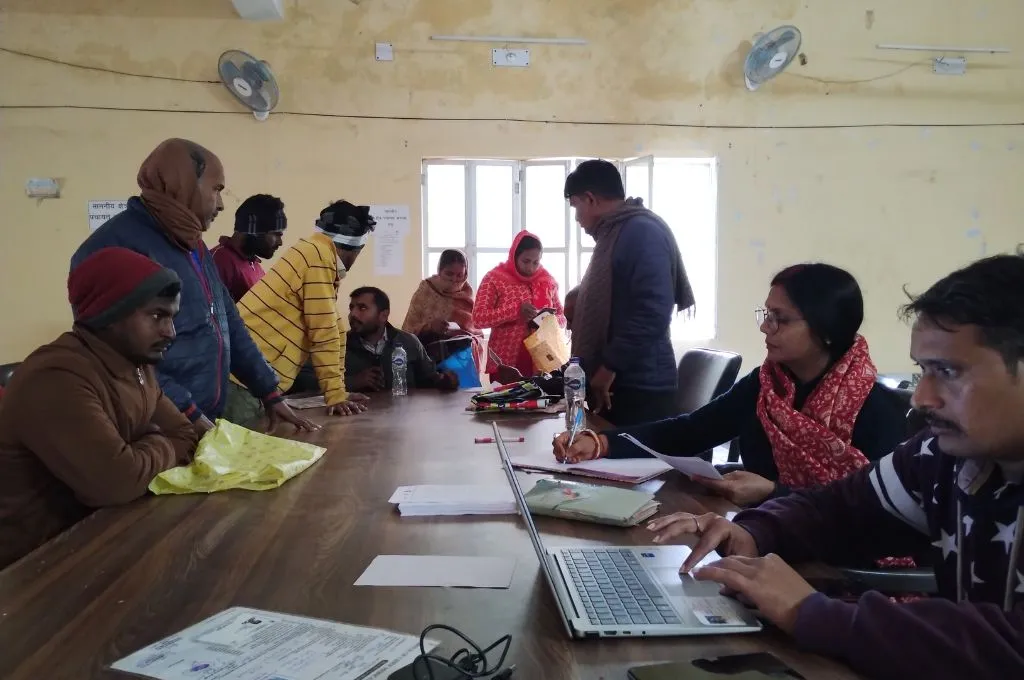
For example, in August 2025, we set up a Programme Management Unit (PMU) in Uttar Pradesh’s Basti district focusing on disability-related initiatives. The unit is working on identifying persons with disabilities in the community and organising awareness campaigns and facilitating access to entitlements such as Unique Disability Identity (UDID) cards. This work is being carried out in close coordination with local officials, with an emphasis on building their ownership so efforts can continue beyond the PMU’s involvement.
Without such collaboration, initiatives risk remaining fragmented and their gains difficult to sustain over time. For nonprofits, this means breaking out of rigid programmatic thinking and doing away with narrow metrics of impact and ‘beneficiaries reached’. Instead, programmes must be designed keeping a community’s complex needs in mind, particularly as these evolve over time. For funders, these means reorienting our funding practices to make them more flexible and long-term, providing on-ground partners the time and resources they need to provide support that is holistic, and does not end up reproducing the vulnerabilities and exclusions faced by marginalised groups.
—
Know more
- Understand how persons with disabilities are undercounted and excluded from national surveys.
- Learn why disability inclusion must be woven into existing education and schooling models.
- Read this report on strengthening rights and improving access to services for persons with disabilities.