There is more Corporate Social Responsibility (CSR) capital in India today than ever before. Since the CSR mandate came into effect in 2014, more than INR 2.2 lakh crore has flowed into the country’s development sector, with nearly two-thirds of that entering in just the last five years. The number of participating companies has also grown from 4,600 to more than 21,000.
CSR has crossed a threshold. It is no longer just a compliance requirement or an additional source of philanthropy. For nonprofits with long-term ambitions, it is now one of India’s most significant domestic funding channels. But more money in the system has not meant easier access to funding. A significant share of CSR capital still flows to a relatively small group of organisations. This is because CSR funding decisions are determined not only by social need, but also by where companies operate, how programmes are implemented, thematic familiarity, visibility of outcomes, and a growing emphasis on strategic alignment with business priorities.
In practice, this means CSR no longer functions like a common pool that any nonprofit can tap into. The question isn’t simply how to raise CSR funds, but whether an organisation understands how funding decisions are made and how its work aligns with a company’s priorities.

Organisations that recognise this shift and adapt their positioning accordingly are likely to capture a disproportionate share of a growing but increasingly selective pool of CSR capital. Those that have not kept pace may find that a larger system only appears to produce fewer viable entry points.
Four shifts define this new logic: nonprofits are no longer the only institutions competing for CSR partnerships; capital remains concentrated even as new opportunities emerge; funding continues to follow corporate geography; and partnerships are increasingly won on strategic fit, not thematic alignment alone.
Understanding these shifts is becoming as important as demonstrating impact.
1. Nonprofits are no longer the only option
According to Sattva Consulting’s CSR’s Next Act report, a set of specialised institutions, such as hospitals, universities, incubators, sports associations, religious trusts, and corporate foundations, is emerging as both a recipient and implementer of CSR funds. Over the last three years, 11 percent of CSR projects routed through implementation agencies were executed by these institutions. In 2023–24 alone, they accounted for nearly one-fifth of CSR implementation funding.
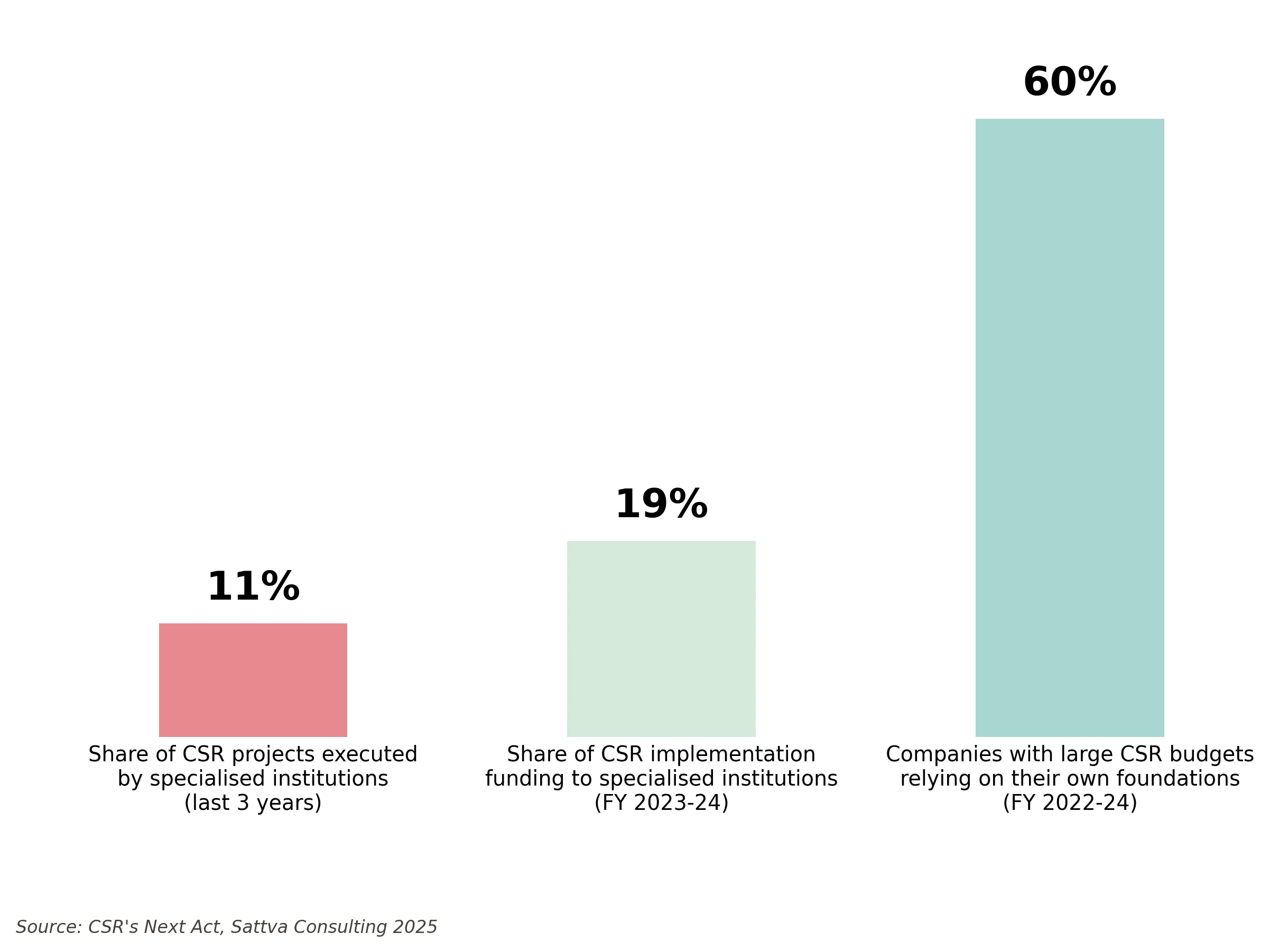
The report also notes a steady rise in corporate foundations, with more than 60 percent of companies with large CSR budgets (above INR 10 crore) relying on their own foundations to implement high-value programmes.

Together, these trends point to a broader change in how companies are approaching CSR. As companies look to work at larger scale, enter specialised sectors, and align CSR more closely with business priorities, they are expanding the kinds of institutions they partner with.
For nonprofits, programmes and community credibility still matter, but they are no longer sufficient on their own.
For nonprofits, this means that programmes and community credibility still matter, but they are no longer sufficient on their own. Specialised institutions often bring the domain expertise, scale, and governance structures that companies find attractive. Corporate foundations already have established systems and long-term programme ownership that companies trust. Remaining competitive means demonstrating similar organisational strengths. This includes managing compliance smoothly, communicating impact clearly, building long-term institutional relationships, and positioning programmes in ways that align with a company’s business priorities, as funding decisions are shaped by strategic fit.
2. Capital is concentrated, but growth is fragmenting
India’s CSR space is highly concentrated, but the future of growth may lie outside its largest funders.
The top 10 companies account for 20 percent of total CSR funding. These are the names most nonprofits pursue, and the boardrooms most fundraising strategies are built around. Smaller companies, particularly those with CSR budgets under INR 1 crore, are significantly more likely to exceed their mandated spend. They tend to fund local problems in the areas where they operate: a school nearby, a health centre, a livelihood programme for their workers’ families. At the other end, larger companies more often carry unspent balances. This is not necessarily a question of intent. Deploying large pools of capital across multiple geographies and implementation partners is operationally complex.
In 2023–24, more than 380 companies with no legal CSR obligation chose to spend anyway, collectively contributing close to INR 800 crore. Growth in CSR is no longer being driven only by India’s largest corporates. For nonprofits, this has important implications. Many fundraising strategies continue to focus disproportionately on a narrow set of high-visibility companies. But the broader market is becoming more diverse, with mid-sized and emerging companies increasingly willing to experiment, move faster, and build partnerships that are closer to their operating realities.
3. CSR funding follows corporate geography
CSR funding in India still follows corporate geography more than developmental geography.
Companies tend to fund causes where they operate: near their factories, offices, and workers. This has not changed much, even as CSR has grown.
Funding to aspirational districts has more than tripled, but it is not evenly spread.
Tier-2 cities and industrial districts are seeing some of the fastest growth in CSR funding, initially led by public sector undertakings and now by private companies. Vadodara, for example, saw CSR funding grow by 131 percent in 2024. In Madurai, two locally rooted companies accounted for more than 60 percent of all CSR spending over the past three years. Both examples illustrate how closely CSR funding remains tied to where companies operate.
Funding to aspirational districts has more than tripled, from 1.3 percent to 4.5 percent, but it is not evenly spread. Three-quarters of all district-level CSR goes to 193 districts, many of which are not among India’s poorest. The Northeast receives very little CSR funding, simply because few large companies operate there.
For nonprofits, this changes how fundraising must be approached. The strongest CSR conversations connect a social issue to the company’s operating context, rather than presenting the issue in isolation.
At the same time, this creates a different reality for regions with high developmental needs but limited corporate presence, such as parts of the Northeast and remote rural districts. In these geographies, CSR may not be the most viable primary funding channel. Family philanthropy, institutional donors, and retail giving often play a more significant role because they are less constrained by operational proximity and business footprint.
4. Cause alignment alone is no longer enough
Until a few years ago, many CSR partnerships were built around broad themes such as education, livelihoods, health, or environment. Today, especially among larger companies, CSR is becoming more closely tied to business priorities and context.
Pharma companies fund health systems. IT companies invest in skilling. Infrastructure firms prioritise districts where they build and operate. CSR is increasingly functioning less as a parallel philanthropic track and more as an extension of long-term business priorities.
As a result, clarity in how nonprofits position their work in relation to a company’s context is becoming a decisive factor in unlocking funding.

What this new logic means for nonprofits
Accessing CSR funding consistently is rarely about a single proposal or pitch. More often, it reflects organisational readiness across strategy, positioning, systems, and relationship-building.
Having a long-term strategy matters: A large education nonprofit we worked with consistently developed and executed five-year strategic plans. That planning horizon fundamentally changed the nature of funder conversations. The organisation was not simply presenting current programmes; it was inviting companies into a longer-term impact journey.
Focus on the right funders: One nonprofit, after analysing its funding portfolio, found that corporate funders with turnover below INR 1,000 crore had grown 32 percent year-on-year over four years, compared to 11 percent for larger funders. This signals where momentum already existed and where effort was worth redirecting.
Reassess how you position your work: Understanding a company’s business context matters as much as understanding its CSR themes. The strongest partnerships tend to come from nonprofits that make deliberate choices about which parts of their work they foreground with which funders, rather than leading with their full portfolio in every conversation.
Strengthen internal capacity and processes: A charitable hospital made a deliberate investment in strengthening its fundraising function by introducing clearer roles, processes, and internal coordination before expanding outreach. A hyperlocal organisation in Maharashtra experienced something similar. Larger partnerships only became manageable after decision-making structures and operational accountability became more clearly defined internally.
Invest in long-term relationships: Access is often shaped by networks, credibility, and consistency over time. But as expectations evolve, the ability to communicate impact clearly becomes equally important. Increasingly, AI tools are helping lean nonprofit teams analyse data, improve reporting, and communicate outcomes with greater sophistication. Nonprofits that use these capabilities well are likely to have a growing advantage.
Understand the geography of your funders: Over the past three years, 193 districts have absorbed three-quarters of all district-level CSR funding, while only three of India’s 54 high-poverty districts featured among the top CSR recipients. For nonprofits operating in regions with limited corporate presence, CSR may not be the most viable primary funding channel. Where there is corporate presence, the strongest conversations are those that connect a social issue directly to a company’s operating location.
Where is this heading?
CSR funding in India is growing, but it is not becoming simpler. Companies are spending more and deploying capital with greater strategic intent, even as family philanthropy, institutional giving, and retail giving continue to evolve.
In this context, CSR is best understood as one part of a broader funding strategy, not a standalone solution. Organisations that succeed tend to pursue CSR partnerships where there is strong alignment and rely on other funding channels where there is not.
As capital grows, access to it is becoming more uneven. Success will depend not only on the strength of an organisation’s impact, but also on its ability to demonstrate strategic fit, organisational credibility, and partnership readiness.
For nonprofits, this means fundraising can no longer be purely reactive. It requires clarity about where to invest effort, which partnerships to pursue, and how to position the organisation for long-term support.
The next phase of CSR growth will be defined not just by how much money enters the sector, but by which organisations are best positioned to navigate where that money flows.
Riya Gupta, Abhishek Modi, and Mabad Ali contributed to this article.
–
Know more
- Read more about how nonprofits can improve their fundraising capacity.
- Learn more about how CSR fits into India’s broader philanthropy landscape.