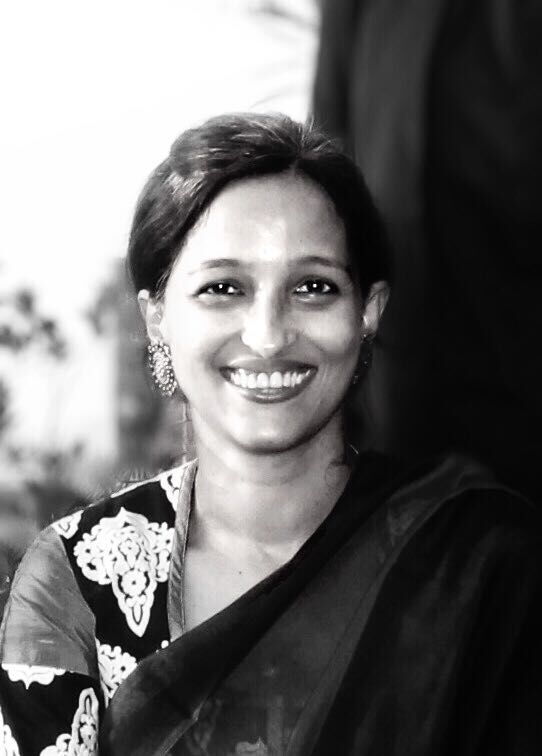
Harish Yarlagadda built his fortune by burning fossil fuels. As founding chairman of Greenko and promoter of Lanco Power, he spent decades in the power sector. But during the pandemic he started thinking about his role in the climate crisis and how he could atone for it. His answer came in the form of his philanthropic venture, Dharmavana Nature Ark—a 400-acre biodiversity conservatory, at Bhongir on the Deccan plateau. Setting up the reserve, along with co-founder William Frederick Durr, has increased his circle of moral concern.
While the environmental spotlight frequently falls on the Himalayas and the Western Ghats, the Eastern Ghats rarely make conservation headlines. However, the dry, scrubby ecosystem is unique and holds extraordinary biodiversity. Harish is determined to preserve this ecosystem.
In this conversation with IDR, the founder and chairman of the Malaxmi Group based in Hyderabad, talks about why biodiversity conservation is ultimately an act of human self-preservation, what it takes to build a long-lasting institution, and why he believes corporate social responsibility (CSR) needs to up its ante on climate funding.

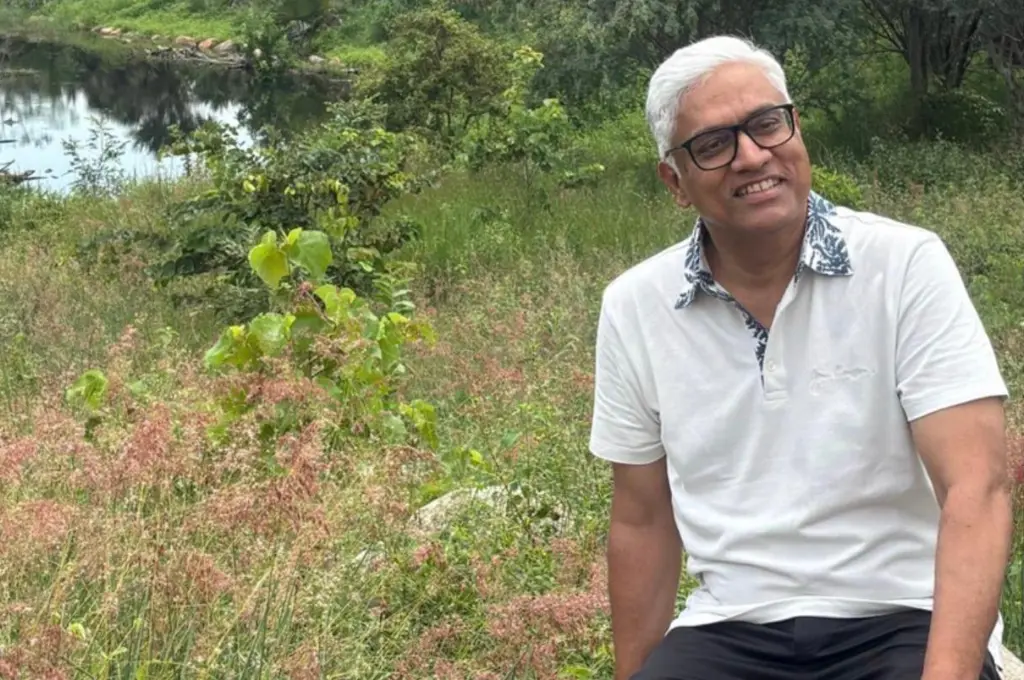
Why did you decide to focus on ecological restoration and a 400-acre biodiversity reserve as a focus area for your philanthropy?
I feel guilt for having been a polluter. I was a power-plant engineer and entrepreneur and made my money burning fossil fuel—coal, gas, naphtha. During the pandemic however, I started thinking about what we have done to our planet and how to atone for my actions.
Earlier, I used to look at philanthropy the way everybody else does—give donations to those who ask for them across different causes. But I began to feel that this was not the right, or the most scientific, approach.
Philanthropy, by definition, is the love for human beings. As the planet faces an environmental crisis, the survival of our species is under threat. For us to survive, we need to protect other species because we survive symbiotically and not in isolation. Biodiversity is therefore crucial to preserving ourselves. It is not just about plants and trees; it involves a fragile balance of hundreds of co-dependent species. For instance, if bees go extinct, humans will become extinct in the next 10 years.
As a practising pantheist, who believes that nature is god, it is my dharma to conserve the ecosystem unique to this region.
What compelled you to anchor Dharmavana in Telangana?
Conservationists often focus on the Western Ghats because the region is lush while the Eastern Ghats and the Deccan Plateau are arid. But this dry and bushy jungle has unique biodiversity and is home to a unique geological heritage, microbial life, native grasses, pollinator systems, bryophytes, lichens and, most importantly, highly climate-resilient species. It is faced with severe degradation.

My family is from Vijayawada, Andhra Pradesh. I consider myself a Telugu with roots in both the states. My parents migrated to Hyderabad in 1947, back when it was still part of Andhra Pradesh. Even though I was born in Vijayawada, my upbringing was in cities such as Hyderabad, and Kothagudem, where my father worked in the state electricity board.
As an erstwhile student leader in Osmania University and a local businessman, I enjoy some advantages that make it easier for me to be effective here.
What kind of resources, operations, and processes did it take to set up and sustain such an initiative?
I firmly believe that when you do what you are passionate about, you manifest synchronicity and magic.
We were looking for a land bank in the region in 2020, when a friend told us about William Frederick Durr, a German American who had set up an arboretum in Bhongir, Telangana in 2005. My wife Dr. Tejaswini, my colleague Sarada Kalavapudi (who later became the CEO of Dharmavana), and I visited Fred and his wife Anu.
I discovered that, like me, he had an atrium filled with plants and creepers in his building. Tejaswini and I had also been involved in promoting the 400-year-old Andhra craft called Kondapalli and we saw many of these craft pieces in their office. I also considered it a sign that Fred and I shared the same birthdate, even though I do not believe in astrology. But what sealed the deal was the discovery that he was also a pantheist.
Dharmavana focuses on flora from the Deccan area and the Eastern Ghats. We conserve many species on the brink of extinction. For example, an environmental protectionist, Kobita Dass Kolli, told us about an endangered bryophyte being destroyed by civil construction in the Gachibowli area of Hyderabad. With the help of experts, we transplanted it to Dharmavana, where it is now conserved.
The Deccan area has about 20 to 25 native species of grass which we nurture. We have also left 50 acres of the 400-acre land untouched, so the patch retains the native ecology it always had. This draws forest department trainees and their teachers since it is near impossible for them to find pockets of rich biodiversity this close to Hyderabad city.
However, it is not enough just to preserve species. We also need to research and document them. Three years ago, we set up a Centre of Excellence. It has a herbarium and a seed bank. It has already produced 12 peer-verified articles in leading global science journals. Scientists, scholars, taxonomists, mycologists, and experts on bats, cobwebs, bees, snakes, and various trees work here. We have tied up with institutions and universities, and research students spend a lot of time at the reserve.

Conserving a fragile ecosystem takes generations of work. How do you plan to keep this initiative going?
Most well-known biodiversity zones, such as those in California or Mauritius, take hundreds of years and three to five generations to develop. To ensure that this privately-owned entity remains a perpetual organisation, Fred and I have decided that it will not be divided among our inheritors like our other property. Only one person from each family will be entrusted with it.
But we also need to ensure it does not turn into a white elephant. It takes about INR 10 crore annually to run, and this amount is likely to increase in future. We are, therefore, looking at ways to ensure that there is enough capital to run it generation after generation; maybe even an endowment to sustain it. To this end, we have been in conversations with other business houses and philanthropists.
How has your experience in biodiversity informed the rest of your work and life?
This project has been my biggest guru. I sold my polluting companies and nowfocus entirely on sustainable ones. Our new platform, Malaxmi Climate Resilience (MCR), works on water management and compressed biogas, among other things. In Amaravathi, our real estate wing develops green buildings. My own office uses biophilic design.
I also try to spread the message of biodiversity everywhere I go. I serve on the Telangana State Biodiversity Board, am an advisor to the Andhra Pradesh Biodiversity Board, and on the National Committee on ESG reporting, where we’re pushing to include biodiversity in the reporting.
Through my involvement with Accelerate Indian Philanthropy (AIP), I have worked alongside fellow philanthropists advocating for greater urgency and support for biodiversity restoration. As part of the Confederation of Indian Industries (CII) in Telangana, we have a sustainability panel, which has about 25 member companies from the construction, real estate, infrastructure, and pharmaceutical sectors. I’m also part of Social Venture Partners (SVP) India, where we support sustainability-oriented organisations.
In India, of the nearly INR 34,000 crore available as part of Corporate Social Responsibility (CSR), only about 10 percent is spent on the environment. I’m on a campaign to increase this share to 40 or 50 percent of the total. Above all, though, I wish I had started this journey at least 20 years ago.
—
Know more
- Read this article to learn more about ecosystem restoration.
- Learn about the importance of bringing back nature to classrooms.
- Read how mangroves, seagrass meadows, and coral reefs are helping communities adapt to rising climate risks.