What happens when bamboo stalks and tendu leaves cross village boundaries and enter the market? When mahua, which carries a legacy of oppression of Adivasi communities, becomes a delicacy for urban consumers? Or when charota seeds, a staple food for Chhattisgarh’s tribal communities, are ‘discovered’ for their medicinal and industrial use?
Forests hold deep social and cultural value for rural and forest-dwelling communities, and remain a critical source of subsistence. Every year, these communities collect an estimated INR 2,00,000 crore worth of non-timber forest products or NTFPs—such as resin, honey, and medicinal herbs—across India.
However, the relationship between people and these commons is fast changing amid growing pressures on forests. This is not limited to expanding commodity chains, but also includes the role of forests in climate targets and the emerging markets of carbon credits, thermal plants, and green energy transitions. While many of the policies around these themes have been drafted under the guise of responding to the climate crisis, the impact on the ground has been destabilising.

They also represent a commodification of nature in a different way—one where though there may be no truckloads of timber logs being carried out of a forest, the disruption to local ecosystems and communities is eerily similar.
The question now is not whether communities participate in these economies but whether such participation strengthens their rights and livelihoods, rather than eroding them.
Ongoing exclusion and the struggle to reclaim forest rights
Despite holding close ties to forests, communities’ ability to manage and govern them has historically been mediated by external forces that include the state and the market.
Under colonialism and even after Independence, the extraction and commercialisation of raw materials such as timber took place alongside the removal of tribal communities from forests, paradoxically, in the name of conservation.
Communities have continued to face threats from the state through the expansion of protected areas.
Towards the end of the 20th century, there was a shift towards the decentralisation of power to the village level, and by the early 2000s, the landmark Forest Rights Act was taking shape. Since then, while people’s rights over customary forest areas—including the collection and management of forest produce—have been clearly recognised in the Act, its implementation has been plagued by bureaucratic hurdles and a dilution of key provisions.

At the same time, communities have continued to face threats from the state through the expansion of protected areas—putting their livelihoods and sustenance at risk.
In 2002, people living in what were previously the Sitanadi and Udanti wildlife sanctuaries in Chhattisgarh were banned from collecting forest produce such as tendu and siali leaves. The core areas of these sanctuaries covered 34 villages in Dhamtari district and 17 in Gariyaband.
Over the years, amid official discussions to convert the sanctuaries into the Udanti-Sitanadi Tiger Reserve, local communities were offered compensation to relocate. However, they refused and demanded their rights, including under the FRA, which came into force in 2006. The reserve was notified in 2009, and since then people have been fighting against arbitrary evictions and other violations of their rights.
“From 2009, we started working with communities in Dhamtari and Gariaband to get their claims under FRA. By 2013, certain rights including individual forest rights (IFR) and nistar rights [under Section 3 (1) (b) which recognises traditional access and rights over local forest resources] had been granted.” says Benipuri Goswami, activist and founder of Khoj, who has been working with communities in these districts for more than 25 years.
Since 2018, Khoj has supported more than 100 gram sabhas, including those in the reserve’s core areas, to secure their community forest rights (CFR).
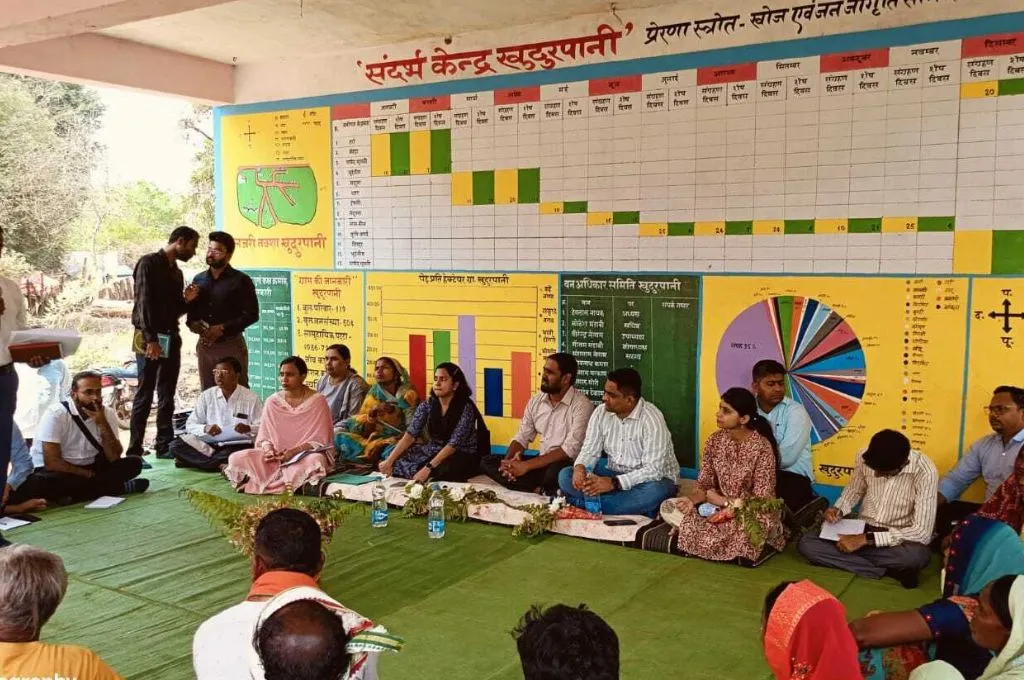
“We worked with gram sabhas to identify forest areas, which we then divided into van khands (sections). Then we mapped the density of flora in each hectare of the khand and the percentages of different trees and plants. All of this information resided with the gram sabha.” Benipuri adds.
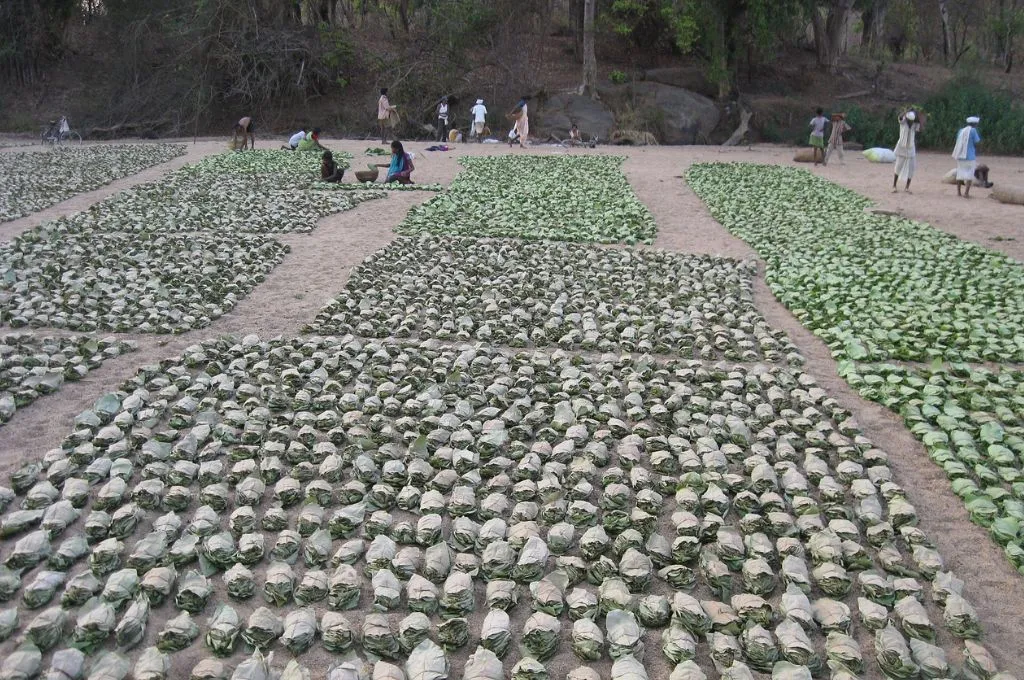
The people decided which khands would be used for grazing, which ones for collecting forest produce, and which would be left alone for three to five years so they could be restored. After these rules were put in place, the District Forest Officer (DFO) reached an agreement with the local gram sabhas and the collection of tendu leaves was finally permitted after a 22-year ban.
However, the sale of these forest products is not yet handled via gram sabhas. While individual collectors gather the produce, the forest department manages the sale of sal seeds and tendu leaves, while collectors sell other NTFPs, including mahua, to middlemen and contractors in the open market.
And herein lies the gap: While communities in some parts of the country have been able to successfully claim their rights to govern forests and NTFPs, they are still excluded from deciding how these are traded and priced in markets, which tend to operate in opaque ways.
From the forest to the market
The harvesting, marketing, and sale of forest products in India has historically been centralised, and as a result, the revenues have also tended to accrue to forest and revenue departments. With the FRA, the devolution of forest governance to gram sabhas gave communities an opportunity to oversee the collection and sale of minor forest produce (which, under the FRA, includes all plant-based NTFPs).
Over the years, a few state governments have deregulated NTFPs to varying degrees. In Odisha, for instance, restrictions have been lifted for the trade of tendu leaves only in specific districts or blocks, sparking protracted struggles by communities in various villages.
Moreover, even when individual collectors or communities try to sell NTFPs on their own, they face a highly unbalanced market.
“NTFP markets trap communities in a perfect storm of vulnerabilities. First, ecological uncertainty—you can’t promise a buyer consistent volumes when climate determines what forests yield. Second, information asymmetry—collectors rarely know market prices until traders quote them, so they cannot negotiate on equal terms, and they also do not have alternate channels. Third, working capital access—communities need funds upfront for processing and storage, but have no collateral that banks accept. And fourth, informal market networks are completely controlled by private traders who’ve spent decades building these relationships. Communities enter these markets from a position of structural disadvantage.” says Raghunathan Narayanan, the chief mentor and chief guiding officer at Vrutti, a nonprofit working with small and marginal producers on livelihood support.
As markets have expanded over time, communities are contending with increasingly complex challenges:
1. State support has been limited
Unlike agricultural produce, government support for communities to trade forest produce has been much weaker.
For instance, in Maharashtra, “forest produce such as bamboo and tendu were under the control of the government. Bamboo grown in forest areas used to be cut and auctioned by the forest department or sold to paper mills at rates approved by the state. Tendu was similarly under state monopoly,” says Dilip Gode, executive director of the Vidarbha Nature Conservation Society (VNCS).
Moreover, prior to the FRA, “though the state tribal development department would buy minor forest produce such as amla, harra, behada, chironji, and gum from tribal communities at a minimum support price (MSP), purchase centres would be located 20–25 kilometres away, and payments would be delayed. Meanwhile, traders would buy produce directly from villages or in open markets or weekly bazaars, but the prices they offered would be low. For the communities, these were essentially distress sales,” he adds.
Over the years, Maharashtra has seen sustained struggles by communities to secure their CFR under the FRA and to take over the trade of forest produce from the forest department. VNCS has supported 275 gram sabhas, organised into nine federations across six districts, to claim their CFR and govern the sale of bamboo and tendu. This work began in 2013, when 12 villages in Gondia and Gadchiroli districts got their CFR, formed a federation, and became among the first to set up the management of tendu leaves.
In 2014, years after the FRA had already come into force, Maharashtra deregulated NTFPs including tendu, allowing gram sabhas to withdraw from the collection and sale process led by the forest department. In 2021, it further removed restrictions on the collection, sale, and transport of mahua flowers by tribal communities.
However, it was only in 2025 that the state government formally recognised the rights of gram sabhas to issue their own transit permits for minor forest produce. Despite being granted under the FRA and the Panchayats (Extension of Scheduled Areas) Act, 1996 (PESA), these rights have been taken over by forest and revenue departments in various states. These permits are needed to aggregate and transport minor forest produce from collection points to be sold in markets. While the resolution came only last year, gram sabhas in some areas had been able to successfully issue their own transit permits even before this, including Dhamaditola village, Gondia in 2013, the first village in the country to do so, Dilip says.
2. Private players have the upper hand when it comes to value addition
Another issue is that of turning raw forest produce into semi-finished or finished products. “Right now, communities collect raw materials, sell for let’s say INR 10 per kilo, and watch private players process them into finished goods worth INR 200 per kilo. That INR 190 margin—where the real value is—stays outside the community. Value addition isn’t just about processing; it’s about power. When communities control the entire chain from forest floor to finished product, they control pricing, quality standards, and buyer relationships. That’s what shifts them from being price-takers to price-makers. But this requires not just processing infrastructure—it requires communities owning the entire economic architecture.” Raghunathan adds.
In recent years, there has been some policy focus on value addition at the community level. The 2018 Pradhan Mantri Van Dhan Yojana proposed setting up Van Dhan Vikas (VDV) Kendras to handle procurement as well as value addition. The Kendras are to be led by Van Dhan Self Help Groups.
However, this poses its own challenges. “These VDV Kendras only trade with SHGs. What happens when a gram sabha approaches this kendra? That has institutional autonomy and clearly defined rights under FRA and PESA. If gram sabhas are treated like an FPO [essentially a company instead of a constitutional body with clear rights], then what happens to their autonomy and ownership?” asks Byasadeb Majhi, president of the Kalahandi Gram Sabha Mahasangh (KGSM), a federation of more than 100 gram sabhas in Odisha’s Kalahandi district.
3. Policies and institutional mechanisms must support collective ownership
“Community-level value addition requires two things simultaneously: capital and ownership structure. The capital part is INR 30–50 crores per cluster for processing infrastructure. This money exists in government schemes, but needs to be shaped for the kind of investments needed.” Raghunathan says.
Unless local governance is strengthened, commons, and the complex ecosystems they support, will continue to run the risk of overexploitation and degradation.
“The ownership part is harder: If one person or family controls the processing unit, you’ve just recreated the middleman problem inside the community. We need approaches that enable gram sabhas or federations of producer groups to be the legal owners and operators. Imagine a sal seed processing unit where 500 women who collect seeds also own shares in the processing enterprise, where profits get distributed based on collection volumes plus fixed dividends, and where governance is through regular community meetings. That’s the model that keeps value at source—not infrastructure alone, but infrastructure combined with genuinely collective ownership.” he adds.
While strengthening systems that empower communities to participate in markets on an equitable standing is important, it is also crucial to ensure that forests and nature do not become subservient to market forces.
This is critical for commons, which perform vital ecosystem functions that go far beyond NTFPs. These functions—including water and climate regulation, improving soil fertility, and supporting diverse lifeforms—cannot, and should not, be commodified.
It is here that community governance becomes essential. It is not simply a matter of the terms of sale, or the structure of markets, or whether it is an SHG or an FPO that is trading NTFPs, but the broader mandate given to gram sabhas to ensure that livelihood needs and ecological preservation go hand in hand. Unless local governance is strengthened, commons, and the complex ecosystems they support, will continue to run the risk of overexploitation and degradation.
When commons governance guides markets
Communities across India, including in Odisha, Maharashtra, and Rajasthan, are demonstrating how principles of commons governance can guide both equitable trade and sustainable management of forest resources. By organising collectively, defining rules, and monitoring forests, they are creating systems to govern CFR areas and the trade of forest produce.
In Odisha’s Kalahandi district, KGSM has been able to successfully organise gram sabhas to oversee the collection and trade of tendu and bamboo. While agreements are signed between individual gram sabhas and traders or contractors, KGSM ensures that the terms and prices are fair. At present, 20 villages are collecting and trading bamboo, and 120 villages are selling tendu.
“It takes three to four years for a bamboo clump to mature. The gram sabha makes a management plan to decide which clump has to be cut in a particular year. Earlier, these plans used to be made using sketch maps. Now, we use GIS mapping to measure different zones and their acreage, and the number of bamboo clumps in each area,” says Byasadeb.
These gram sabhas have also been able to gain and exercise their powers to issue transit permits. After the produce is harvested, it is loaded onto trucks and carried to a particular village’s stock point.
Once the trader-buyers make the payment for tendu or bamboo, the gram sabhas and the federation determine how this revenue will be divided, including allocations for the wages of collectors, funds for the conservation and restoration of bamboo clumps, and a share of money for the general development of the village.
“The royalty, tax, and profits that were earlier being diverted either to the forest or the revenue department have now been returned to the hands of the people. The other important system KGSM has been able to establish is one of consolidation, or economies of scale,” says Byasadeb.
“If a gram sabha or even a few gram sabhas are able to collectivise, then they are able to trade in larger volumes which brings in bigger traders. The profit margins are also wider than they would have been at a smaller or more individual scale,” he adds.
Moreover, this model has also given communities control over who they trade with. For instance, gram sabhas have prohibited the sale of bamboo to the paper industry, given the risk of overexploitation of the clumps.
Ensuring the ecological security of commons
When communities govern forests collectively, conservation is not an afterthought, it is built into the rules themselves. “Forest-dwelling communities have always viewed forest products as a source of livelihood or subsistence. But these are being turned it into market commodities. This is what the forest department has done. They have created elaborate ten- to 20-year working plans during which they will do thinning of trees, then they will cut the trees, and then they will sell them like a market commodity. Like how vegetables are sown, grown, and sold. But forests will not be conserved through this,” Benipuri stresses.
“Take just enough of what the forest is able to give you. If not, then it doesn’t matter if a gram sabhas is doing it or if the forest department is doing it—the forest will be destroyed. For many forest-dwelling and rural communities, the forest has been a part of their lives. It was never the primary source of income,” he adds.
At a broader level, this requires a reorientation of existing policies to account for the diverse ways in which the livelihoods of rural communities are structured, and to centre ecorestoration in developmental planning at the grassroots.
“The money earned from selling bamboo and tendu goes back to the people. The gram sabhas only retain five percent of this amount, which is reinvested into management and development ranging from buying computers for the village school, to desilting and deepening ponds. The latter has improved soil moisture, which has also been beneficial for agriculture, especially since landholdings are small. People have been able to sow a second crop every year. At the household level, this has also meant money for children’s education or to repair homes,” Dilip says.
He adds, “Once we have strengthened gram sabhas, the question then is what kind of development are we doing? We have to ensure ecological security. If forests are degraded, then the ground water levels will also go down. Where will we get water for farming then? There is this connectivity, yet we manage each of these components separately. There is a department for forests, for water, for fisheries…this way the ecosystem itself gets fragmented. We need a much more integrated approach and the villages we work with our leading by example through a joint management of forests, water, and agriculture. There is trust—that if the forests survive, so will the people.”
And finally, when it comes to markets, if they are to continue to engage with forests, and commons more broadly, they must do so on terms defined by community governance systems that already exist—not by replacing them.
Shreya Adhikari, Srishti Gupta, and Sidharth Bhatt contributed to this article.
—
Know more
- Read more about how gram sabhas across India are reclaiming and governing commons.
- Read why millions of pastoralists across India are still being denied their rights over forest land and resources.
- Learn more about commons at the intersections of markets, the climate crisis, and communities’ rights.