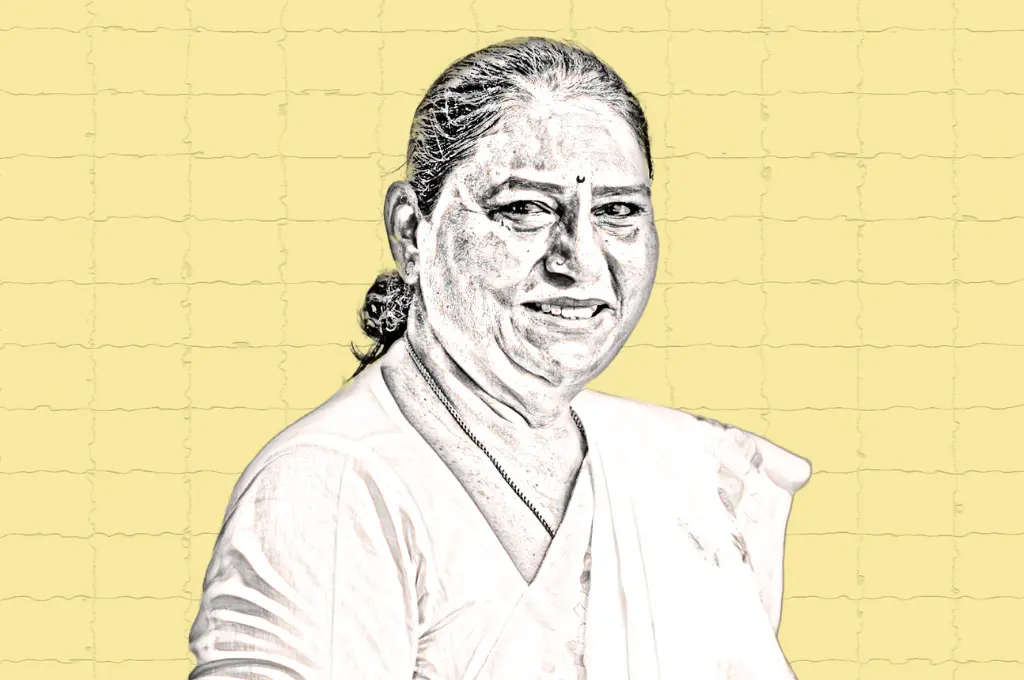
A Revathi is a writer, actor, and trans rights activist based in Tamil Nadu. She has worked with civil society organisations (CSOs) that serve sexual and gender minorities since the late 1990s She has authored and been the subject of books including Our Lives, Our Words (2006), The Truth About Me (2010), and A Life in Trans Activism (2016). She has written and performed Vellai Mozhi, her solo play based on her life, across several places in India and abroad, and now runs a theatre group called Nugam Kalaikalam that promotes rural folk arts and trains new performers.
In this interview with IDR, Revathi talks about embracing her identity, finding kinship with other trans people in the jamaats (communes), and working for the cause of her community from within and outside the development sector. She also reflects on the need for mobilising queer people under a common umbrella, elaborates on the importance of art in self-expression, and tells us why she writes the way she speaks.
Could you tell us about your life before you became an activist?
I was born in a small village in Tamil Nadu’s Namakkal district. Since society and the law called transgender people an anomaly, as a young person I felt guilty thinking that it was wrong to embrace my female identity. Art was the only way I could express myself. I would dress up in feminine attire and perform at plays and religious festivals such as the Mariamman festival. However, I struggled for acceptance at home and in my village.
When I was 14–15, I was told by someone that there were more trans people like me who had similar experiences and they met at the Namakkal fort. When I went and met them, I was surprised to see that there was an entire community of people who shared a common identity and a language of feminine intimacy. They told me if I go to Delhi, there’s an entire jamaat where I could live independently.
At Sangama, I frequently engaged with people from Dalit and Adivasi communities. Learning about their movements changed how I understood my own life.
I left my house, still carrying my school uniform and books, thinking I could return to my studies. Instead, I learned to beg door to door. The gurus (leaders of the jamaats) taught me to see this not as begging but as an equal exchange where I offered a blessing for the money I received. I wanted to get a gender-affirming surgery like many others around me, and the search for it took me to Mumbai. By begging on the streets of that city, I gathered the funds for my surgery. Around this time, I had several traumatic experiences and I realised that trans people often have no one to share these with. There is no one guiding them in the difficult journey of finding kinship and care or even helping them access health facilities. By now, I had met some activists and younger trans people who knew people in the civil society space who focused on our issues. I wanted to join them.
In 2000, I started working at Sangama, a nonprofit that works with gender and sexual minorities. I joined them as a documentation assistant with a salary of INR 2,500 per month.
At Sangama, I frequently engaged with people from Dalit and Adivasi communities. Learning about their movements changed how I understood my own life. I saw that these communities were relentless in their struggle even as the government and the society continued to snatch away their rights. I thought if they can fight so should the larger trans community. We should fight for our education, employment, and healthcare.
Fighting for my rights is something I have continued to learn from people both older and younger than me. I do not call myself a feminist, but I learned from feminists that everyone deserves equal rights, regardless of gender or language. Writers and activists Gauri Lankesh and Du Saraswathi, social workers Shakun Mohini and Madhu Bhushan, they all taught me something. Manohar Elavarthi, the founder of Sangama, taught me how to lead by example and cut no corners in social work because running a nonprofit requires much more dedication than working at a corporate company. I also learned from the kindness of the jamaat that taught me solidarity and gave me a home.
What is the jamaat system and how has it evolved over time?
A great deal of trans people’s history has never been documented and has only reached us orally. So I will narrate what I have heard. In the beginning here in Tamil Nadu, there were Devaradiyar, who danced for the gods and were considered married to them, and who were therefore not meant to marry. Trans women worked alongside them, dancing with them or calling out the dance beats. Then in 1947, the Madras government passed a law banning the devadasi system, and trans people who had depended on that world for support lost it overnight. At that moment, with no support anywhere, a devadasi mother came forward and built the jamaat system. If someone comes to you needing support, you support them in turn, and you live together like a family. I have daughters of my own now, and granddaughters, and great-granddaughters, because of that same idea.
Inside the jamaat, the guru teaches the chela (protégé) how to live, what work to pursue, how to wear a saree, and how to speak. If a problem arises with one guru, the chela can move to another house within the jamaat. If someone has a falling out with their guru and chooses to leave the jamaat altogether, they have to pay compensation before they go.
The jamaat has changed a great deal since I first entered it. The love that held it together still exists, but so does a kind of exploitation that runs alongside it. Some people now run it like a business. A great deal has also changed for the better. Many people no longer have to beg or do sex work and can instead run enterprises like an idli shop for a living. But it is a slow process.
Fear also often dictates the behaviour within jamaat, and given that they function in a marginalised structure, it does make sense. During my initial days of activism, I would often have to engage in difficult conversations with the jamaat, especially when I come into conflict with the police for their harassment of our people. I would be told by the gurus and others, “You can speak out, have your words out in newspapers, and walk away. Our children would still have to walk these streets.” I had to make them understand that only by speaking out we could make ourselves heard.
Could you tell us about your journey in the social sector?
I always had a desire to work in an office. I never really wanted to do sex work or beg on the streets.
I already had some skills from the crisis intervention work that we did in our personal capacities because our life was a struggle every day and the law and society were against us. Even with a lawyer beside us, a police station could still frame us in false cases. We fought through unity; we continued to express our dissent. So, in a way, even before joining Sangama, I was always out in the field.
Even though I started as a documentation associate, I constantly looked for opportunities to work on the ground. In 2002, I travelled to Kerala. At that time, transgender people faced ridicule and harassment in that state for wearing a saree in public. We did rallies wearing sarees, and people looked at us like we were something strange. There was a real fear we would be beaten. I spent years doing sensitisation work in police stations, explaining why transgender people should be able to wear what we wanted. Gradually, because of my work I became a small-town coordinator at Sangama, eventually rising to the post of director before leaving the organisation in 2010.
How easy or difficult is it to bring the very diverse trans community together on common causes?
The community holds many different identities, and each carries a different weight of struggle. People from upper castes who speak English face fewer barriers. Transmen and transwomen, especially those who do not speak English, face the most violence of all. Initially, the women’s movement in India left us out, and we had to work hard to find a common ground. It is important for marginalised identities to interact with one another to gain more awareness and build solidarities.
In the beginning, it was mostly transwomen who came out and took to the streets to fight for their rights. Transmen took longer because they face other kinds of societal pressures. Since very early on in their lives, they are forced to perform women’s role in this patriarchal society; many of them are even forced into early marriage. Transwomen built a jamaat network across the country that helped us. Transmen did not have that, and without this support system, many could not leave their homes at all.
At Sangama, we ran crisis interventions specifically for transmen. We arranged shelter for three months, during which they would learn the local language and find work. Many came from Kerala, often with partners, and we brought them into the community together. They also built their own independent work, some opening bakery shops, and I helped however I could, buying household items, paying rent.
Even getting trans men fully accepted took a great deal of effort from our side, and there is still disagreement within the movement over whether non-binary people should be accepted in the same way. The truth is that none of us stand apart from each other and we all fall under the same umbrella.
How can civil society do a better job at supporting the trans community?
Civil Society Organisations (CSO) can do a better job of supporting the trans community by respecting their voices and right to participate in decision-making. They can ensure that trans people are not seen only as beneficiaries; they should also be involved in designing and implementing programmes and should be given leadership opportunities.
These organisations can run awareness programmes in schools and colleges to make students and teachers aware of diverse gender identities and the lived experiences of trans people. Schools should be turned into safe and inclusive environments where trans students are protected from bullying, humiliation, and discrimination that lead to them dropping out.
CSOs can conduct sensitisation and training programmes for government officials about the rights of trans people so that officials can help the community access welfare schemes. When trans people apply for identity documents, certificates, welfare benefits, or other government services, they should be treated with dignity.
Further, they can educate doctors and healthcare professionals about the specific health needs of trans people. Healthcare should be respectful, non-judgmental, confidential, and free from discrimination.
Most importantly, CSOs must advocate for fair and equal employment of trans people across government entities, private companies, and nonprofits. Trans people should be assured of stable, secure, and dignified opportunities, including permanent positions wherever possible. They should also be guaranteed protection from workplace discrimination and harassment. The community’s lived experiences and knowledge must be respected, and they should be given meaningful opportunities to take leadership roles in organisations and programmes that affect their lives.
How would you describe your relationship with art?
Before society was ready to accept me as a woman, performance art was the only way I could express it. Once I became an activist, I set theatre aside for a while but returned to it in the late 2000s.
It has been a long-drawn-out process to include trans people in India’s theatre space, even though I believe it can play a crucial role in creating conversations in society about gender.
As for writing, I write the way I speak, without strict grammar, which is what people call vellandhiya (candid language).
For decades, we have fought to have lessons on gender and sexuality taught in schools, because children have no curriculum and no trained teacher to help them explore their feelings around their identities. Only recently, have things started changing. Since 2023, I have performed my play Vellai Mozhi in government schools for classes eight to 12, with workshops built around it. It is heartening to see that within the trans community, more people are now emerging as writers and theatre artists.
This change is important because few directors work with our community, and we still struggle to find space and venues. Recognitions like the Sangeet Natak Akademi Award or the Kalaimamani Award, that reache the cis community easily, barely reach us.
As for writing, I write the way I speak, without strict grammar, which is what people call vellandhiya (candid language). For Our Lives, Our Words, I did not conduct interviews in the usual sense. I would stay with someone for five or six days, cook and talk with them like family, share my own life, and ask about theirs, then write about it in my own words rather than quoting them verbatim. Perumal Murugan and others helped improve my writing without ever asking me to soften what I had written or telling me to make it more palatable.
Back pain limits how much I can write now, so I take my ideas forward through theatre instead. My grouse with the literary circle has always been that when someone outside our community adapts or translates my book, they receive the award, but I do not. However, I am glad for the little global recognition that I have received. Columbia University’s Butler Library has placed my name beside Maya Angelou’s and keeps my books there.
What is one piece of advice that you would like to share with our readers?
I would tell young trans people to go back to studies. If you had to drop out because you left home, find a way to return to studies. Education alone lets us live with dignity. The people who threw us out will one day have to accept us back as collectors, doctors, and judges. People like me have struggled for 35 years so you can speak freely today, and because of that struggle, I am now invited to Zurich, London, and Harvard University for my plays.
To society, I ask only that it respects the trans community as human beings. Families should accept their children with love, dignity, and respect rather than rejecting or isolating them. Family acceptance can make a significant difference in the lives of trans people.
To the government, I ask for reservation in education and employment. I ask for permanent jobs with leaves, including recovery leave after surgery and pension after retirement.
—
Know more
- Learn why DEI drives aren’t doing enough to ensure sustainable employment for trans people in India.
- Read how state governments can protect transgender rights.