India’s unorganised sector is largely invisible in data. According to the Economic Survey 2021-22, nearly 44 crore out of 53 crore workers in India are part of the unorganised sector. Yet, reliable information about who these workers are, what they do, and what their daily lives look like is hard to come by. Where data exists, it is often outdated, incomplete, or too generalised to be useful. For anyone designing interventions for these communities, even the most basic understanding of the audience often has to be built from scratch.
At Purpose, when we began conceptualising ‘Nayi Soch Ki Sawari’ in 2023, an awareness initiative aimed at preparing India’s trucking community for the transition to electric trucks, this gap immediately became apparent.
Trucks make up only 3 percent of total vehicles on Indian roads but account for nearly 53 percent of particulate matter emissions, making the sector a priority for zero emissions mobility. The transition to electric mobility in India is still at a nascent stage. In 2024, only 280 electric trucks above 3.5 tonnes were sold in India and challenges around charging infrastructure and financial viability are yet to be addressed at scale.

The goal of the campaign, therefore, was not to persuade the community to make the switch to electric trucks, but to ensure they had the information they needed to make the decision when the transition eventually came to them.
Working without data
Engaging with the trucking community on this transition, however, meant first understanding who they are, something that existing data made very difficult. Much of this community—including drivers, mechanics, and small fleet operators—works outside any formal employment structure, making them as hard to reach as they are to count. When we began working on ‘Nayi Soch Ki Sawari’, the data available on people in the trucking sector was nearly a decade old. Basic figures, such as the total number of small fleet operators and the number of truck drivers in the field, were either outdated or unreliable.
Therefore, reaching this community required us to rethink many of our assumptions, about data, about audiences, and about what it means to design a campaign that actually resonates with the people it is meant for.
We learned a few key points in this process.
1. Treat existing data only as a starting point
The nature of the unorganised sector makes even existing studies go out of date quickly. Workers move, operations shift, and what was true of the trucking sector eight to ten years ago may bear little resemblance to what exists today. When we started mapping the community, we found that basic questions had no clear answers. How many small fleet operators who owned between one and five trucks were there? Where were drivers concentrated? How were mechanics in the unorganised sector distributed across regions?

As a result, we treated the numbers we had only as a starting point for forming hypotheses, not as a reliable picture of ground reality.
We tested our engagement format across a diverse set of geographies and evaluated audience questions and comments after every ten events.
The team chose to build feedback loops at every stage of the campaign. We confirmed and corrected our hypotheses by conducting field immersion visits before the campaign design began. These included in-depth conversations with our core audience, drivers, mechanics, and fleet operators, but also with those who influence them on the ground every day, rest stop owners, fuel pump operators, and aggregators. These visits gave us crucial insights on touch points for the audience and helped us to understand the nuances within the trucking sector.
For example, trucking operations in Punjab looked very different from those in Delhi, which again looked very different from Gujarat. The geography shaped everything, from how operators ran their businesses to how drivers thought about their work. Beyond that, a lot of what actually happens in the sector simply does not appear in any formal data.
Overloading, informal employment arrangements between fleet operators and drivers, and off book financial understandings only became visible when we were present on the ground. No dataset would have told us any of this. And we realised that going to the field was not a way to fill gaps in our research but that it was the research itself. Given the nature of the sector, we also realised that it is very unlikely that we would interact with the same set of people twice. Thus, we integrated feedback mechanisms into the campaign design. We tested our engagement format across a diverse set of geographies and evaluated audience questions and comments after every ten events, rather than waiting until the end of the project.
2. Map the full spectrum of your audience
The unorganised sector is not one homogenous group and the trucking sector is a good example of this. On the surface, it appears to have three core audiences: drivers, mechanics, and fleet operators. But each of these contains its own spectrum.
Fleet operators include single owner-drivers, small operators managing a few trucks without fixed routes, and larger companies with structured operations and long-term contracts and billing. Drivers with long-haul or short-haul roles have differing concerns, information needs, and communication preferences. Mechanics are either trained at authorised workshops or have learned entirely on the job, working as generalists out of transport nagars. This difference also shapes how they perceive new technology.
These distinctions matter because the same messaging will not work across this spectrum. When we began engaging the trucking community, for example, we found that drivers were most concerned about their livelihoods. A portion of a driver’s income comes from however much diesel they are able to save, and the prospect of electric trucks raised immediate questions about what that would mean for their earnings. Mechanics, on the other hand, questioned their job relevance the moment they heard that electric trucks do not have a traditional engine. Fleet operators, meanwhile, prioritised financial viability and technical reliability, focusing on battery range, charging time, and the conditions under which electric trucks are cost-effective. There was also another layer. While fleet operators make the final decision on adopting electric trucks, they rely heavily on input from drivers and mechanics. It is a tightly knit community that runs on peer testimony where a fleet operator will ask a fellow operator how a truck has performed. They will check with their mechanic about breakdown rates. Focusing only on the decision-maker would have overlooked these key influencers.
As a result, the content of each engagement also had to be tailored. Drivers wanted to understand what electric trucks would mean for their comfort and their income. Mechanics wanted to know how similar or different electric trucks were from diesel ones, and whether their existing skills would still be relevant. Fleet operators wanted hard numbers on financial viability and technical reliability. The same information, presented the same way to all three, would have landed poorly with each of them.
3. Don’t make assumptions
One of the most common mistakes in campaign design is going in with a fixed idea of what will resonate with the audience. For many of us working on issues such as climate or technology transition, we often assume that themes of national interest, environmental impact, or long-term change will not resonate on the ground, especially for those who are seen as being focused on immediate survival. Our experience while designing this campaign, however, challenged this assumption.
In interacting with the trucking community about electric mobility, we expected pollution and climate to feel distant and abstract. Instead, truck drivers across India—many of them from smaller towns and villages—spoke about visible environmental changes over their lifetimes. They could see the difference between the air their children were breathing and what they remembered from their own childhoods. For them, pollution was not a policy issue, but a personal concern tied to their children’s future. This perspective was consistent across drivers, mechanics, and fleet operators.
Fleet operators revealed other insightful observations. Some independently raised energy security, noting India’s dependence on imported oil and the potential for locally generated electricity, particularly through solar power. This perspective emerged organically and ultimately strengthened our communication strategy.
We also found that assumptions about who could do the fieldwork, particularly around gender, did not always hold. Women team members engaged with the community on equal terms, including on technical topics, which was not what we had expected going in. When we asked truckers about women entering the sector as drivers, their hesitation was not rooted in gender bias. Their concern was about the job itself, the unpredictable routes, safety risks, and difficult conditions that made most truckers unwilling to see anyone they cared about enter the sector.
4. Build trust early
Trust was also built through who we showed up with. Many truckers in the unorganised sector were sceptical of outside organisations coming in with their own agendas.
So we partnered with on-ground organisations like Child Survival India who had been working on trucker welfare for years and already had the community’s trust. This signalled that we were not there to sell something, but to give the community information it could use on its own terms. We also made sure that language was not a barrier. Materials and posters were produced in several languages, and the digital resources we created expanded over time to reach communities beyond the Hindi speaking belt.
We made sure that the community’s questions were addressed by experts from IIT Madras as well as by drivers who had already operated electric trucks.
Additionally, we were transparent with the trucking community from the get-go. Rather than overselling electric trucks, we were upfront about the conditions under which electric trucks make financial sense right now and the current limitations like range and charging time. Drivers and fleet operators responded better to honest information than to messaging that felt like it was trying to sell them something.
We also made sure that the community’s questions were addressed in real time by technical experts from IIT Madras as well as by drivers, fleet operators, and mechanics who had already operated electric trucks. For a community that runs on peer testimony, the latter carried as much weight as the former.
5. Design how you show up
Understanding your audience is only half the work—how you show up matters just as much. The format, location, and tone of engagement can determine whether people participate at all.
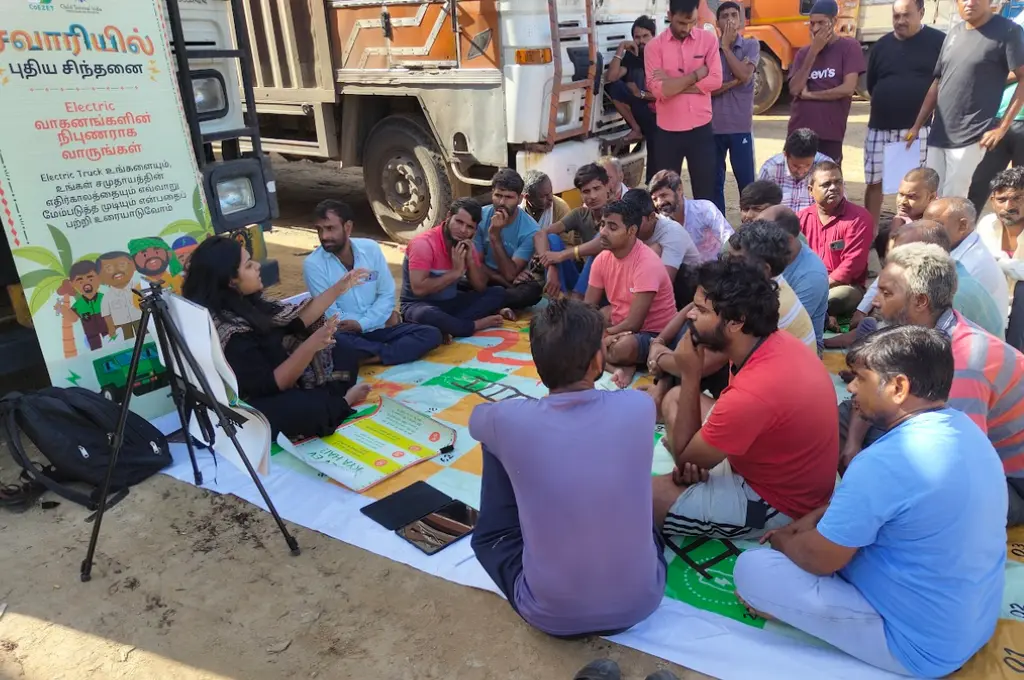
Engaging with truck drivers required working around the realities of their schedules. Long hours on the road meant that time was limited, and breaks were often spent at roadside eateries or loading areas. Rather than expecting them to come to us, we took the conversation to where they already were, rest stops on the highways, loading and unloading points, chai tapris and company canteens. We engaged them where they were seated, whether on chairs, sofas, or the floor, making the interaction feel natural and conversational. We reframed technical information sessions as ‘Chai pe Charcha’, informal conversations over tea that encouraged open dialogue. Often, discussions continued among participants long after we had left.
However, we also observed that while drivers were comfortable sitting together on the floor in informal setting, fleet operators were not. Bringing them into the same setting would have made the interaction unproductive. Therefore, we designed separate engagements for each audience—formal office discussions for fleet operators and informal sessions for drivers, without making any of them exclusive. The design of the location attracted the specific audience.
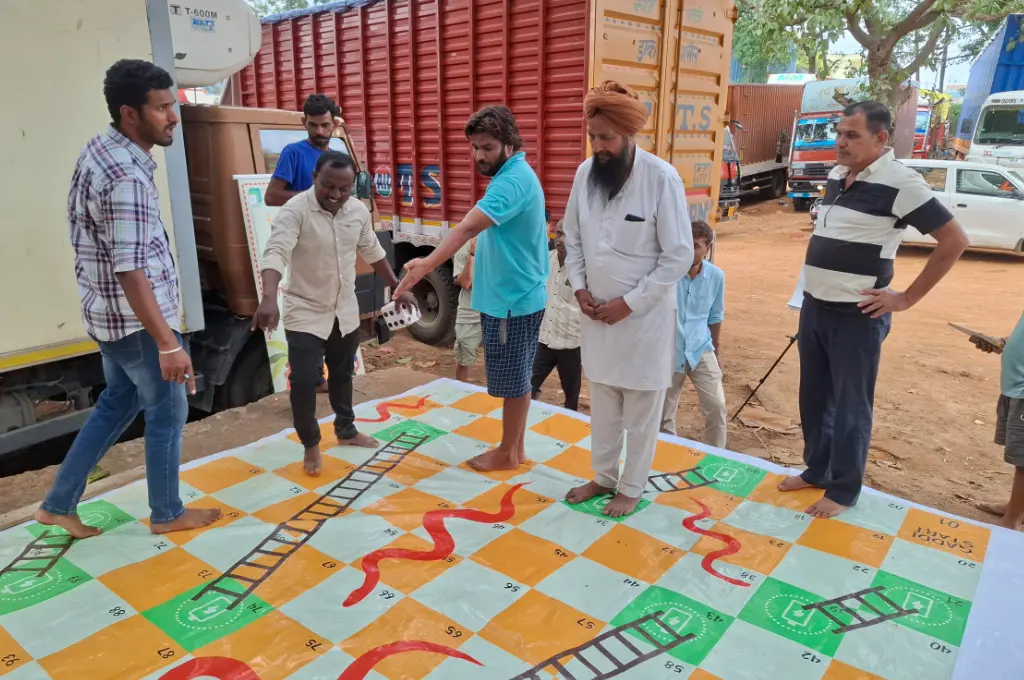
Another tool we used to initiate conversations was a snakes-and-ladders game, played during community sessions as a way of understanding how people perceived electric trucks. Every time a participant landed on a ladder, they named an advantage. Every time they landed on a snake, they named a concern. This surfaced perceptions that a straightforward survey might have missed. For example, when the two-hour charging time came up, we had assumed it would be seen as a disadvantage. Drivers saw it differently. For them, it meant guaranteed rest time on long routes, something they rarely get with diesel trucks.
6. Plan for what happens when you leave
Engagement did not end with the sessions. Many of the questions people raised, around charging, costs, battery life, or simply what driving an electric truck actually feels like continued long after we left. So we experimented with building something that people could return to on their own time: EV OK Please, a YouTube channel shaped by the concerns and curiosities we encountered on the ground.
A few things were especially important to make this work. First, the content stayed closely linked to what people were asking on the ground. Questions, doubts, and myths that came up during field interactions were turned into videos, making the channel an evolving bank of answers rather than a fixed content plan.
Second, language became equally important. Long-haul drivers spoke Hindi or other North Indian languages, while shorter-route drivers often preferred their local language. So the content was produced in multiple languages to stay accessible across driver groups.
Finally, we wanted the channel to reflect the many worlds that shape the trucking ecosystem. Alongside experts from IIT Madras and representatives from Ashok Leyland, BillionE, ChargeZone and the Ministry of Heavy Industries manufacturers, the channel also featured drivers, mechanics, and fleet operators from the community itself. Videos circulated through WhatsApp groups, extending conversations beyond the sessions. Designing for communities in the unorganised sector is not just a communication challenge. It is a research, design, and trust challenge all at once. Data will often be missing, the audience more varied than it first appears, and the concerns that resonate rarely the ones you expect. Our experience with ‘Nayi Soch Ki Sawari’ showed us that none of these are insurmountable. They require a willingness to start without all the answers, to let the community’s reality reshape your assumptions, and to build engagement that outlasts your presence in the field.
—
Know more
- Read more about the impact of India’s electric vehicle transition on the economy.
- Learn how nonprofits can design effective behaviour change programmes.