Across Uttar Pradesh’s Prayagraj (Allahabad) district, there are eight food packaging and processing plants responsible for meeting the nutritional needs of pregnant women, lactating mothers, and young children.
These plants are part of the Take Home Ration (THR) programme, which is an extension of the Integrated Child Development Services scheme (ICDS) (subsumed under Saksham Anganwadi and Poshan 2.0 in 2021). Launched in 1975, the ICDS has since evolved into one of the largest community-based child development programmes in the world. Its role in addressing child malnutrition was further strengthened following a series of Supreme Court orders under the landmark Right to Food case, which emphasised the state’s responsibility in ensuring supplementary nutrition for children and women.
In recent years, the programme has adopted an increasingly decentralised approach. Using data from the Poshan Tracker, the ICDS department issues orders every quarter for Supplementary Nutrition packets that have to be produced by each THR plant. These plants are run by women from local self-help groups (SHGs), formed under the National Rural Livelihoods Mission (NRLM), and they manage the procurement, packaging, and distribution of grains and other goods for the food packets.

Despite their central role in improving nutritional outcomes at the grassroots, little is known about the women who operate the THR plants.
In 2025, I, along with a team of officials from the State Rural Livelihoods Mission (SRLM), conducted field visits to four THR plants in Prayagraj. These facilities collectively serve approximately 28,000–30,000 women and children in the area.
During our interaction, women spoke about operational and logistical challenges, managing gender and social dynamics, and how their precarious status under the scheme impacted employment security and access to welfare and labour protections. This stands in stark contrast to the image of the THR programme as a model of women’s economic empowerment and community-led development, and highlights a need for reforms.
Decentralisation without adequate support
The Block Mission Management Units (BMMUs), formed under the SRLM at the block level, are responsible for monitoring and reviewing the THR programme. These units are set up to support the plant, while women are encouraged to ‘own’ and manage its operations. However, many financial and operational decisions, procurements, and reimbursements are managed by BMMUs which takes away decision-making authority from women, who then become mere employees.
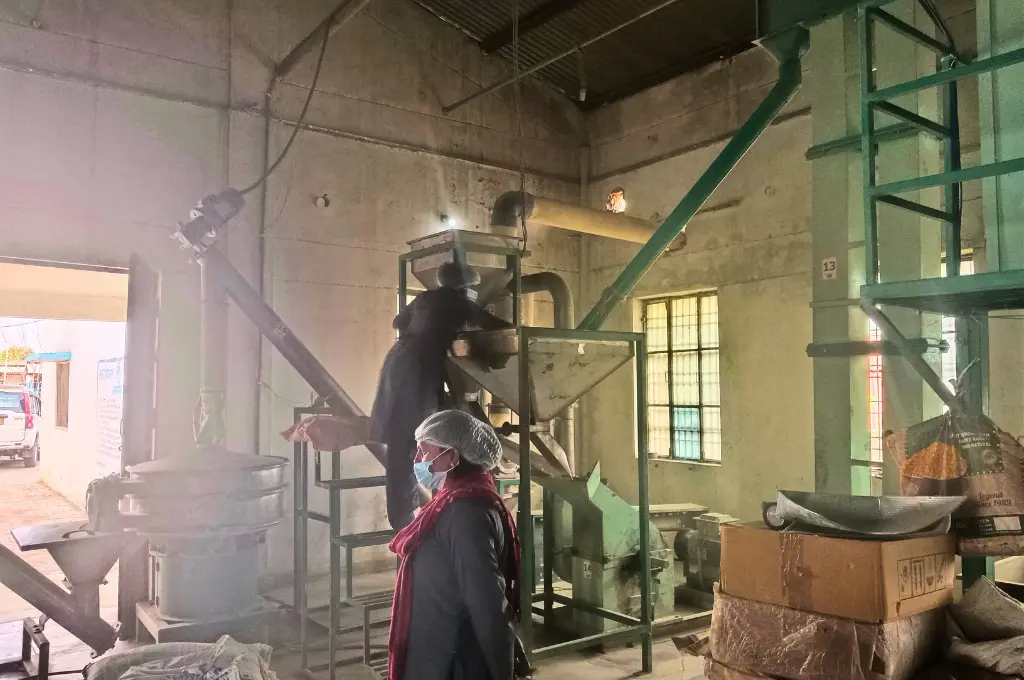
In areas where electricity is erratic, or when machines break down, women often work double shifts, into the night, to fulfil the orders on time.
The number of Supplementary Nutrition packets needed for a particular area is raised by the ICDS department in the form of a Demand Indent (DI) sent to the THR plants. Each plant is run as a separate entity with its own procurement channels. Rice and pulses are procured from NAFED, while other essentials such as cooking oil, sugar, and rava are purchased from local vendors by the women workers at their own expense. They also buy the wrapping paper used to package these items from a vendor identified at the district level.

The ICDS department releases payments in the form of reimbursements only when the DIs are fulfilled. In areas where electricity is erratic, or when machines break down, women often work double shifts, into the night, to fulfil the orders on time. Delays in this entire process mean that women often work for weeks without pay. On days with no assigned tasks, they earn nothing.
These disruptions, along with the conditions in the plants, make it difficult for the women to work, ultimately affecting mothers and children who rely on timely access to nutritious food under the ICDS.
Informalised working arrangements increase vulnerability
For many women, the THR scheme provides a rare economic opportunity in an area where unemployment is a pressing concern. However, each THR plant typically employs only around 20 women. They are selected from the Cluster Level Federation (CLF) of local SHGs based on their adherence to the Panchsutras (five core principles) of SHG functioning. These include their attendance in CLF meetings, savings and timely repayment of SHG loans, bookkeeping, relationships with Block Mission Managers, and practical considerations such as the proximity of their village to the THR plant.
Once selected, the women are referred to as ‘nutripreneurs’, and their work is often classified as ‘community-based’ or ‘entrepreneurial’. Moreover, since they are members of independent entities such as SHGs or CLFs, they are not recognised as formal workers under the scheme and are not given formal appointment letters. The average wage rate for an eight-hour shift is INR 283, which amounts to a monthly income of around INR 8,500.
Given that women are not recognised as employees, they do not have access to protections afforded by existing labour laws. When the plant is operational, there are no provisions for paid leave. Women are also not given insurance, pension, or maternity benefits.
Unsafe working conditions
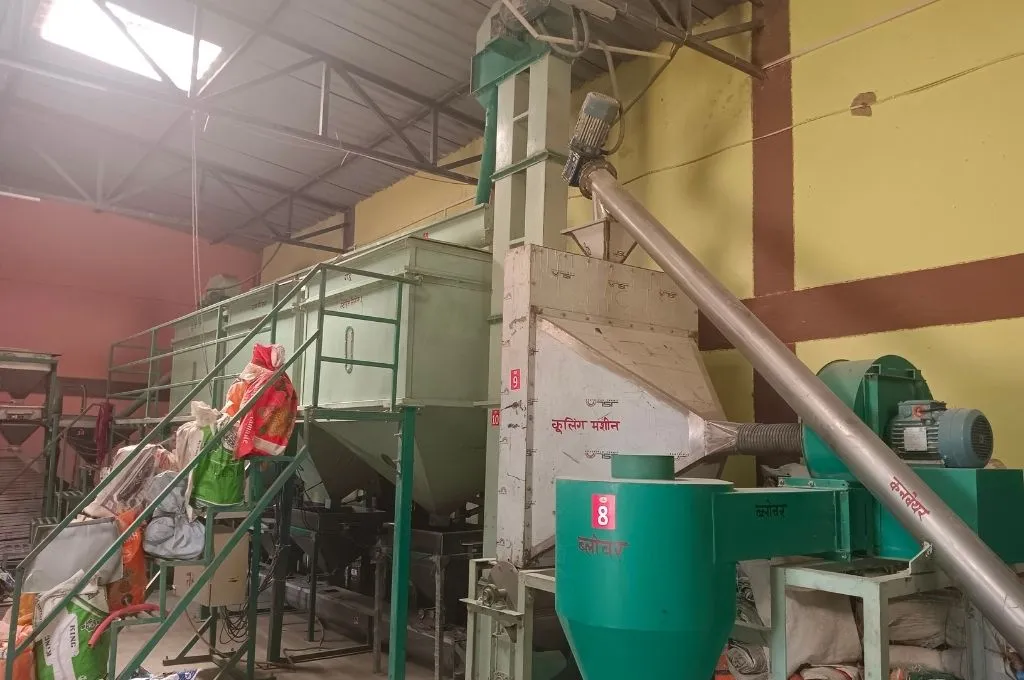
The lack of labour protections is detrimental to the workers’ health and well-being given the nature of work at the THR plant. While one might assume that women are simply packing food, in reality, women face significant occupational hazards. These include technical issues with machinery, physically strenuous work, double and overnight shifts, lifting heavy loads, and a general lack of safety at the plant.
A woman at Ahaar Prerna Laghu Udyog, a THR plant in the Baharia block, shared that her finger was amputated while operating a machine. The only support she got for her treatment was from her SHG. Shortly before our visit to the plant, another worker had fallen from a machine platform and was injured. Several women also reported suffering from chronic back and neck pain due to lifting heavy materials.
The plant has tin-roofed sheds, which become unbearably hot during the summers when temperatures in the district soar up to 45–46°C. Not only that, fans or coolers have to be turned off while handling powdered ingredients due to dust dispersion, effectively leaving women without any relief from the heat. We also observed open and loose wiring in the plant, posing the risk of electrical hazards, especially during the monsoons or when electrical gadgets are switched on during the summer.
There is also a general lack of security at the plant site. At the facility in the Bhagwatpur block, a worker said, “Because of the low boundary wall surrounding the plant, there have been 2–3 instances where men jumped inside and caused chaos.”
In Koraon, since the toilet is located outside the plant’s premises, women said they faced difficulty accessing it at night even though a security guard is on duty. A common boundary wall could solve the issue, but the land outside falls under the jurisdiction of the Public Works Department (PWD), which would mean that construction plans would have to move through a complicated bureaucratic process.
Women also face challenges related to mobility, especially when they have to travel alone. A few of them explained how they had arranged for the husband of one of the women, who owned an auto rickshaw, to take them from their homes to the THR plant and back, making it easier and safer for them to travel.
Another key aspect of the vulnerability faced by workers in the plants lies in the social stigma they face as women who often have to work during the night. In three out of four plants, women stated that they were looked down upon and were subjected to gossip and comments in their villages.
This was also a common experience shared by many SHG members when they first started stepping out for meetings and training.
Improving security and support for women
On paper, the THR initiative is an effective example of convergence between different government schemes to ensure a more decentralised delivery of entitlements. Through coordination between the ICDS and the NRLM, this programme also links nutrition delivery with local livelihood opportunities for women.
However, as the findings from the THR plants show, it is crucial to overhaul existing mechanisms for implementation. The sustainability of THR hinges on formally recognising the labour of the women that keep these plants running.
Following our visit, we submitted a report to the district officials highlighting the concerns and problems across the four plants. We also met with the Labour Department and found that they were not aware of the existence of the THR plants, or of the women working there. Following discussions, the department stated that the women could be recognised as informal gig workers and registered on the e-Shram portal, which would also give them access to the Ayushman Bharat health card and a pension scheme.
The sustainability of THR hinges on formally recognising the labour of the women that keep these plants running.
Shortly after, a letter was issued by the district administration to get all women working in THR plants registered on e-Shram so that they can access the schemes provided by the Labour Department. Since then, this intervention has been rolled out at the state level, under a directive issued by the SRLM.
While this is a necessary step, more needs to be done at the level of systemic reforms.
At the plant level, it is crucial to ensure that women are working in safe conditions, including while operating heavy machinery or working during periods of intense heat. Additionally, plants must be properly equipped with toilet facilities and proper security.
Importantly, women must be given meaningful ownership over the THR plants. Instead of being treated as procurement and fulfillment centres, policy measures must be directed towards equipping women to run these plants as collective enterprises. This includes providing training and capacity building for essential functions such as bookkeeping, maintaining records, accounting, and decision-making over the plant’s operations. While some of this work is being done by civil society organisations and the NRLM, stronger and more targeted government support is required to make sure that the women in charge of fulfilling the country’s primary nutritional needs are able to do so with a sense of agency and security.
—
Know more
- Understand why it is critical to increase budgetary allocations to address child malnutrition.
- Learn how a proposed amendment to the National Food Security Act will impact already vulnerable households.
- Read how nutrition tracking has increased the burden on Anganwadi workers amid longstanding demands for fair pay.