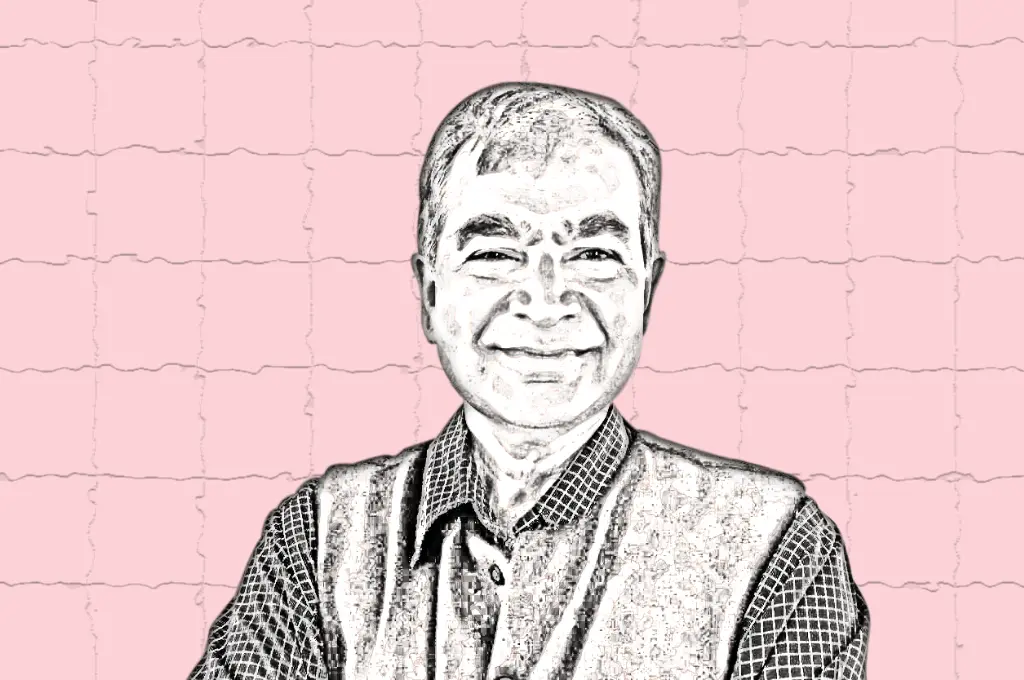
Martin Macwan is a human rights activist from Gujarat, India, and the founder of Navsarjan Trust, Dalit Shakti Kendra, and Dalit Foundation.
The recipient of the Robert F. Kennedy Human Rights Award in 2000, Martin has spent decades challenging untouchability by mobilising marginalised communities and organising campaigns across the country. His mentorship and grassroots activism have inspired generations of young leaders from India’s marginalised communities.
In this interview with IDR, Martin discusses how his lived experience and interactions with others have shaped his activism, talks about the courage and creativity that define his work, and shares what gives him hope during bleak periods.

Can you tell us a bit about your formative years?
When I was studying BA at St Xavier’s College, Ahmedabad, my professors, Fr. Heredero and Pheroz Contractor, used to tell me to take up social work instead of chasing degrees. I would tell them, “I am from a very poor family. My mother is a tobacco worker. She earns 65 paise per day. I myself am a child labourer, and we are a family of 11 people. I am the first in my locality to go to college.”
But the professors were adamant. They would say, “The educational institutions will give you degrees, but you won’t have any knowledge. Instead, if you go and live in a village with the people in their homes, you will gain knowledge that is far more important than a degree.”
I was only 20, and while this was a tough choice for someone from my background, I chose to accompany my professors to the villages in Gujarat’s Khambhat taluka for a survey. I was told of a simple rule: “When you are in the villages, you will keep your eyes and ears open, but you will keep your mouth shut.” I soon realised that this wasn’t easy to follow.
In the village where I was staying, when I would look out of my window, I could see a pond, a banyan tree, and a dominant-caste man sitting under the tree. On the exact opposite side of the tree, there was a Dalit locality. Day after day, that man would sit there the entire day leering at women from that Dalit locality going to fetch water. I continued to see several forms of casteism especially against Dalit women. I told my professor, “I can’t not speak because this makes me very angry.” He advised me to write what I observed and how I felt in a journal.
What my professors were trying to tell me was that “when you speak, you aren’t listening, you aren’t observing”. Since then, I’ve kept on writing. My journal pile started from the floor and reached the ceiling very quickly. At one point I had no space of my own, so I started keeping them at a friend’s place. One day a few years ago, someone thought these were wastepaper and they sold my writings of 25 years.

I learned that introspection is very important, which you see completely missing in the voluntary sector today. You have programmes, meetings, followed by lunch, and posts about these events on the internet. I don’t see people sitting for more than two hours to reflect on what they are doing or witnessing.
The activism that you practice requires a lot of courage. Is this courage innate or is it something you learned from others?
Today, I have an office car, a good house, and I have food, but there are millions and millions of people who don’t have these privileges. Their life is a battle that they fight every day. I derive my courage from them.
I will give you an example. In the early ’90s, in a village in Gujarat, Dalit people were being oppressed so much that they had to leave their homes and settle in camps. One of these people was a young factory worker who had to travel hours for his livelihood. He bought a bicycle for INR 200 to be able to travel faster, not knowing that he had purchased stolen property. When the police caught him, he said, “Look, I bought this cycle. I did not know that it was stolen.” Legally, the police should have just confiscated the cycle and let the man go. Instead, they took him to the police station, made him sleep on an ice slab, and beat him black and blue.
Over and over, I’ve seen that people who are on the receiving end of atrocities are fearless.
Eventually, they had to present him before the magistrate for bail, but he could not even stand so they presented his younger brother in place of him. On reaching home, he could not sit up, and could not even sleep on his back. People took him to the hospital where the doctor asked to know what happened before he could be treated. On learning about his ordeal, the doctor called the police department and told them that there was a complaint against them. Later, the man was found hanging in his own house. Somebody had come and hanged him in his own house.
As a trained lawyer and activist, I took up that case. The deceased had left his widowed mother and his brother behind. The police would turn up at their door every day and offer INR 5 lakh in cash to drop the case. But the mother wouldn’t budge. For her safety, I took her to my own house for 15 days.
Back then, we weren’t well-off; we lived in a small mud house. My wife and our two children used to sleep in a room at the back of the house. That woman would constantly be sitting or standing outside our door. She would keep repeating, “Martin bhai, no matter what happens, we may lose or win the case, but we have to fight.”
One day I broke down and I cried bitterly saying, “I have got everything and I have complaints. This lady has nothing but look at her commitment to justice. She wants to fight.”
Over and over, I’ve seen that people who are on the receiving end of atrocities are fearless. On the other hand, voluntary organisations and funders who claim to work for them choose safe strategic interventions instead of courage.
Time and again, you have had to pay for this bravery. Have the setbacks changed how you work?
Over the decades, I have lost a lot. In 1986, during the early years of my journey, I had to deal with the murder of my four colleagues, who were gunned down by feudal landlords during a Dalit movement that we participated in.
I founded Navsarjan in 1989 to fight the practice of untouchability, especially in Gujarat. We kept coming into conflict with the powers of the day. In 2016, in a bid to weaken us, the government took away our FCRA licence, followed by our 80G, thereby affecting our sources of funding. Now they are trying to cancel our 12A license.
It was a huge blow, and we had to change our model radically. I had given up the reins of the organisation way back in 2002, after I did a major padyatra against untouchability in Gujarat. I wanted a new generation of leaders to take over. I told the board that I was ready to train younger people, but that I did not need to be a leader anymore. So, I resigned from the board of trustees and as the director of the organisation. They requested me to look after the Dalit Shakti Kendra, a vocational school that we run. I said I will do it voluntarily.
However, when the tragedy struck the organisation in 2016, the Navsarjan board said, “Look, we have no options left. Either you come back or we let go of the entire organisation.” So, I took over again, much against my planned vision.
After coming back, as I analysed the problem, I realised that our issue wasn’t a lack of money. The problem was that we didn’t have good programmes.
In the voluntary sector, more than money, one requires creativity. As we lost everything, we became more creative than ever before in running our programmes.
In 2017, the Chief Minister of Uttar Pradesh was visiting a Dalit village in Kushinagar district. The government officials went and distributed soap bars and shampoo sachets to the people so that the smell of the Dalit bodies wouldn’t reach the nostrils of the Chief Minister, they said.
People were angry. So, we said, “Let’s do something. Let’s make a soap; but one large enough to attract the attention of the whole world.” We made a soap, which was 4 feet tall, 2 feet wide and a foot deep, weighing about 125 kilograms, because it was B.R. Ambedkar’s 125th birth anniversary.
We also agreed to raise money from the people, between one and five rupees a person. Making the soap cost us 2,500 rupees, and people happily gave the money. We made a beautiful carving of Lord Buddha on the soap because Kushinagar is also the place where Buddha attained nirvana. Then we wrote a letter to the Chief Minister which said, “Buddha eliminated caste 2,500 years ago in Kushinagar. You are reinventing it with state money and power. Your sin can be only washed by Buddha and nobody else. So, you may be clad in holy clothes but that’s not enough. The dirt from your mind has to be removed. This soap is for you.”
We must lose fear of what the government can do to us and our organisations and keep finding creative ways to spread awareness and express dissent.
The soap went around Gujarat in a large truck, so that people across the state could see it. After Gujarat, our colleagues took the Sabarmati Express to go to Lucknow to present it to the Chief Minister. At Jhansi, the train was halted by about 700 policemen armed with rifles. They asked, “What is there in the box?” When they opened it and saw Lord Buddha, the police removed their caps and saluted it. Within moments, that selfie became popular across India.
Promptly, the police changed their behaviour. They said, “We have no problem. We are here for your safety, and we have made arrangements for your stay and food.” My colleagues said, “Look, we don’t insist on personally meeting the CM and giving him the soap. Could you issue a receipt on behalf of the state and take the soap yourself?” Finally, after a lot of negotiation, they issued a receipt.
The soap is still safe with the authorities. We have confirmed this through an RTI.
This was the cheapest campaign of my life. I’ve done hundreds of campaigns, but this INR 2,500 event got the attention of the nation. It taught me that we must lose fear of what the government can do to us and our organisations and keep finding creative ways to spread awareness and express dissent.
You have spent almost five decades in the voluntary sector. What still keeps you going?
Working with young people gives me both hope and energy.
At Dalit Shakti Kendra, we have trained 11,000 young men and women. We don’t just focus on teaching them how to stitch a shirt or make something; we also teach them life skills. For example, it’s part of the curriculum that regardless of gender, everybody has to learn how to make chapatis. Many boys come to the kitchen for the first time in their life at the age of 25. We also teach them how to go to the police station and register an FIR, how to read land documents, etc. It is not just education for the sake of education and training for the sake of training.
There was a girl from a tribe in Jharkhand who was with us for two months. She just wouldn’t talk; wouldn’t even tell people her name. I tried talking to her several times. People said, “Martin bhai, I don’t know who brought this girl here; she is a waste of our resources.” I said, “Look, let’s have patience. We produce time bombs here. Some bombs explode right here. Some do after 10 years. So, let’s not lose patience.”
When she returned home after two months, she accompanied her mother to a gram sabha meeting to address a conflict. The thakur, sitting on his chair and twirling his moustache, ordered for the meeting to start. In response, the girl stood up and said, “I am sorry, but you aren’t the pradhan (head of the panchayat); your wife is.” That man lost his temper. Nobody had the courage to question him in all these years. He shouted, “Whose daughter is this?” To his surprise, eight or nine women stood up and said, “It doesn’t matter whose daughter she is; what’s important is whether what she has said is correct.” The meeting ended in chaos. But in the next meeting, his wife, the real pradhan, came and occupied the chair.
Dalit Foundation has documented these stories of this young woman and other people who have wrought change in society, in the book Stories of Change.
Today, I’m very happy. This was the mission of my life: 47 years and training hundreds of young people again and again. Simply speak with young people, have a dialogue, go to their houses, eat with them, and listen to all the things they have to say. After all, they are our future.
During the recent Gen Z protests, it was heartening to see so many people holding up posters of Ambedkar. They were carrying Ambedkar as a symbol of an equitable India; they were carrying copies of the Constitution as a tool to ask for their rights and were openly embracing anti-caste slogans. This unabashed display of courage and solidarity gives me hope. I see change coming, and that’s what keeps me going.
Juhi Mishra contributed to this article.
—
Know more
- Watch this interview to learn more about Martin Macwan’s creative solutions to questioning casteism.
- Read this story by a safai karamchari who wants to ensure minimum wage and skill development for people seeking a life beyond manual scavenging.