“If you get these f***ers to do some boxing, all their issues will get solved.”
This is what a CSR leader told us (Mohit and Saanchi)1 during a meeting to pitch Project Second Chance, a nonprofit that we run to advocate for prison reform and to support formerly incarcerated people in India.
Neither is this statement unusual nor the underlying assumption: that people in prison are broken in a way that a punching bag can fix; that their problems are theirs alone.

Across conferences and meetings with funders, we have often found ourselves explaining why former prisoners deserve a second chance at all. Discussions around prison reform, access to justice, and rehabilitation are reduced to piecemeal initiatives or short-term vocational programmes, which prioritise scale and visibility over meaningful impact.
These conversations are also reflective of the pervasive stigma that is attached to incarceration. In public imagination, prisons are spaces designed to confine and punish ‘offenders’, those deemed to have crossed red lines defined by the law. However, the reality is not quite so linear. While a guilty verdict may take years to come—if at all—the real punishment is the process: a grueling grind of police procedures, court visits, and social isolation. And it begins long before people even set foot into prison.
According to the India Justice Report 2025, India has 1,332 prisons designed to hold 4.4 lakh people. However, there are currently between 5.3 to 5.8 lakh people in prisons, with 12 of these facilities across the country running at 400 percent capacity. Not only that, but 76 percent of the prison population comprises people who are undertrials, of which 49 percent are between the ages of 18 and 30.
These figures show the scale and scope of incarceration in India. However, data often flattens as much as it reveals, morphing individual lives into an indistinguishable crowd. At the same time, when a system seems as impenetrable as India’s prisons, it can be difficult to pinpoint where and how reform can happen.
After spending a decade working in India’s prisons, we have noticed that opportunities for cross learning are few and far between. Moreover, reform is often happening at the level of a single facility. For instance, Pawan Kothari, the jailor of Dehradun district prison rehauled the visitation process, shifting it from dingy rooms with cracked and hazy screens separating prisoners from their families to an outdoors compound where they could meet and interact.

But, in silos, such practices often evade top-level policy discourse or discussions around ‘evidence-based’ action.
Over the course of working with prisoners and officials in multiple geographies including Delhi, Uttarakhand, and Haryana, we have also found that action and change often falls to individual discretion, which means that if official appointments change, work may be stalled or stopped altogether. This has also made institutional reform difficult.
As India’s prison population continues to grow, the question before us is whether we respond by building more infrastructure to punish and confine, or invest in rehabilitative and reformatory approaches aimed at reintegration.
Towards rehabilitation and reintegration
India invests nearly a billion dollars a year in its prison system, and much of that money sustains confinement rather than rehabilitation.
But who is in prison, and is India’s incarcerated population homogenous?
Data has consistently shown that marginalised communities are disproportionately represented among India’s prison population: Dalit communities (22 percent), Muslims (16.5 percent), and Adivasi communities (13 percent).
Moreover, a few years ago, we conducted a study and found that people who were poor, who did not have access to proper legal aid, and often only had one or two family members actively pursuing their case were spending up to 200 to 250 extra days in prison than what their sentence might mandate. A second category that is even more vulnerable is people who have simply vanished within the system—no family, no lawyers, no resources.
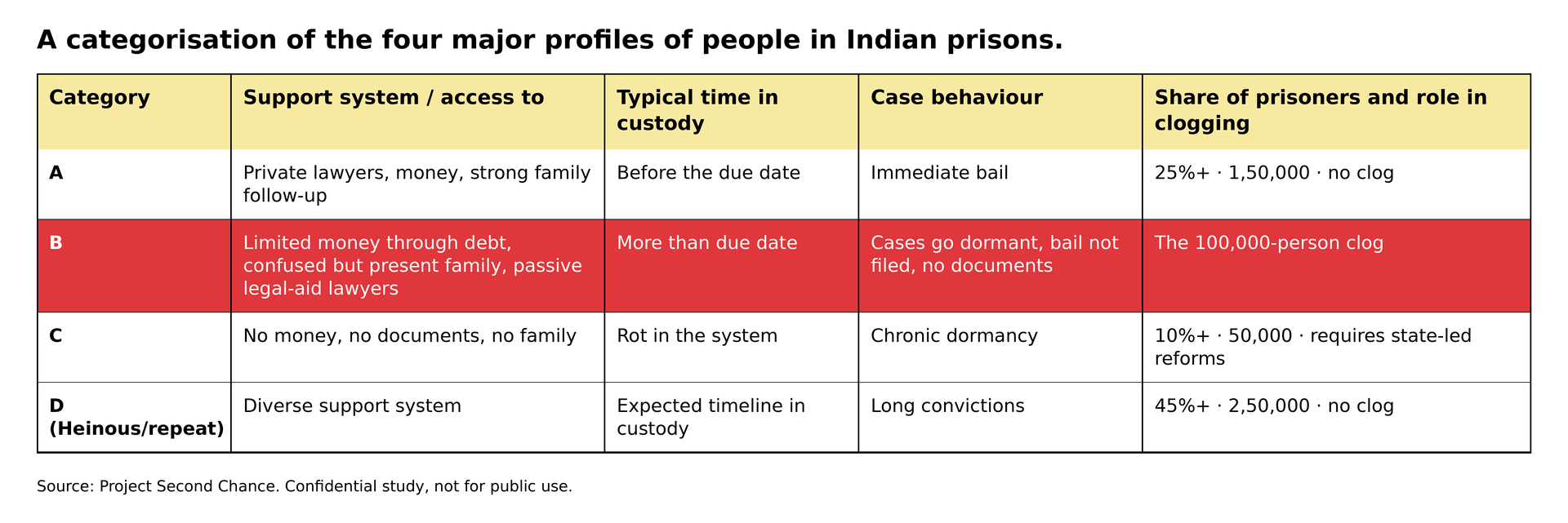
In this context, the problems we want to tackle are:
- How do we get vulnerable people who are stuck in administrative and legal limbo out of prison?
- What kind of support can we provide within prisons to ensure that people can sustain themselves and prevent re-arrests, re-convictions, and re-imprisonments?
While legal aid and justice are critical components of this work, rehabilitation requires policy reorientation and funding, and there is already evidence that spending differently works. A 2025 study by Dipparna Jana and Saibal Kar found that expenditure per inmate had a positive, statistically significant impact on rehabilitation outcomes, with about a one-year forward lag. Moreover, estimates suggest that effective rehabilitation could save up to INR 1,200 crores annually.
Rehabilitation isn’t merely a question of fiscal efficiency, but ensuring long-term stability and reintegration of people moving through the prison system. This is especially important given how stigma attached to incarceration impacts social and community relationships and livelihood opportunities.
Navigating complex systems and strengthening support for reform
Since 2017, Project Second Chance has worked with more than 11,000 prisoners across themes including education, livelihoods support, and bail support. We have collaborated with prison officials and have also reached out to funding organisations and partners in the social sector who are willing to invest time and resources into meaningful reform and rehabilitation. This process has involved various challenges and learnings in a space that often leaves little room for error or experimentation.
1. Circumstances can change quickly
We have set up schools inside prisons—a process that took us five to six years to build. In one of the prisons, the authorities were very cooperative, they gave us about 10 barracks to set up the school, and we trained senior prisoners to be educators. However, one day, new leadership came in, and they were largely indifferent to the project. Then, there was COVID-19, and people were barred from leaving their barracks. The programme came to a halt. It took us about a year and a half to rebuild the system, and this time, we decided that everything should be done on the official ‘green paper’ of the prison. Instead of a nonprofit-run programme, the school was positioned as the prison’s own initiative. So, remaining flexible and adaptable has been a major lesson.
2. Acting as a mediator between prison officials and funding organisations
While working one-on-one with prison authorities has given us access and support to implement some of our projects, we have run into challenges when trying to secure funding and collaboration for our work. Public sector undertakings (PSUs) and semi-governmental institutions in particular have often sought to formalise any kind of involvement with prisons through MOUs or tripartite agreements with us and the prison authorities. However, authorities are often unwilling to enter into such structured arrangements.
This is due, at least in part, to the complexities and rigidity of bureaucracy that can accompany working with a government system. Individual officials or departments may be reluctant to enter into agreements with private or nongovernmental entities because of perceptions and constraints around their own liability and accountability. Moreover, there are also considerations of security when it comes to working in prisons. Some clearances may need to come from the Union ministry, which can be difficult for small scale programmes. This is a significant logistical challenge in itself.
3. Addressing biases and hesitation around compliance
Apart from an inherent bias against incarcerated people as undeserving of support, PSUs, CSR foundations, and other potential funders hesitate with funding prison reform because of practical considerations around compliance and whether programmes with prisons can even qualify as CSR under existing guidelines.
At the same time, even if we are able to get some funders on board, their approach to problem solving tends to be skewed. Both the objectives of a programme and its metrics of success are defined in narrow numbers, such as arranging lawyers for 500 people or training 200 people in plumbing or other vocational courses.
However, this space is changing, and there are funders and philanthropic organisations that are interested, aware, and willing to support work around prison reform and rehabilitation. For instance, flexible, trust-based, and multi-year support by funders such as Rohini Nilekani Philanthropies has allowed us to experiment and set up Kunji—a helpline that connects recently released prisoners with local nonprofits and government institutions—and build a legal tech platform for people in prisons.
While these opportunities are emerging, the philanthropic and nonprofit space is ultimately embedded in broader public culture and civil society discourse, and it is here that awareness and action need to be strengthened further.
Strengthening the culture and vocabulary of advocacy
When we talk of rehabilitation and reform, it is not simply a question of individual prejudice but systemic bias that is reinforced in everyday social interactions, including the media we consume. India has, for decades, lacked a cultural infrastructure around prisons. We have a robust culture of protest, of social justice movements, of legal activism. But, in our observation, the specific experience of incarceration has largely been invisible.
However, in different parts of the country, there are growing initiatives to tell stories of incarceration in ways that are nuanced, personal, creative, and most importantly, in the words and voice of people with lived experiences.
For instance, Studio Nilima, an action research collective, works with people in five correction homes in Guwahati. Together, they released Assam’s first prison music album, a collaboration between incarcerated poets and outside musicians. The songs are about longing, regret, and home—the everyday emotions that the word ‘prisoner’ tends to erase. Studio Nilima also runs reading circles, health camps, and well-being programmes.
Similarly, the Justicemakers Mela, an annual gathering organised by Agami brings together more than a thousand people working in spaces of justice and social change in different ways. India Prison Voices, an event we organised in March 2026 was an effort to push this work of cultural advocacy and shared learning further. The convening brought together more than 100 people from across the prison ecosystem including formerly incarcerated people, families of prisoners, prison departments, academia, judiciary, civil society actors, and philanthropic organisations, to share best practices and to build a mutual sense of trust.
Creating new spaces for knowledge exchange and learning
At Project Second Chance, our work has been fundamentally guided by the fact that people with lived experience must lead the conversation so that they are not footnotes, but the starting point of how the problems in the prison system are defined, and what action must look like. For instance, more than 75 percent of our staff are formerly incarcerated people. So, it is also a matter of how organisations themselves are set up, and how this reflects in the work that they do.
This leads us towards new models of thinking, designing programmes, and ultimately institutionalising these changes. In our own work, we have so far identified three key pillars:
1) Building a space of co-learning: We have focused on creating interaction between people with lived experience of incarceration and organisations and individuals working on prison reform and rehabilitation. For instance, if someone wants to understand the intersections of heat stress and incarceration, they can come to our office and interact with people who have spent time in barracks where temperatures have reached 55 degrees celsius. This removes the layer of abstraction that often creeps into research.
2) Enabling access to institutions: Over the course of our work, we have been able to cultivate relationships with prison officials, which has allowed us to enter facilities and work directly with prisoners. However, this dynamic is fragile, and often young researchers or organisations find it difficult to gain access at all. It is thus important for organisations to leverage existing networks to support each other to navigate this space and create more collaboration.
3) Funding new ideas: Ultimately, a lot of this work requires funding support and grants, especially for emerging researchers. However, there are very few grantees who are open to directly supporting formerly incarcerated people or young researchers who may not already have significant institutional backing. We incubate them and provide them with a space to pilot new ideas and interventions so that people can experiment, adapt, learn, and grow.
In doing this work over the past decade, the question we keep trying to understand is where does prison reform begin: Does it begin in the barracks, in public mobilisations and advocacy, on green papers and in closed door meetings with prison officials, or in funder conferences? Sustaining change when progress is fragile and often siloed requires creating spaces of co-learning and conversation; to go beyond stopgap programmes that look impressive in impact reports to invest in rehabilitation and reintegration; and to build a thriving culture of advocacy that brings incarceration out from behind prison walls and court rooms into the public discourse.
While there is no singular answer or solution for this, the starting point is clear: any meaningful work must begin with people’s lived experiences and dignity at its core. Not as an abstraction, but as a practical demand.
—
Footnotes
- This article is a collaboration between Mohit Raj, Saanchi Marwaha—the founders of Project Second Chance—and Rishabh Lalani. All first-person references in the article (us, we, our) are directly from Mohit and Saanchi’s experience. The article is an adapted and updated version of this essay, which was authored and published by Rishabh Lalani on March 25, 2026.
—
Know more
- Learn how a lack of infrastructure and support has led to a growing mental health crisis in India’s prisons.
- Read about open air prisons and their potential to offer a more rehabilitative alternative to incarceration.
- Understand how systemic bias and caste discrimination impede access to justice for marginalised communities.