In April 2026, nearly 8,000 teachers across Jharkhand taught in classrooms while fasting in protest. The action was organised in response to reports that the School Education and Literacy Department had halted funding for 223 of the state’s 523 non-aided institutions for FY 2025–26. Teachers warned that the move would put the education of nearly four lakh students at risk and announced a statewide mahadharna in Ranchi.
That same month, the government delayed the long-overdue Jharkhand Teacher Eligibility Test (JTET), a state-level examination similar to the national Central Teacher Eligibility Test (CTET) held by the Central Board of Secondary Education (CBSE). The JTET, which is mandatory for people seeking employment as primary and assistant schoolteachers, has not been held in Jharkhand for a decade.
The sight of teachers working without pay—a result of the cuts in funding—while countless aspirants wait to write the eligibility exam is the outcome of a system that has steadily withdrawn from investing in its own foundations. The impact on children’s education is not difficult to imagine.

Chronic shortages and skewed classroom ratios
According to the 2025–26 Unified District Information System for Education (UDISE) report, Jharkhand has 44,378 schools—including 35,819 state government and 1,146 government-aided institutions—serving 7.5 million students. Of these, 5.5 million children are enrolled in foundational (pre-primary), preparatory (primary), and middle (upper-primary) schools.
In line with the pupil-teacher ratio (PTR) of 30:1 for primary schooling that has been mandated by the Right to Education Act, Jharkhand’s teaching workforce must constitute 1,85,238 teachers. However, data reveals that the state is facing a shortage of at least 60,000 teachers at the primary level. Following a PIL filed by economist and activist Jean Dreze, the High Court of Ranchi ruled that 26,000 teachers must be recruited in 2025. However, the order has still not been fulfilled due to various reasons, including the delay in the JTET.
Meanwhile, 9,827 or more than 20 per cent of all schools in the state are single-teacher schools, serving more than four lakh students. Here, the lone teacher is often also the only representative of the state, overseeing everything from classroom teaching to mid-day meals—tasks they are neither equipped nor trained to manage on their own.
However, long before teachers are able to set foot in a classroom, or candidates can even make it to a JTET centre, aspiring teachers in Jharkhand have to navigate an education and training landscape that has become increasingly shaped by market logic, functioning less as a public good and more as a for-profit commodity.
Lack of public institutes and the proliferation of private training
Under the Seventh Schedule of Article 246(2), the Constitution establishes a shared legislative framework for education wherein both the Union and state governments have the power to make laws. In this context, the government of Jharkhand is responsible for funding teacher education. There are approximately 139 Teacher Education Institutes (TEIs) for B.Ed. programmes currently registered in the state, training more than 15,000 teachers. However, only four of these institutes are publicly funded, and they collectively offer only 400 seats.

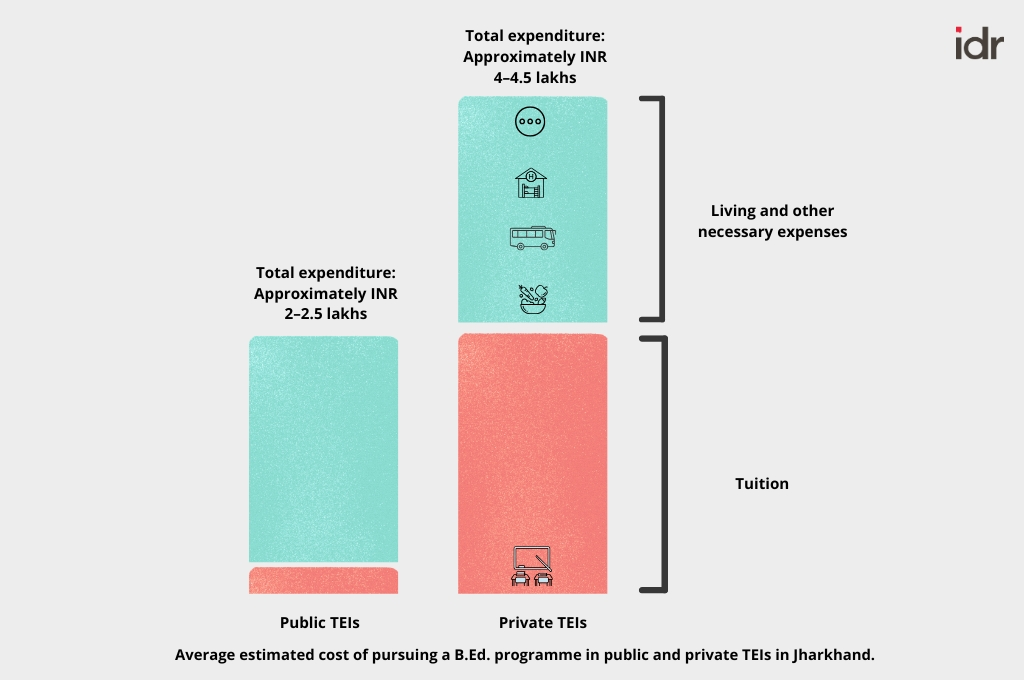
Even when students qualify for admission to any of these institutes, programme fees and related costs pose significant barriers. On average, government institutions charge an annual fee of approximately INR 20,000–30,000 for a two-year B.Ed. degree, excluding accommodation, food, and other recurring costs. When we factor in these expenses, the total amount reaches about INR 2–2.5 lakh. Meanwhile, most state universities do not have education departments, with the exception of the Central University of Jharkhand, where a two-year B.Ed. programme costs approximately INR 65,000, again excluding accommodation and other necessities. As such, even though these institutions are subsidised to an extent by the government, these costs can still be entirely prohibitive for many students, as I have observed in my own peer groups.
The shortage of publicly funded institutions in the state and increasing competition for limited seats has inevitably pushed students towards private TEIs.
Both the Justice Verma Commission Report on Teacher Education (2012) and the National Curriculum Framework on Teacher Education (2009) warned against this disconnect between TEIs and university departments, and highlighted the debilitated condition of TEIs. In the time since, the duration of B.Ed. programmes has been extended and internships have been introduced, but the core issues of quality, critical pedagogy and academic rigour remain unresolved. Instead, training has become increasingly mechanical in its orientation and focused largely on technical competencies.
The shortage of publicly funded institutions in the state and increasing competition for limited seats has inevitably pushed students towards private TEIs, which have been found to sidestep quality norms set by the National Council for Teacher Education (NCTE). These private institutes also charge exorbitant fees, with a two-year B.Ed. programme costing more than INR 2 lakh, an amount that almost doubles when we account for living expenses, field work, and internships.
Ultimately, these factors make it nearly impossible for first-generation learners or students from vulnerable socioeconomic and other marginalised communities to access teacher training.
“Children from ordinary and tribal families in Jharkhand simply cannot pursue a B.Ed. Who could possibly come up with the INR 3–4 lakh required for the two-year course?” Ramesh*, who comes from a Scheduled Tribe community in Silli, told me. He is a Maths teacher in a minority-run secondary school in Ranchi. While he was able to get admission to a B.Ed. course in a public institution, his course fees were not subsidised and were nearly equivalent to that of a private institute. Ramesh had to take loans from local moneylenders and friends to fund his education, promising to pay them back using money from his post-matric scholarship, which he would receive from the state government separately. However, irregularities and delays in fund disbursement made this challenging. “There have been times when I’ve had to get by for a whole week eating nothing but boiled rice water with salt and chillies,” Ramesh added.
The choice for aspiring teachers in Jharkhand is this: they either have to compete for limited seats in government institutes or be pushed towards private TEIs where the quality of education is lower. When we factor in high costs and limited scholarship support, the challenge becomes almost insurmountable. Effectively excluded from education within Jharkhand, some of my peers decided against pursuing a B.Ed despite being interested in teaching because of the unaffordable fees and scarcity of seats in state-funded TEIs.
Students have also been forced to migrate out of the state. Speaking from my own experience, I took admission to a B.Ed. programme at Jamia Millia Islamia university in Delhi rather than study in Jharkhand due to unaffordable fees and the unreliable quality of private TEIs in the state. While fees in central universities such as JNU and Jamia are lower compared to institution in Jharkhand, the living costs in big cities such as Delhi are higher. Pursuing teaching means constantly having to weigh these costs.
Meanwhile, similar conditions have been observed across the 24 District Institutes of Education and Training (DIETs) in Jharkhand, which are district-level public institutions for in-service and pre-service teacher training of schoolteachers.
How can equity, inclusion, and social justice be claimed when teacher preparation is so exclusionary?
These are meant to train teachers for more than 33,000 foundational, preparatory, and middle schools. Reports published by the National Curriculum Framework on Teacher Education (NCFTE) in 2009, Azim Premji Foundation in 2010, National Coalition For Education in 2015, and the World Bank in 2025 have consistently flagged issues regarding the quality of training, infrastructure barriers, irregularities in credentialing of students, vacant faculty positions, intentional financial overdraw, and limited capacity for research and training.
Persistent concerns and failure to comply with quality standards have also resulted in the NCTE to regularly derecognise institutes.
The crisis has been compounded by a lack of government funding. In 2024, a parliamentary response from the Ministry of Education revealed that although INR 92,320.18 crore was approved under the Samagra Shiksha Abhiyan (SSA) for 2023–24, only INR 30,559.13 crore was released for DIETs nationwide, which are central to conducting research, supporting curriculum development, and building teacher capacity. Moreover, while the National Education Policy (NEP) 2020 ambitiously proposes strengthening DIETs, the lack of financial and administrative commitment suggests these promises may be more rhetorical than actionable.
Meanwhile, weak or absent public institutions, combined with the unfettered mushrooming of private and unregulated institutes, have also undermined the minimum standards of educational qualifications set for teachers. For instance, based on the 2025–26 UDISE Plus data, approximately 33 percent or 68,872 of the 2,07,697 teachers across all levels of schools in Jharkhand did not have professional teaching qualifications. This is against the backdrop of reports over the years of teachers being employed with fake degrees.
The lack of policy attention and infrastructural support, coupled with the commercialisation and commodification of teacher education, undermines Article 21A of the Indian Constitution and the Right to Education Act, 2009, which envisioned inclusive, equitable education rooted in social justice and constitutional morality. How can equity, inclusion, and social justice be claimed when teacher preparation is so exclusionary?
Without urgent reform, teacher education in Jharkhand risks becoming a hollow promise devoid of emancipatory purpose.
Resisting the collapse of a constitutional ideal, and the political urgency of reform
The above grim backdrop compels one to ask the following questions:
- Can quality public education exist without rigorous, accessible teacher training?
- Are teachers being trained as “agents of social change” as national policies envision?
- Why has the state neglected its constitutional duty to invest in public TEIs?
- Why are there no publicly funded educational research departments in state universities in Jharkhand?
These questions are not technocratic in nature; they are deeply political ones. At a time when India’s public education system is facing neo-liberal, communal, and anti-democratic threats, the commodification of teacher education must be resisted, especially as it continues to exclude first-generation learners and aspiring teachers from communities that have been historically locked out of accessing education.
There is an urgent necessity to expand state-funded TEIs and DIETs, and to improve access to teacher education, especially for marginalised communities.
The NCFTE 2009 and the Justice Verma Commission Report on Teacher Education (2012)have already outlined recommendations to strengthen and regulate TEIs. These include increasing government investment to establish TEIs, increasing institutional capacity for teacher preparation; situating TEIs in multi- and inter-disciplinary academic environments; and enhancing overall investment in the promotion of research in education in general—and in teacher education in particular—in universities.
Without capable, critically-aware, and socially-sensitive teachers, we cannot reclaim education as a tool of liberation that critical educators such as Henry Giroux and Paulo Freire, and anti-caste social reformers and educators such as Jyotirao and Savitribai Phule and Fatima Sheikh in India envisioned. For instance, in his 1882 ‘Memorial Addressed To The Education Commission’, Phule had called for the expansion in the number of primary schools “by utilising the indigenous schools as they should be, and [that they] should be conducted by trained and certificated teachers, by giving them liberal grants-in aid.”
144 years after Mahatma Phule’s address, the state of teacher education paints a grim picture. The systemic rot in teacher education must be acknowledged and addressed not just for the future of Jharkhand, but as a social and political imperative for India’s democratic project.
*Name changed to maintain confidentiality.
Correction: This article was updated on August 22, 2026, to reflect that Jharkhand has four publicly funded TEIs, collectively offering 400 seats. We deeply regret the error.
—
Know more
- Read this report on the conditions in single-teacher primary schools in Jharkhand’s Latehar district.
- Learn how teachers from the historically marginalised Musahar community in Bihar are making education more inclusive.
- Understand how teacher education can be used to strengthen the values of democratic citizenship and social justice.